


Russia’s Sukhoi Su-37 Terminator was Moscow’s answer to American stealth fighters like the F-22 Raptor. Built on a modified Su-27M airframe with Saturn AL-31FP thrust-vectoring engines, the Su-37 used canards, digital fly-by-wire, and supermaneuverability to win dogfights the U.S. Air Force planned never to let happen. Sukhoi’s bet was that close-range agility could blunt stealth advantages once aircraft got near each other. The Pentagon’s bet was the opposite: beyond-visual-range missiles, sensor fusion, and networked warfare would eliminate opponents before any dogfight began. The 1990s collapse killed Russia’s chance to ever find out who was right.
Russia’s Su-37 Was the Answer to U.S. Stealth Fighters

VIRGINIA BEACH, Va. (Sept. 20, 2025) The United States Air Force F-22 Demo Team performs at the 2025 Naval Air Station (NAS) Oceana Air Show aboard NAS Oceana, Sept. 20, 2025. The show’s theme celebrated 250 years of America’s navy and featured performances highlighting the precision, power, and innovation of naval aviation. (U.S. Navy photo by Mass Communication Specialist Seaman Apprentice Oliver McCain Vieira)
Russia’s Su-37 Terminator, built by Sukhoi, was one of the more novel post-Soviet fighter prototypes to emerge after the collapse of the Soviet Union. Even by the standards of the 1990s, the Su-37 was a futuristic aircraft.
With Thrust-vectoring engines, aggressive canard control surfaces, and a digital fly-by-wire control system, the Su-37 was incredibly agile.
The aircraft gained some measure of notoriety for its acrobatic maneuvers during airshows, but the Su-37 was not a genuine production fighter — rather, it was a technology demonstrator that was built during a time when Russia’s aerospace industry was struggling to adjust to new market realities and a massive shift in aircraft demand and production.
Origin Story of the Su-37 Terminator
The Terminator originated during the late Cold War, when the Soviet Union began to worry about what kind of technologies would drive the next generation of aircraft design.
The fourth-generation aircraft that emerged in the 1970s and 1980s, such as the American F-15 and F-16, shaped the design of the Su-27, which was aimed at restoring parity in the air, particularly in agility and overall air combat capability.

F-15C Fighter at Smithsonian National Security Journal Photo
But by the late 1980s, the Soviets were increasingly aware that nascent American stealth fighters, such as the YF-22 and YF-23, had the real potential to completely outclass even the Soviet Union’s most advanced fighters and air defenses.
The Response
Rather than designing a completely new, clean-sheet aircraft, Sukhoi began with an evolutionary approach to the Su-27.
The Su-37 thus emerged from the Su-27M program, and the Su-37 was, in essence, a heavily modified Su-27M prototype aircraft equipped with some experimental systems — a research and development platform, but not an experimental fighter.

YF-23A Black Widow II National Security Journal Photo. Taken at the Western Museum of Flight by Harry J. Kazianis on August 16, 2025.
Perhaps the Su-37’s most distinctive feature was its thrust-vectoring controls.
The Saturn AL-31FP engines that powered the jet had movable exhaust nozzles, allowing the Terminator to maneuver in directions unattainable with conventional control surfaces.
The Su-37 consequently had exceptionally low-speed maneuverability.
But these features were not merely to impress airshow audiences. The Soviet and later Russian designers who worked on the Su-37 believed that, in the future, close-range dogfights could favor aircraft that were extremely maneuverable.
Advances in missile targeting meant that a pilot only needed an adversary in his field of view for a brief moment. The implications were grand: non-stealthy but extremely maneuverable aircraft could blunt stealth advantages if they got close in.
Import-Export: Su-37 Terminator as Marketing
But the Terminator was also a kind of marketing strategy for Russia. Following the collapse of the Soviet Union, the Russian defense industry was in poor financial shape. Funding had all but evaporated, and factories sat still and idle.
Aerospace companies, including Sukhoi, hoped that foreign sales would breathe fresh life into the sector, and advanced but experimental aircraft like the Su-37 were flying advertisements for potential international buyers, particularly in the Middle East, Asia, and India.
In some regards, the Su-37 was successful.
The Su-37 demonstrated that Russian aerospace expertise remained formidable and that, despite the post-Soviet chaos, Russia could still build leading designs.
Western pilots and analysts took the jet seriously: its maneuverability was impressive, and some of the technologies initially trialed on the Su-37 design eventually found their way onto later production aircraft, such as the Su-35S and Su-30KI. But the Su-37 itself was not necessarily a complete success.
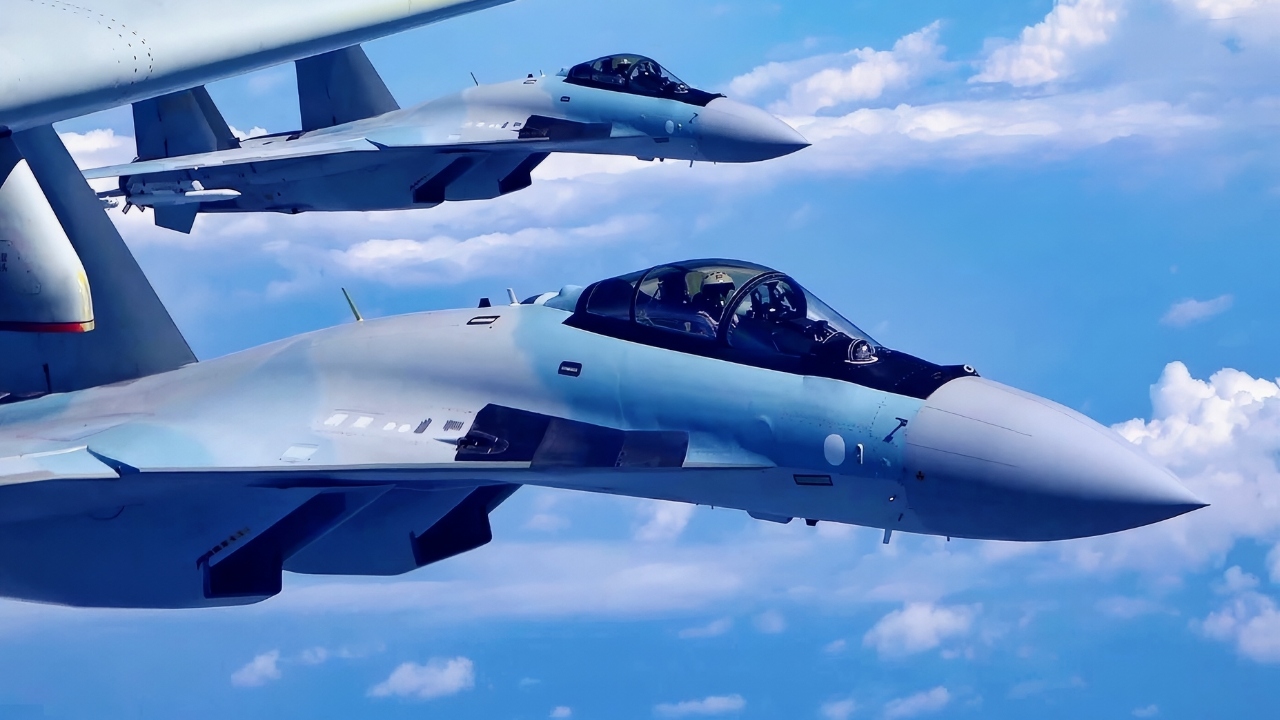
Su-35 from China. Image Credit: Chinese Air Force PLAAF.

Sukhoi Su-35 Fighter. Image Credit: Creative Commons.
Show Me the Money
Russia in the 1990s could not afford a large-scale procurement of advanced fighters.
The Russian Air Force struggled to maintain its existing fleets, let alone buy a significantly more advanced aircraft. Technical promise was not enough: lacking sufficient funds, many projects, even beyond the Su-37, died. But another issue was the Su-37’s complete lack of interest in incorporating fifth-generation stealth technology.
The Terminator was supermaneuverable at a time when air forces in the United States, but elsewhere in the NATO alliance, were focusing on beyond-visual-range air combat. Stealth, sensor fusion, and networked warfare would be key to air combat at extended ranges.
Planners were much less interested in remarkable close-range maneuverability than in eliminating opponents before a dogfight could even begin.
Still, the Su-37 did leave an impression on future Russian aircraft. Some of the most successful lessons from the Su-37 were put into later aircraft.
Instead of copying the exact Su-37 design, Sukhoi instead modified the Su-27 family into multiple variants, some of which were explicitly export-oriented.
Fighters like the later Su-30MKI incorporated thrust vectoring and canard control surfaces, which the Su-37 had shown were valuable additions.
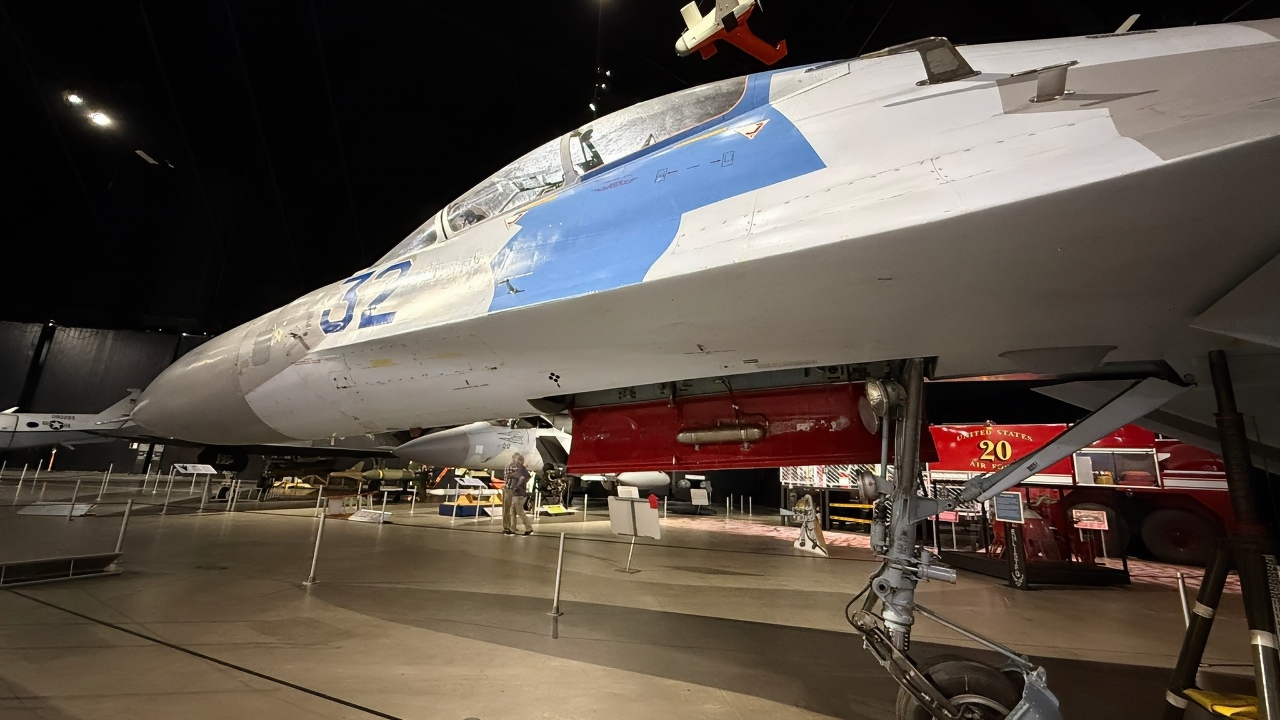
Russian Su-27 Flanker from the USAF Museum. Image Credit: National Security Journal.
The Su-37 Was No Failure in the Traditional Sense:
Ultimately, the Su-37 was not a complete dead end; it served as a bridge between late Cold War-era Soviet aircraft and later Russian aerospace designs.
The Su-37 also reflected Russian aerospace design at the time: unable to compete financially with the United States, the Su-37 emphasized aerodynamic excellence and pure maneuverability rather than stealth.
About the Author: Caleb Larson
Caleb Larson is an American multiformat journalist based in Berlin, Germany. His work covers the intersection of conflict and society, focusing on American foreign policy and European security. He has reported from Germany, Russia, and the United States. Most recently, he covered the war in Ukraine, reporting extensively on the shifting battle lines in Donbas and writing about the war’s civilian and humanitarian toll. Previously, he worked as a Defense Reporter for POLITICO Europe. You can follow his latest work on X.


