

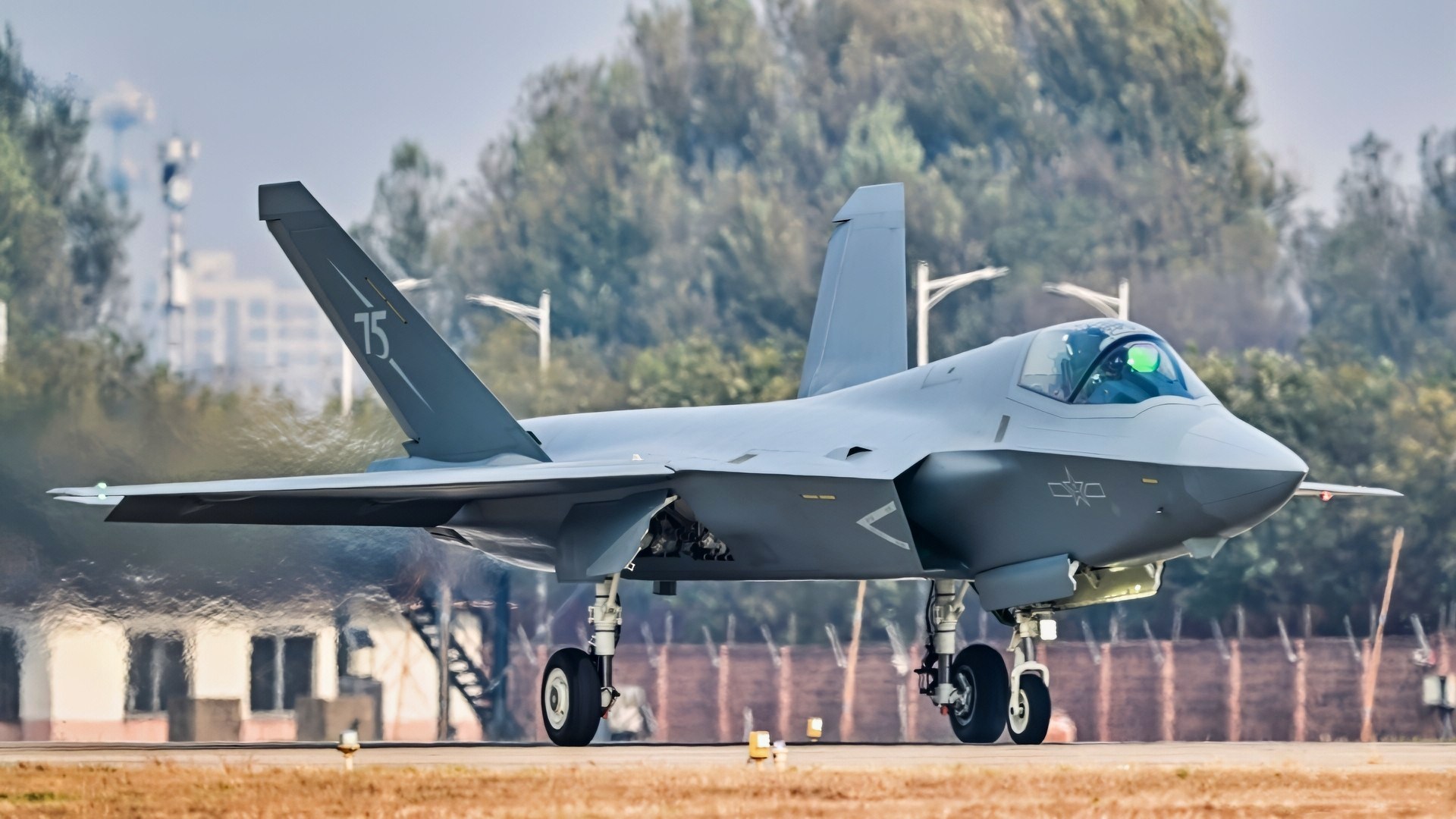
When Shenyang rolled the FC-31 Gyrfalcon out of its hangar in 2012, nobody took it seriously. The aircraft had no customer, used Russian engines, and had lost the competition to the J-20. Fourteen years later, the same airframe has produced two operational variants — the carrier-based J-35B launching from China’s first EMALS aircraft carrier, and the land-based J-35A entering frontline PLA Air Force service. Pakistan looks set to take 40 planes. The Pentagon projects that 1,300 Chinese fifth-generation fighters will be in service by 2030. The aircraft Western defense press dismissed in 2014 has become the centerpiece of Chinese stealth aviation expansion.
Inside The J-35A: How China’s Second Stealth Fighter Went From Forgotten Export Concept To The Fastest-Multiplying Fifth-Generation Aircraft Outside The United States
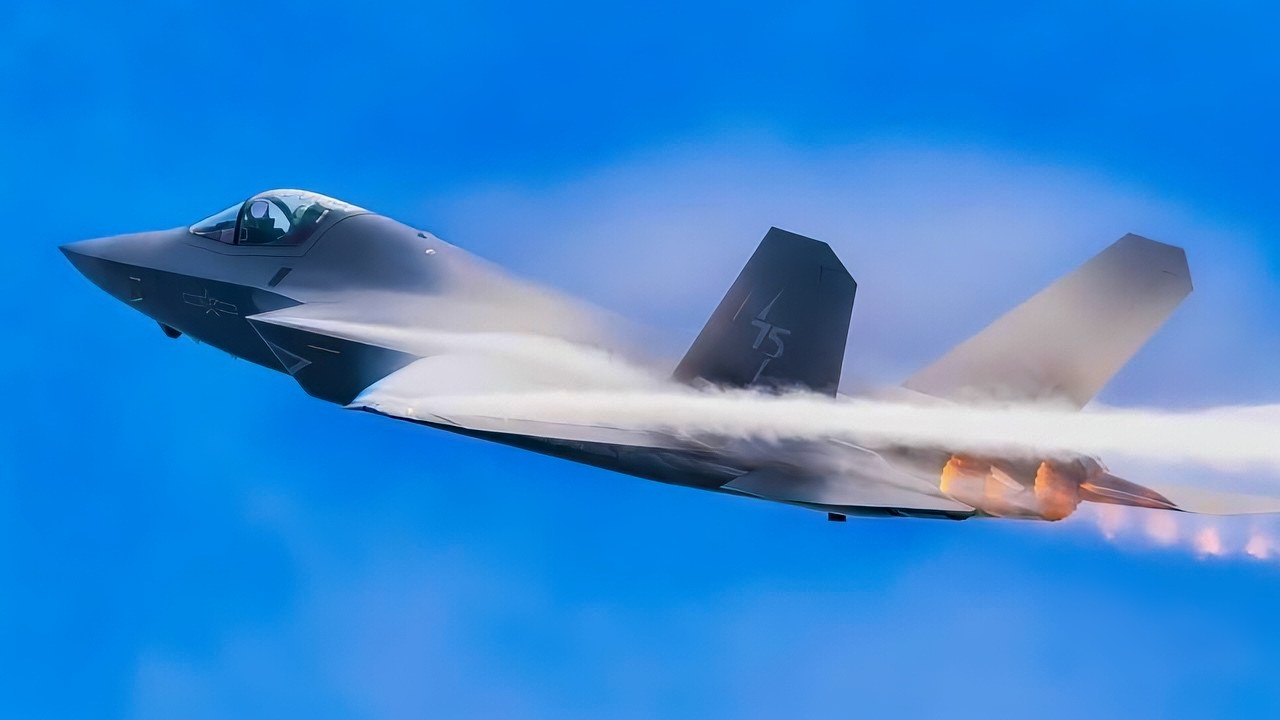
J-35A Fighter in the Clouds. Image Credit: Chinese Weibo.

J-35 Fighter Chinese State Media Photo.

J-35 China Weibo Screenshot.
When Shenyang Aircraft Corporation rolled the FC-31 Gyrfalcon out of its hangar in 2012, nobody in the Western defense press took the airplane seriously. I know years back, I was pretty skeptical. The aircraft had no announced customer. It had been funded privately rather than through the People’s Liberation Army procurement channels that produced the J-20. It used Russian RD-93 engines rather than indigenous Chinese powerplants. It was widely described as an underwhelming export concept that had lost the competition to the Chengdu J-20 and was looking for foreign buyers to keep the program alive.
Fourteen years later, the same airframe has produced two operational variants. The carrier-capable J-35B is launching from China’s first electromagnetic-catapult aircraft carrier. The land-based J-35A is being produced in serial numbers and entering frontline service with the People’s Liberation Army Air Force. Pakistan seems to want 40 of the aircraft. Saudi Arabia, the United Arab Emirates, and several other Middle Eastern and Asian states have expressed interest in export variants designated J-35E and J-35AE.
The Pentagon’s latest assessment is that China will deploy approximately 1,300 fifth-generation stealth fighters across the J-20 and J-35 fleets by 2030 — a force structure that would exceed every American fifth-generation tactical aviation program combined.
The aircraft that nobody in 2012 thought would matter has become the centerpiece of Chinese tactical aviation expansion in the late 2020s. The story of how that transition happened — what the airframe is, what its operational capabilities actually are, and what it means for the regional balance of power across the Indo-Pacific — is the most consequential development in Chinese military aviation in the past decade.

China’s New J-35 Stealth Fighter

China New J-35 Fighter on Aircraft Carrier. Image Credit: Chinese Weibo.

J-35 Fighter on Chinese Aircraft Carrier. Image Credit: X Screenshot.
The FC-31 That Almost Was Not
The original Shenyang FC-31 prototype, designated F-31 V1, made its first flight on October 31, 2012, at the Shenyang Aircraft Corporation test facility. The aircraft was powered by two Russian Klimov RD-93 turbofan engines — the same engine family that powered the Pakistani-Chinese JF-17 Thunder. The decision to use a foreign powerplant was practical: indigenous Chinese fighter-engine development was substantially behind Russian and Western capabilities at the time, and Shenyang needed something that would actually fly.
The aircraft attracted attention at the 2014 Zhuhai Airshow when a full prototype was displayed publicly for the first time. The marketing pitch was direct: this was supposed to be a Chinese alternative to the F-35 for nations that could not buy American stealth aircraft. Shenyang positioned the FC-31 as a cost-competitive export platform aimed at clients in the Middle East, South America, and parts of Asia.
The export market did not materialize. The aircraft had no clear performance advantages over existing Russian and European fourth-generation alternatives at substantially higher cost. It lacked the operational pedigree and integrated logistics support that would have made it competitive against the F-35. Several years of marketing efforts produced no orders.
A second prototype, designated F-31 V2, flew on December 23, 2015, powered by domestic Chinese WS-21 engines that replaced the Russian RD-93s. The design was meaningfully refined — improved aerodynamic shaping, redesigned engine inlets, and modified avionics integration. But the export market remained dry.
What changed the program’s trajectory was not export interest. It was a Chinese Navy requirement.
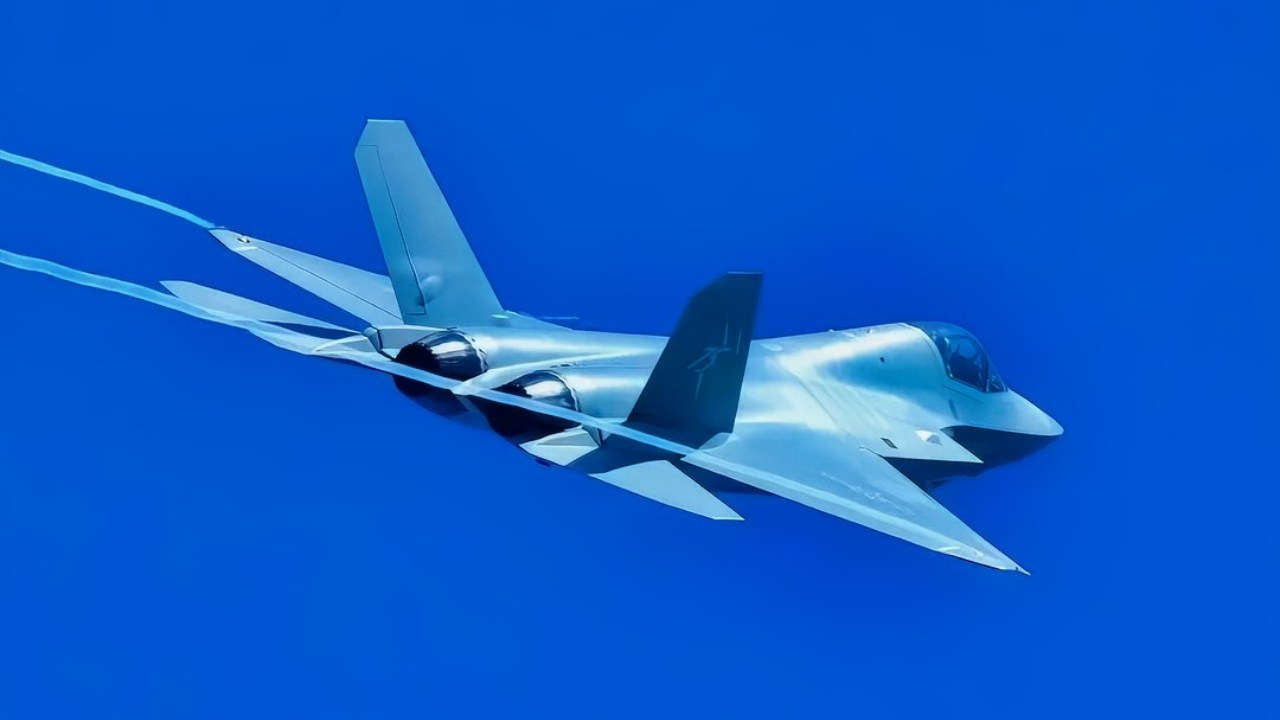
J-35A Fighter from China. Image Credit: PLAAF
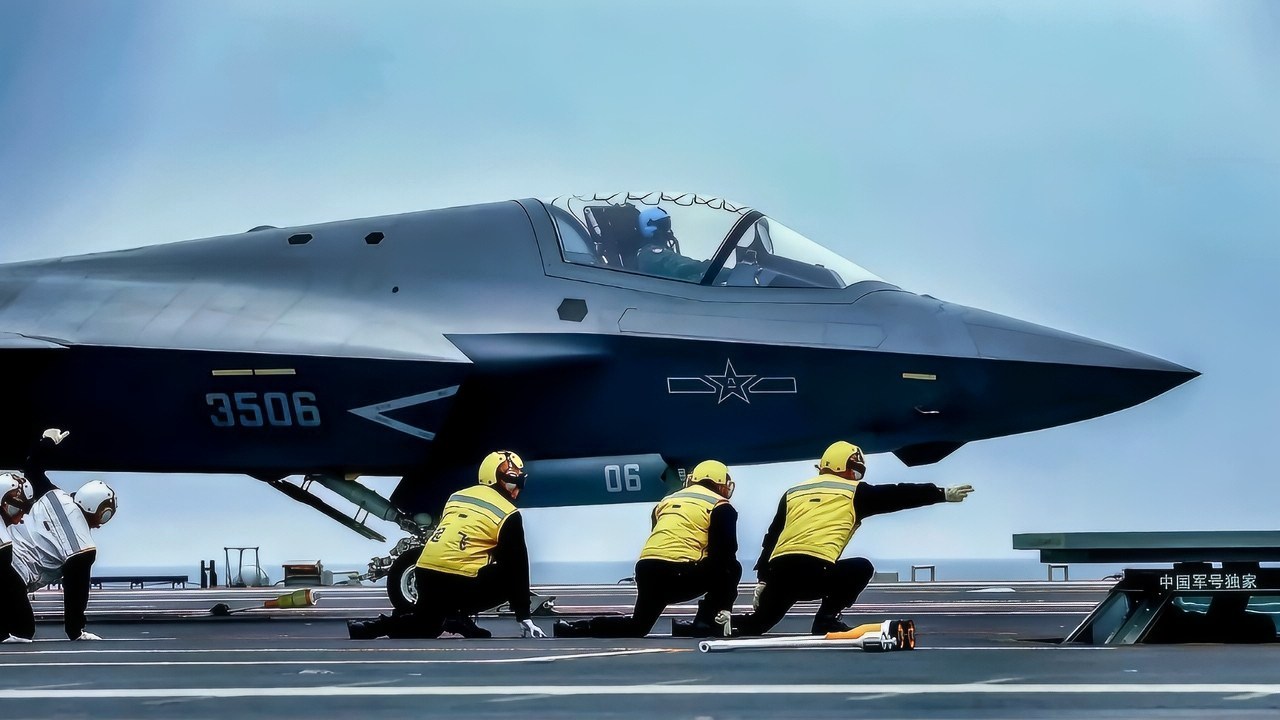
China J-35 Fighter. Image Credit: Chinese Navy/PLAN.

J-35 Factory in China. Image Credit: CCTV Screenshot.
The Carrier Program That Saved The Airframe
By the mid-2010s, the PLA Navy had decided to pursue a new generation of aircraft carriers — what would eventually become the Type 003 Fujian-class. The Fujian (CV-18) would be China’s first carrier equipped with electromagnetic catapults rather than the ski-jump ramps used on the converted Soviet hull Liaoning and the indigenous Shandong. It would need a fifth-generation stealth fighter to operate from those catapults.
The J-20 — China’s first fifth-generation fighter, in service with the PLA Air Force since 2017 — was the wrong airplane for the job. The Chengdu J-20 was a large twin-engine air superiority fighter optimized for long-range engagements over the Western Pacific. It had not been designed for carrier operations and lacked the structural reinforcement, landing gear architecture, or folding-wing geometry that catapult-launched aircraft require.
The FC-31 was. The airframe had been designed from the start as a medium-weight twin-engine stealth fighter, roughly comparable in size to the Lockheed Martin F-35. With modifications — reinforced landing gear, catapult launch bar, arrestor hook, folding wings, and corrosion protection for sustained saltwater operations — it could become a carrier aircraft.
The naval variant, initially designated J-XY and later J-35 (with the eventual carrier-specific designation J-35B), made its first flight on October 29, 2021. The aircraft incorporated the structural modifications required for catapult launches and arrested recovery aboard a carrier. It also benefited from the broader Shenyang investment in fifth-generation development triggered by the PLA Navy’s requirement.

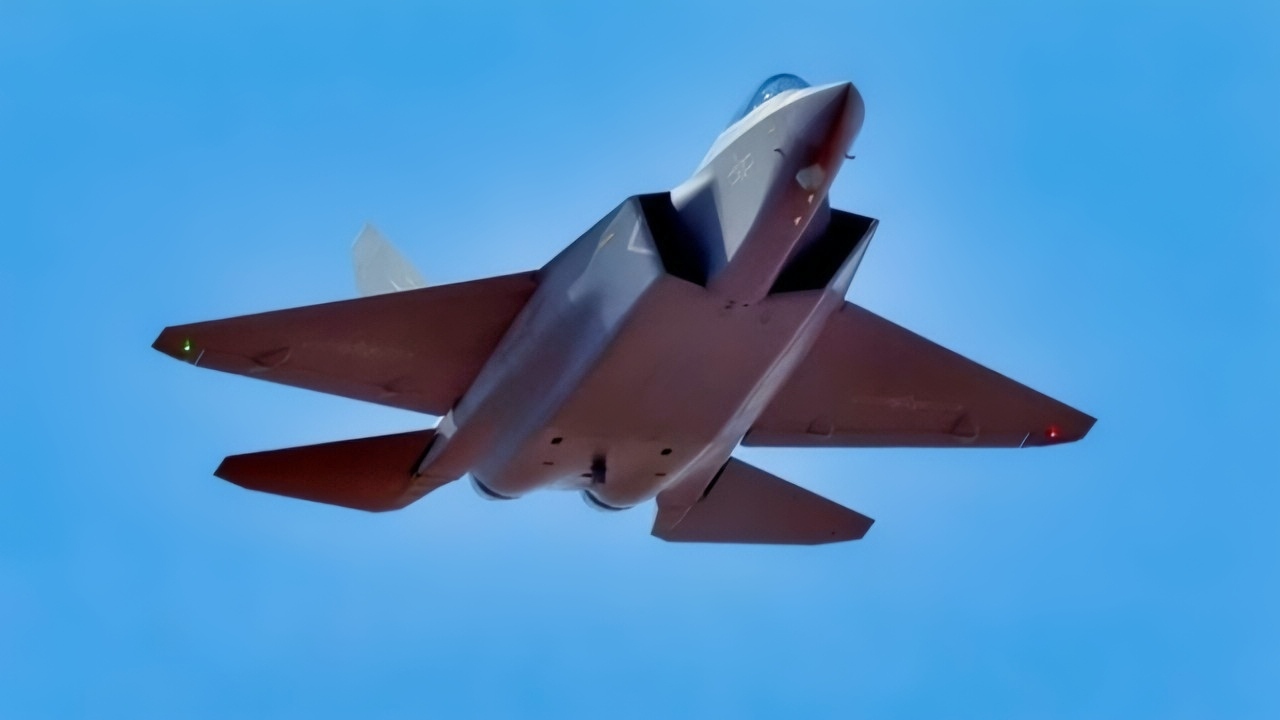
J-35 Fighter from China. Image Credit: PLAAF.

J-35 New Stealth Fighter from China
A parallel land-based variant followed. The J-35A — optimized for runway operations, with lighter structure, single-wheel nose landing gear, no catapult attachment points, and greater internal fuel capacity — made its first flight on September 26, 2023. The aircraft was designed to complement rather than replace the J-20 in PLAAF service, providing a medium-weight fifth-generation fighter that could be produced in larger numbers at lower cost.
The two variants — the naval J-35B for the PLAN and the land-based J-35A for the PLAAF — gave Shenyang a dual-track product line built around shared production tooling, common avionics, and overlapping supply chains. That commonality made both variants substantially cheaper to produce than they would have been as independent programs.
What The Aircraft Actually Is
The J-35A is approximately 17 meters long with a wingspan of 11.5 meters. Maximum takeoff weight is in the 25 to 28-ton range — substantially lighter than the 37-ton J-20 but heavier than the 22-ton F-35A. Powered by two Guizhou Aero Engine Corporation WS-19 turbofans, each generating roughly 22,000 pounds of thrust with afterburner, the aircraft is capable of maximum speeds approaching Mach 1.8.
Per Army Recognition’s profile of the production-standard aircraft, the airframe incorporates edge-aligned control surfaces, serpentine engine inlets that obscure the compressor face from frontal-aspect radar returns, and radar-absorbent coatings designed to reduce overall radar cross-section. The internal weapons bay carries air-to-air and air-to-ground munitions to preserve stealth characteristics, with stealth-compromising external hardpoints available for additional weapons in permissive air environments.
The sensor suite, while not fully disclosed, is widely believed to include an active electronically scanned array radar developed by Chinese institutes, an electro-optical targeting system, an infrared search-and-track sensor, a helmet-mounted display, and a wide-area cockpit display similar in concept to the F-35’s panoramic cockpit display. Network-centric warfare capabilities allow the aircraft to share targeting information with other PLAAF assets, including the J-20, the KJ-500 airborne early warning aircraft, and ground-based command nodes.
The weapons fit displayed at the September 2025 Changchun Air Show included the PL-10E short-range infrared air-to-air missile, the PL-15E long-range radar-guided air-to-air missile, the PL-12AE medium-range air-to-air missile, and the LD-8A anti-radiation missile. A new PL-16 missile with a more compact design than the PL-15 but reportedly longer range was reported in late July 2025, allowing the aircraft to carry more weapons internally while preserving stealth.

F-35 Near the Flag. Image Credit: Creative Commons.
The J-35A is not a one-for-one match for the F-35A. It lacks the F-35’s operational maturity, the sensor-fusion software that took two decades and tens of billions of dollars of American investment to develop, and the network of allied users that generate the operational lessons feeding back into F-35 capability upgrades. But it is also not the underwhelming export concept the FC-31 was in 2012. The aircraft has crossed from prototype to operational platform in the four years since the J-35 first flew in 2021.
The Carrier Breakthrough That Changed The Conversation
The single most consequential moment in the J-35 program’s history came on September 22, 2025, when the PLA Navy released footage of the carrier-based J-35 conducting catapult launches and arrested landings from the Fujian carrier.
Per Interesting Engineering’s coverage of the announcement, the trials made the J-35 the first fifth-generation stealth fighter to launch from an electromagnetic catapult at sea — a distinction that the U.S. Navy’s USS Gerald R. Ford, the only other carrier equipped with EMALS, had not yet achieved with the F-35C.
The trials demonstrated several things at once. They proved that the J-35 could survive catapult launch loads and arrested recovery without structural failure — a non-trivial engineering challenge for a stealth airframe. They proved that the Fujian’s EMALS system worked under operational conditions. They proved that the PLA Navy could coordinate launch and recovery operations across multiple aircraft types simultaneously, including the J-15T fourth-generation fighter and the KJ-600 carrier-based airborne early warning aircraft.
Per CNN’s coverage of the trials, only the USS Gerald R. Ford and the Fujian operate EMALS-equipped flight decks. The Ford-class entered service with EMALS in 2017 but has not yet conducted operational F-35C launches. The Fujian achieved that milestone with the J-35 first.
The Fujian was formally commissioned into PLAN service on November 5, 2025, with Chinese President Xi Jinping in attendance at a ceremony in Sanya, Hainan. Per Naval Technology’s coverage of the commissioning, the warship and its air wing now provide the PLA Navy with carrier-based fifth-generation strike capability for the first time.
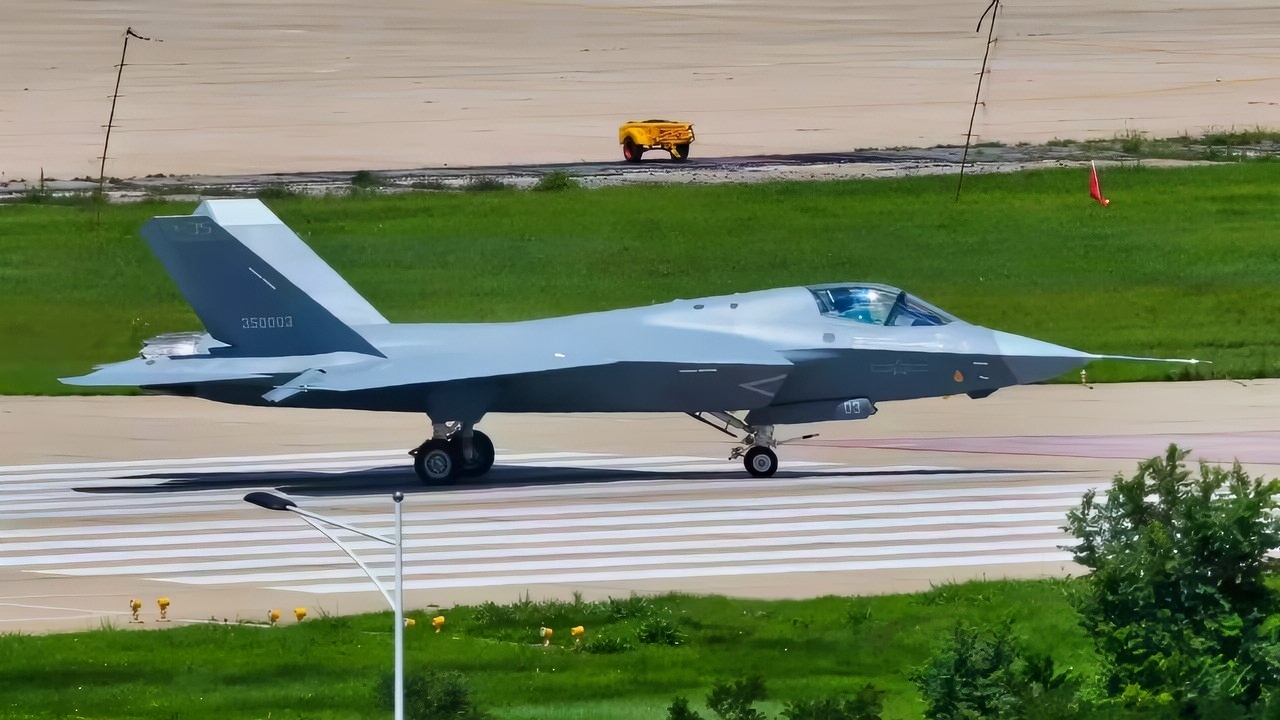
J-35 Fighter X Screenshot. Image Credit: X Screen Capture.
The strategic implications are substantial. The carrier element of the U.S.-China military competition in the Western Pacific had been one of the few areas where the United States held an unambiguous capability lead. With the Fujian operating J-35Bs from EMALS catapults, that gap has narrowed faster than most Pentagon force planners projected.
How Many And How Fast
Per the Aviationist’s analysis of the September 22 footage, at least three KJ-600s were visible during the carrier trials based on serial numbers below the cockpit, with multiple J-35s and J-15Ts also operating from the deck. That deck activity, combined with the broader Shenyang production indicators, points to a serial production program that has moved well past prototype validation.
Public estimates of J-35 production vary, but the most-cited figures place total production at approximately 57 airframes as of October 2025, with multiple sources tracking continued production ramp-up at the Shenyang facility. Aerospace Global News reported on the EMALS launches that the Fujian alone is expected to carry approximately 50 aircraft including J-35s, J-15Ts, KJ-600s, and supporting helicopters.
Land-based J-35A production has paralleled that of the carrier variant. Per multiple Chinese-language reports, the first operational PLAAF unit to receive the J-35A is based near Shenyang and also operates J-20 fighters — making it the first publicly identified Chinese unit to operate two distinct fifth-generation stealth platforms simultaneously. Aircraft serials 61820 and 61821 were linked to the 1st Air Brigade of the PLAAF in mid-2025, confirming initial operational induction.

J-35A Fighter at Le Bourget Air Show. Image Credit: Author/National Security Journal.

J-35 Fighter. Image Credit: X/Screenshot.
Per Defence Security Asia’s force-structure analysis, the Pentagon’s open-source estimates project that the combined J-20 and J-35A force could reach approximately 1,300 aircraft by 2030. That number exceeds the U.S. Air Force F-22 fleet (187), F-35A fleet (approximately 450 as of mid-2026), and projected F-47 NGAD fleet (185-plus) combined. The math is not a one-for-one capability comparison — Chinese fifth-generation aviation has not yet demonstrated the operational maturity of American platforms — but it does represent a substantial quantitative shift in the regional balance of fifth-generation fighter inventory.
The Export Push
The September 2025 EMALS demonstration was followed by aggressive export marketing. China displayed a model of the J-35A at the 2025 Paris Air Show and a full-scale mock-up at the 2026 Singapore Airshow in February.
Per MILMAG’s coverage of the Singapore Airshow display, the Aviation Industry Corporation of China and the China National Aero-Technology Import & Export Corporation unveiled the mock-up at the Changi Exhibition Centre during the February 2-8 show. The exhibition coincided with the J-35A’s transition from a domestic priority to a global export product.
Pakistan is the lead announced export customer, although we want to be clear, reporting on this is all over the place, with many claims and counterclaims. There are some reports that Pakistan’s Air Force Chief Air Chief Marshal Zaheer Ahmad Babar publicly confirmed plans to procure the J-35 in January 2025, with subsequent reporting indicating a Pakistani requirement for 40 aircraft — designated J-35E for export, with downgraded avionics relative to the PLAAF J-35A baseline but core stealth and weapons-bay architecture preserved. Per AeroNewsJournal’s coverage of the Pakistani acquisition timeline, Pakistani officials have publicly stated that initial deliveries are expected in 2026 or 2027. However, other reports have emerged to dispute this, so it seems, at least to me, that the purchase is not completely guaranteed.

J-35. Image Credit: Creative Commons.
Other reported export prospects include Saudi Arabia, the United Arab Emirates, Egypt, and several Southeast Asian states that have either been restricted from F-35 procurement or are looking to diversify away from American or European fighter dependencies. The export-variant designations J-35E and J-35AE have appeared in Chinese trade press throughout 2025 and into 2026.
What This Means: No F-35, But a Problem
The J-35A represents the kind of strategic outcome that Western defense planning frequently fails to anticipate.
A program that began as a privately funded export concept nobody wanted has become the second leg of China’s fifth-generation fighter force, operating from the first non-American electromagnetic catapult carrier in service anywhere in the world. The platform is being produced in serial numbers, fielded operationally with both the PLA Air Force and PLA Navy, exported to Pakistan, and aggressively marketed to other potential customers across the Middle East and Asia.
Per Global Times’ coverage of the Fujian’s catapult capabilities, the J-35 makes China only the second nation after the United States to field a fifth-generation carrier-based stealth fighter. That achievement compressed roughly two decades of American naval aviation development into less than a decade of Chinese effort — a pace of capability gain that the U.S. defense community is still working out how to respond to.
The aircraft itself is not a Stealth Wonder Weapon that single-handedly tips the balance of Indo-Pacific airpower. The F-35 retains substantial advantages in sensor fusion software, operational experience, allied integration, and combat-proven employment in actual war zones. The J-35A has not yet flown a combat sortie against a peer adversary.
But the J-35A does not have to match the F-35 one-for-one to matter. It has to exist in numbers, deliver baseline fifth-generation capability — stealth, sensor integration, internal weapons carriage, network-centric combat — and provide a credible alternative for export customers who do not have access to American fifth-generation aviation. It is delivering on all three of those metrics right now.
Per GlobalSecurity’s tracking of the broader PLA carrier program, the Fujian represents the first generational leap in Chinese carrier capability — and the J-35 is the air wing that gives the platform actual combat relevance against U.S. and allied carrier strike groups in the Western Pacific.
When the U.S. Navy faces a Chinese carrier strike group in 2030 — and increasingly it will — the air wing on the opposite deck will be the J-35. Not the J-20. Not the J-15. The aircraft that the Western defense press dismissed in 2014 as an underperforming export concept.
The 14-year transition from a forgotten prototype to an operational fifth-generation fighter has reshaped the Indo-Pacific airpower balance more than any other Chinese military program over the past decade.
The aircraft that nobody wanted is now the aircraft everyone is paying attention to.
About the Author: Harry J. Kazianis
Harry J. Kazianis (@Grecianformula) was the former Senior Director of National Security Affairs at the Center for the National Interest (CFTNI), a foreign policy think tank founded by Richard Nixon based in Washington, DC. Harry has over a decade of experience in think tanks and national security publishing. His ideas have been published in the NY Times, The Washington Post, The Wall Street Journal, CNN, and many other outlets worldwide. He has held positions at CSIS, the Heritage Foundation, the University of Nottingham, and several other institutions related to national security research and studies. He is the former Executive Editor of the National Interest and the Diplomat. He holds a Master’s degree focusing on international affairs from Harvard University.


