


We all know that China’s primary geopolitical objective is to reunite Taiwan with the Mainland, either by peaceful means or by force. Part of this effort is to keep the United States out of the Taiwan Strait and stop the Americans from interfering. This means that the Chinese want to play defense against the United States, and they have created a new “Great Wall” of anti-ship missiles to keep the Americans and their aircraft carriers down and out in East Asia.
Keeping the Americans Down and Out in the Indo-Pacific

ATLANTIC OCEAN (Sept. 21, 2024) The world’s largest aircraft carrier, USS Gerald R. Ford (CVN 78), sails in formation with the Japan Maritime Self Defense Force (JMSDF) Kashima-class training ship, JS Kashima (TV-3508), middle, and Hatakaze-class guided missile destroyer JS Shimakaze (TV-3521) while conducting routine operations in the Atlantic Ocean, September 23, 2024. The U.S. Navy and JMSDF continue to train together to improve interoperability and strengthen joint capabilities. For more than 60 years, the U.S.-Japan Alliance has been the corner stone of stability and security and is crucial to the mutual capability of responding to contingencies at a moment’s notice. (U.S. Navy photo by Mass Communication Specialist 2nd Class Jacob Mattingly)
The U.S. Navy believes that all of China’s territorial claims in the First Island Chain are invalid and illegal. The Navy wants to continue its practice of conducting freedom-of-navigation exercises in the South China Sea. China is prone to counteract these missions with a huge amount of anti-ship missiles that create a no-go zone with anti-access/ area denial tactics. Could the huge amount of projectiles that the Chinese deploy in East Asia keep U.S. aircraft carrier strike groups away from China?
What is the ‘Kinetic Missile Fight?’
Both countries know that a future conflict will develop into what I call the “Kinetic Missile Fight.” This is the next dominant phase of modern warfare.
There will be long-range missiles, drones, cruise missiles, and interceptors rather than classic dogfighting between fighter jets or mass armored maneuvers on land. Ultimate victory depends on missile inventories and industrial production.
Ships and air defenses will rapidly consume intercepting missiles.
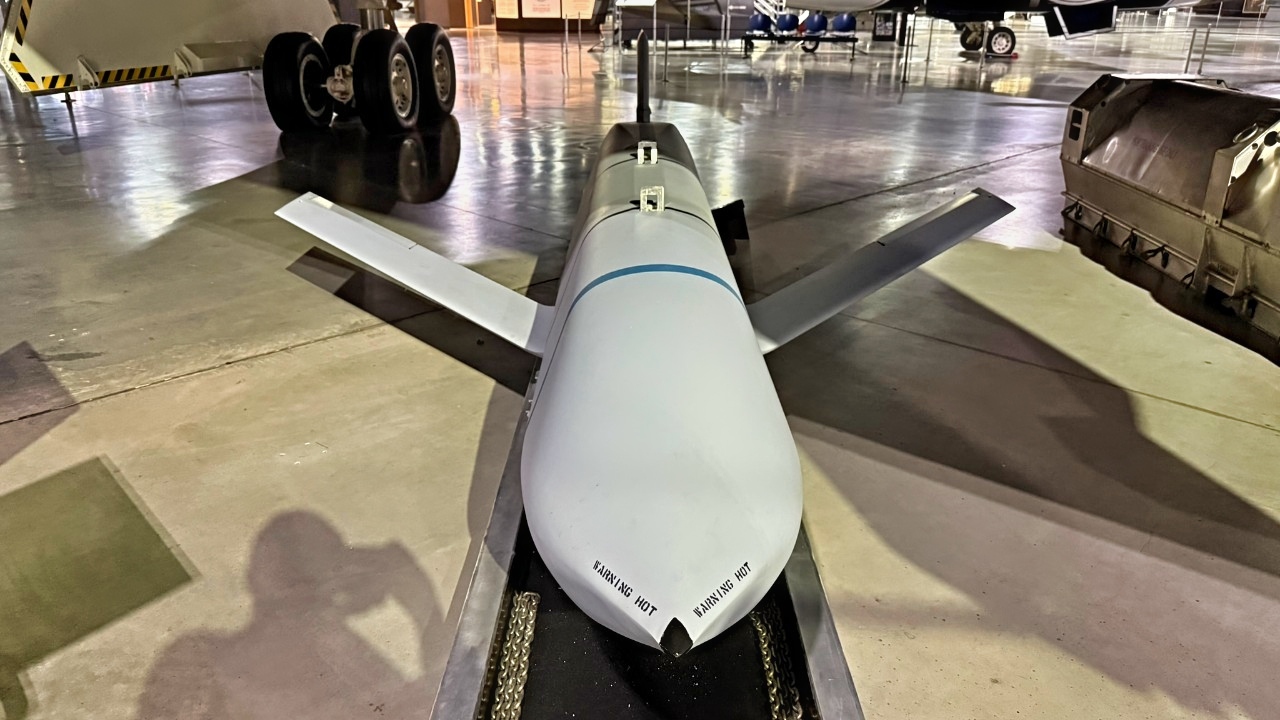
JASSM Missile National Security Journal Original Photo. All Rights Reserved.
U.S. standoff weapons like JASSMs and LRASMs become central, and “magazine depth” (how many missiles a force can sustain) becomes strategically decisive. Can the Americans manufacture missiles quickly enough and ship them to the Indo-Pacific to sustain combat?
The Sharp Blade of the ‘Assassin’s Mace’
China also believes in using the “Assassin’s Mace” concept for its weaponry.
This is asymmetric warfare at its finest.
These types of Assassin’s Mace missiles are meant to counteract the movement of U.S. carrier strike groups.
China will launch precision weapons from long distances. The People’s Republic hopes that the Americans will run out of interceptors such as the SM-2, SM-3, and SM-6.
The supply of cruise missiles, such as Tomahawks, could be limited. China will launch overwhelming salvoes of anti-ship missiles until the United States runs out of interceptors.
Dangerous Islands and Reefs
China’s militarized islands could also affect the effectiveness of U.S. Navy carriers in the First Island Chain. The Navy may have to conduct amphibious operations against these reefs to counteract their effectiveness in the Chinese defensive posture and order of battle.

U.S. Air Force Major Jacob Rohrbach, a pilot assigned to the 40th Flight Test Squadron at Eglin Air Force Base, Florida, releases the first Joint Air-to-Surface Standoff Missile Extended Range, or JASSM-ER, from an F-16 over the Gulf of Mexico on September 19th, 2018. The test gathered data on safe separation and software integration of the JASSM-ER, and demonstrated the Eglin test range’s ability to monitor and control test items in flight over the Gulf of Mexico.
Taking a Closer Look at Chinese Missiles
The new YJ series of anti-ship missiles is a significant part of China’s defensive strategy and a definite threat to aircraft carriers. The YJ-19 and YJ-20, as well as the YJ-15 and YJ-17 naval strike projectiles, are excellent. Some of these are scramjet-propelled hypersonic missiles and could sink a U.S. Navy ship.
They can be launched by Type 055 Renhai-class destroyers and H-6K strategic bombers.
China also deploys carrier-killer missiles, including the DF-21D and DF-26. These are especially lethal. They are designed to keep the Americans guessing and hold U.S. carrier strike groups under threat, both close to Taiwan and in the First Island Chain.
The People’s Republic may have an idea to allow the American carrier strike groups to proceed into the First Island Chain, watch them to gain confidence in their freedom of navigation exercises, and spring a trap that would catch the U.S. Navy unaware of the danger.

AH-64 Apache Helicopter Photo. Image Credit: Creative Commons.
How Can the United States Get More Missiles to the Theater?
The Americans must be the side that best manages missile range, interception efforts, magazine depth, and replenishment capacity for a prolonged war.
China has an advantage since it is fighting in its own backyard. It can resupply missiles at will, while the Americans are thousands of miles from home.
Guam Killing Missiles
U.S. military installations in Okinawa and Guam could be under attack, too.
The DF-26 intermediate-range ballistic missile is known as the “Guam Killer” or “Guam Express.”
It has a range of over 3,100 miles. It is also nuclear-capable. Much of the aircraft infrastructure could be destroyed, such as runways and hangars. China could also eliminate American airplanes on the ground, similar to how the Iranians attacked U.S. Air Force tankers and airborne early warning airplanes in the Middle East.
What About U.S. Allies?
The United States hopes that allies such as Japan and South Korea will assist the Americans in a war against China, but it is unclear whether the Japanese and South Koreans would participate.
A Drone Force Like No Other
China would also employ sea drone “motherships” to launch naval unmanned aerial systems into reconnaissance or attack mode. These UUVs can deploy one-way loitering munitions to attack U.S. shipping. Other aerial unmanned vehicles can control smaller, swarming kamikaze drones meant to foil American vessels. The Americans could run out of interceptors defending against these types of attacks.
When Defense-mode Is the Winning Hand
China’s defense posture is strong when it employs anti-access/area denial tactics.
The People’s Republic has a huge supply of anti-ship missiles that can threaten American carriers. China could also attack U.S. bases on Guam and Okinawa. The Navy may decide to keep its carriers out of the First Island Chain altogether to avoid China’s “Great Wall” of missiles and drones.
The Prussian military expert Carl von Clausewitz often reminded warriors that defense can sometimes be stronger than offense. China has the wherewithal to defend itself with the Assassin’s Mace tools and its asymmetric weapons.
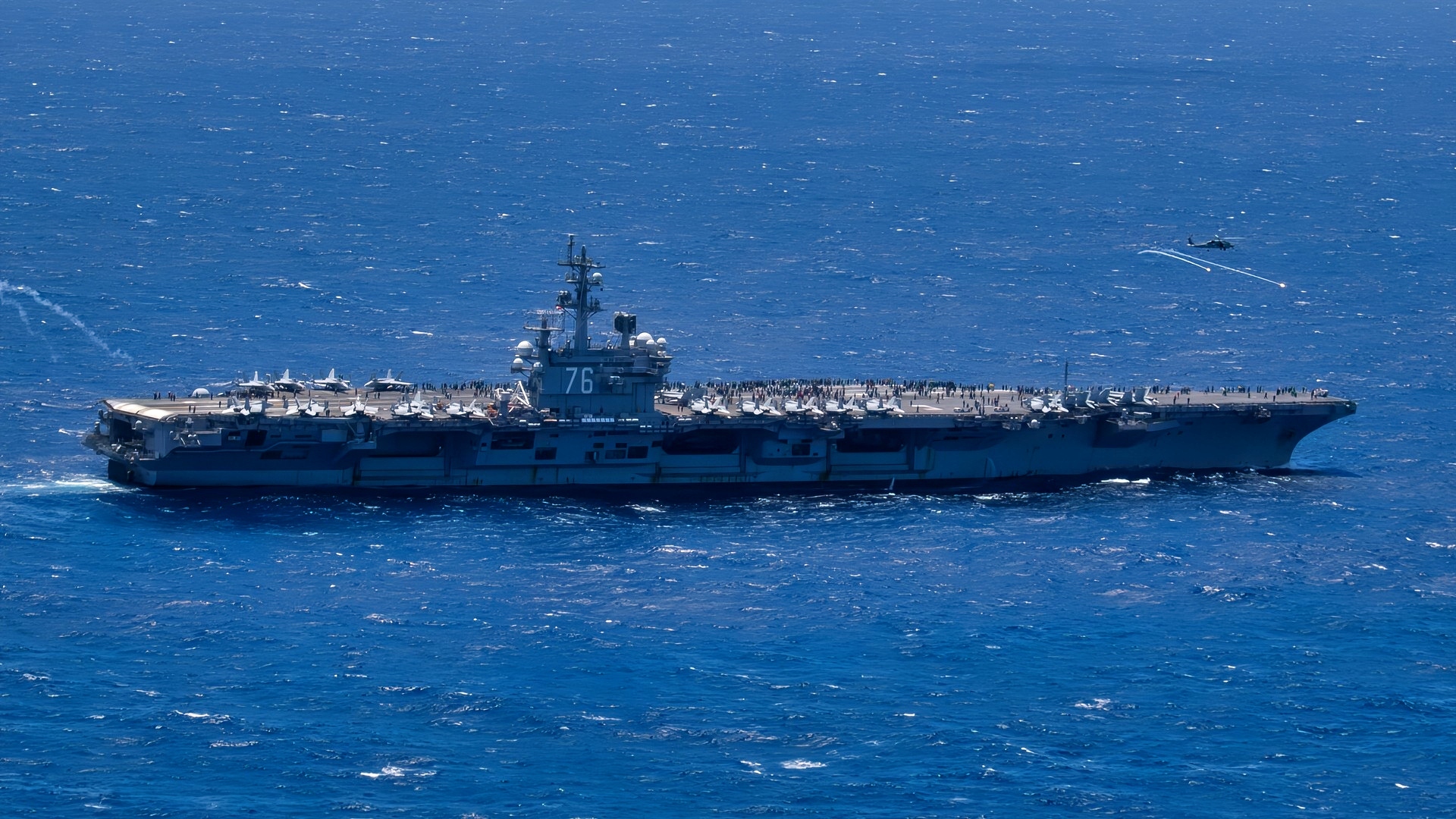
(July 3, 2024) An MH-60R Sea Hawk helicopter, attached to the Saberhawks of Helicopter Maritime Strike Squadron (HSM) 77, launches flares near the U.S. Navy’s only forward-deployed aircraft carrier, USS Ronald Reagan (CVN 76) during air combat-skills practice in the Pacific Ocean, July 3. HSM 77’s missions include surface warfare, anti-submarine warfare and a variety of support roles for Ronald Reagan and Carrier Strike Group 5. Ronald Reagan, the flagship of Carrier Strike Group 5, provides a combat-ready force that protects and defends the United States, and supports alliances, partnerships and collective maritime interests in the Indo-Pacific region. (U.S. Navy photo by Mass Communication Specialist 2nd Class Charlotte Dudenhoeffer)
The United States could very well lose the Kinetic Missile Fight, and an aircraft carrier could also be sunk in the process.
This type of loss would shock the Americans into inaction, and China could chalk up an early victory that would remind the world that the People’s Republic is a potent adversary that can keep its enemies from operating in the First Island Chain.
About the Author: Dr. Brent M. Eastwood
Author of now over 3,500 articles on defense issues, Brent M. Eastwood, PhD, is the author of Don’t Turn Your Back On the World: A Conservative Foreign Policy and Humans, Machines, and Data: Future Trends in Warfare, plus two other books. Brent was the founder and CEO of a tech firm that predicted world events using artificial intelligence. He served as a legislative fellow for US Senator Tim Scott and advised the senator on defense and foreign policy issues. He has taught at American University, George Washington University, and George Mason University. Brent is a former US Army Infantry officer. He can be followed on X @BMEastwood.


xi-xi-xi
May 22, 2026 at 8:48 am
Incorrect, doc.
USA (pacom + stratcom) will launch the high-end war against china irrespective of whether china can/cannot send American carriers to Davy Jones’ locker.
The only way to prevent agents of the shadow agency launching the cataclysmic war (in the western pacific) is the awareness or knowledge that China has the means to hold American cities st risk.
At risk of total obliteration.
Right now, today, in 2026, and even in 2027, china possesses zero ability or capability to hold American cities like Miami or NYC or chicago or Washington dc or Detroit or st Louis at risk of destruction.
Things will get even worse when US has its golden dome up and running in 2029.