


Marine Corps Lieutenant General Stephen Sklenka, the Deputy Commandant for Installations and Logistics, told the Modern Day Marine Expo in late April that China is no longer a near-peer of the United States — it is a peer. He said China rivals the U.S. in nearly every measure of national influence and intends to supplant American global leadership. Chinese shipbuilding capacity is more than 200 times that of the United States. China’s Atlas drone swarm platform lets one operator launch 96 autonomous drones in less than three seconds. Sklenka said American bases — including those on CONUS — now face non-kinetic Chinese attacks as debilitating as any kinetic strike.
China’s Military Rise Is a Problem for America
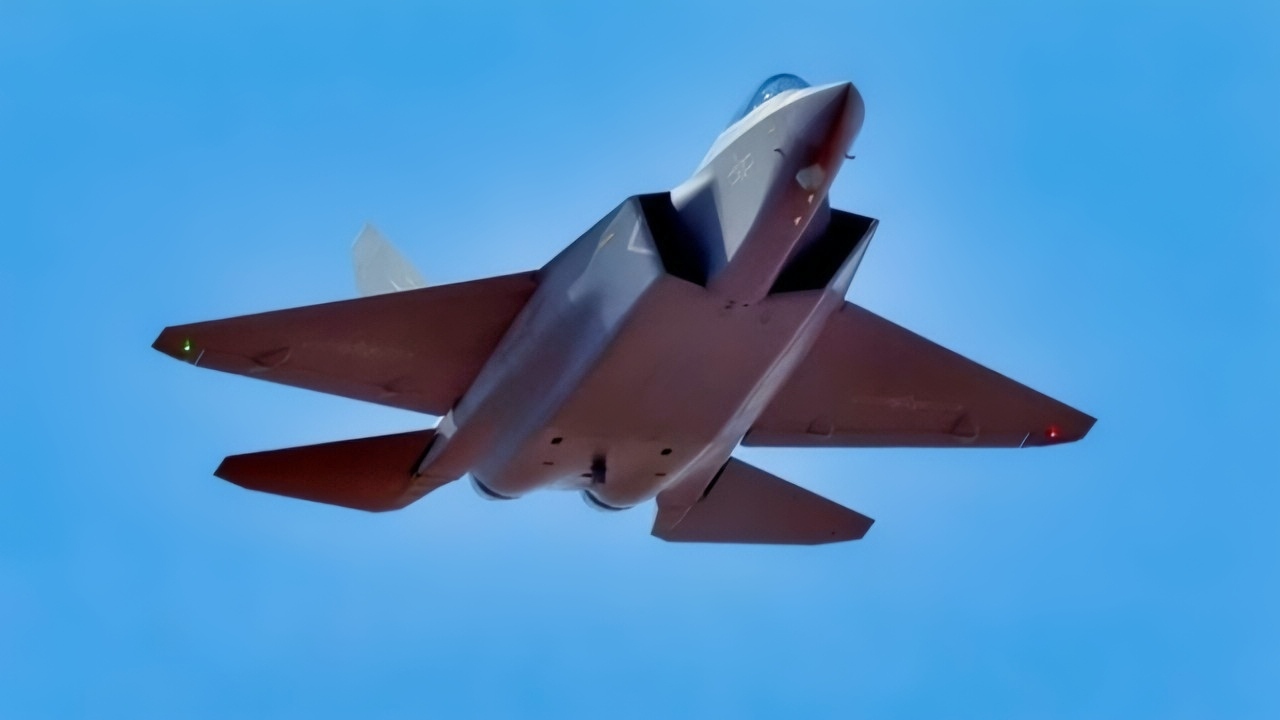
J-35 Fighter from China. Image Credit: PLAAF.
Marine Corps Lieutenant General Stephen Sklenka recently declared that China is no longer just a “near-peer,” but a full military equal capable of contesting the U.S. across all domains.
Speaking at the Modern Day Marine Expo in late April, the Deputy Commandant for Installations and Logistics urged defense planners to drop the “near-peer” label entirely.
“There is no threat that looms larger than the People’s Republic of China,” Sklenka said at the Washington, D.C. event. “Don’t listen to this garbage about them being a near peer. They’re a peer because they rival us in nearly every single measure of national influence.”
“They are not interested in sharing the global leadership position. They want to supplant us.”
All of the points the general makes are valid.
China (Obviously) Would Offer A Significantly Costlier War Than Iran
Skenka makes the argument that the US has not faced a foe with the military and economic power that China has, and uses the ongoing conflict in Iran as a benchmark.
Operation Epic Fury has shown “how a mid-tier power can hold a significantly superior force at risk,” General Sklenka said. “As a learning organization, we ask ourselves, ‘how do we carry every lesson from this fight forward, and how do we ensure that we’re equally prepared to dominate the conflict with China?’”

J-36 Fighter from X Screenshot. Image Credit: X Screenshot.
He added that the United States has to take a hard look at “the complexities and complications… with Iran, and then ask… ‘how are we going to respond and act when we’re going up against a nation that’s number two in national GDP?’. “The fact is that Iran doesn’t have anywhere near China’s economic might.
“They don’t have their industrial base. They certainly don’t have their military modernization trajectory.”
Industrial And Shipbuilding Might
China has been outproducing the United States for decades, and no area is more indicative of that than shipbuilding.
China’s shipbuilding capacity is more than 200 times that of the United States, and that isn’t going to change anytime soon, considering the state of the US shipbuilding industry.
Less than 1 percent of commercial shipbuilding is done in the United States.
The Chinese Navy (PLAN) now has the largest number of warships in the world, although its tonnage is still second to the United States…for now. China’s naval strategy is shifting from a Littoral force to a true blue-water navy.
They have doubled their nuclear submarine construction, and their ballistic and hypersonic missile development is progressing rapidly.
Military Bases Need To Be Hardened For A Future Conflict
General Sklenka said, “They’ve (Iran) launched hundreds of drones and ballistic missiles at our bases and our allies throughout the region – Israel, Saudi Arabia, Qatar, Kuwait, Jordan – reinforcing the point that the bases that we have, they’re no longer administrative garrison sanctuaries.
“We really need to start looking at our bases as warfighting formations, just as critical of a warfighting formation as our divisions, wings, and [Marine Expeditionary Units] MEUs.”

J-36 Fighter X Screenshot Image.
China is actively transforming future warfare by developing AI-controlled, mobile drone swarm systems such as the “Atlas” platform, which allows a single operator to command up to 96 autonomous drones simultaneously. This drone swarm can launch nearly 100 drones in under three seconds.
These swarms feature artificial intelligence algorithms that enable them to scout terrain, disrupt enemy sensors, and coordinate split-second strikes with minimal human intervention.
“Our bases, posts, and stations…are the front lines of decisive terrain. And I’m not just talking about those in the first island chain. This isn’t just [Marine Corps Installations Pacific] MCIPAC.
Future Attacks May Start With Cyber Attacks Inside The US
Sklenka pointed out that an early attack by China could involve cyberattacks on infrastructure, disinformation campaigns, or drone operations targeting US bases, including those on American soil.
“Our CONUS installations are subject to non-kinetic attacks. Non kinetic-attacks, they’re going to be just as debilitating and just as strategically consequential as any kinetic attack that’s going to be out there.
“And they’re going to carry an air of non-attrition that’s designed to both confuse decision makers and sow chaos during the most critical phases of the fight, the beginning, the first shots of that next war.”

A soldier from the Idaho Army National Guard, Charlie Company, 2-116th Combined Arms Battalion, 116th Cavalry Brigade Combat Team makes Idaho National Guard history with the first firing of a Javelin anti-tank missile.
In a historic moment of training for the Idaho Army National Guard, soldiers from Charlie Company, 2-116th Combined Arms Battalion, 116th Cavalry Brigade Combat Team, fired the FGM – Javelin portable anti-tank missile on Sunday while conducting a series of field training exercises scheduled for the week on the Orchard Combat Training Center ranges.
Sklenka’s point is driven home by what the Ukrainians did to Russia during “Operation Spider Web,” where swarms of drones attacked Russian infrastructure and air bases.
“We need integrated base defense, and we need industry’s help to do all this,” Sklenka said. “We’re not going to be just fighting from our bases. In many cases, we’re going to be fighting for those bases. That’s a concept that’s new to us.
We’ve got to start embracing that.”
Everything will be contested in a shooting war with China. And the casualties of such a conflict would no doubt be extremely high…on both sides.
And the general may be spot on with his assessment. It may be time to ditch the “near-peer” moniker when it comes to China. Back in 2020, the Pentagon wrote in its annual China Military Power Report that the PRC “has already achieved parity with—or even exceeded—the United States in several military modernization areas.”
MORE – The Dodge Durango of Submarine: The Virginia-Class Is Best on Planet Earth
About the Author: Steve Balestrieri
Steve Balestrieri is a National Security Columnist. He served as a US Army Special Forces NCO and Warrant Officer. In addition to writing on defense, he covers the NFL for PatsFans.com and is a member of the Pro Football Writers of America (PFWA). His work was regularly featured in many military publications.


