


Since the February 28 strikes on Iran, traffic through the Strait of Hormuz has fallen to roughly 5% of pre-war levels. That removes approximately 20 million barrels per day from global markets. The world is burning through strategic reserves. Most analysis in national security channels focuses on pressuring Iran to back down. None focuses on China. China buys roughly 90% of Iran’s crude oil exports. Beijing holds working leverage over the Strait’s reopening. The 2021 Comprehensive Strategic Partnership locked in a 25-year framework between Beijing and Tehran. Iran’s economy runs on Chinese demand. No naval adjustment alters that. The off-ramp exists. China is holding it. Washington is not asking for it.
Iran Just Handed China a Veto Over the Global Economy:
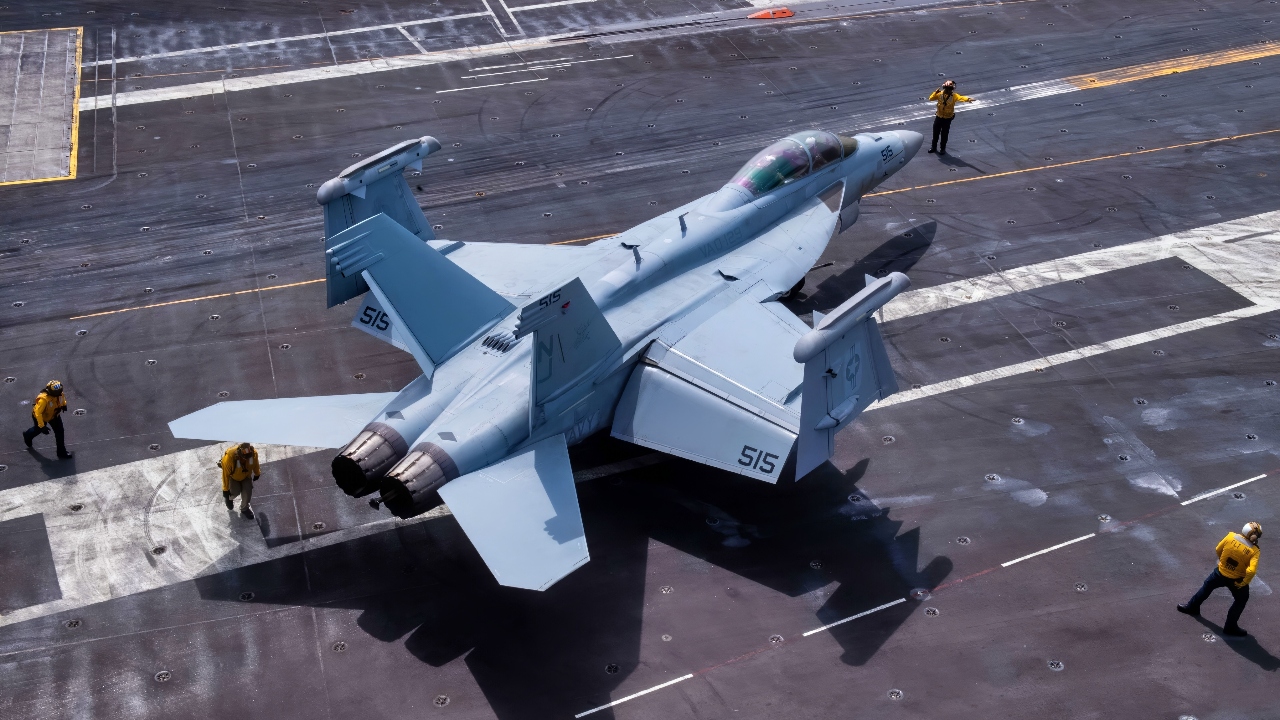
PACIFIC OCEAN (Aug. 11, 2025) – U.S. Navy Sailors direct an E/A-18G Growler, assigned to the “Vikings” of Electronic Attack Squadron (VAQ) 129, on the flight deck of the Nimitz-class aircraft carrier USS Theodore Roosevelt (CVN 71), Aug. 11, 2025. Theodore Roosevelt, flagship of Carrier Strike Group (CSG) 9, is underway conducting exercises to bolster strike group readiness and capability in the U.S. 3rd Fleet area of operations. (U.S. Navy photo by Mass Communication Specialist Seaman Apprentice Cesar Nungaray)
The standard read on the Strait of Hormuz crisis puts Tehran at the center and treats Beijing as a spectator. That reading is dead wrong.
Since the February 28 strikes on Iran, traffic through the Strait of Hormuz has fallen to roughly 5% of pre-war levels, removing the better part of 20 million barrels a day from global markets. The EIA estimates the resulting global inventory draw at roughly 5 million barrels per day. The world is burning through strategic reserves to cover that gap, and the arithmetic of a sustained drawdown ends in one place: a global depression. Most of the analysis circulating through national security channels focuses on how to pressure Iran into backing down. Almost none of it focuses on China, which is where the problem actually has to be solved.
Why China Is Running a Different Clock
Most coverage of Beijing’s position in this crisis treats China as an energy-dependent bystander, managing its exposure to a disruption it didn’t cause and can’t control. That picture misreads who is benefiting from the current situation and why.
China has spent five years building reserve capacity well beyond what EIA reporting captures. Satellite analysts at Kpler and Vortexa have tracked the tank farm buildout in detail — the groundwork was laid long before this crisis started.
Beijing also holds supply options unavailable to any American ally in the Pacific: the Power of Siberia pipeline from Russia and overland routes through Central Asia that run nowhere near the Strait. Japan, South Korea, and India have none of those alternatives. They are Hormuz-dependent, and they are bleeding.
That bleeding matters beyond the energy numbers. Those three countries are China’s most significant regional competitors and America’s most important treaty partners in the Indo-Pacific. Every week the closure holds, they fall further behind China in relative economic terms.

U.S. Air Force Capt. Nick “Laz” Le Tourneau, F-22 Raptor Aerial Demonstration Team commander, performs an aerial maneuver during the Hyundai Air and Sea show at Miami, Florida, May 25, 2025. The F-22 Aerial Demonstration Team highlights cutting-edge airpower, precision, skill, all while reinforcing public confidence in the Air Force’s ability to protect and defend. (U.S. Air Force photo by Staff Sgt. Lauren Cobin)
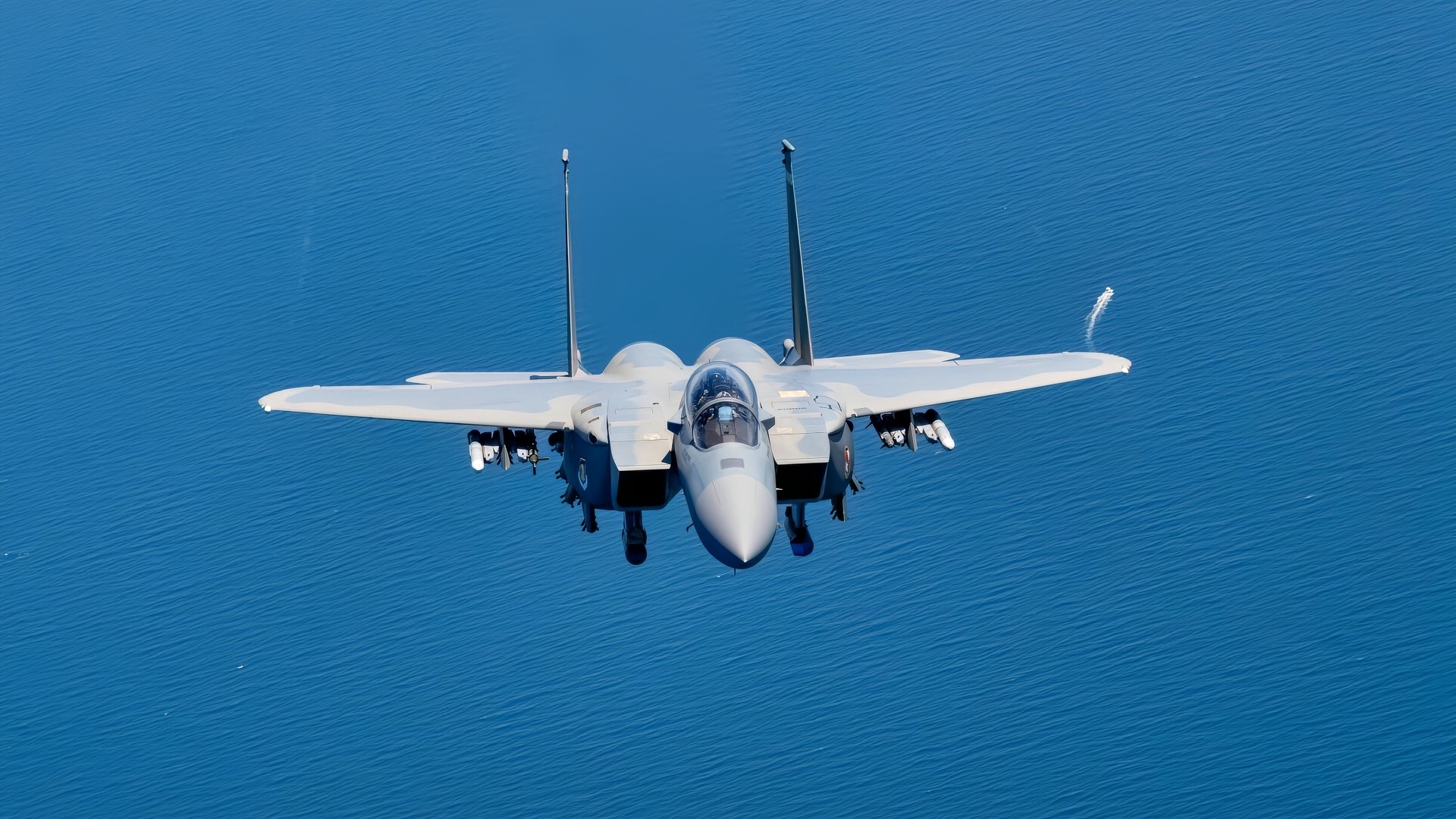
A U.S. Air Force F-15EX Eagle II flies over the Gulf of America, September 16, 2025. The F-15EX, from the 40th Flight Test Squadron at Eglin Air Force Base, Florida, is one of the first F-15EXs in the Air Force, and is going through developmental and operational test series at Eglin to confirm its operational capabilities before it is delivered to the combat Air Force. (U.S. Air Force photo by Staff Sgt. Blake Wiles)
Beijing did not engineer this outcome. It is collecting the returns without lifting a finger.
The counterargument is that China absorbs pain here too, and that is true — energy costs rise in Beijing, along with everywhere else. But the relevant question is not whether China hurts. It is whether China runs out of tolerance before Washington’s allies do. No democratic government facing voter anger over fuel prices holds the same position as one that doesn’t. China runs a longer clock, and the current American strategy does not account for that.
The Off-Ramp Washington Isn’t Holding
Beijing already showed how it manages Gulf crises. In April 2023, Iranian forces seized the Advantage Sweet, a Chinese-owned tanker, in the Gulf of Oman. Days later, IRGC speedboats forced the Panama-flagged Niovi into Iranian waters.
Beijing said nothing publicly, sent no warships, and kept buying Iranian crude. China protects its Gulf interests through economic relationships rather than naval deployments. That approach has been consistent long enough that it is now simply how Beijing operates.
Those economic relationships are the crux of the current problem. The 2021 Comprehensive Strategic Partnership locked in a 25-year framework across energy, infrastructure, and security. China buys roughly 90% of Iran’s crude exports.
Tehran’s ability to withstand international sanctions — which was supposed to collapse under sustained pressure — has held because Chinese demand funds the budget that pays the engineers and keeps the production lines running. Iranian officials understand that dependency clearly.
Beijing does not direct IRGC operations. The relationship does not work that way, and it does not need to work that way to matter. A signal from Beijing — slower oil purchases, less reliable Security Council cover, a cooling at the senior level — carries real weight in Tehran without a formal instruction.
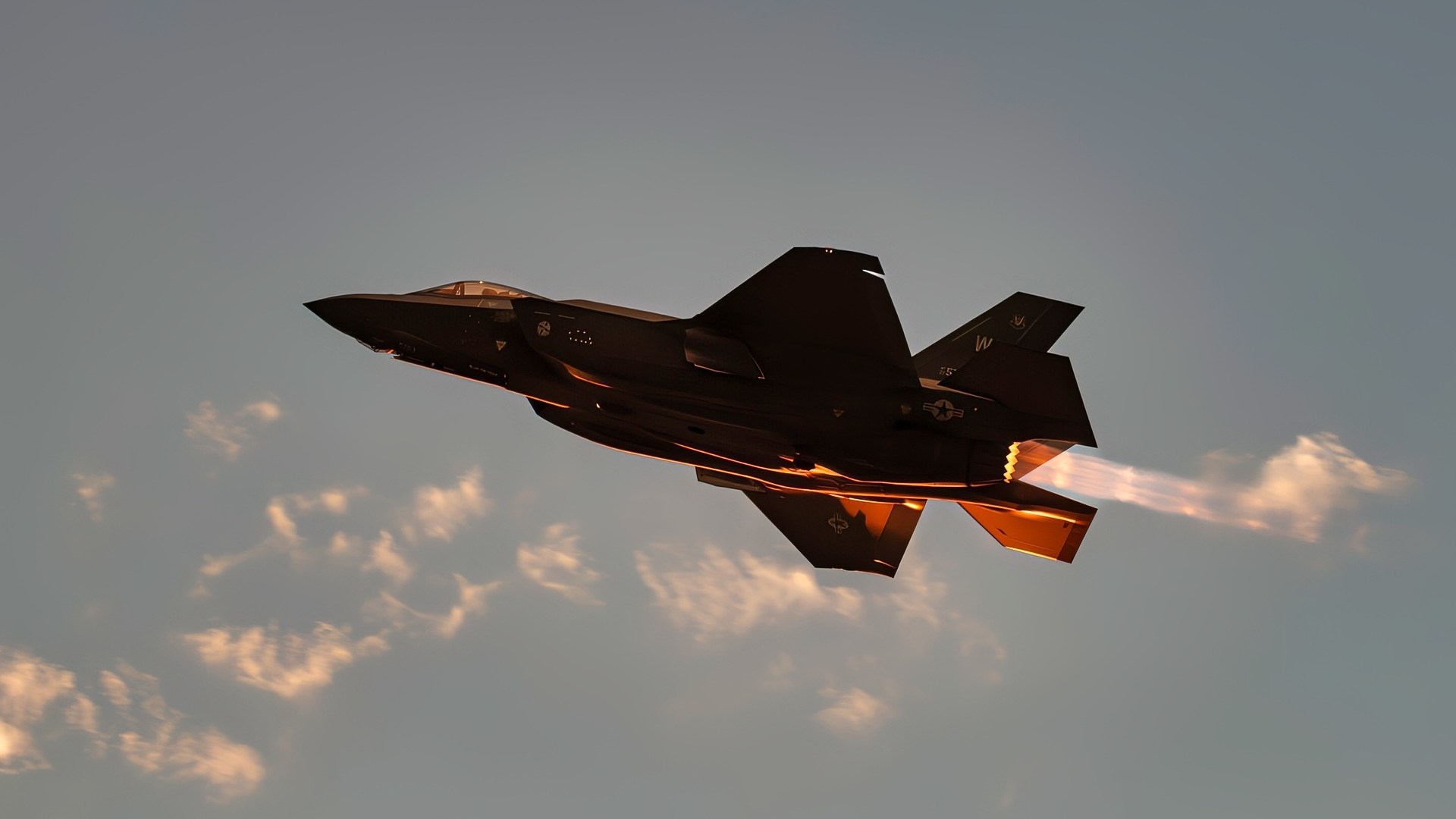
A U.S. Air Force F-35A Lightning II takes off for a mission during U.S. Air Force Weapons School Integration (WSINT) at Nellis Air Force Base, Nevada, June 4, 2025. WSINT is a graduate-level training event that combines multi-domain assets in large-force scenarios, enabling U.S. Air Force and joint service members to hone tactical expertise and integrate advanced capabilities in a dynamic threat environment. (U.S. Air Force photo by William R. Lewis)
Analysts tracking the 2023 period noted that a visible pullback in Chinese engagement with Tehran came before Iranian moves toward de-escalation in the Red Sea theater. The timing strongly suggested Beijing’s preferences were being noticed in Tehran.
Since the U.S. naval blockade of Iranian ports began on April 13 — creating what analysts have described as a dual blockade of the world’s most critical energy chokepoint — that signal has not come. Chinese energy access has continued. Iranian crude has continued to reach Chinese ports. The off-ramp exists. China is holding it.
The Bilateral Strategy for a Trilateral Problem
Washington’s response has been organized around pressure on Iran — carrier groups, Gulf state diplomacy, and administration statements. None of that changes the central fact: Iran’s economy runs on Chinese demand, and no naval adjustment alters that.
None of this guarantees Chinese cooperation. Beijing may ultimately decide that prolonged disruption weakens the American alliance network more than it costs China — in which case the current arrangement suits Beijing’s interests regardless of what Washington signals. That risk is real. It is also an argument for naming the problem clearly rather than ignoring it.
Three things would address the actual situation. The first is direct communication to Beijing — not a threat, but a clear statement of what follows. How China handles its position in this crisis will be priced into every subsequent conversation: Taiwan, chip controls, trade.
Beijing moves when the cost of not moving becomes concrete, and right now that cost is not being named.
Washington also needs to offer China a structured role in post-crisis Hormuz governance. That is not a concession — Beijing already holds working leverage over the Strait’s reopening, and a formal role acknowledges what is already true.
Beijing cannot simultaneously demand Gulf stability and disclaim responsibility for delivering it. Keeping China out of a formal role while it holds that leverage is a losing position, and right now that is exactly where Washington stands.
A third step would be rebuilding the economic leverage Washington spent years surrendering. A strategy that leaves Beijing holding the financial lifeline to Tehran while the U.S. Navy patrols the Gulf is not a sustainable balance of power — it is a geopolitical dependency trap of America’s own making.
The gap in American influence that this crisis has exposed did not appear overnight. It grew out of years of sanctions policy that pushed Tehran toward Beijing while leaving Washington with fewer economic tools in the Gulf than it once had.
The 2023 tanker seizures showed how this dynamic works on a small scale. What is unfolding now is the same dynamic, but on a scale that threatens the global economy.
About the Author: Dr. Andrew Latham
Andrew Latham is a professor of international relations and political theory at Macalester College in Saint Paul, MN. You can follow him on X: @aakatham.


Swamplaw Yankee
May 12, 2026 at 5:28 pm
What the heck? Not verbally whip lashing Mexico to immediately purchase 100 plus F-35 air frames?
The dynamic is “World War Xi” viciously active since the 2014 POTUS Obama betrayal of NATO-UK-EU-Ukr, the WEST, by the facilitation of the Balkanization of independent Ukraine.
WW Xi is unique with ‘Jagged’ edges.
xi-xi-xi-xi-xi
May 13, 2026 at 4:46 am
US reckless military adventure by president donald trump’s now threatening US and world economic health, very serious seriously.
Now it is up to xi jinping to stop trump and his madness over Iran, but he mustn’t mention the ‘files’ to trymp.
What should xi say.
Xi should remind trump that the US suffered economic malaise in the year 1970 because of the high expenditure caused by the nam war. It was a stupid stupid war. Like today’s Iran war.
The Iran war is actually $29 bil and not $25 bil as mentioned by hegseth.
If trump continues to wage war on Iran, the US economy will collapse, as the US can’t afford to spend money on domestic front while fighting Iran and supporting war-mad netanyahu.
But does xi have the balls to tell it straight & undilyuted to trump.
Peter wolf
May 13, 2026 at 12:03 pm
And THAT folks is how Iran will finance its weapons reconstruction. And there’s nothing anyone can do about it.
Dr. Mike Jenkins
May 13, 2026 at 8:52 pm
Mmm, A whole lot of circuitous discussion based on incorrect ideations of reality and strategic objectives. IRAN IS DONE. Period. Their military is destroyed, their economy is collapsed, and THEY’RE OUT OF STORAGE. Mr. Latham doesn’t understand that if u take oil wells offline, it’s EXTREMELY DIFFICULT to get them back in production, and depending on how old the well is, it might flood with water once pumping stops.
We’re already set to go in and secure the uranium, and most likely TAKE OR DESTROY KHARG. So all this circular talk about China buying Iran’s oil is nonsense – cause it AIN’T THERE ANYMORE. Why do we think Trump, Hegseth and Rubio are ALL IN CHINA RIGHT NOW?? 🤔🤔
Trump is the MASTER DEAL MAKER, AND HE .. ALWAYS WINS. If ppl haven’t figured this out by now – they believe the Groping Sniffing Creep Criminal Incest Pedophile Alzheimer’s Assclown was a great POTUS and Ka ma la should b in office.
Anthony Richens
May 14, 2026 at 10:05 am
You have a large blindspot in your argument.
If Iran cannot get it’s oil to Chinese markets via the Straight of Hormuz, then how is it getting it’s oil to any market?
Do overland or rail routes exist to deliver it’s oil to China? I’m not sure that they do.
So then how is Iran funding it’s economy?
You are focusing on Chinese demand for Iranian oil – that is completely clear, and I agree with you.
But my question for you is this: how can you say that a blockade wouldn’t work? I have seen reports that the Iranian military and IRGC have already missed payroll….for two months now…
MAJ (ret) Anthony Richens
Retired Army Officer
Former NSA Analyst
C. Carrier
May 15, 2026 at 9:49 am
Maj (ret) Anthony Richens,
This author is correct, but you raise good points. Here’s why Andrew Latham is correct. It’s not just Chinese “demand” for Iranian oil keeping Iran afloat. It is ACTUAL Chinese purchases that are taking place NOW over various pathways, including through the [“double-blockaded”] Strait of Hormuz.
China is ignoring the US “blockade of the blockade,” and we’re letting them through. No one is advertising that fact, but I have seen this unfortunate dynamic mentioned in at least one recent mainstream media source (WSJ, CNN or Fox) during its coverage of the Trump-Xi summit. China is citing its own domestic laws that give it [questionable-but who can truly enforce/challenge them?] legal authority to basically “ignore illegal orders from international actors.”
In essence, Chinese ships are currently successfully sailing through the Strait and basically calling the US’ bluff. And we are in no position to call that bluff. We’re not exactly announcing this fact pattern to the public because it makes us look weak.
In sum, our blockade is only working against much weaker and smaller powers who are unwilling (and unable) to take on the US. China, however, is absolutely strong enough (financially and militarily) to ignore our orders. No US Naval ship is going to fire on or commandeer a Chinese ship. They’re basically daring us to do that right now (without saying a word), knowing that we will not.
We need to find some way to weaken China’s de facto upper hand here. Trump can try to ask them to purchase US oil “instead.” BUt even that tactic has limited efficacy. Xi, ever the chess player, will likely agree to buy our oil (giving Trump a small win), BUT-this is KEY-Xi will buy that oil IN ADDITION TO Iranian oil, NOT instead of it. He’ll play both sides because it is absolutely in China’s best interest to do that. China’s best “game theory” position here is to keep both Iran and the US at loggerheads (thereby maintaining a kind of control over both) without destroying either one.