

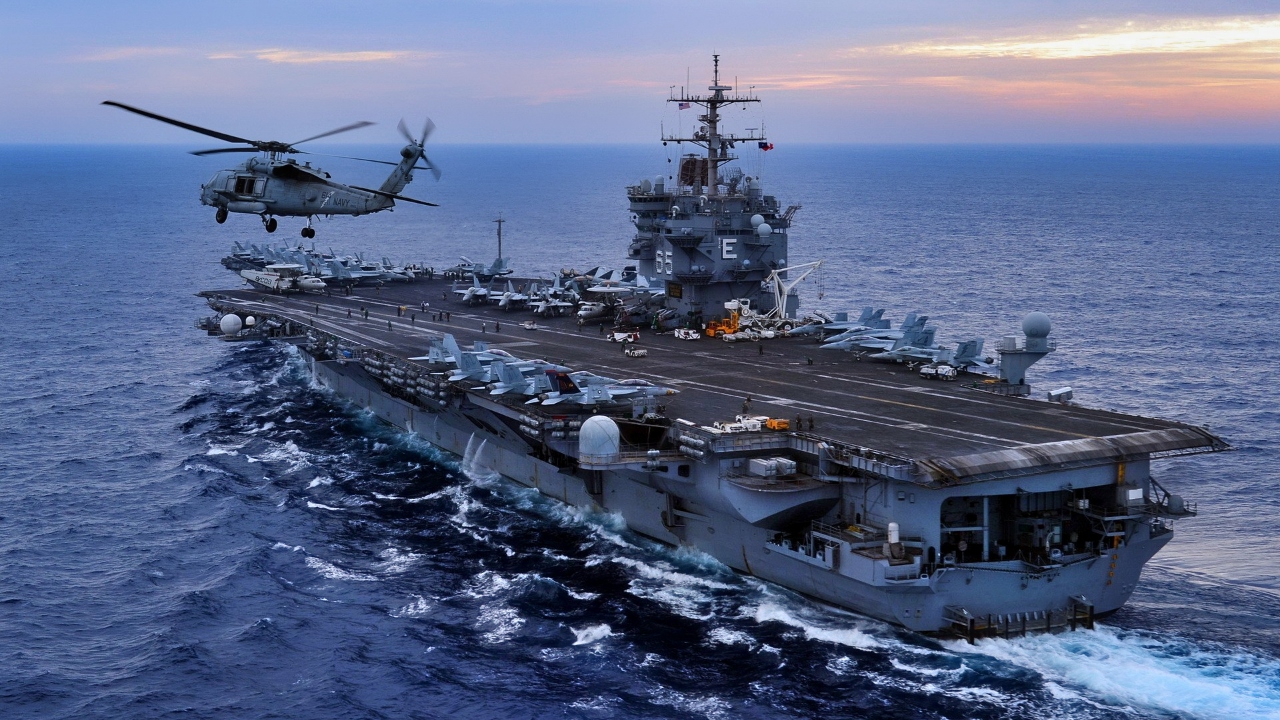
In 1985, the U.S. Navy’s nuclear-powered USS Enterprise aircraft carrier hit Bishop Rock at Cortes Bank — an underwater seamount roughly 100 miles west of San Diego — during an Operational Readiness Exercise. The collision opened a massive gash along the port side and damaged the propellers, but the nuclear reactors were unaffected. The crew executed a counter-flooding operation to stabilize the carrier. Captain Robert L. Leuschner Jr. then decided to continue the exercise before returning to port for $17 million in emergency repairs. Leuschner was relieved of command afterward. The Enterprise survived to fight another day.
How a U.S. Navy Aircraft Carrier, USS Enterprise, Survived a Tragedy
We are often concerned about how nuclear-powered aircraft carriers have met their match. Anti-ship missiles and drones are always a concern. They are difficult to maintain and need costly midlife nuclear refueling. Carriers are big targets for enemy warplanes. And they can succumb to fires and even sewage problems. Did I mention the price tag? The USS Gerald R. Ford supercarrier cost more than $13 billion.
But sometimes the enemy of a ship is Mother Nature’s ocean geography. In 1985, the carrier USS Enterprise crashed into an underwater mountain. It ripped a gaping hole in the ship, and the captain and crew wondered if this was the end.
What Happened to the USS Enterprise?
The accident occurred off the coast of California during a drill.
The vessel hit Bishop Rock at Cortes Bank. The port side was ruined with a huge gash. This looked like it was going to be catastrophic. The Operational Readiness Exercise could have been the USS Enterprise’s last mission. And it had some wondering if the carrier would survive to sail again.
Bishop Rock is an underwater sea mount, and the formation is known as Cortes Bank. It is located 100 miles west of San Diego. While there was a substantial rip in the hull, the nuclear reactors were not affected, but the carrier would have to return to port for some emergency repairs. It was not clear at the time whether the Enterprise could make it back home safely.

(September 24, 2021). The navy’s only forward deployed aircraft carrier USS Ronald Reagan (CVN 76) transits the South China Sea. Reagan is attached to Commander, Task Force 70/Carrier Strike Group 5 conducting underway operations in support of a free and open Indo-Pacific. (U.S. Navy Photo by Mass Communication Specialist 1st Class Rawad Madanat)

201117-N-NH257-1123 NORTH ARABIAN SEA (Nov. 17, 2020) The aircraft carrier USS Nimitz (CVN 68) steams ahead of the guided-missile cruiser USS Princeton (CG 59) while participating in Malabar 2020 in the North Arabian Sea. Malabar 2020 is the latest in a continuing series of exercises that has grown in scope and complexity over the years to address the variety of shared threats to maritime security in the Indo-Asia Pacific where the U.S. Navy has patrolled for more than 70 years promoting regional peace and security. Nimitz Carrier Strike Group is currently deployed to the 7th Fleet area of operations in support of a free and open Indo-Pacific. (U.S. Navy photo by Mass Communication Specialist 3rd Class Elliot Schaudt/Released)
The Command Team Made A Quick Decision to Save the Carrier
How did the crew react? This was the good news. They quickly engaged in damage control and executed the counter-flooding operation. This stabilized the massive ship. The carrier did not sink, and it was able to limp along until the crew was certain it could maintain a minimum speed.
Continue Mission or Limp Home
The sailors assessed the damage. Would the carrier be able to function well enough to complete the exercise? This was a critical time of decision-making. The carrier was stabilized, but there was still more danger ahead. The Enterprise could take on more water as the gash widened due to sea pressure. The commander took a chance and decided to continue the mission.
Expensive Repairs Were Needed
However, there was going to be a reckoning. After the exercise, the Enterprise would need a massive amount of work, estimated at $17 million. The propellers were damaged, and the port keel needed repairing. Heads were also going to roll. The commander, Robert L. Leuschner Jr., was relieved.
This incident could have been a lot worse. The crew was well-trained to act quickly to counter the massive amount of seawater that could have sunk the carrier. Leuschner should be given credit for making a quick decision.
Was This Wreck Evidence of Systemic Weakness?
But this sent a message to allies and adversaries. The vaunted U.S. Navy aircraft carrier fleet was not invincible. Mistakes were made that could have led to the ship’s capsizing. Were American sailors up to the challenge of a war with the Soviet Union? An anti-ship missile could be used to make a carrier pay the price in damages and morale.
The captain’s negligence was evident in the wreck. There was a problem with the navigation system, and he lacked proper situational awareness. No command team wants to be responsible for a major accident that could have sent the ship to Davy Jones’ Locker, putting thousands of shipmates in danger of perishing with the ship.
Ramming or Collision Is Still a Potential Problem Today
The incident with the Enterprise still resonates today. More warships and commercial vessels are in the water at any given time. Accidents, miscalculations, and mistakes can create more opportunities for dangerous maneuvers that could lead to a crash.
The Stakes Are Still High
Sea lanes are crowded. Just take the current state of the Strait of Hormuz, where scores of ships are trying to maneuver through the critical waterway. There are sea mines too, and itchy trigger fingers on devastating missile systems.
One U.S. destroyer even opened fire from its 5-inch deck gun at an Iranian cargo ship that was sailing against American orders while enforcing a blockade against Iran.
The Soviets Would Have Rejoiced if the Enterprise Were Sunk
A damaged ship can be an act of war that prolongs the fight due to a misunderstanding and a lack of communication. During the Enterprise’s accident, the Cold War was raging.
President Ronald Reagan was trying to build up the 600-ship fleet. There could be no room for bad decisions. If the Enterprise were sunk, the Soviet state-run propaganda complex would have used the incident as a public relations bonanza to show that the U.S. Navy was weak and error-prone.
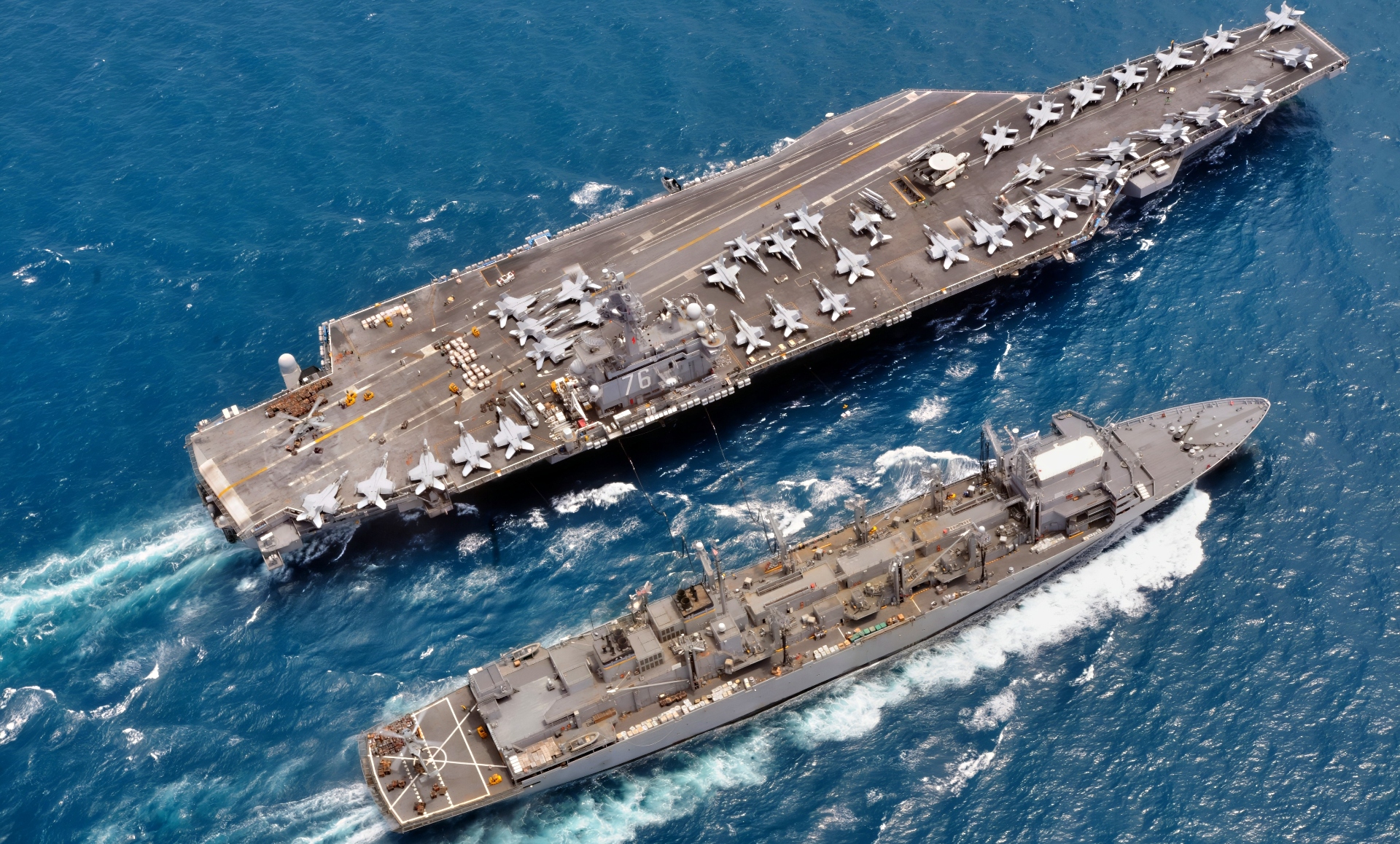
(August 15, 2008) With SH-60 helicopters moving pallets of supplies both USS Ronald Reagan (CVN 76) and USNS Bridge (T-AOE 10) work together during a replenishment at sea or RAS. With Reagan’s six galleys and approximately 4,100 Sailors it takes a lot of produce to feed that many folks and the Nimitz-class aircraft carrier got what it needed from USNS Bridge to do so.
The Ronald Reagan Carrier Strike Group is on a routine deployment in the 7th Fleet area of responsibility. Operating in the Western Pacific and Indian Ocean, the U.S. 7th Fleet is the largest of the forward-deployed U.S. fleets covering 52 million square miles, with approximately 50 ships, 120 aircraft and 20,000 Sailors and Marines assigned at any given time.
U.S. Navy photo by Senior Chief Mass Communication Specialist (SW/NAC) Spike Call
What About a Blockade in the Indo-Pacific?
Blockades could also happen in East Asia today. China could easily quarantine the Taiwan Strait and keep ships from departing or arriving in Taiwan. This would mean there could be problems with accidents again. A ship’s ramming or crashing into another could spark a battle and lead to a prolonged war.
Carriers Can Live to Fight Another Day
The Enterprise accident teaches us another lesson about carriers: they can take a punch and still survive. The crew’s quick reaction and the strength of their damage-control training allowed the carrier to survive without going to the bottom. This may mean a carrier could take a hit from an anti-ship missile or submarine and still fight again.
The name of the game now is ship survivability. The Enterprise incident is likely still studied at the U.S. Naval Academy, the various staff officer training schools, and the U.S. Naval War College.
This could have been disastrous, and the need for advanced seamanship and improved navigation procedures was a lesson learned from an accident that could have been far worse. Let’s hope the nation’s carriers do not have to face this type of calamity again.
MORE – The Dodge Durango of Submarine: The Virginia-Class Is Best on Planet Earth
About the Author: Brent M. Eastwood, PhD
Author of now over 3,500 articles on defense issues, Brent M. Eastwood, PhD, is the author of Don’t Turn Your Back On the World: A Conservative Foreign Policy and Humans, Machines, and Data: Future Trends in Warfare, plus two other books. Brent was the founder and CEO of a tech firm that predicted world events using artificial intelligence. He served as a legislative fellow for US Senator Tim Scott and advised the senator on defense and foreign policy issues. He has taught at American University, George Washington University, and George Mason University. Brent is a former US Army Infantry officer. He can be followed on X @BMEastwood.


