

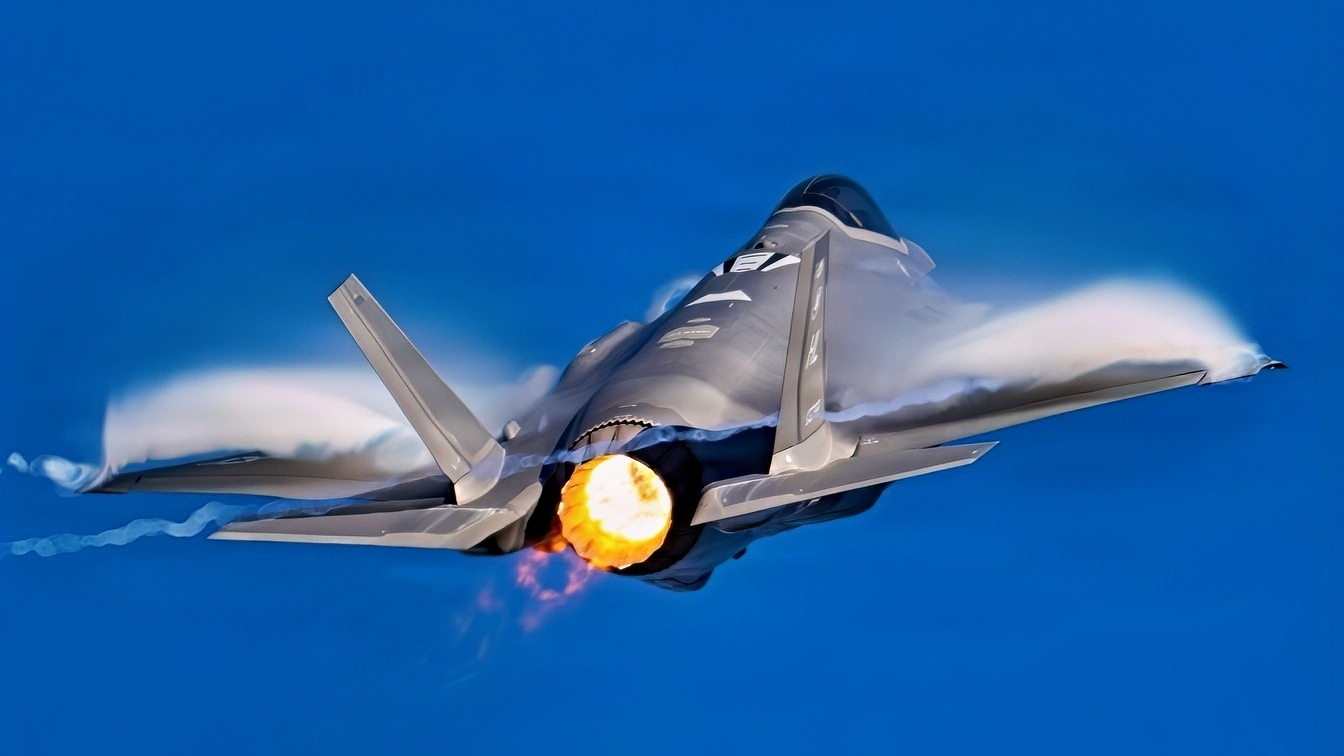
There is no F-35 Lightning II kill switch — the Joint Program Office and Lockheed Martin have both said so directly. But the rumor that the U.S. could remotely disable allied F-35s gained traction after the Trump administration’s televised confrontation with Volodymyr Zelensky in March, and several allies are rethinking their orders. Canada is contractually obligated to only 16 of an originally agreed 88 F-35s; Saab is pushing the JAS-39 Gripen for the remaining 72. Portugal canceled its F-35 buy. Stacie Pettyjohn of CNAS says no kill switch exists, but cutting off spare parts, ALIS and ODIN software updates, and U.S. maintenance support would quickly hobble any allied F-35 squadron.
The F-35 Could Become a Leverage Point for America

F-22 and F-35 and the Flag. Image Credit: Creative Commons.

F-35I Adir Lockheed Martin Photography by Todd R. McQueen.
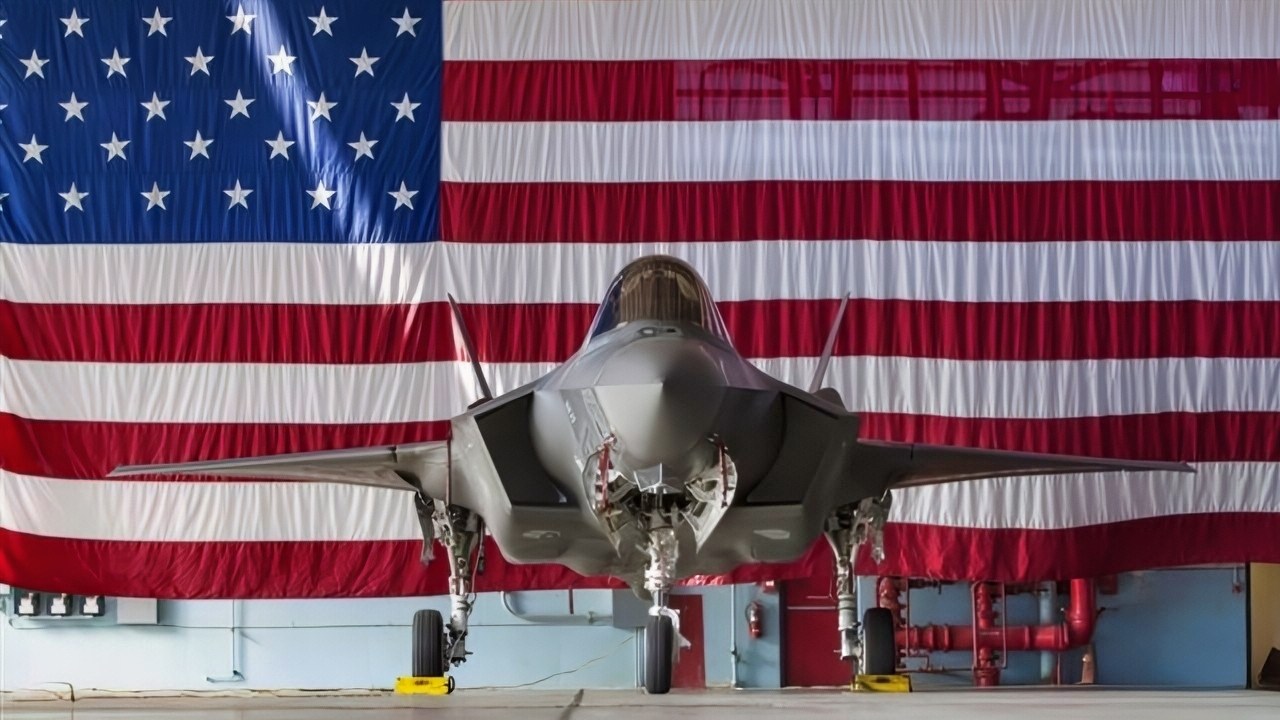
F-35 Fighter Image by Lockheed Martin
The F-35 is the world’s premier fifth-generation stealth aircraft, unmatched in all fixed-wing aircraft. Lockheed Martin perfected different variants of the F-35 that are in use by various American allies today.
There are currently over 1,300 F-35s in use worldwide.
Given its widespread use, the United States could leverage software updates and spare parts as strategic leverage. Because the aircraft relies on a central logistics system and U.S.-controlled mission data files, the U.S. maintains significant control over the operational capabilities, maintenance, and deployment readiness of every international F-35 fleet.
Background on The “Kill Switch” Myth
The Trump administration has been very critical of NATO over its refusal to take a more active role in its defense, leaving the United States to foot the bill.
And among many Europeans, who dislike Trump’s criticism, a furor arose over whether the US had hidden a “backdoor” in the 800 million lines of code for an F-35 that could render it inoperable.

Capt. Kristin “BEO” Wolfe, F-35A Lightning II Demonstration Team pilot and commander, flies during an airshow demonstration practice Mar. 5, 2020, at Hill Air Force Base, Utah. The team will make its first of 20 appearances at the Yuma Air Show, Mar. 13-14, 2020, at Marine Corps Air Station, Yuma, Ariz. (U.S. Air Force photo by Cynthia Griggs)
Back in March of last year, the Trump Administration had a controversial meeting ripping Ukraine’s President Volodymyr Zelensky live on television, creating a panic among US allies regarding the F-35, and a mythical “kill switch” that the US could use to basically shut down the aircraft.
This has led many allied nations to reconsider purchasing the F-35 from the US, despite the US’s efforts to dispel the rumors.
The Canadian And Portugese Decisions To Forego The F-35
The fallout from the disastrous Zelensky meeting led to reports that Portugal and Canada were rethinking their decision to buy the F-35 after a kill-switch rumor gained traction.
Canada, in particular, has been trying for some time to get out of its F-35 deal, under which it planned to purchase 88 F-35 Lightning IIs. They are contractually obligated to 16 F-35s, which will be delivered beginning in 2027.
Prime Minister Mark Carney took office from Justin Trudeau and has stated that the Canadian government is rethinking the F-35 deal, on which he promised a decision last September.
Saab, the Swedish company that manufactures the JAS-39 Gripen, has been pushing hard for the Canadians to purchase the remaining 72 fighters from them instead of the F-35.

SAAB JAS 39 Gripen Fighter. Image Credit: SAAB.
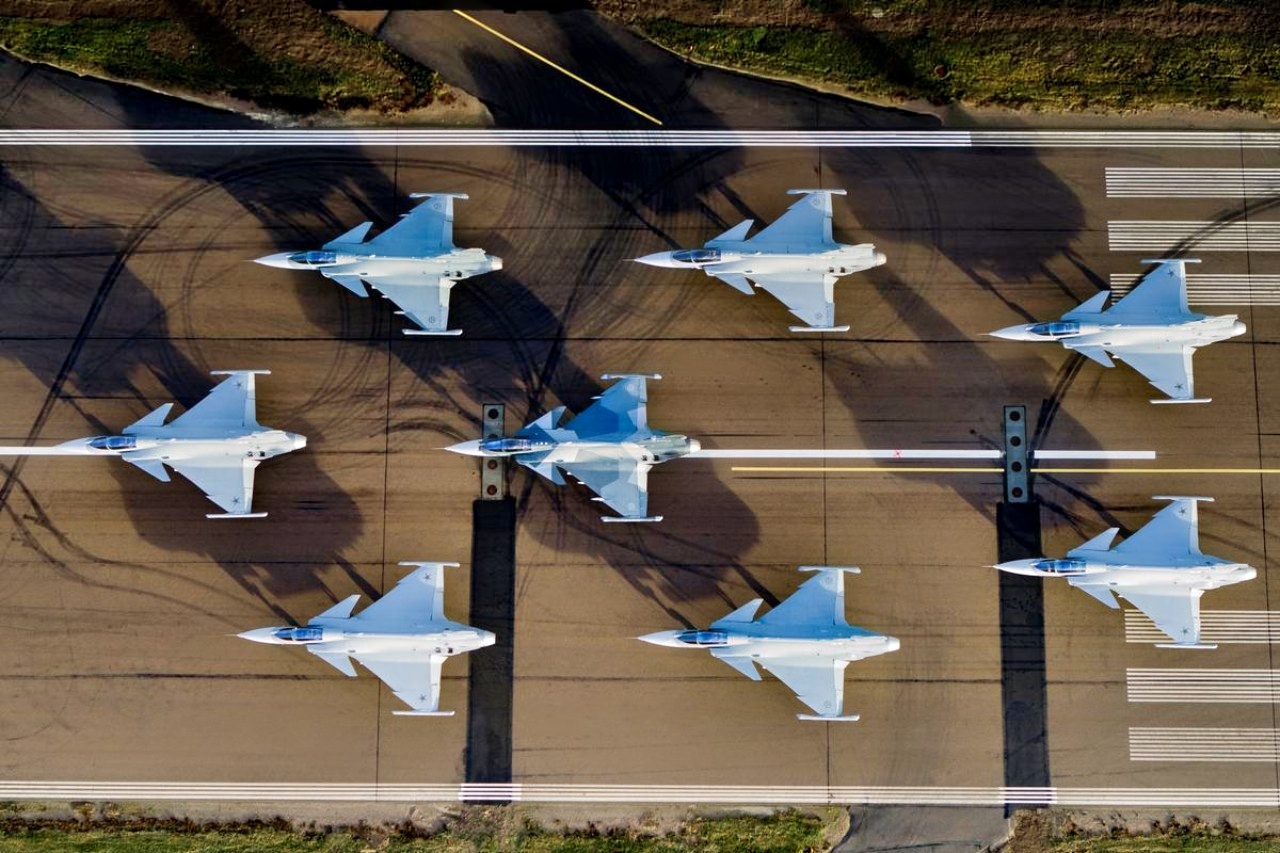
JAS 39 Gripen E Fighters. Image Credit: Creative Commons.
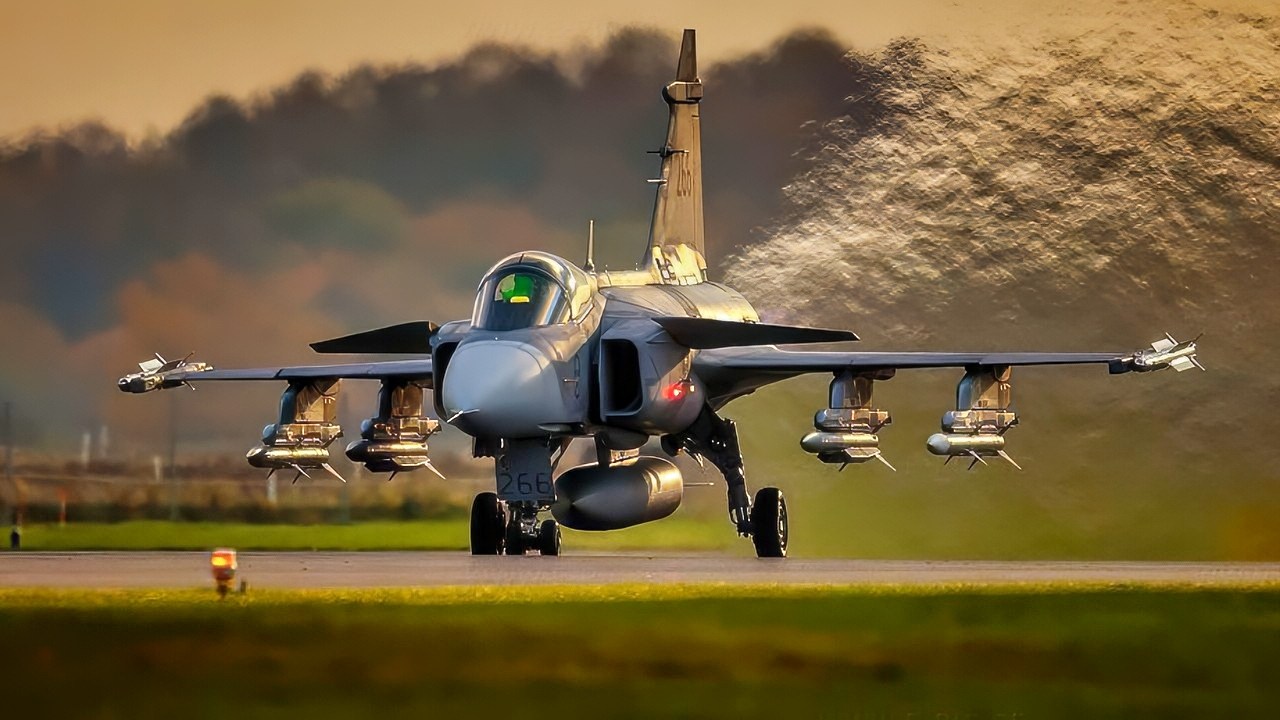
JAS 39 Gripen SAAB Image Handout
The F-35 won the original 2022 aircraft competition by a wide margin, scoring 95 percent on military capabilities compared to the Gripen’s 33 percent.
Carney is using Canada’s sovereignty as its own leverage, as well as his anti-American stance. In January, he delivered a very anti-American speech in Davos, Switzerland, while courting China and Xi Jinping.
Canada is trying to court the idea of a mixed air fleet, something they can’t afford economically, and isn’t the best idea militarily.
Portugal backed out of acquiring the F-35 to replace its aging F-16 fleet due to concerns over U.S. political volatility and potential US restrictions on software, maintenance, and spare parts.
Portuguese officials cited unpredictability in U.S. foreign policy toward NATO allies and are exploring European alternatives to ensure defense sovereignty.
Portugal denied the United States the use of its Azores airbases during the bombing of Iran’s civilian infrastructure.
There Isn’t an F-35 Kill Switch And Other Rumors
That kill switch rumor was reported as fact, and it created uncertainty, especially among NATO allies, that the US could literally flip a switch and, through back-door coding in the software, turn the F-35 into a lawn ornament.
“There is no kill switch,” the Joint Program Office (JPO) for the F-35 program said in a statement.
“The program operates under well-established agreements that ensure all F-35 operators have the necessary capabilities to sustain and operate their aircraft effectively. The strength of the F-35 program lies in its global partnership, and we remain committed to providing all users with the full functionality and support they require,” the statement added.
Lockheed Martin also tried to dispel the rumors and said that the company “is committed to helping our customers strengthen their airpower and security with the F-35. The F-35 program recently surpassed 1 million flight hours across 20 military services flying the aircraft.
“We remain committed to providing the reliable and capable F-35 to enable our customers to complete their missions and come home safely.” Lockheed Martin has also affirmed its commitment to providing all F-35 users with full functionality and support.
Software Upgrades And Spare Parts Being Withheld Is A Concern
Though the F-35 doesn’t have a physical kill switch, the U.S. government can adversely affect the fifth-generation fighter’s long-term effectiveness by limiting its logistics, maintenance, and software upgrades.
The F-35 is a software-defined weapon system (roughly made of 8 million+ lines of code) of a highly networked nature, reliant on systems like the Autonomic Logistics Information System (ALIS), its successor Operational Data Integrated Network (ODIN), and software updates, which have raised legitimate questions about U.S. influence over allied operations.
If maintenance and upgrades aren’t provided, an F-35 squadron could be rendered less effective in combat. As the Aviationist piece suggests, an F-35 is like a smartphone and needs the latest software upgrades to operate at peak efficiency.
Without those upgrades, it is still usable but less effective.
However, US partner nations have established F-35 maintenance centers in Europe, with one in Rygge, Norway, and another in Cameri, Italy.
Called the F-35 Euro-Mediterranean Airframe Depot, the center sits alongside a final assembly line for the jet, which has turned out Italian and Dutch F-35s and is where Lockheed Martin staff have handled sensitive aspects of assembly, such as anti-radar coatings.
The European nations also have a robust spare parts catalog to keep their F-35s flying in a crisis.
Israel is the only country that is allowed to operate a fully independent platform for its F-35I Adir.
Software Updates Are Crucial To Maintain Air Superiority Edge
“[It] isn’t an electronic kill switch. The US also cannot remotely take control of the F-35,” Stacie Pettyjohn, the director of the defense program at the Center for a New American Security, said to Breaking Defense.
“But by severing maintenance support, shipments of spare parts, and cutting foreign F-35s off from U.S. computer networks, the aircraft would quickly be hobbled.
“Without these software updates, F-35s could fly, but would be much more likely to be shot down by enemy air defenses. Also, without U.S. maintainers and spare parts, it would be difficult to keep the aircraft flying for long, as it is an incredibly complex weapons system,” she added.
Software Updates Have Been Limited Due To Stability Issues
Lockheed Martin has recently finished the newest software upgrade for the F-35 Lightning II and is awaiting Air Force approval to begin installing it.
“We believe we have reached that point” where the software for the upgrade known as TR-3 is stable enough to support new combat capabilities, J.R. McDonald, Lockheed’s vice president of business development for the F-35 program, said in a briefing.
Lockheed Martin’s software upgrade is designed to increase processing power 37 times and memory 20 times over the F-35’s current capabilities. The U.S. plans to buy 2,470 Air Force, Navy, and Marine Corps aircraft within a program cost estimated at more than $2 trillion.”
However, the testing office reportedly described the long-touted Technology Refresh-3 (TR-3) as “predominantly unusable… due to stability problems, shortfalls in capability and the ongoing discovery of efficiencies,” according to Bloomberg.
While that isn’t being withheld, it is still a major issue that needs to be resolved.
MORE – The Dodge Durango of Submarine: The Virginia-Class Is Best on Planet Earth
About the Author: Steve Balestrieri
Steve Balestrieri is a National Security Columnist. He served as a US Army Special Forces NCO and Warrant Officer. In addition to writing on defense, he covers the NFL for PatsFans.com and is a member of the Pro Football Writers of America (PFWA). His work was regularly featured in many military publications.


Rick B22
May 21, 2026 at 3:22 pm
Do you think the government would admit to a kill switch if there were one? Denying it is a logical thing to do.