

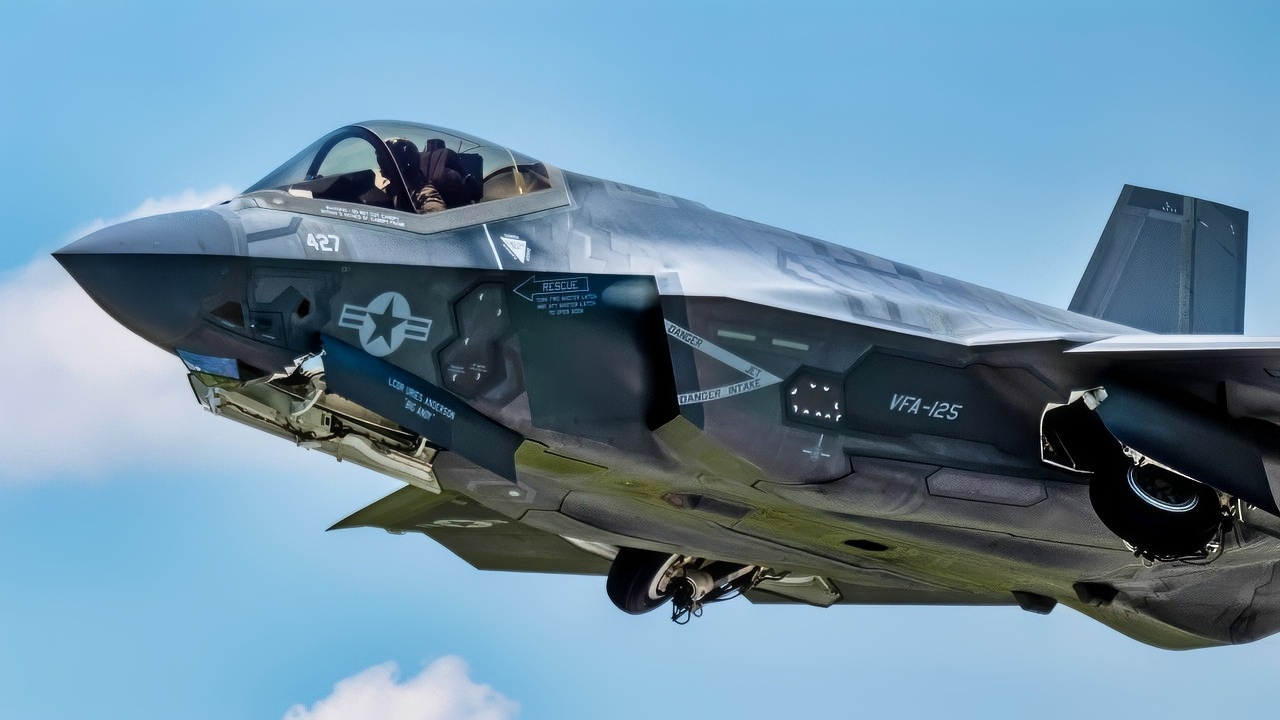
Key Points and Summary – Persistent European fears that the U.S. could use a “kill switch” to disable their F-35 fleets are not grounded in historical precedent.
-The U.S. has a long and reliable record of supporting advanced weapons sold to its allies, with only one rare exception.
-The real drivers of this anxiety are contemporary European politics.
-The “kill switch” narrative is a useful political metaphor that fuels the push for “strategic autonomy,” justifies channeling billions into domestic defense industries instead of buying American, and plays into domestic skepticism about U.S. reliability.
Europe and F-35: A Complicated Relationship and the Kill Switch
Ever since the Europeans signed on to the F-35 program, it has been clouded by one persistent fear: that in some future geopolitical crisis, Washington might seek to exercise leverage by denying software updates or spare parts, thereby rendering the European fleet inoperable.
But where does this geopolitical anxiety come from?
Is it grounded in historical fact (i.e., have there been precedents in which the United States weaponized its control over advanced weapon systems against its allies)?
Or is it fed by more contemporary dynamics, including the domestic politics of sovereignty, the logic of defense-industrial policy, and, above all, the ideal of European strategic autonomy?
The F-35 Fear Justified? History Has Clues
Answering the first question first: what does the historical record of U.S. behavior on so-called “kill switches” tell us about the origins and legitimacy of European concerns over the F-35?
Washington, of course, has transferred some of its most sensitive systems to its allies in the past: from the F-4 Phantom and F-104 Starfighter to various NATO air forces in the 1960s and 1970s, to AWACS to Saudi Arabia in the 1980s, to a long list of other combat aircraft sold to partners and allies.
In almost every case, support for these systems continued uninterrupted, even amid political differences over issues ranging from the Suez Crisis to the Vietnam War to oil policy and beyond.
Even when allies went sharply off-message—as Britain and France did during the Suez Crisis—Washington did not attempt to disable or withhold support for systems already in service.
The Turkish Case and More
The Turkish case in 1974, following Ankara’s intervention in Cyprus, stands out precisely because it was the exception that proved the rule.
Under intense congressional pressure, Washington imposed an arms embargo that temporarily disrupted the flow of spare parts and equipment to Turkey’s armed forces.
Yet it was an extraordinary departure, driven less by a White House decision to coerce an ally than by domestic political backlash on Capitol Hill. Even then, the embargo was eventually lifted to preserve NATO cohesion.
To be sure, in cases of fundamental rupture—such as Iran in 1979—the United States has cut off spare parts and support, but that was the logical result of a partnership collapsing into outright hostility, not a tactical instrument in a transatlantic quarrel. And the more recent case of Afghanistan in 2021, where the abandonment of Afghan airframes without logistical support effectively grounded that country’s fleet, is also not comparable to any conceivable dispute between the U.S. and its European allies.
That was the byproduct of withdrawal from a failing client state, not an intentional denial of support to leverage an ally. The historical record, then, contains only one anomalous case in Turkey, and far from establishing a precedent, it underscores just how rare—and how politically costly—it is for Washington to interrupt support to an ally.
Why the F-35 Makes Europe So Nervous
Now let’s address the second question: if the historical record is so devoid of evidence that Washington has pulled the plug on allied capabilities in the past, then what exactly accounts for the persistent worry among European leaders that the White House could suddenly ground the F-35?
Here, the answer is less historical and more grounded in today’s politics and economics.
More than anything else, these anxieties reflect Europe’s broader sovereignty debate. Dramatizing the dangers of dependence on Washington is political catnip, with leaders across the continent finding it helpful to tell the story of diminished independence in which American control of the F-35’s fate is just the latest piece of evidence.
From Paris to Berlin, the language of vulnerability serves as a convenient proxy to argue that Europe can no longer trust the United States with its own security.
This, in turn, dovetails with the broader strategic debate over the shape and purpose of Europe’s defense. Long in the works, “strategic autonomy” has, in recent years, evolved from academic journals to ministers’ speeches, becoming a battle cry for those who view the continent as needing to stand on its own two feet.
Casting the F-35 as hostage to American goodwill offers political leaders a vivid, easily understood way to illustrate the dangers of this dependency, and a means of reframing the debate over strategic autonomy as not an abstract principle but a concrete necessity. Here, the “kill switch” functions less as a real risk than as a vivid metaphor for Europe’s lack of control.
Nor, of course, should the economic and industrial incentives be discounted. The fact that Washington could prevent European F-35s from flying offers a handy rationale for European leaders to invest heavily in European alternatives, from the Franco-German-Spanish fighter project to efforts to revitalize the Eurofighter or develop drones domestically. Invoking the threat of American leverage also provides political cover to channel billions of euros into European defense industries, which, in turn, can create jobs, provide technological expertise, and yield political dividends.
In that sense, the “kill switch” narrative serves as a discursive smokescreen to justify Europe’s own industrial strategy.
Domestic Politics Matter
Nor, finally, should we ignore the purely domestic political dynamics of this story. Publics across Europe, already skeptical of American reliability after years of political turbulence in Washington, are primed to believe claims that reliance on U.S. military systems leaves them vulnerable. Leaders can both amplify that skepticism and redirect it toward support for national or European defense initiatives.
The result is a kind of feedback loop: anxieties about dependence on Washington reinforce calls for strategic autonomy, which in turn justify investments in domestic industry, thereby entrenching and feeding the narrative of vulnerability. The upshot is that, on the surface, what appears to be a fear of American coercion actually disguises a narrative Europe tells itself to further its own sovereignty, ambitions, and industries.
What Happens Now?
The evidence, then, points to one conclusion: Washington has no tradition of weaponizing its control over advanced weapons systems against its closest allies. The only outlier—the Turkish embargo of 1974—was not the product of a concerted policy of coercion so much as domestic political grandstanding in Washington. And it was short-lived, abandoned at the first sign of NATO’s possible unraveling.
In other words, the exception proves the rule. Europe’s fear of a “kill switch” endures not because history justifies it, but because Europe itself has found the fear useful.
It feeds comforting narratives of sovereignty. It lends weight to the rhetoric of strategic autonomy. It provides cover for shoveling money into European defense industries. The kill switch, then, has never resided in the jet itself. It lives in Europe’s imagination—as a symbol of its unease with dependence and as a justification for its ambitions to break free of it.
And so long as Europe clings to this anxiety, the F-35 will symbolize not American dominance, but Europe’s unfinished struggle to decide what kind of power it truly wants to be.
About the Author: Dr. Andrew Latham
Andrew Latham is a non-resident fellow at Defense Priorities and a professor of international relations and political theory at Macalester College in Saint Paul, MN. You can follow him on X: @aakatham. He writes a daily column for National Security Journal.
Fighter Jet Fails
Russia’s Su-57 Felon Stealth Fighter Is a Waste of Rubles


Enis PINAR
August 26, 2025 at 1:12 am
Prof. Latham, in an effort to make his case, disregards certain inconvenient facts. First, the U.S. does not allow purchasers of the F-35 (except Israel) access to any of the electronic source codes for a plane nicknamed a “Flying computer”. So, buyers have to accept on faith that there is no backdoor “kill switch”.
Second, the good professor glosses over the fact that even in the absence of a “kill switch”, in the event an ally displeases the U.S., all it has to do to slowly disable a nation’s F-35 fleet is simply to stop providing regular upgrades to the software of the purchased planes.
Should anyone scoff at the idea of such a possibility, I would suggest they consider how following the 28 February 2025 contentious televised meeting at the White House between Ukrainian President Volodymyr Zelenskyy and President Trump, how Trump ordered the cut off of all access to satellite intelligence sharing and military aid with Ukraine from approximately March 3 to 11 March 2025 in an attempt to coerce Ukraine into agreeing to a 30-day ceasefire with Russia. This was to a friendly nation in the middle of a war.
Furthermore, with regard to Prof. Latham’s example that “when allies went sharply off-message—as Britain and France did during the Suez Crisis—Washington did not attempt to disable or withhold support for systems already in service” that was in 1956. The fighter planes in service at the time were hardly as dependent on electronic technology as today.
Finally, the author brushes off the Turkish embargo of 1974 as having been “short-lived”. I would like to respectfully remind him that it lasted from February 1975 until October 1978, for over 3½ years. Then, circa 2013 when the Turks sought to purchase our Raytheon Patriot PAC 2 system for their air defense, the U.S. refused to sell it because they had also asked for technology transfer relating to the system which they had been willing to pay $3.5 billion for. So, in 2017 they bought S-400’s from Russia for a billion less. As Shakespeare wrote in his play The Tempest: “Whereof what’s past is prologue”.
Baudouin Dupont
August 26, 2025 at 10:40 am
From a European point of view, this article is laughable. Performance and/or continued supply of US defence technology is not the crux of the matter here.
Despite close cultural and historical traits, there is no reason to think that the interests of the US and those of the EU will always align. Mr Trump has been very able at reminding Europeans of this fact. We have the technical know-how, we have the money to make most of the gear we would need by ourselves. Buying US is a net loss in almost every possible way (strategic, political, industrial, financial etc…).
willful knowledge
August 26, 2025 at 2:03 pm
Trump has been clear that he us skeptical, at best, about NATO. Europe has no reason to trust the US under Trump or any of his adherents.