

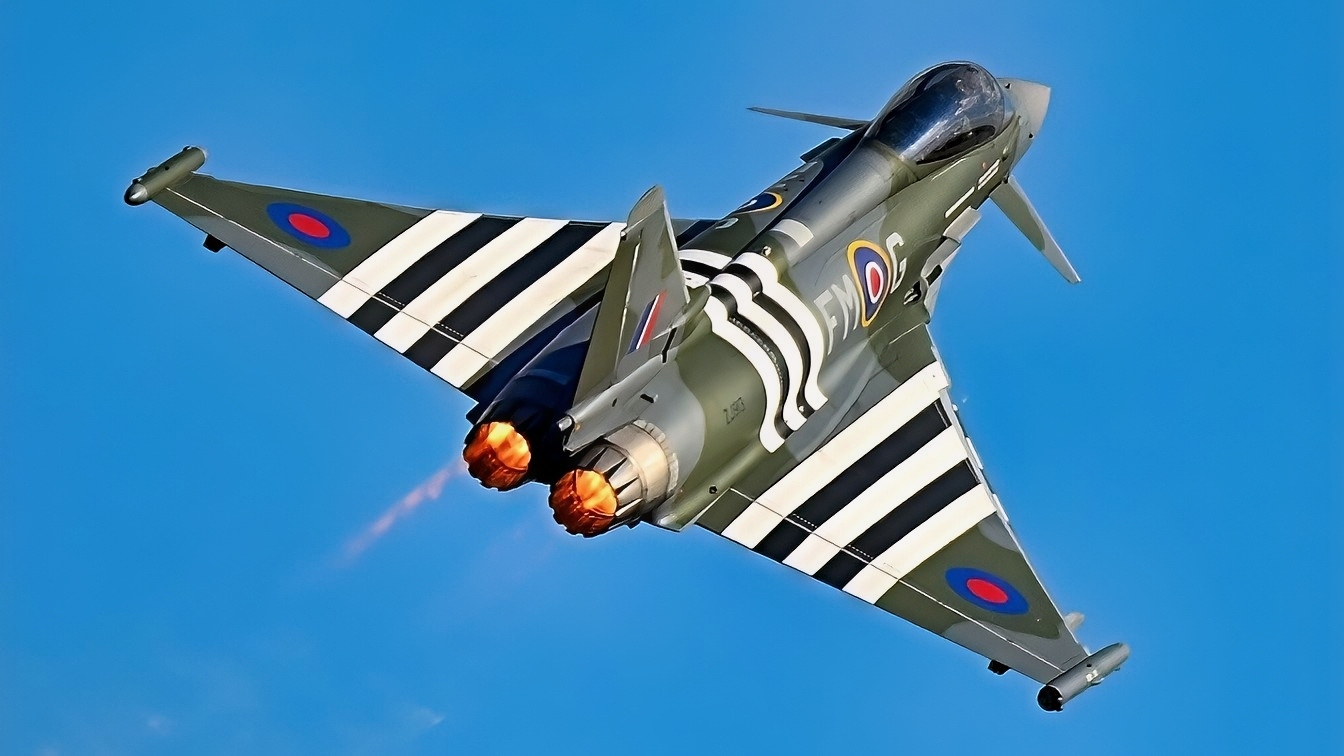
On May 20, 2026, Airbus Defence rolled out the latest Tranche 4 Eurofighter Typhoon for the German Air Force at its Manching facility in Bavaria. More than 600 Typhoons are now in service across 9 operators. The aircraft Britain, Germany, Italy, and Spain built after France walked out of the joint Future European Fighter Aircraft program in 1985 has accumulated genuine combat experience across Libya, Iraq, Syria, Yemen and now Iran. An RAF FGR4 scored Britain’s first military air-to-air kill since the 1982 Falklands War over Syria in December 2021. RAF Typhoons have logged 4 air-to-air kills in the past 18 months. The program now moves into Long-Term Evolution to keep the Typhoon flying through the 2060s.
Eurofighter Typhoon: How Britain, Germany, Italy, And Spain Built A Fighter France Refused To Build With Them — And Why It Is Still Selling In 2026

Eurofighter Typhoon Upgrade. Image Credit: Creative Commons.
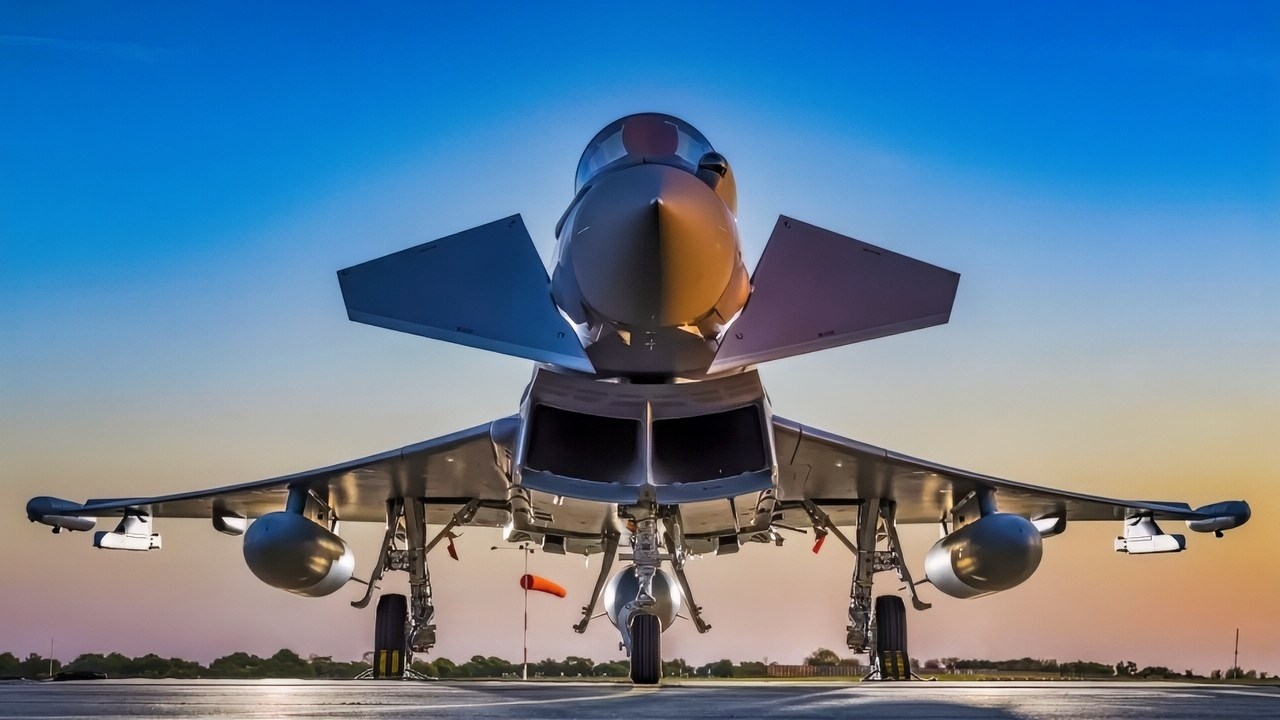
Eurofighter Typhoon on the Runway. Image Credit: Creative Commons.
On May 20, 2026, Airbus Defence rolled out the latest Tranche 4 Eurofighter Typhoon for the German Air Force at its Manching facility in Bavaria. The unveiling was part of the broader Airbus Defence Summit and marked the latest visible step in a fighter program that has, despite predictions of imminent obsolescence stretching back nearly two decades, continued to deliver new airframes, secure new customers, and absorb new combat missions across the past five years.
The Eurofighter Typhoon is not stealthy. It is not a fifth-generation aircraft. It is not the F-35. And it is also not going away anytime soon.
More than 600 aircraft are in service across nine operators. New orders continue to roll in. The Royal Air Force has been running the platform in active combat operations over the Middle East throughout 2024, 2025, and into 2026. Germany is reorganizing 15 of its existing airframes into electronic warfare aircraft. Italy quietly added eight more new-build Typhoons to its order book in May 2026. And the entire program is now entering a Long-Term Evolution upgrade cycle designed to keep the aircraft viable through the 2060s.
The Eurofighter program also has a backstory that explains nearly everything about how the European combat aircraft industry actually works. France was supposed to be part of this aircraft. France walked away. France built the Dassault Rafale instead. Forty years later, the two fighters Europe split into two separate programs are still competing for the same export contracts — and the choice that made them rivals in the 1980s continues to shape European military aviation policy in 2026.

Dassault Rafale Fighter Special. Image Credit: Creative Commons.
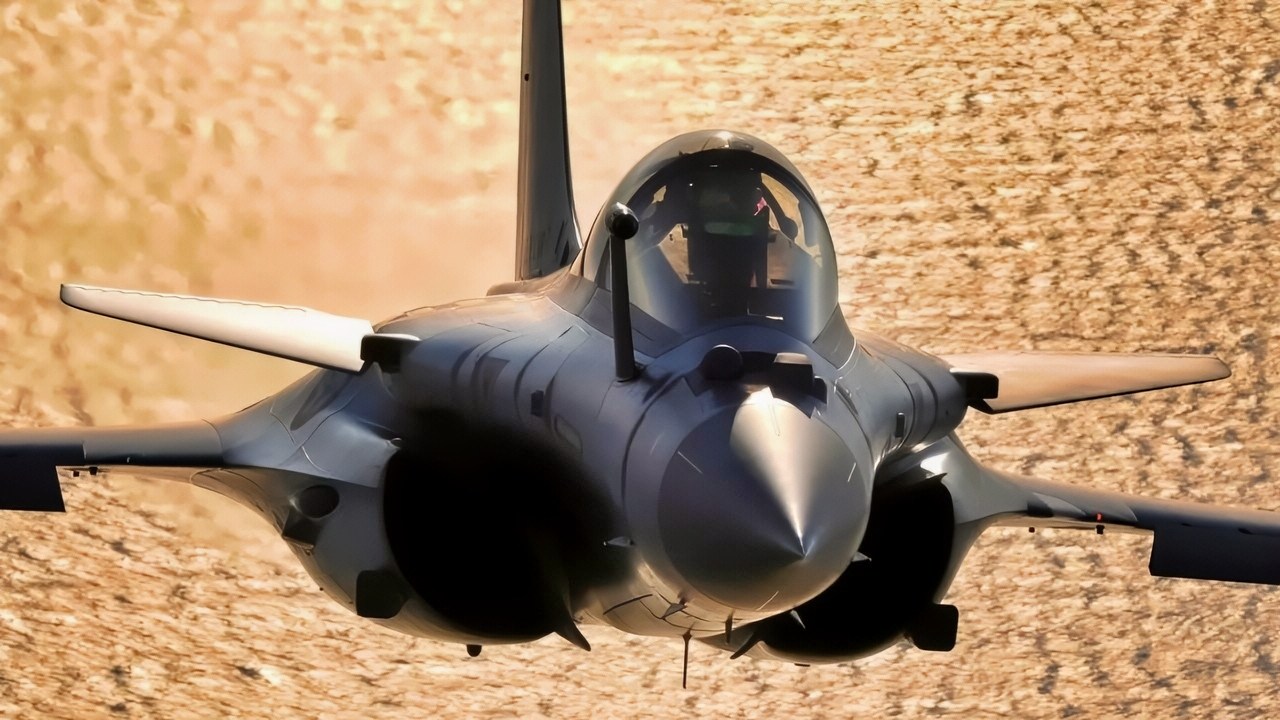
Dassault Rafale Fighter. Image Credit: Rafale.
The Program That France Walked Out Of
The early 1980s defense environment in Western Europe was straightforward. Five major NATO partners — the United Kingdom, France, West Germany, Italy, and Spain — needed a new fighter to replace aging Cold War-era platforms across the next decade. Each country had its own national aerospace champion. Each country had its own set of operational requirements. Each country wanted to maintain domestic industrial capability.
The Future European Fighter Aircraft program was launched in 1983 to do all of those things at once. Five nations would jointly design and produce a single advanced multirole fighter that would replace national legacy fleets and preserve European combat aviation industrial capability across the next generation.
The program survived less than two years.
The core disagreement is well documented: France wanted a lighter, carrier-capable multirole fighter that could operate from French aircraft carriers and perform multiple mission profiles. The other four nations wanted a larger aircraft optimized for air superiority — specifically, intercepting Soviet aircraft at high speed and altitude across central European airspace. Neither side would compromise. France also wanted to lead industrial control of the program — a non-negotiable requirement from Dassault Aviation and the broader French aerospace establishment.
French withdrawal became official in July 1985. The Turin meeting on August 2, 1985, confirmed that the UK, West Germany, and Italy would proceed with what became the Eurofighter program. Spain initially declined but rejoined in early September 1985 under pressure from Madrid’s NATO commitments. France pursued its own program — the ACX, which became the Dassault Rafale — through Dassault Aviation alone.
The split had consequences neither side fully anticipated. France ended up with a sovereign French fighter program with complete national control over design, production, exports, and political decisions about which customers to sell to. The remaining four nations ended up with a multinational consortium that required agreement across four governments and four industrial primes for every major decision — a structure that has produced both the Typhoon’s institutional resilience and its persistent delivery delays across the past four decades.
The consortium itself was formalized in 1986 with the establishment of the Munich-based Eurofighter Jagdflugzeug GmbH and the parallel EuroJet Turbo GmbH alliance combining Rolls-Royce, MTU Aero Engines, Italy’s Avio, and Spain’s ITP for the EJ200 engine program. The workshare arrangement embedded each nation’s industrial share into the program design itself — an architecture that has held essentially constant for forty years.
The first Eurofighter prototype flew on March 27, 1994 — nearly a decade after the original program launch. The first production aircraft entered service in 2003 with the German Luftwaffe and the Italian Air Force, followed by the UK Royal Air Force and the Spanish Air Force across subsequent years.
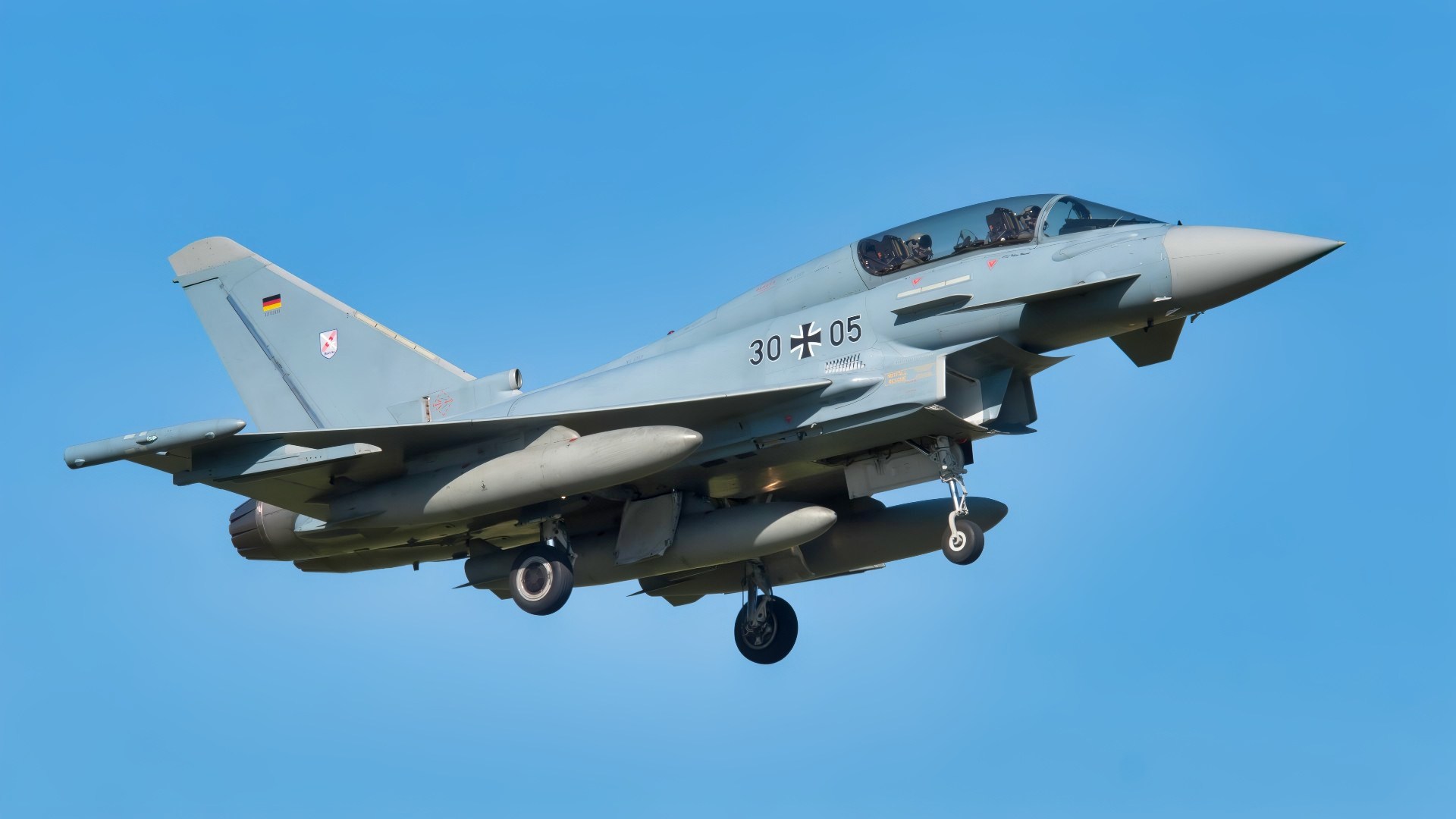
Eurofighter Typhoon Training in Sky. Image Credit: Creative Commons.
Design And What The Aircraft Actually Is
The Eurofighter Typhoon is a twin-engine, canard-delta wing, multirole fighter optimized for air superiority. The aircraft measures approximately 15.96 meters in length with a wingspan of 10.95 meters and a maximum takeoff weight of approximately 23,500 kilograms. Powered by two Eurojet EJ200 turbofan engines each producing approximately 20,000 pounds of thrust with afterburner, the Typhoon achieves a top speed of Mach 2 and a service ceiling of approximately 65,000 feet.
The defining design choice is the canard-delta configuration. The forward canard control surfaces, combined with the delta wing, give the aircraft exceptional high-altitude maneuverability and supersonic performance — a capability that was specifically prioritized for the Cold War air superiority mission against Soviet aircraft at altitude over central Europe. The configuration is also fundamentally unstable in flight, requiring a fully redundant fly-by-wire flight control system to keep the aircraft airborne. The fly-by-wire architecture is one of the most sophisticated in any operational fighter and contributes substantially to the platform’s per-unit cost.
The avionics suite has been progressively upgraded across the four production tranches. Earlier Typhoons used the CAPTOR mechanically scanned radar. Current Tranche 3 and Tranche 4 aircraft are receiving the ECRS Mk0, Mk1, or Mk2 active electronically scanned array radars depending on operator and configuration. The Mk2, developed by UK-led teams under an £870 million contract awarded in July 2023, will be integrated onto RAF Typhoon Tranche 3 aircraft and offered to other Typhoon operators across the program’s installed base. The radar contract supports approximately 1,300 UK engineering jobs across the next decade.
The sensor and weapons suite is built around the Pirate infrared search and track system, the Praetorian Defensive Aids Sub-System integrated electronic warfare suite, and a weapons fit that includes the MBDA Meteor very-long-range air-to-air missile, the ASRAAM short-range air-to-air missile, the Brimstone air-to-ground missile, the Storm Shadow cruise missile, the Paveway IV laser-guided bomb, and the integrated 27mm Mauser BK-27 cannon. The aircraft has 13 hardpoints capable of carrying approximately 9,000 kilograms of external stores.
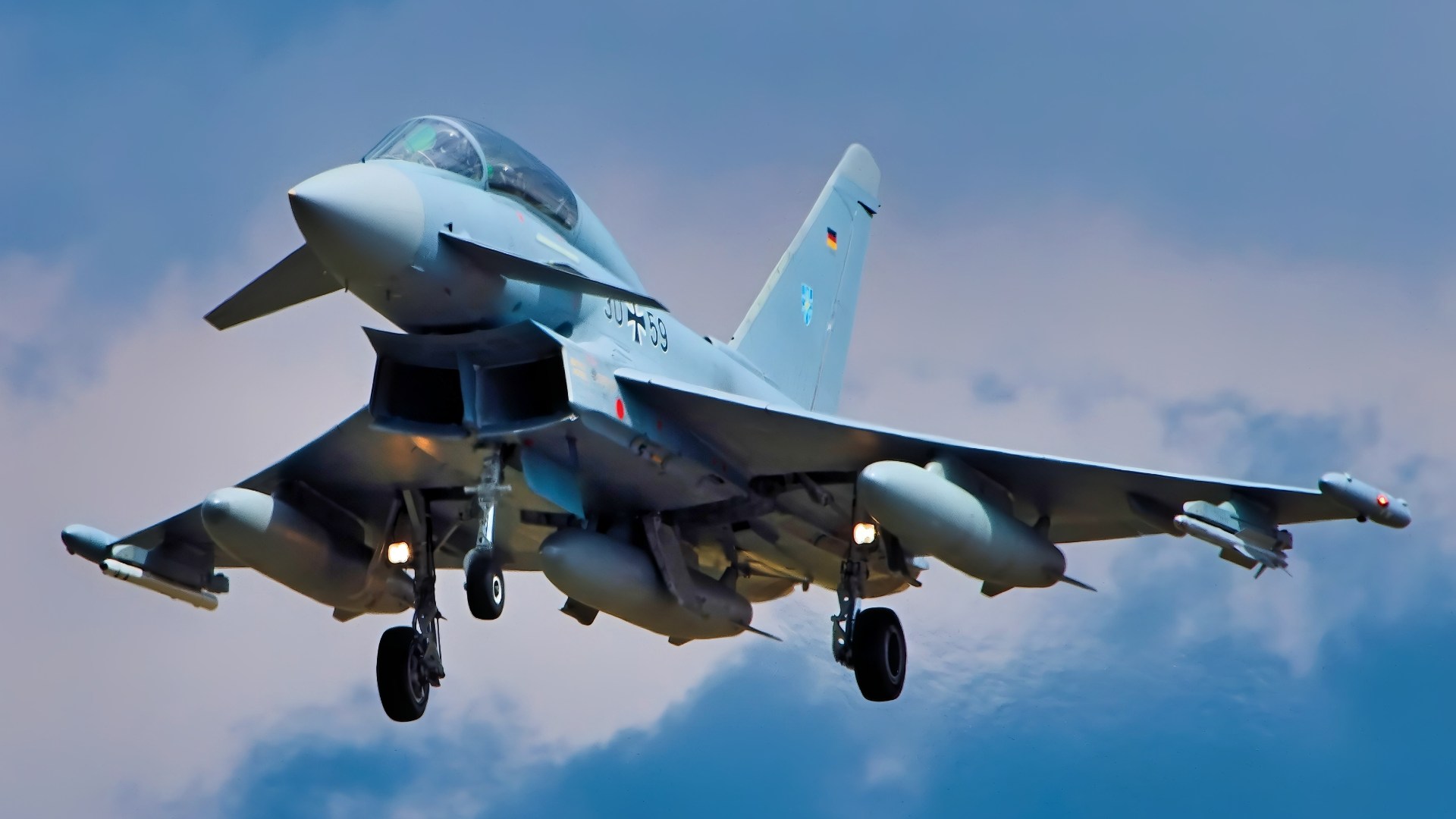
2017 Eurofighter Typhoon. Image Credit: Creative Commons.
The fighter is widely regarded by Western analysts as among the most capable non-stealth air superiority fighters in service. The Meteor missile in particular, with reported range exceeding 200 kilometers, gives the Typhoon beyond-visual-range engagement capability that compares favorably to any contemporary non-stealth fighter on the planet.
Tranches: How The Program Evolved
The Eurofighter Typhoon has been delivered across four production tranches, each substantially more capable than the last.
Tranche 1 was the initial production configuration, with basic air-to-air capability and limited air-to-ground integration. The aircraft were optimized for the air-superiority mission that had originally driven the program and were not yet capable of the full multirole strike capabilities enabled by subsequent tranches.
Tranche 2 brought substantially expanded air-to-ground capability, additional weapons integration, improved avionics, and Block 5 mission system upgrades. Aircraft delivered in Tranche 2 are widely considered the first true multirole Typhoons.
Tranche 3 added the Captor-E AESA radar option, further mission system upgrades, and the structural provisions needed for advanced weapons including Meteor and Storm Shadow. Tranche 3 production also benefited from the ongoing investment by export customers including Saudi Arabia and Oman. The tranche-by-tranche capability breakdown traces the evolution of the platform across all four production blocks.
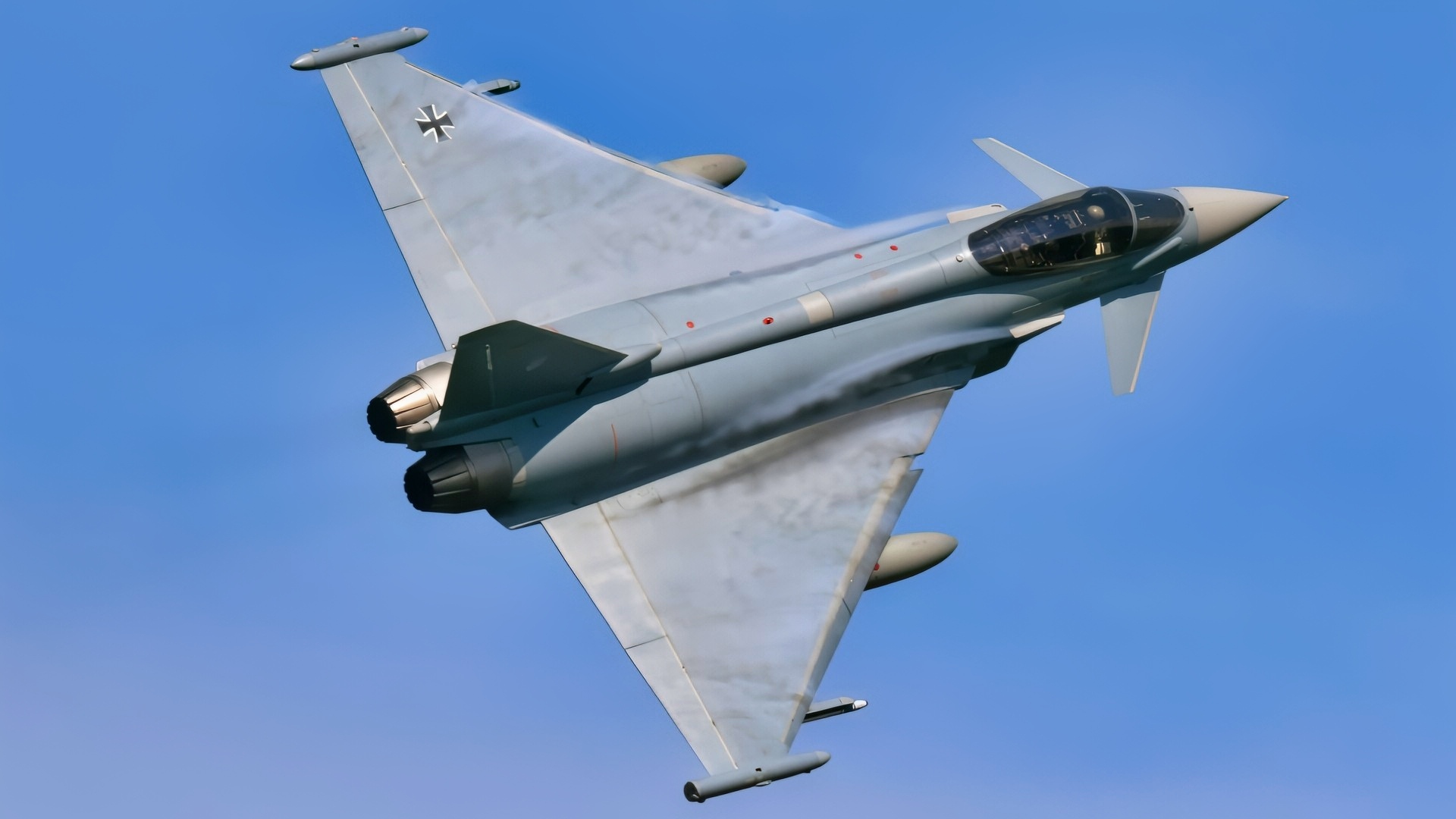
A German Air Force pilot, assigned to the German Air Force Weapons School, conducts strafing runs with an Eurofighter Typhoon in conjunction with U.S. Air Force Joint Terminal Attack Controller assigned to 2d Air Support Operations Squadron identifying targets on the ground at the 7th Army Training Command’s Grafenwoehr Training Area, Germany, June 9, 2021. (U.S. Army photo by Gertrud Zach)
Tranche 4 is the current production standard. Germany’s Quadriga program is delivering 38 single-seat and 8 two-seat Tranche 4 aircraft to the Luftwaffe between 2025 and 2030 to replace early Tranche 1 jets, with the deal valued at approximately €5.4 billion. Spain’s Halcón I and Halcón II procurements are bringing approximately 45 additional Tranche 4 aircraft into Spanish Air Force service across the same window. Italy added 8 additional Tranche 4 Eurofighters to its order book in early 2026, a deal formalized through Leonardo’s Q1 2026 financial results released in May 2026.
The May 20, 2026 Airbus rollout of the latest Tranche 4 standard for the German Air Force is the most visible recent program milestone. Coverage of the German Tranche 4 unveiling details how the Luftwaffe configuration includes the Hensoldt ECRS Mk1 AESA radar — different from the UK ECRS Mk2 — plus the new Large Area Display that replaces the previous three 6-by-6-inch multifunction head-down displays with a single 12-by-22-inch panoramic cockpit display. Falling outside the Quadriga scope but tracked as a parallel German priority is the plan to transform 15 existing Luftwaffe Eurofighters into electronic warfare aircraft equipped with the Saab Arexis EW suite and the AGM-88E Advanced Anti-Radiation Guided Missile.
The Long-Term Evolution program is the umbrella effort that ties these national configurations together. The broader LTE contract structure covers cockpit modernization, mission computing upgrades, flight control computer improvements, communications equipment, and armament control system enhancements across the four core nations’ fleets. The stated objective is to keep the Eurofighter operationally viable into the 2060s and to position the platform as a bridge to sixth-generation fighter technology.
Operational History And Combat Record
The Typhoon entered RAF service in 2003 and Italian Air Force service the same year. Initial deployments focused on air policing and quick reaction alert missions over the UK, Germany, Italy, and Spain. The aircraft also assumed primary air defense responsibility for NATO’s eastern flank operations, including Baltic Air Policing missions over Estonia, Latvia, Lithuania, and Poland; Iceland Air Policing deployments; and routine intercepts of Russian Tu-95 Bear bombers and other long-range aircraft probing NATO airspace across the North Sea and the Mediterranean.
Combat debut came in March 2011 in Libya. The RAF and the Italian Air Force deployed Typhoons in support of NATO Operation Unified Protector, enforcing the no-fly zone over Libya during the campaign that ultimately ended the Gaddafi regime. The aircraft conducted aerial reconnaissance, no-fly zone enforcement, and precision strike missions against Libyan ground targets — the first time the Typhoon had been used in the multirole strike configuration that subsequent tranches expanded.
The most consequential combat record came after 2014. Typhoons from the RAF, the Royal Saudi Air Force, and other operators conducted extensive operations against Islamic State targets in Iraq and Syria across 2015 and the following decade. The UK’s Operation Shader saw RAF Typhoons fly thousands of strike sorties using Paveway IV laser-guided bombs and Brimstone air-to-ground missiles. The Royal Saudi Air Force was the first operator to employ Paveway IV from a Typhoon airframe during strikes against ISIS in 2015. Saudi Typhoons were also used extensively in the Yemen conflict against Houthi targets across the Yemeni civil war.
The Typhoon’s first air-to-air engagement came in December 2021 over Syria, when an RAF FGR4 shot down a small hostile drone with an ASRAAM missile. The engagement was the first British military air-to-air kill since the 1982 Falklands War.
Air-to-air activity has expanded substantially since 2024. RAF Typhoons participated in the air defense operations during the Iranian drone and missile attacks against Israel in April 2024, shooting down multiple Iranian Shahed-136 unmanned aerial vehicles during the engagements. The pattern continued into 2025, with additional Shahed interceptions across the Middle East. In November 2025, an RAF official disclosed that Typhoon FGR4 aircraft had recorded four air-to-air kills across an eighteen-month period — exceeding the platform’s entire previous combat record.
The 2026 Iran Crisis has put the Typhoon into the most operationally demanding combat environment of its program life. RAF, Luftwaffe, and Italian Air Force Typhoons deployed to Cyprus, Qatar, and other Middle East locations have flown sustained air defense patrols, intercepted Iranian drones approaching coalition bases, and supported the broader Operation Epic Fury campaign in conjunction with U.S. Navy and Air Force assets. Operation Eastern Sentry — the German Luftwaffe’s contribution to NATO air policing along the eastern flank — has expanded Typhoon presence across Romania, Bulgaria, and Estonia as the war in Ukraine continues and the broader European security environment deteriorates.
Operators And The Export Market
The Eurofighter program currently has nine operators across Europe and the Middle East. The four core consortium nations — the United Kingdom, Germany, Italy, and Spain — fly the largest fleets. Saudi Arabia, Austria, Oman, Kuwait, and Qatar are export operators. Turkey signed a 2025 deal for 12 Eurofighter Typhoons, becoming the program’s newest customer.
The Eurofighter-Rafale rivalry that has defined European combat aircraft sales for the past two decades sees both aircraft competing head-to-head in nearly every export campaign on the planet. The Rafale has won contracts in India, Egypt, Qatar, Greece, Croatia, Indonesia, the UAE, and Serbia. The Eurofighter has won contracts in Saudi Arabia, Oman, Kuwait, Austria, and now Turkey. Some markets — Qatar most notably — have ordered both aircraft, hedging across the two European options.
Institutional differences matter in export competition. France can sell the Rafale on Paris’s sole authority, with no requirement for partner approval. Eurofighter exports require consensus among the four consortium governments — and have been blocked or delayed multiple times due to German parliamentary objections to Saudi Arabia, the United Arab Emirates, and other customers. The consortium structure that gave Eurofighter its multinational institutional resilience also gave it a structural export disadvantage that France has consistently exploited across the past two decades.
The Future: LTE, Tranche 5, And The Sixth-Generation Question
The Eurofighter program faces the same structural challenge that every fourth-generation Western fighter program is now confronting. The F-35 has captured most of the fifth-generation market. The F-47, the GCAP, and the FCAS sixth-generation programs are in development. The Chinese J-20, J-35A, and Russian Su-57 represent the next generation of threats the aircraft was not originally designed to engage.
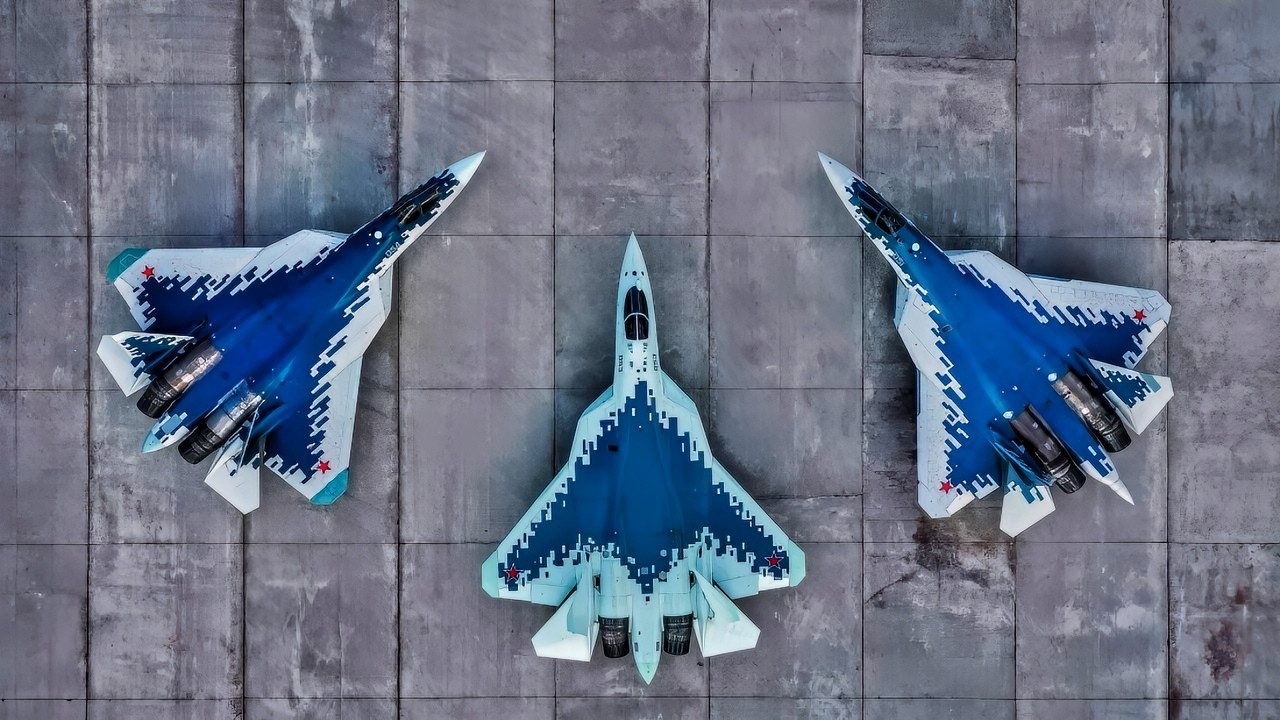
Su-57 Felon Screengrab from Russia. Image Credit: X Screengrab.

Su-57 Felon Stealth Fighter Taking Off. Image Credit: Creative Commons.
The consortium’s answer is Long-Term Evolution. The four-core-nation umbrella program covers Eurofighter modernization through the late 2020s and into the 2030s. Cockpit upgrades. New mission and flight control computers. Improved communications and electronic warfare suites. Enhanced sensor integration. The Tranche 5 procurement decision — a follow-on production run beyond the current Tranche 4 deliveries — is the parallel question German, Spanish, Italian, and British defense ministries are still working through.
The strategic case for Tranche 5 is industrial. German Eurofighter production is currently scheduled to end in 2030 with the last Tranche 4 delivery. Without a follow-on order, German combat aircraft manufacturing capability would face a 10-year gap before the Future Combat Air System reaches initial operational capability around 2040. The same industrial calculus applies in Britain, Italy, and Spain. A Tranche 5 commitment would preserve the European combat aviation industrial base across the transition to FCAS, the GCAP, and other sixth-generation efforts.

GCAP 6th Generation Fighter.
The strategic case against Tranche 5 is operational. Every euro spent on additional fourth-generation Typhoons is a euro not spent on the sixth-generation programs that are the long-term future of European combat aviation. F-35 procurement competes with Typhoon procurement for the same finite tactical aircraft budget. And the survivability calculus for non-stealth fighters in contested airspace against modern Chinese and Russian air defenses continues to favor stealth platforms over even the most capable fourth-generation aircraft.
The current consortium consensus appears to be a combination of both — continue Tranche 4 production through 2030, commit to LTE upgrades for the existing fleet, evaluate Tranche 5 procurement on a national basis, and use the program to bridge the gap between current operational requirements and the sixth-generation FCAS and GCAP programs that will eventually replace the Typhoon in the 2040s.
What The Typhoon Actually Means
The Eurofighter Typhoon is not the most advanced fighter in service. It is not stealthy. It does not match the F-22 or the F-35 in survivability against peer threats. The platform’s defenders openly concede all of these limitations.
What the Typhoon is, is the European combat aircraft program that actually worked. The four-nation consortium has held together for 40 years. The aircraft has been continuously upgraded across four tranches. It has secured export customers in every region the program has actively pursued. It has accumulated genuine combat experience across Libya, Iraq, Syria, Yemen, and now Iran. Its institutional knowledge base — the pilots, the maintainers, the supplier base, the multinational program management — is the foundation on which the FCAS and GCAP sixth-generation efforts will eventually build.
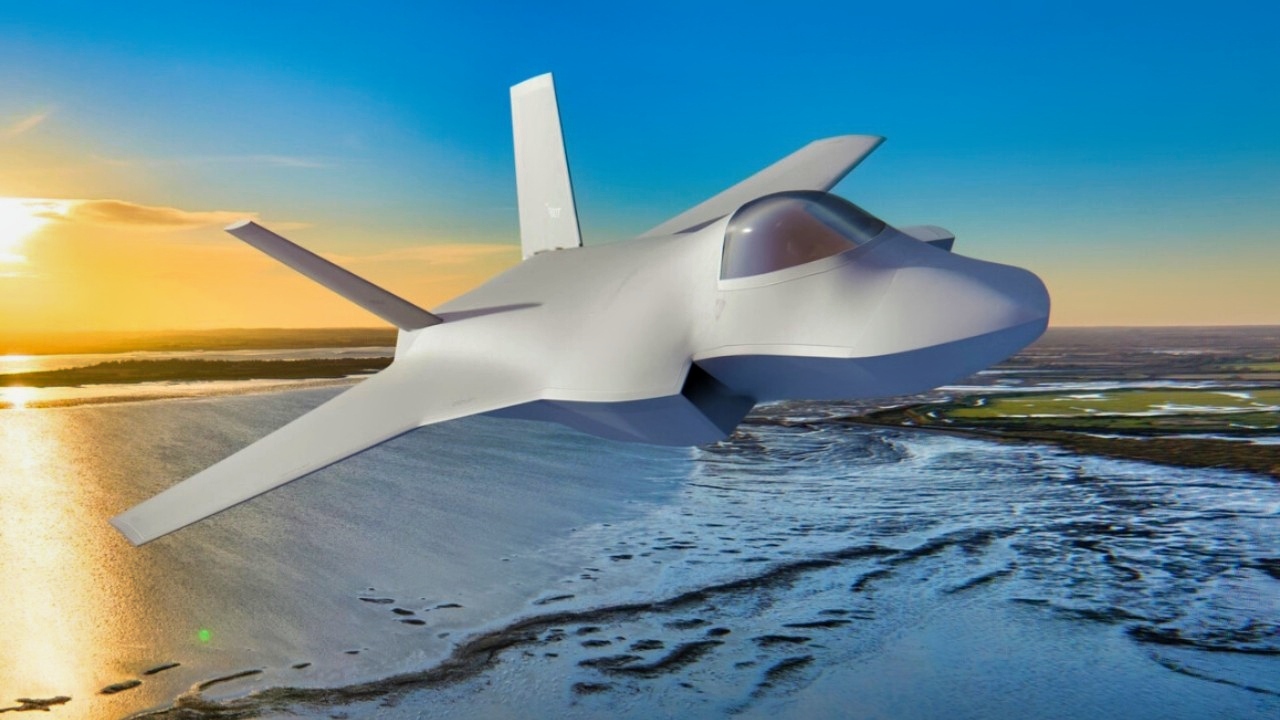
Tempest Fighter from BAE Systems.
The Tranche 4 aircraft Airbus unveiled in Manching on May 20, 2026, is not the most exotic combat aircraft Europe is currently developing. It is the aircraft Europe is currently flying. And by every credible projection, it will remain the dominant European combat platform across most NATO operators through the 2030s and into the 2040s, until the sixth-generation programs finally arrive to replace it.
About the Author: Harry J. Kazianis
Harry J. Kazianis (@Grecianformula) was the former Senior Director of National Security Affairs at the Center for the National Interest (CFTNI), a foreign policy think tank founded by Richard Nixon based in Washington, DC. Harry has over a decade of experience in think tanks and national security publishing. His ideas have been published in the NY Times, The Washington Post, The Wall Street Journal, CNN, and many other outlets worldwide. He has held positions at CSIS, the Heritage Foundation, the University of Nottingham, and several other institutions related to national security research and studies. He is the former Executive Editor of the National Interest and the Diplomat. He holds a Master’s degree focusing on international affairs from Harvard University.


