

Ukraine Needs Help with Missile Defense Right Now: In an unprecedented move, Ukraine’s President Volodymyr Zelenskiy has urged US President Donald Trump to help his nation by providing more air defense systems and interceptor missiles. His request comes as Russia has threatened waves of new strikes on the capital Kyiv and other cities. Ballistic missiles, said the Ukrainian leader, are Moscow’s “last major advantage on the battlefield.”
Zelenskiy’s appeal came in the form of a letter sent directly to Trump and the US Congress, and which was shown to the Reuters news agency. In the letter, Zelenskiy says to the US president and lawmakers, “I ask for your help in protecting Ukraine’s skies from Russian missiles. We have already proposed that Ukraine is ready to purchase the number of Patriot systems and interceptor missiles we need.”

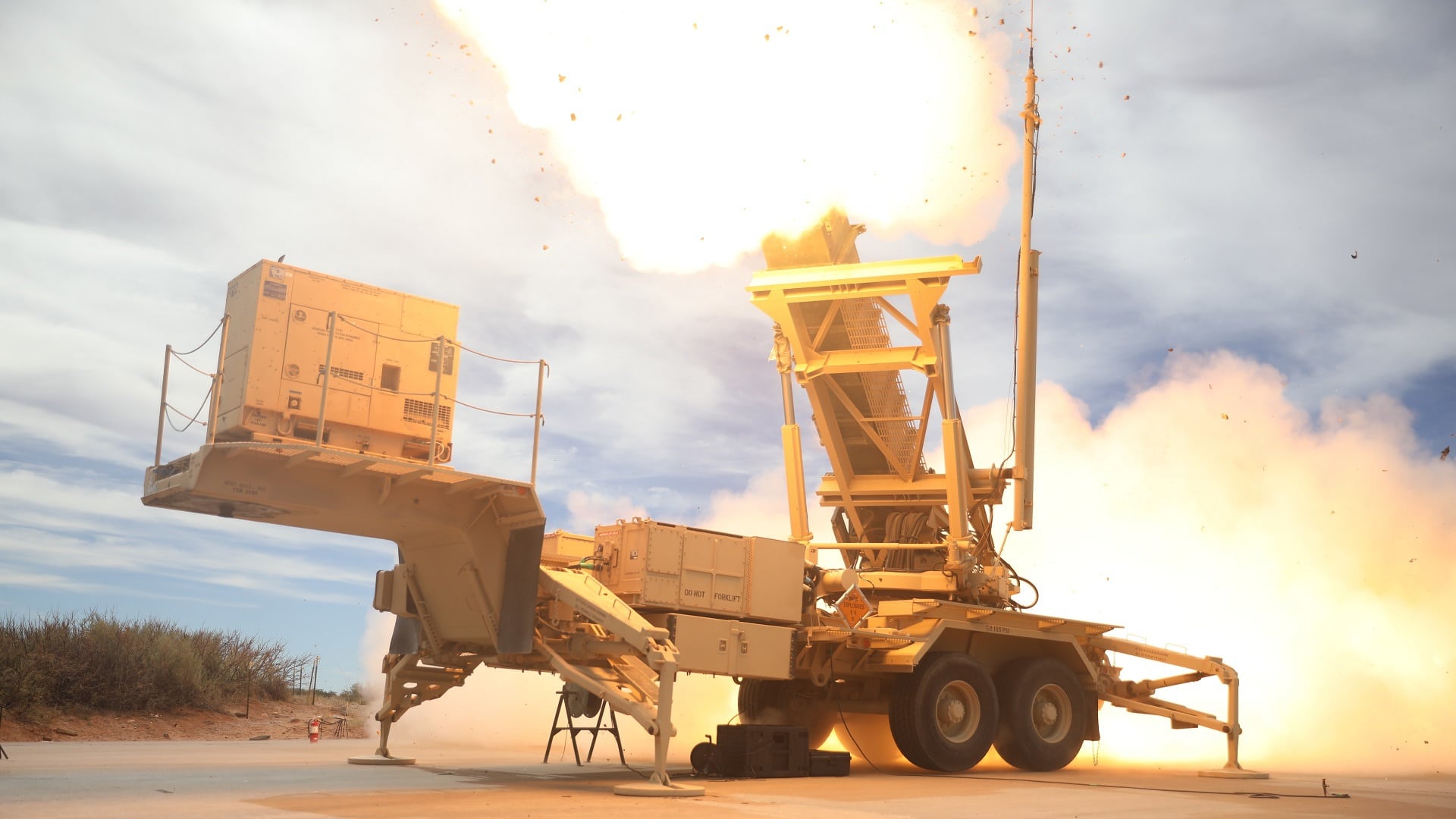
Exercise Artemis Strike is a German-led tactical live fire exercise with live Patriot and Stinger missiles at the NATO Missile Firing Installation in Chania, Greece from Oct. 31-Nov. 09. Over 200 U.S. soldiers and approximately 650 German airmen will be participating in the realistic training within a combined construct, exercise the rigors associated with force projection and educate operators on their air missile defense systems. The 10th Army Air Missile Defense Command will deploy, operate and fire live missiles within a tactical scenario, under Supreme Headquarters Allied Powers Europe operational readiness evaluation criteria.

German soldiers assigned to Surface Air and Missile Defense Wing 1 fire the Patriot weapons system at the NATO Missile Firing Installation (NAMFI) during Artemis Strike Nov. 7 in Chania, Greece. Artemis Strike is a German-led multinational air defense exercise. German soldiers Over 200 U.S. soldiers and approximately 650 German airmen will be participating in the realistic training within a combined construct, exercise the rigors associated with force projection and educate operators on their air missile defense systems. (Photo By Officer Candidate Sebastian Apel, Air Defence Missile Group 24)
Ukraine has been provided with dozens of different US and European air defense systems since Russia’s February 2022 invasion. Most of these are capable of taking out the one-way suicide drones, cruise missiles, and other air-launched or aerodynamic weapon systems fired by Russia at Ukrainian cities.
However, the high-speed ballistic missiles that Russia has been using to target cities can often only be shot down by the US-made Patriot Air and Missile Defense System (PAC-3). Kyiv finally received its first PAC-3 battery in April 2023, provided by Germany, one of the system’s export customer countries.
Requirements and Providers
Thus far, a coalition of nations has been providing Patriot systems from their own arsenals. Ukraine’s military does not publicly confirm these numbers, but according to records, the United States and Germany have directly provided at least two complete systems.
In addition, Romania has pledged and deployed one full battery, Germany and the Netherlands have supplied one combined/composite Patriot battery, and the Netherlands additionally delivered a partial system – radar units and launchers that were provided to support the broader Patriot network.
These PAC-3 systems have been critical to the defense of numerous important facilities in Ukraine. Additionally, in 2024, the system was used to shoot down one of the Russian Aerospace Forces (VKS) Beriev A-50 airborne and early warning command aircraft.
The A-50 is one of the most valuable and vital assets operated by the Russian forces, which has only a few in its inventory. This aircraft, along with other A-50s that have been brought down, is a significant loss for Moscow.
The crews that were lost take an incredible amount of time to train – more than a year in some cases – and, due to sanctions on the import of electronic systems, Russian industry is reportedly unable to modernize its existing aircraft to the latest configuration.
But even with these successes, Ukraine’s military says it would still require another 10 to 25 full-up Patriot systems to adequately cover the nation’s entire territory.

Image Credit: Creative Commons. Image is of a Russian missile being tested.
Missile Shortages in Ukraine
But even as Ukraine eventually acquires more Patriot batteries, there remains another more pressing problem. Ever since acquiring the PAC-3 system, Ukraine has struggled to maintain a steady supply of interceptor missiles. During the more than four years of war, Kyiv has been perennially short of these missiles.
But the situation becomes worse. The high usage rates of the Iran war have brought the number of these missiles that are available worldwide down to historically low levels.
Of the different missiles fired by the PAC-3, the Lockheed Martin (LM) Missile Segment Enhancement (MSE) interceptor is the top-end of the PAC-3 system. It is also the only one capable of intercepting incoming Russian ballistic missiles. Demand for the MSE has been soaring over the past 3 years, yet its production has remained lethargic at 500 per annum ever since Ukraine received its first PAC-3 battery.
The Iran war then came along – and at the worst possible time. Thus far, around 5,000 rounds of various munitions have been fired in that conflict, and that number includes 18 months’ worth of MSE production used up in just four days.
Overall, the number of MSE and other Patriot system missiles fired in these same four days exceeds those expended in more than three years of war in Ukraine. Russia used 30 ballistic missiles against Ukraine in its latest massive strike on Sunday, 24 May, and only 11 of them were shot down, according to Ukraine’s Air Force (PSU).
“The sooner we can provide greater protection against ballistic missiles, the faster we can ensure that diplomacy works,” Zelenskiy’s letter reads. “As long as Russia relies on missiles, its interest in diplomacy is not genuine. We must correct this, and we can only correct it together, with America.”
“But as long as Putin still has even one meaningful advantage in conventional weapons, he will avoid conventional diplomacy. Today, his ballistic missiles remain exactly that — his last major advantage on the battlefield,” Zelenskiy’s letter added.
About the Author: Reuben F. Johnson
Reuben F. Johnson has thirty-six years of experience analyzing and reporting on foreign weapons systems, defense technologies, and international arms export policy. Johnson is the Director of Research at the Casimir Pulaski Foundation. He is also a survivor of the Russian invasion of Ukraine in February 2022. He worked for years in the American defense industry as a foreign technology analyst and later as a consultant for the U.S. Department of Defense, the Departments of the Navy and Air Force, and the governments of the United Kingdom and Australia. In 2022-2023, he won two awards in a row for his defense reporting. He holds a bachelor’s degree from DePauw University and a master’s degree from Miami University in Ohio, with a specialization in Soviet and Russian studies. He lives in Warsaw.


