


Last year, I walked into the National Museum of the U.S. Air Force outside Dayton, Ohio, and stood close to the batwinged shape of a B-2 Spirit, and I have the video and photos below to prove it. The aircraft on display there is the only public B-2 anywhere in the world, a stealth bomber so far ahead of its time that the United States can afford to retire one example to a museum exhibit while a fleet of operational Spirits still flies. That is the backdrop against which China’s H-20 has to be measured. Beijing first acknowledged it was building a stealth bomber to rival the B-2 back in 2016, and a full decade later, no one outside a handful of Chinese facilities has confirmed seeing the thing fly. The United States has stealth bombers to spare.
China cannot field even one.
H-20 Stealth Bomber: A Decade Of “Coming Soon”
The H-20’s defining feature, after ten years, is the gap between what has been promised about it and what has actually appeared.
The program emerged into public view around 2016 as China’s bid to build a long-range flying-wing bomber, the missing leg of a true strategic triad, and a rough analog to the American B-2.

B-2 Spirit Stealth Bomber At USAF Museum. Image Credit: Harry J. Kazianis/National Security Journal.
Since then, it has become one of the most reliably anticipated aircraft in the world, repeatedly described as nearly ready and repeatedly failing to materialize.
The pattern of missed debuts is by now almost comic in its consistency. The development of a next-generation stealth bomber was first acknowledged in 2016, but no official first-flight or entry-into-service date has ever been set.
A widely expected unveiling tied to the People’s Republic’s 70th-anniversary celebrations in 2019 came and went with nothing. Reports in Chinese state-controlled media in 2022 suggested the aircraft was close to its maiden flight, and again no confirmation followed. In 2024, a senior PLAAF officer offered yet another prediction that the bomber would appear coming “very soon,” a forecast that quietly faded like the ones before it. Each cycle followed the same arc: a burst of optimistic signaling, a flurry of speculation, and then silence.
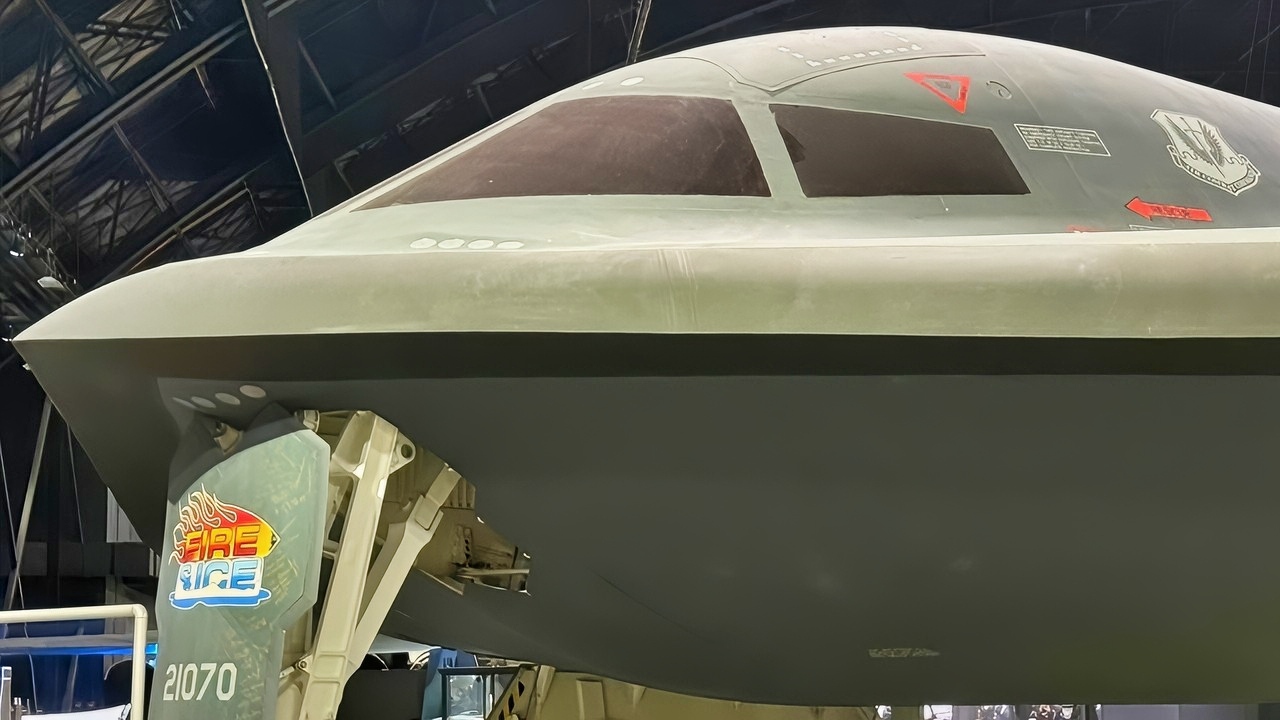
The Mighty B-2 Spirit Stealth Bomber. Image Credit: National Security Journal.
What makes the silence conspicuous is its timing. The official Chinese messaging that the H-20 was imminent had been a recurring feature of the late 2010s, but that drumbeat largely subsided over the past year or so, even as China rolled out a stream of other high-profile aviation programs.
A country that has been eager to show off new fighters, drones, and naval hardware has gone quiet on the one platform it once trumpeted, and, in this context, quiet tends to signal trouble rather than triumph.
What The H-20 Is Supposed To Be
To understand why the delay matters, it helps to understand what China intended the aircraft to do, because the ambition is enormous. The H-20 is envisioned as a subsonic flying-wing bomber built around a low radar cross-section, advanced composite materials, and internal weapons bays that conceal its ordnance to preserve stealth, the same broad design philosophy that produced the B-2 and its successor, the B-21 Raider.
The projected numbers are what give the program its strategic weight. A U.S. assessment indicated the H-20 would have a range exceeding 10,000 kilometers, enabling the PLAAF to cover the Second Island Chain and reach into the western Pacific, with that reach extendable across the globe using aerial refueling.

H-20 Bomber Mock Up. Image Credit: Creative Commons.

H-20 Bomber from China. Image Credit: Creative Commons.
Other reporting on the projected specifications points to a payload in the range of 30 to 45 tons and the ability to carry conventional precision-guided munitions, gravity bombs, hypersonic cruise missiles, and nuclear weapons, which would make it five times more capable than the H-6K, the aging bomber that currently anchors China’s strategic aviation. A platform like that would, in theory, hand Beijing a credible nuclear second-strike option from the air and the ability to hold Guam, Hawaii, and potentially parts of the continental United States at risk.
The keyword in all of it is “projected.” Every one of those figures is a reported estimate or a design aspiration, not a measured performance number from a flying aircraft, because there is no confirmed flying aircraft to measure. The H-20 exists, for now, as a set of impressive specifications attached to a plane the world has never seen take off.
The Engineering Wall
The reason the H-20 has stalled is not a lack of Chinese ambition or money. It is that building a true intercontinental flying-wing stealth bomber is one of the hardest problems in all of aerospace, a problem only the United States has ever fully solved.
The flying-wing configuration that gives the B-2 its stealth also makes the aircraft inherently unstable and brutally difficult to control, demanding fly-by-wire systems and aerodynamic refinement at the outer edge of what is achievable. Layer onto that the requirement for genuine all-aspect, broadband stealth, and the challenge multiplies.
Two specific hurdles recur in assessments of the program: stealth materials and engine performance. Producing radar-absorbent coatings and structures that work across the full spectrum, and doing so on an airframe large enough to cross oceans, is a materials-science problem of the first order.
Powering that airframe with engines that are both efficient enough for intercontinental range and refined enough to avoid compromising the aircraft’s low-observable profile is another challenge. The reported engineering hurdles in stealth materials and engine performance are precisely the areas where China’s aviation industry has historically lagged, and they are not problems that yield to brute force or reverse-engineering.
The B-2 took the United States, with the most advanced aerospace base on earth, years and enormous expense to perfect, and even then only 21 were ever built. China is attempting to clear the same bar from a standing start.

B-2 Bomber from U.S. Air Force Display. Image Credit: Harry J. Kazianis/National Security Journal.
In 4 Words: “Just Not There Yet”
The most authoritative recent read on where the H-20 actually stands comes from the officer responsible for America’s own bombers. General Stephen Davis, the head of U.S. Air Force Global Strike Command, addressed the program directly in an interview, and his assessment was as plain as it was pointed.
He acknowledged that China is pursuing long-range strike aggressively and understands perfectly well why Beijing wants the capability, but on the question of whether it has arrived, his verdict was blunt: the Chinese are “just not there yet.”
Davis characterized the People’s Liberation Army’s bomber arm as a regional force rather than a true intercontinental strategic one, and the supporting evidence backs him up. China’s demonstrated bomber reach still rests on the H-6 family, an updated descendant of a 1950s Soviet design that flies missions beyond the First Island Chain and around Taiwan but cannot operate in genuinely contested airspace the way a stealth bomber must.

China’s H-20 Stealth Bomber. Image Credit: Creative Commons.
The Pentagon’s own assessment of Chinese military power noted that of China’s currently fielded systems, it is the DF-26 intermediate-range ballistic missile and the H-6N’s air-launched ballistic missile that represent its most precise theater strike options, weapons suited to regional rather than global missions.
That is the strategic reality the H-20 was meant to change, and it has not changed it, because the H-20 is not yet real in any operational sense. U.S. intelligence now assesses that the bomber may not debut until sometime in the 2030s, a timeline that has quietly replaced the “coming soon” of years past.
The Phantom Sightings
The information vacuum around the H-20 has been periodically filled by grainy images and unverified footage that surface on Chinese social media and set off rounds of speculation. None of it has resolved the basic question of whether a flyable bomber exists.
Alleged H-20 test-flight footage circulated in early 2025, and various photographs purporting to show the aircraft have appeared over the years, but these sightings cannot be independently verified as depicting a next-generation stealth bomber, and even if authentic, they leave unclear what stage the program has actually reached.
The confusion has been compounded by China’s genuine and rapid progress on other flying-wing designs, which gets repeatedly mistaken for the bomber. When a large stealthy flying-wing aircraft design surfaced, and some outlets reported it was the H-20, more careful analysis suggested otherwise.
The War Zone assessed that the new flying wing was likely a drone, perhaps for intelligence, surveillance, and reconnaissance, rather than the H-20 itself, something closer in concept to the secretive American RQ-180. China is unmistakably building advanced uncrewed flying wings. That is not the same as fielding a crewed intercontinental stealth bomber, and the tendency to conflate the two has helped sustain the impression of H-20 progress that the hard evidence does not support.
The B-2 Over Iran
While the H-20 remained grounded in speculation, the aircraft it was designed to rival demonstrated exactly what a mature stealth bomber can do.
During the 2025 and 2026 operations against Iran, American B-2 Spirits flew the kind of mission the H-20 exists only to imagine. In Operation Midnight Hammer, B-2s dropped 30,000-pound bunker-busters on Iran’s hardened, deeply buried nuclear facilities, and the aircraft later flew in Operation Epic Fury as well, delivering precision penetrating munitions against targets no other platform could reach. The bombers struck and returned without loss, a live demonstration of penetrating stealth strike at intercontinental distance.

U.S. Airmen from the 393d Bomber Generation Squadron inspect and secure protective covering on the B-2 Spirit stealth bomber at Whiteman Air Force Base, Mo., July 25, 2024. Crew chiefs directly support the B-2 by inspecting and maintaining it daily to ensure its mission ready at a moment’s notice. (U.S. Air Force photo by Airman 1st Class Bryce Moore)
For Beijing, the lesson was pointed. American officials reported that Chinese observers were closely monitoring operations to study U.S. stealth performance, and the unchecked effectiveness of the B-2 reportedly sharpened China’s sense of urgency to close the gap. But urgency is not capability. The B-2 over Iran did exactly what the H-20 was conceived to do and still cannot, and it did so with a 1990s-era airframe that the United States is already preparing to supplement with the next generation.
The forthcoming B-21 Raider is expected to increase survivability and integrate into networked joint strike operations, and it is moving toward service even as the H-20 remains stuck at the starting line. The gap China is trying to close is not holding still; it is widening.

U.S. Air Force Airmen with the 912th Aircraft Maintenance Squadron prepare to recover the second B-21 Raider to arrive for test and evaluation at Edwards AFB, Calif., Sept. 11, 2025. The arrival of a second test aircraft provides maintainers valuable hands-on experience with tools, data and processes that will support future operational squadrons. (U.S Air Force photo by Kyle Brasier)
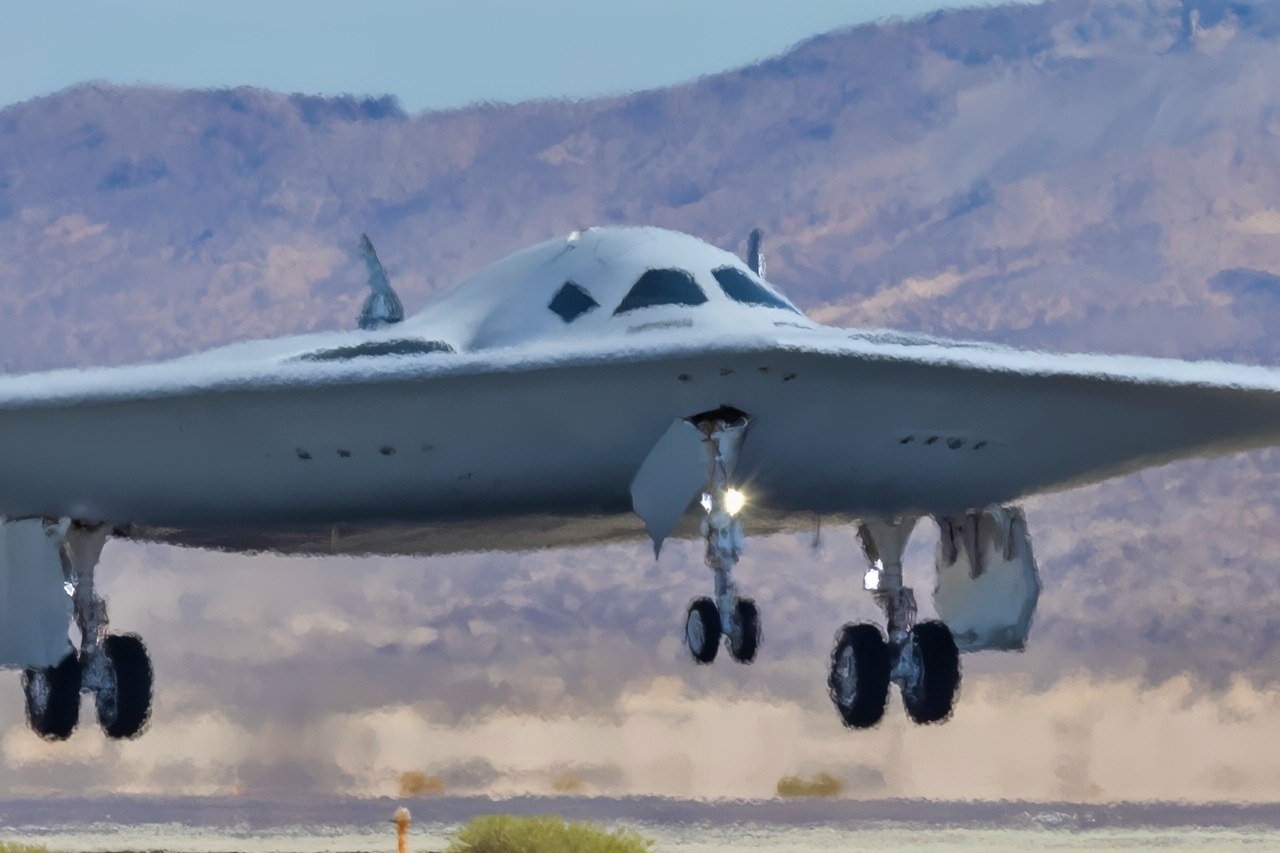
A B-21 Raider test aircraft lands at Edwards Air Force Base, Calif., during ongoing developmental flight testing, Sept. 11, 2025. The B-21 will be the backbone of the bomber fleet; it will incrementally replace the B-1 Lancer and B-2 Spirit bombers. (U.S Air Force photo by Todd Schannuth)

A second B-21 Raider, the nation’s sixth-generation stealth bomber, joins flight testing at Edwards Air Force Base, Calif., Sept. 11, 2025. The program is a cornerstone of the Department of the Air Force’s nuclear modernization strategy, designed to deliver both conventional and nuclear payloads. (Courtesy photo)
What The Absence Means
It is worth being careful about what the H-20’s invisibility does and does not prove, because secrecy is not the same thing as failure. China revealed almost nothing about the J-20 fighter or its aircraft carrier program until it was ready to do so, and a stealth bomber is exactly the sort of capability a closed military system would keep hidden until the last possible moment. It is entirely possible that prototypes have been built and are flying out of sight, and that the program is further along than the public record shows. The reported specifications, the sustained official interest, and China’s broader aviation momentum all suggest the H-20 is a real program rather than a fiction.
But a decade is a long time, and the weight of the evidence points toward genuine difficulty rather than mere secrecy. There are no confirmed flight tests, no officially unveiled prototype, and no verified production line, and the official “coming soon” messaging has gone quiet rather than building toward a reveal. The most credible American military assessment calls the PLAAF a regional force and places the bomber’s debut in the 2030s.
Set against that, the museum B-2 in Ohio is more than a rhetorical flourish. The aircraft in Dayton is a ground-test airframe christened “Spirit of Freedom,” not a retired combat jet, which means the United States built its stealth bomber so successfully it could spare a structural test article for public display while all 19 operational Spirits kept flying. China announced its intention to build one ten years ago and has yet to show the world a single H-20 in the air.
About the Author: Harry J. Kazianis
Harry J. Kazianis (@Grecianformula) was the former Senior Director of National Security Affairs at the Center for the National Interest (CFTNI), a foreign policy think tank founded by Richard Nixon based in Washington, DC. Harry has over a decade of experience in think tanks and national security publishing. His ideas have been published in the NY Times, The Washington Post, The Wall Street Journal, CNN, and many other outlets worldwide. He has held positions at CSIS, the Heritage Foundation, the University of Nottingham, and several other institutions related to national security research and studies. He is the former Executive Editor of the National Interest and the Diplomat. He holds a Master’s degree focusing on international affairs from Harvard University.


Fred Thompson
June 2, 2026 at 5:12 pm
China will release Duke Nukem Forever 2 any day now…
Mayday
June 2, 2026 at 7:28 pm
Paper tiger
rosy dawn
June 2, 2026 at 8:24 pm
Few people are ready to admit that slow-flying manned bombers like the b-2, b-21 and b-52, are useless in an all-out high end war between US and a peer rival.
So, whaddaya think should fly in a true all-out high-end great slaughter of such a war.
UNMANNED BOMBERS/ATTACKERS.
No leader worth his salt would want to spend billions, even trillions of bucks on manned bombers that have little chance of survival in the coming ww3.
Especially with all the space-based monitoring systems already operational in space, plus new ones coming up, and the soon-to-be-developed super-duper really amazing golden dome.
Unmanned systems are the way for the immediate future, including the upcoming war of great final apocalypse.
Vigilant Veteran
June 2, 2026 at 9:00 pm
I’ve stood beneath the B-2 at the WPUSAF Museum. It is very difficult to even look at the airplane close up. The “paint” won’t let your eyes focus like normal. You have to step away from it, and you still can’t see detail. It is the best aviation museum in the world. IMO, and it is free for all. Check it out.
stephen MAIO
June 3, 2026 at 9:06 am
The Chinese H-20 isn’t flying yet for 1 simple reason. They haven’t succeeded in stealing all the plans from us yet.
MrObvious
June 3, 2026 at 2:25 pm
I would like to remind everyone worried about China that just last week China put on a show with a robot that was only supposed to walk.
It fell down and jerked, kicked and squirmed like an epilepsy patient before it went through an UNCONTROLLED DISASSEMBLY!
This thing here has to fly!
China, who can’t build a robot that can walk has everyone scared they can build a plane that will fly!!!