


Summary and Key Points: Here’s a thought experiment one national security analyst can’t shake: what if the Strait of Hormuz simply stays closed — not for weeks, but until Christmas? For a month or two, reserves and rerouting paper over the damage. After that, the buffers run dry — and analysts say America hits that wall right around its 250th birthday on July 4. From there, the scenario gets stranger than a gas crisis. The fuel that does the real damage isn’t the one in your tank; it’s the one moving the nation’s food, freight, and machinery.
The Iran War and the Impact on the U.S. Economy

U.S. AIR FORCE ACADEMY, Colo. – Two F-22 Raptors perform a flyover and air demonstration during noon meal formation at the U.S. Air Force Academy in Colorado Springs, Colo., April 12, 2023. Events such as these aim to cultivate warrior ethos, a future-focused mindset, and supplement existing character, leadership, and officer development efforts with the cadets. (U.S Air Force Photo by Trevor Cokley)
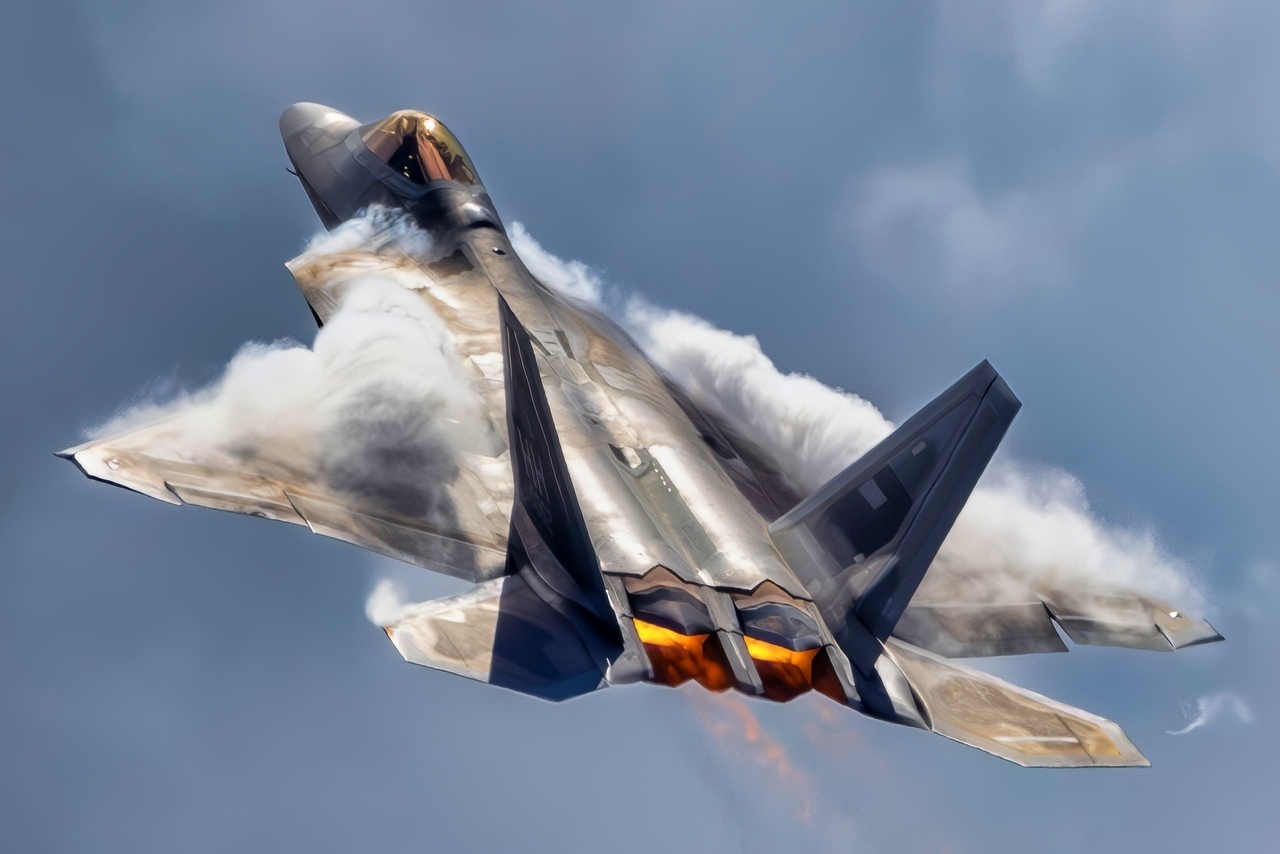
An F-22 Raptor performs an aerial demonstration at Marine Corps Air Station Kaneohe Bay, Hawaii, Aug. 8, 2025. The rapid change in angle of attack causes visible vapor to form around the aircraft, giving spectators a clear view of the jet’s aerodynamic performance. This demonstration highlights the unique thrust-vectoring capabilities of the F-22, allowing it to achieve extreme agility unmatched by other fighter aircraft. (U.S. Air Force photo by Staff Sgt. Lauren Cobin).
With news that the Organization for Economic Cooperation and Development (OECD) is anticipating slower economic growth and higher inflation for the next two years because of the Iran War (and the resulting closure of the Strait of Hormuz), Americans need to realize that none of the leaders of the three warring nations–Iran, the US, and Israel–have the incentive or vision to end the war.
Plus, the war has gone on for so long that there will be economic damage regardless of whether it ends.
It is more likely, though, that the Strait isn’t reopening anytime soon. Let’s say, as a thought experiment, the Strait remains closed until Christmas. If that happened–and it is very likely that it could–then the world economy would be in territory that few modern policymakers have ever experienced. In fact, there would be few policy prescriptions available to policymakers because the world has never experienced such a crisis.
And the consequences would extend far beyond gasoline prices if the Strait of Hormuz remained closed until Christmas.

A U.S. Air Force B-52 Stratofortress departs after being refueled by KC-135 Stratotanker over the Pacific Northwest July 18, 2024. The 92nd Air Refueling Wing and 141st ARW’s ability to rapidly generate airpower at a moment’s notice was put to the test when Air Mobility Command’s Inspector General team conducted a no-notice Nuclear Operational Readiness Inspection, July 16–18, 2024. During the NORI, Airmen demonstrated how various capabilities at Fairchild AFB enable units to generate and provide, when directed, specially trained and equipped KC-135 Stratotanker aircrews to conduct critical air refueling of U.S. Strategic Command-assigned strategic bomber and command and control aircraft. (U.S. Air Force photo by Staff Sgt. Lawrence Sena)

Multiple B-52H Stratofortresses sit parked on the flight line on Minot Air Force Base, North Dakota, Aug. 8, 2022. The B-52 Bomber has been in service since February of 1955. (U.S. Air Force photo by Airman Alysa Knott)
The Energy Shock Becomes Structural
The first few weeks of a disruption, as we’ve seen, can be managed with strategic reserves, emergency stockpiles, rerouting, and demand destruction.
By Christmas, the emergency measures that the United States and other countries have been living on would be largely exhausted. Indeed, many analysts are pointing to the week of July Fourth as the moment when America depletes most of its buffers.
Just in time for America’s 250th anniversary.
Anyway, roughly one-fifth of globally traded oil and a significant portion of the world’s liquefied natural gas (LNG) supplies normally pass through the Strait of Hormuz. A six- to nine-month disruption would ensure the world is no longer dealing with a temporary supply shock. At that point, it would be contending with a permanent supply deficit.
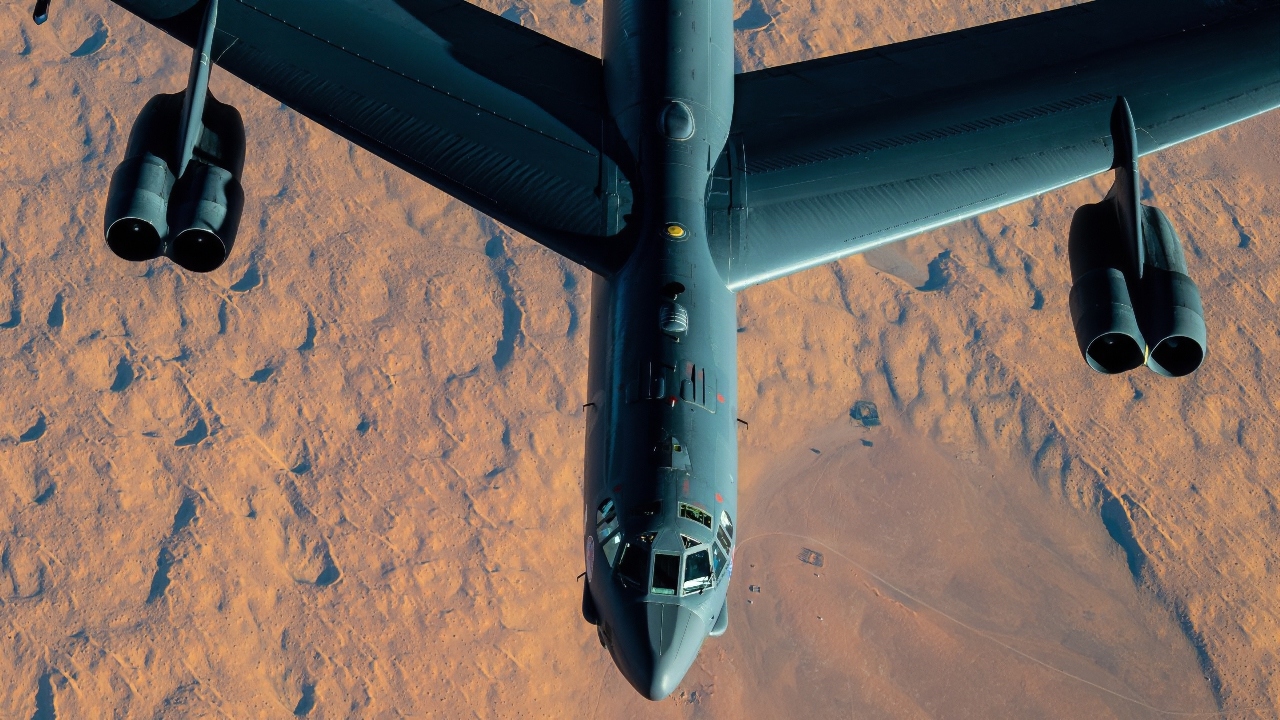
A U.S. Air Force B-52 Stratofortress, assigned to the 2nd Bomb Wing, receives fuel from a KC-135 Stratotanker, assigned to the 340th Expeditionary Air Refueling Squadron, during a multi-day Bomber Task Force mission over Southwest Asia, Dec. 10, 2020. The B-52 is a long range bomber with a range of approximately 8,800 miles, enabling rapid support of Bomber Task Force missions or deployments and reinforcing global security and stability.(U.S Air Force photo by Master Sgt. Joey Swafford)
At that point, the price of oil per barrel would remain well above historical norms. Diesel shortages, the lifeblood of the commercial transportation economy–as well as the fuel that most military vehicles run on–would become more important than gasoline shortages.
For instance, diesel powers farming equipment, railroads, trucks, construction machinery, and generators. When diesel becomes scarce, it gets expensive. When the price of diesel spikes, inflation results.
International air travel would come to a halt, as jet fuel would be scarce. LNG-dependent economies, meanwhile, would endure rolling industrial shutdowns.
In this situation, the crisis is a supply-side one rather than a demand-side problem. It’s the exact opposite of what caused the pandemic-related economic depression in 2020.
Asia Gets Hit First
The biggest losers would be the major Asian importers of Mideast supplies. Countries such as Japan, South Korea, India, and even China rely heavily on Gulf energy supplies.
By Christmas, Asian states would be rationing fuel, prioritizing military and emergency services, restricting industrial consumption to conserve finite energy supplies, and providing subsidies to prevent social unrest.
The manufacturing sector of Asia, the most important component of Asia’s dynamic regional economy, would slow significantly.
Europe Enters Recession
Europe would have already been in recession long before Christmas. European industry weakened due to the loss of cheap Russian energy following the conflict in Ukraine. A prolonged closure of the Hormuz closure would add another energy shock before the continent fully recovered from the first.
Under these conditions, the sectors of Europe’s economy most affected would be those involved in chemicals, fertilizers, steel, aluminum, and transportation.
The government would likely revive emergency programs similar to those seen during the 2022-23 energy crisis.
America Is Not Immune
Even the starkest assessments of where the crisis is heading, such as the one proffered by the OECD, tend to sound Pollyanna-ish when one considers the law of unintended consequences. But, given the OECD’s slightly negative tone, many experts believe that the United States produces enough oil to avoid serious damage from the closure of the Strait of Hormuz.
Yet, that assumption is only partly true.
American consumers are affected by the rise in oil prices as much as the rest of the world, even though America is a net exporter of petroleum products.
Plus, refineries in the United States cannot process the light, sweet crude that comes from North American wells. So, the US exports its light, sweet crude but must import heavy crude from places like Canada, Mexico, Venezuela, Saudi Arabia, and even Russia.
Then there’s the added complication that diesel markets are interconnected. The diesel market in the United States, therefore, is not insulated from the volatility of the broader diesel market. And let us not forget the reality that, as large as America’s Strategic Petroleum Reserve (SPR) is, America’s reserves are finite.
So, if the Strait of Hormuz remained closed until Christmas, there would be persistently high gas prices, explosively high diesel prices, higher food costs, greater electricity costs in certain regions of the United States, and overall slower economic growth.
Food Inflation Gets Really Ugly
By Christmas, because fertilizer costs would remain elevated, and transportation costs would surge (along with refrigeration and storage costs), agricultural production would become more expensive. Americans would experience a second-round inflation shock. American consumers may tolerate expensive gasoline. They become far less tolerant, though, when grocery prices spike another 20-30 percent from their current level (and most Americans have believed food prices were already too high ever since the pandemic).
Historically, food inflation has destabilized governments far faster than fuel inflation.
Financial Markets Begin Pricing a New World
A nine-month disruption signals something much larger: the Persian Gulf is no longer a reliable energy corridor. Investors would start repricing risk globally. This scenario would undoubtedly lead to persistent inflation, higher bond yields (which will negatively impact the US dollar), slower growth, collapsing consumer confidence, and reduced investment in the United States.
Basically, the world would look less like the globalization era of the 1990-2020 period and more like the fragmented energy politics of (at best) the 1970s.
The Political Fallout
By Christmas, pressure on Washington would become immense. American voters generally care about foreign wars only when they begin impacting fuel prices, food prices, jobs, and retirement accounts.
If the Strait of Hormuz remains closed through Christmas, politicians in both parties would face growing demands to end the conflict regardless of the geopolitical consequences. If, as I suspect, inflation returns in force–and unemployment spikes–then consumer spending will weaken, leading to another recession.
The Biggest Strategic Consequence
But the biggest strategic consequence of all would not even be economic. If Tehran succeeds in keeping the Strait of Hormuz sealed for most of the year, despite US military pressure, every major power would draw the same conclusion: the United States can no longer guarantee freedom of navigation in one of the world’s most important maritime chokepoints.
There will be serious, negative knock-on effects resulting from this inability to reopen the Strait of Hormuz by force (and the Americans can’t reopen it; if they could, they would have by now).
Those knock-on effects would be the geopolitical equivalent of an earthquake, as the rest of the world, which had consistently depended on US military guarantees and economic support, realized those guarantees were fundamentally worthless. In turn, those states would seek new arrangements beyond Washington–arrangements that would lead to the collapse of the post-Cold War international order, such as it is, and herald the rise of multipolarity.
So, on top of ringing in the new year in 2027, the American people would be closing out a 30-year era of undisputed dominance in exchange for a significantly diminished geopolitical role and a massive economic downturn.
About the Author: Brandon J. Weichert
Brandon J. Weichert is Senior National Security Editor. He also manages The Weichert Brief on Substack. Weichert hosts “National Security Talk” on Rumble, too. He is the author of four bestselling national security books, the most recent of which is A Disaster of Our Own Making: How the West Lost Ukraine (Encounter Books). Follow him via Twitter/X @WeTheBrandon.


