

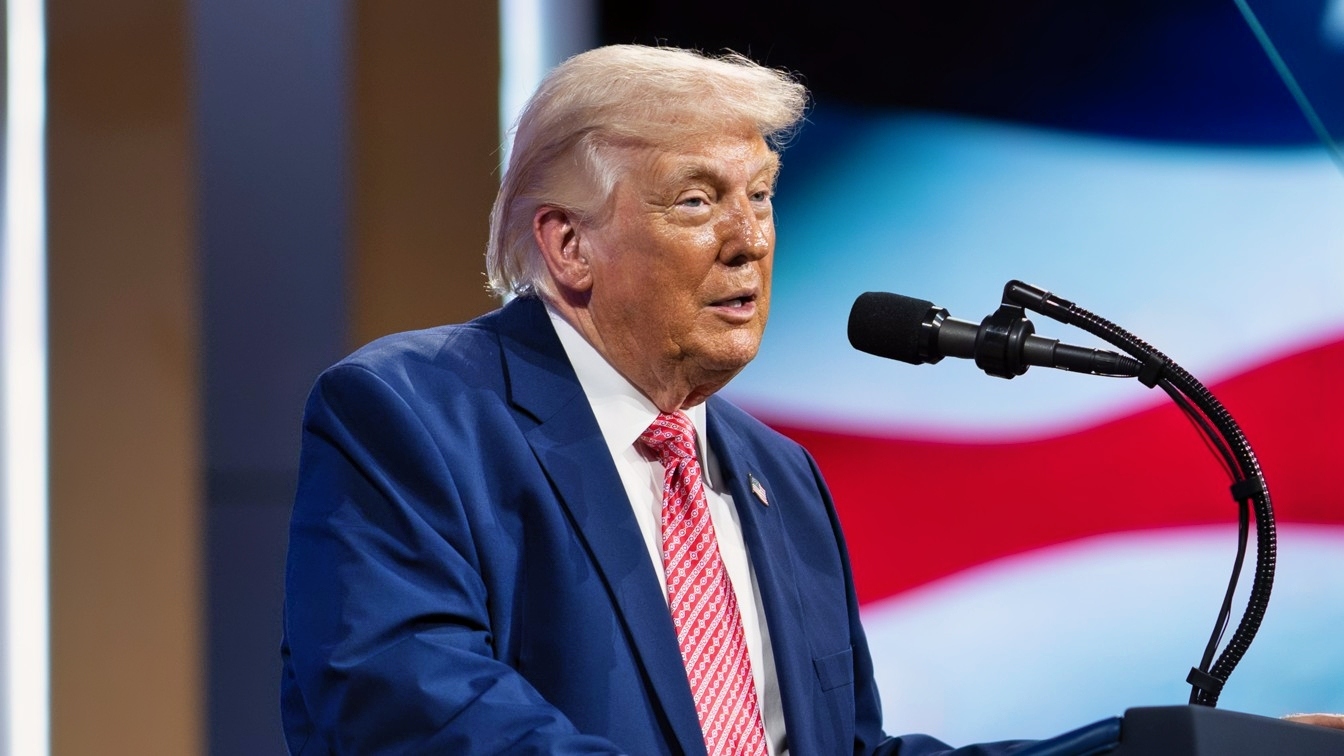
Summary and Key Points: It’s a war full of contradictions: a ceasefire that isn’t, an economy teetering even as the stock market soars, a public that’s furious and indifferent at once. Now, a Wall Street Journal report reveals President Trump has told aides he won’t return to all-out war with Iran “unless U.S. troops are killed” — a line that sounds simple until you see the trap behind it. Brandon Weichert argues that everyone hoping for a clean ending to this war will be disappointed.
The Iran War: No Happy Endings?

A U.S. M1A1 Abrams tank needed for training the Armed Forces of Ukraine awaits offloading at Grafenwoehr, Germany, May 14, 2023. The M1A1 training is expected to last several weeks and will include live fire, crew qualification, maneuver, and maintainer training. Armed Forces of Ukraine training is conducted by 7th Army Training Command at Grafenwoehr and Hohenfels training areas in Germany on behalf of U.S. Army Europe and Africa. (U.S. Army photo by Spc. Christian Carrillo)
We’re in a ceasefire; we’re at war.
We’re teetering on the brink of economic collapse; the stock market is rallying to all-new highs.
The American people are angry at President Donald Trump for starting the war; then again, the American people don’t really seem to care.
We are living through one of the most confusing major wars in American history.
A recent Wall Street Journal exclusive has the forty-seventh president telling aides that he won’t resume all-out war with Tehran “unless U.S. troops are killed.”
That statement seems straightforward enough until you realize that the American president finds himself in an escalation trap and that just a few weeks ago, his top White House officials were publicly ruminating on a national military draft.
Meanwhile, President Trump appears willing to tolerate a surprising amount of Iranian military activity, from public threats to massive missile attacks against American allies. Trump’s threshold for conflict went from “UNCONDITIONAL SURRENDER” of the Islamic Republic to threatening civilizational annihilation to just denuclearizing Iran’s military to focusing only on reopening the Strait of Hormuz, through which 20 percent of the world’s oil passes, 18 percent of the liquified natural gas (LNG) passes, and one-third of the world’s agricultural production inputs (not to mention a bevy of other key industrial inputs, from naphtha to helium).

F-16 Fighting Falcons from both the 35th and 80th Fighter Squadrons of the 8th Fighter Wing, as well as from the 466th Fighter Squadron of the 419th Fighter Wing at Hill Air Force Base, Utah, demonstrate an elephant walk formation as they taxi down a runway during an exercise at Kunsan Air Base, Republic of Korea Dec. 2, 2011. The exercise showcased Kunsan AB aircrews’ capability to quickly and safely prepare an aircraft for a wartime mission. (U.S. Air Force photo by Staff Sgt. Rasheen Douglas/Released)
Why American Casualties Have Remained Limited
Blessedly, US casualties in the war have thus far not been high. Of course, every loss of American life is a blow to America. But the casualty toll has been far smaller than what a conflict of this size would usually produce.
That’s because the Americans drastically repositioned their troops out of what turned out to be vulnerable bases throughout the region. Those Americans who did receive injuries were close enough to advanced hospitals to receive critical care during the “Golden Hour” of injuries, ensuring the death toll was low for a war of this size.
So, unless Trump orders a ground invasion (or unless darker forces seeking to antagonize Iran kill Americans as part of a false flag), it does seem unlikely that any US troops will die.
The President Who Became What He Opposed
What the WSJ essay highlights is a moment in history that few have lived through.
An American leader, Trump, who explicitly billed himself as the anti-Mideast-wars-of-choice candidate during all three of his presidential campaigns (2016, 2020, and 2024), is now commander-in-chief during a Mideast war of his choosing. The forty-seventh president insists he wanted to go to war and that there were no other options.

U.S. Air Force Nathalie Olarte, crew chief, launches an F-16 Fighting Falcon from an undisclosed location within the U.S. Central Command area of responsibility, Jan. 14, 2024. The F-16 can fly more than 500 miles (860 kilometers), deliver its weapons with superior accuracy, defend itself against enemy aircraft, and return to its starting point. The U.S. Air Force’s expeditionary capability enables U.S. and coalition forces to rapidly establish credible, combat-ready forces within U.S. Central Command’s area of responsibility to proactively deter potential adversaries. (U.S. Air Force photo by Tech. Sgt. Alexander Cook)
We all know that Trump’s close relationship with Israeli Prime Minister Benjamin Netanyahu is likely to be to blame for this moment in American history.
Trump clearly wants out of the war. At the same time, though, he’s stuck between that understandable desire and the fact that the conditions of war have not remained. Come to think of it, the Islamic Republic is more powerful today than it was on February 28, when the war began.
The Strange Logic of Strategic Restraint
In the meantime, Trump is apparently willing to accept all manner of provocations from the Iranians. Missile attacks on bases, drone attacks, harassment of international shipping, and proxy attacks through Hezbollah. Trump will absorb a certain amount of pain. This situation has taken a strange turn for a president who continues harping publicly that the United States and Israel defeated the Islamic Republic.
Why is Trump showing restraint at all?
It’s fantastically–painfully–obvious, as my colleague Michael Yon might say. Unfortunately, the US side did not win the war. And it cannot win the war under current conditions.
Even the braggadocios Trump is realizing this hard reality. From the start of the conflict, Trump and his team asserted they had planned for a maximum six-week war (in fact, my sources tell me that the president believed the conflict would be 96 hours at most). Regardless, we’re beyond six weeks of the conflict, and there’s still no sign of victory for Washington.

A U.S. Air Force F-16 Fighting Falcon taxis to be disarmed after returning from a flight during Combat Archer UK at RAF Lakenheath, England, April 15, 2025. Combat Archer UK was one of six elements in the Combat Weapons Systems Evaluation Program, typically held in the U.S. By hosting Combat Archer UK in Europe, U.S. Air Forces Europe saved millions of dollars, allowing them to enhance the mission in other capacities. (U.S. Air Force photo by Airman 1st Class Zachary Jakel)
The Strait of Hormuz Problem
The Strait of Hormuz remains closed, shipping remains contested, and energy markets are stressed. The Trump administration’s original assumption was wrong. Now, the US president may have (finally) concluded that additional military pressure is unlikely to force rapid Iranian capitulation.
While those of us who’ve followed Trump closely for years have assessed that the man had fundamentally changed (not for the better), abandoning his previous righteous stance against any more unpopular wars of choice in the Mideast, this news indicates the old Trump remains buried inside the man occupying the Oval Office.
Reality, it seems, is finally forcing that old, buried war skeptic out into the fray (however tepidly).
The Economic Clock is Ticking
For Trump, too, the economy is his main passion. Trump’s commitment to the economy is likely due to his having made his bones in business and long associating himself with that world. Since the war began, though, the economic outlook for the United States has declined.
Inflation, the real policy reason behind Trump’s reelection in 2024, has risen and is expected to increase further the longer the Strait of Hormuz remains disrupted. Fuel prices (which are pushing inflation higher) are rising, supply chains are breaking down, and global growth is slow.
As the United States approaches a contentious Midterm election in just five months, contrary to the confidence that Trump exudes about the pending outcome, Republicans are scared that the war and its knock-on effects will cause a catastrophic defeat at the polls. Trump is worried, too. If he loses the House, it’ll be bad.

A F-16 Fighting Falcon assigned to the 35th Fighter Wing takes off at Yokota Air Base, Japan, May 21, 2022 during the Japanese-American Friendship Festival. Due to COVID-19 pandemic, this year festival marks the first time Yokota has held the annual event since 2019. (U.S. Air Force photo by Yasuo Osakabe)
But if the economic conditions in the country deteriorate, as those of us at this publication have assessed repeatedly, the president’s party will lose both houses of Congress–and Trump’s political enemies will drown him and his administration in endless, sweeping investigations that will stymie the president’s agenda for the final two years, and likely end in the president’s impeachment.
Iran Has Become an Usolved Problem
Iran has proven itself to be an impossible nut to crack.
Even with Trump’s apparent turn toward tolerance in the Iran War, the chances of a real negotiated settlement are low. There are three parties in this fight: Iran, the United States, and Israel. None of these parties is anywhere near a consensus. In fact, there now appear to be real fissures in the US-Israeli relationship over the war. And Israel’s Prime Minister Netanyahu has proven himself to be the real wild card in this diplomatic triangle. The whole reason the war began was due to Netanyahu’s meddling. It cannot end now because of his intransigence.
From Ceasefire to Frozen Conflict
Speaking from the Oval Office earlier this week, President Trump nonchalantly explained to a room full of confounded reporters that ceasefires in the Middle East are “when you’re shooting more moderately.”
While humorous, it betrays a wider point. There is no peace deal coming as so many hope for. Indeed, there isn’t even a traditional ceasefire in the offing. We’re closer to getting a frozen conflict of the kind that existed between Russia and Ukraine for years before the Russians finally invaded in February 2022.
Trump has been clearly using negotiations as a backdoor to reduce the conflict without actually getting a true ceasefire or a lasting peace deal. So, the likeliest outcome of this mess is a managed conflict in which both sides continue to use force but try to avoid crossing specific escalation thresholds.
The War That Won’t End
And what that means is that, in view, unless the Americans are willing to accept an entirely new paradigm in the Strait of Hormuz where the Iranians exercise direct control, and unless the US is willing to accept a truly nuclear-armed Iran going forward, the conflict will continue defining international affairs for years to come.
There is no peace deal, and there isn’t even a traditional ceasefire in sight.
About the Author: Brandon J. Weichert
Brandon J. Weichert is the Senior National Security Editor at 19FortyFive.com. He also manages The Weichert Brief on Substack. Weichert hosts “National Security Talk” on Rumble, too. He is the author of four bestselling national security books, the most recent of which is A Disaster of Our Own Making: How the West Lost Ukraine (Encounter Books). Follow him via Twitter/X @WeTheBrandon.


