


Last July, I spent two days at the National Museum of the U.S. Air Force outside Dayton, Ohio, walking among the aircraft that represent the roads American airpower chose not to take. I literally took almost 4,000 pictures, yes, I am serious. I stood close to the Boeing X-32, the Northrop YF-23, and the strange little YF-118G Bird of Prey — you can get right up next to most of these machines, even if you can’t quite stand beneath all of them — and the photographs I shot that day run throughout this piece. What struck me was how much money and engineering genius the United States poured into radical stealth designs that never flew a single operational mission in military service. Some flew as prototypes and lost their competitions. Some never left the drawing board. Every one of them shaped the aircraft America flies today.
Here are five that stand out, at least for me, over the decades I have studied these amazing pieces of aviation technology.
The Lockheed X-44 MANTA

X-44 MANTA. Image Credit: Creative Commons.

X-44 MANTA concept art.
The most futuristic aircraft on this list never got built at all. Conceived by Lockheed Martin’s Skunk Works around 1999, in collaboration with NASA and the Air Force, the X-44 MANTA, short for Multi-Axis No-Tail Aircraft, was a radical reimagining of the F-22 Raptor.
The idea was to take the Raptor’s fuselage and propulsion, strip away every vertical and horizontal tail surface, stretch a large delta wing over the result, and rely entirely on three-dimensional thrust vectoring for pitch, roll, and yaw. Removing the tails would slash both drag and radar signature, while the larger wing would carry more internal fuel for greater range.
It was an audacious bet that an aircraft could be flown on engine thrust alone, with no rudders, elevators, or ailerons of any kind.
The program never advanced beyond the conceptual stage. Funding dried up around 2000, the priorities of a post-9/11 Pentagon shifted, and no MANTA was ever built or flown.
Yet a quarter-century later, the Air Force renderings of Boeing’s new F-47 sixth-generation fighter show a tailless, stealthy planform that looks remarkably like the MANTA’s old concept art, a reminder that a design can lose its moment and still turn out to be right.
The Boeing X-32
Some aircraft lose on looks before they ever lose on merit, and the Boeing X-32 never escaped its reputation as the ugly one. I saw that’s total garbage, as the restored X-32 in Ohio looks like she could fly right now in 2026 and warrants no such ‘ugly’ talk. Period.
It was Boeing’s entry in the Joint Strike Fighter competition, the contest to build a single affordable stealth fighter for the Air Force, Navy, and Marine Corps, and it flew head-to-head against Lockheed Martin’s X-35.
The X-32 did take to the air and demonstrated the core concepts, but when the evaluations were complete, the X-35 was judged the better performer on stealth and supersonic flight, and Lockheed’s design went on to become the F-35 Lightning II, now the most widely fielded fifth-generation fighter in the world.
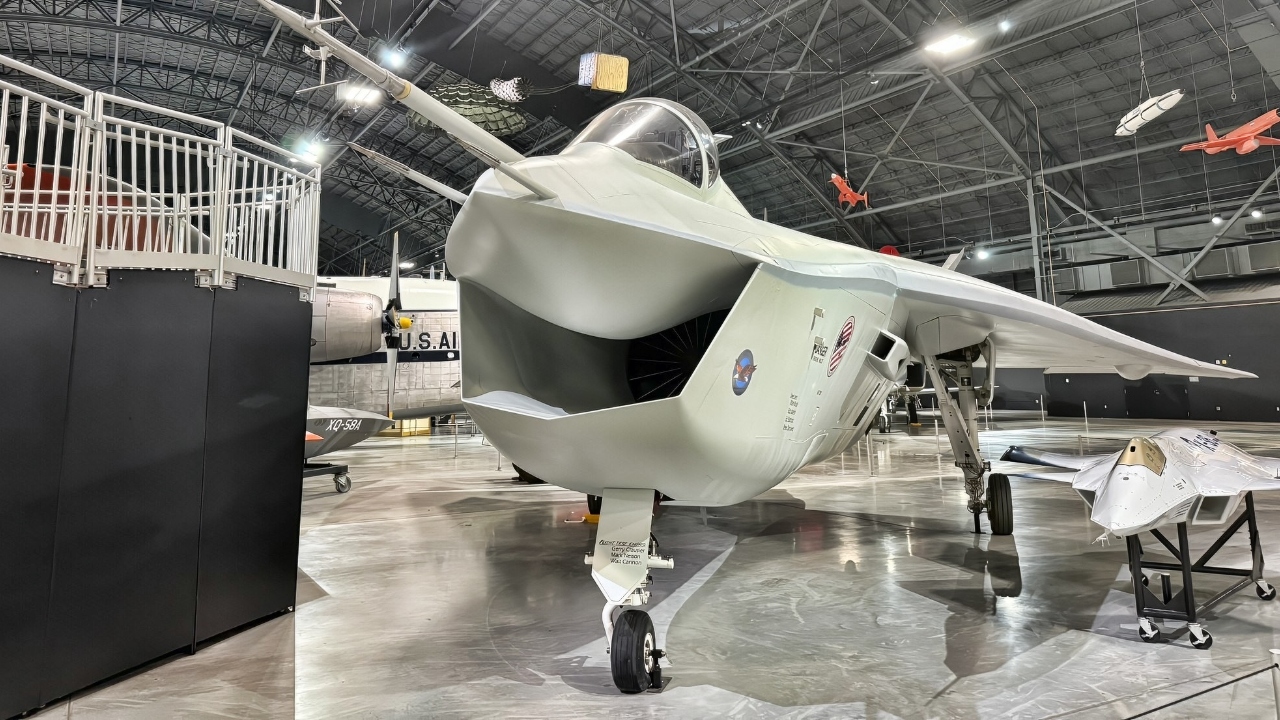
Boeing X-32 Bright Image 2025. Credit: National Security Journal.
The X-32’s bulbous, grinning air intake made it an easy target for ridicule, but the deeper problem was that its one-size-fits-all design struggled to satisfy three services at once, particularly the Marine Corps’ short-takeoff and vertical-landing requirement.
It flew, it proved its ideas, and then it lost. Today, one of the two X-32 demonstrators is on display at the Dayton museum.
Crazy Fact You Might Not Know: The X-32 and YF-23 are within 100 feet of each other at the National Museum of the U.S. Air Force. Pretty amazing stuff. Photo below for your viewing pleasure.

X-32 and YF-23 Together at the U.S. Air Force Museum. Image: National Security Journal.
The Northrop YF-23
No aircraft on this list inspires more devotion than the Northrop YF-23 Black Widow II, and none has a stronger claim to being the best fighter America never fielded.
The McDonnell Douglas program, built for the Advanced Tactical Fighter competition, was meant to give the Air Force a stealthy successor capable of dominating the latest Soviet fighters. The YF-23 was a genuine leap.
At a time when the only operational stealth aircraft, the F-117 Nighthawk, lacked air-to-air weaponry and could not fly supersonic, the YF-23 combined deep stealth with sustained supercruise in a single airframe.
Two prototypes were built and flew, one with Pratt & Whitney engines and one with General Electric engines, and by most accounts, the YF-23 was both stealthier and faster than its rival, the Lockheed YF-22, with a longer range to boot. What it gave up was low-speed agility.

YF-23 National Security Journal Photo. Taken by Harry J. Kazianis at U.S. Air Force Museum on 7/19/2025.

YF-23 National Security Journal Photo. Taken by Harry J. Kazianis at U.S. Air Force Museum on 7/19/2025.
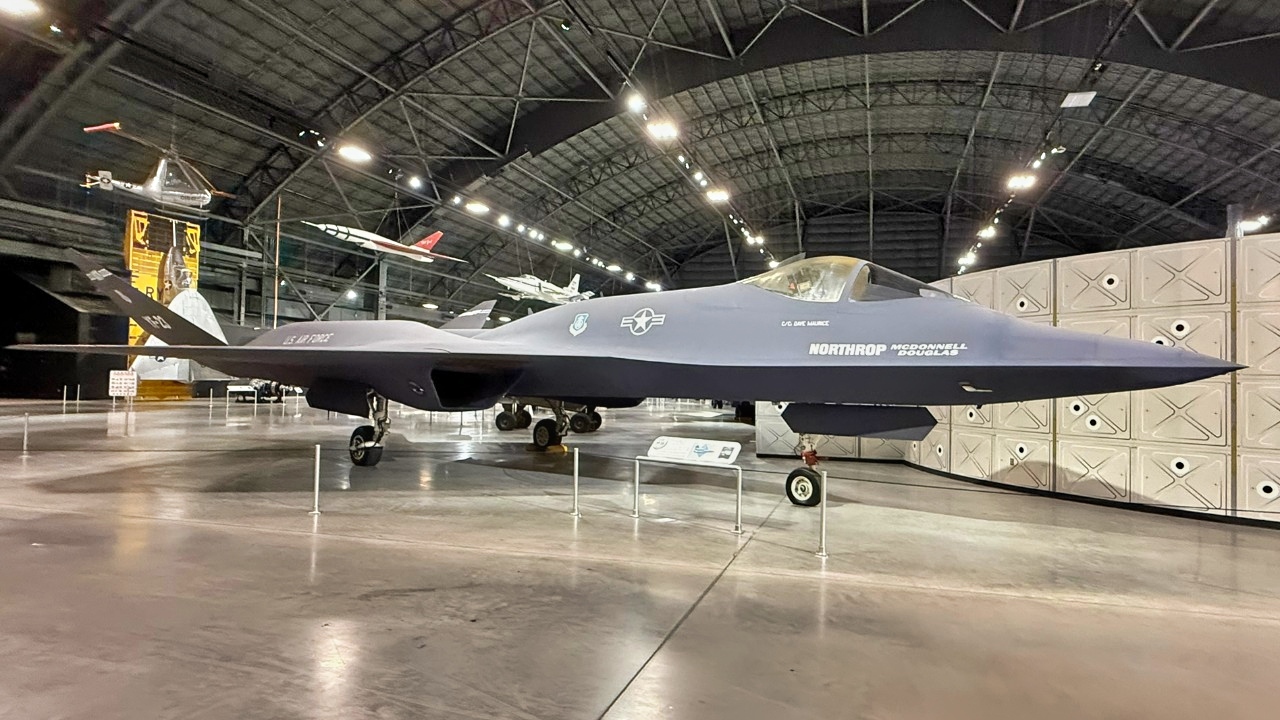
YF-23 National Security Journal Photo. Taken by Harry J. Kazianis at U.S. Air Force Museum on 7/19/2025.
The YF-22 had thrust-vectoring nozzles that made it a better dogfighter, and an Air Force still wedded to close-in maneuvering chose the Lockheed design, which became the F-22 Raptor.
The YF-23 never entered production. One of two prototypes rests at Dayton, and the other in Southern California, and the legend that the wrong plane won has never stopped growing. I have visited both.
Strange YF-23 Fact: The YF-23 at the Western Museum of Flight had the engines removed for “national security reasons”, as explained by the museum curator who showed me the plane. A photo below shows this clearly.
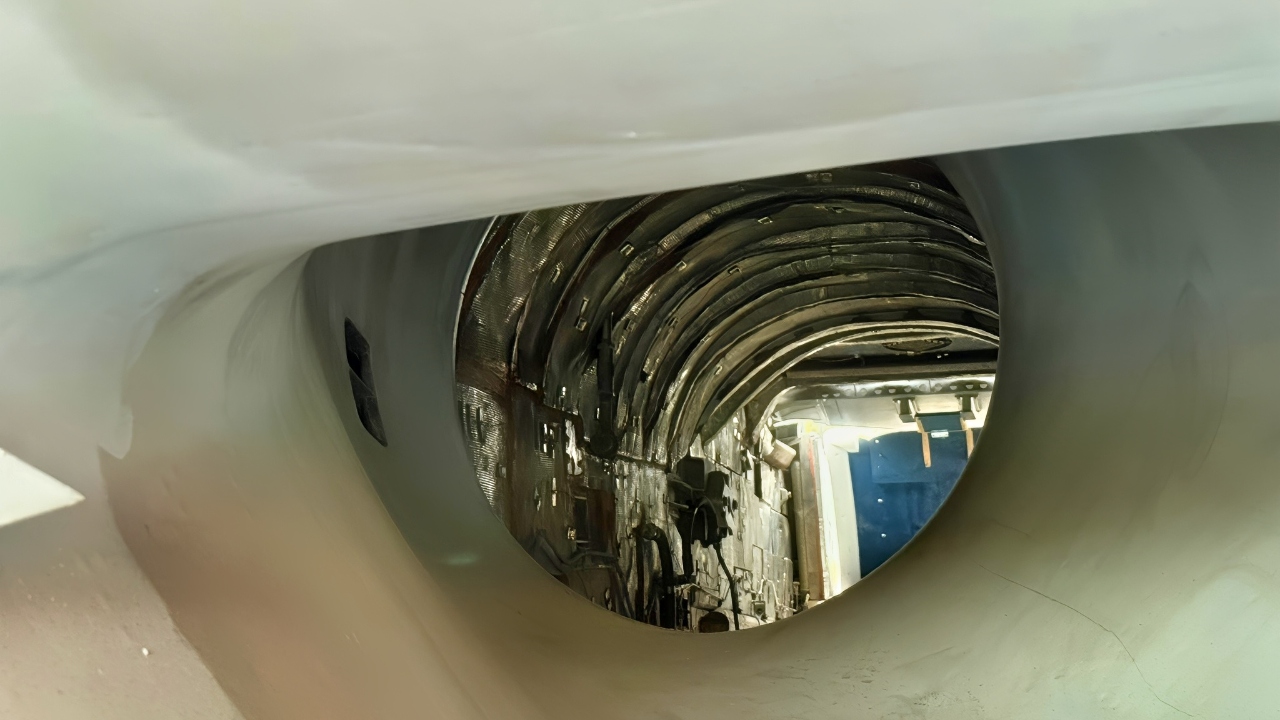
This photo was taken inside a YF-23A Black Widow II, where the engine had been removed. Photo: National Security Journal.
The Naval YF-23
The YF-23’s story has a saltwater postscript that almost nobody remembers.
While the Air Force ran its Advanced Tactical Fighter contest, the Navy was pushed by Congress into a parallel effort called the Naval Advanced Tactical Fighter, an attempt to build a carrier-capable stealth fighter to replace the aging F-14 Tomcat.
A program office was set up at Wright-Patterson Air Force Base in late 1988, and the existing ATF contracts for both competing teams were modified to study naval variants, which meant a carrier-based spinoff of the Northrop YF-23 was on the table alongside a naval version of the Lockheed design.
A navalized YF-23 would have been a formidable creature, but it ran headlong into the brutal physics of carrier aviation.

YF-23 National Security Journal Close Up Photo
A jet built to be catapulted off a deck and slammed back down onto it needs a heavily reinforced structure and landing gear, corrosion-resistant materials, and slower approach speeds, changes that would have driven up weight and cost enormously.
By August 1990, the admiral in charge of Navy fighter requirements said he saw no way the program could fit into an affordable plan for naval aviation, and in early 1991, before the Air Force had even picked its winner, the naval effort was dropped.
The Navy chose to extend the F-14 instead, and the carrier-based stealth fighter would have to wait for the F-35C for decades. No naval YF-23 was ever built.
The YF-118G Bird of Prey
The last entry was never a fighter at all, and that is precisely why it belongs here. Boeing’s YF-118G Bird of Prey, likely named for the Klingon warship and built in secret in the 1990s, was a technology demonstrator rather than a combat aircraft, but the lessons it taught shaped nearly every stealth design that followed.
The once highly classified project ran from 1992 through 1999 and was not unveiled to the public until October 2002, by which point the techniques it pioneered had quietly become industry standards.
The Bird of Prey was deliberately humble where it could afford to be. Powered by a small Pratt & Whitney business-jet turbofan, it flew at modest speeds, around 260 knots, and altitudes no higher than 20,000 feet, because its job was never to be fast. Its job was to prove out low-observable shaping and, just as importantly, radically cheaper and faster ways to design and build stealth aircraft using single-piece composite structures and digital modeling. Those manufacturing breakthroughs rippled forward into later programs, and the strange, hunched little jet now hangs in the Dayton museum as a monument to an aircraft that never fought yet influenced everything that came after it.
Crazy Fact You Might Not Know, #2: The YF-118G is really hard to take pictures of at the National Museum of the U.S. Air Force, as it’s hoisted just above an F-22 Raptor that is also on display. That’s just amazing, and when I saw it, I literally screamed “Yes!” Thank god the museum just opened, and no one was around. That would have been weird. And, yes, I have the photo to prove it.

YF-118G Bird of Prey and F-22 Raptor. Image Taken at the U.S. Air Force Museum on 7/20/2025.
The Stealth Fighters Trapped in a Museum or a History Book
Taken together, these five aircraft trace the shadow history of American stealth, the designs that lost, stalled, or never left the drawing board but seeded the ideas now flying in the F-35, the B-21 Raider, and the tailless F-47 still taking shape.
The roads not taken in aviation are rarely dead ends. More often, they are detours, and the engineering that went into a canceled fighter or an unbuilt naval variant tends to resurface years later in something that does fly.
Standing among these machines in Ohio, that was the thought I kept coming back to. None of them ever flew in anger for the United States, and yet American airpower would look nothing like it does without them.
About the Author: Harry J. Kazianis
Harry J. Kazianis (@Grecianformula) was the former Senior Director of National Security Affairs at the Center for the National Interest (CFTNI), a foreign policy think tank founded by Richard Nixon based in Washington, DC. Harry has over a decade of experience in think tanks and national security publishing. His ideas have been published in the NY Times, The Washington Post, The Wall Street Journal, CNN, and many other outlets worldwide. He has held positions at CSIS, the Heritage Foundation, the University of Nottingham, and several other institutions related to national security research and studies. He is the former Executive Editor of the National Interest and the Diplomat. He holds a Master’s degree focusing on international affairs from Harvard University.


