


War can spur significant innovation, and the Russo-Ukrainian conflict has seen numerous combat inventions. The use of drones and missiles is especially relevant against military and civilian targets. These projectiles seem to get better each day, with longer ranges and more accurate guidance systems.
The Ukrainians have the upper hand in creating and deploying new instruments of war. Verity Bowman, writing for the UK’s The Telegraph, has reported on the staggering number of new weapons Ukraine has developed in recent years. The Ministry of Defense in Kyiv said it produced 175 new weapons systems in just one month – 95 percent of these have been created indigenously, Bowman wrote.
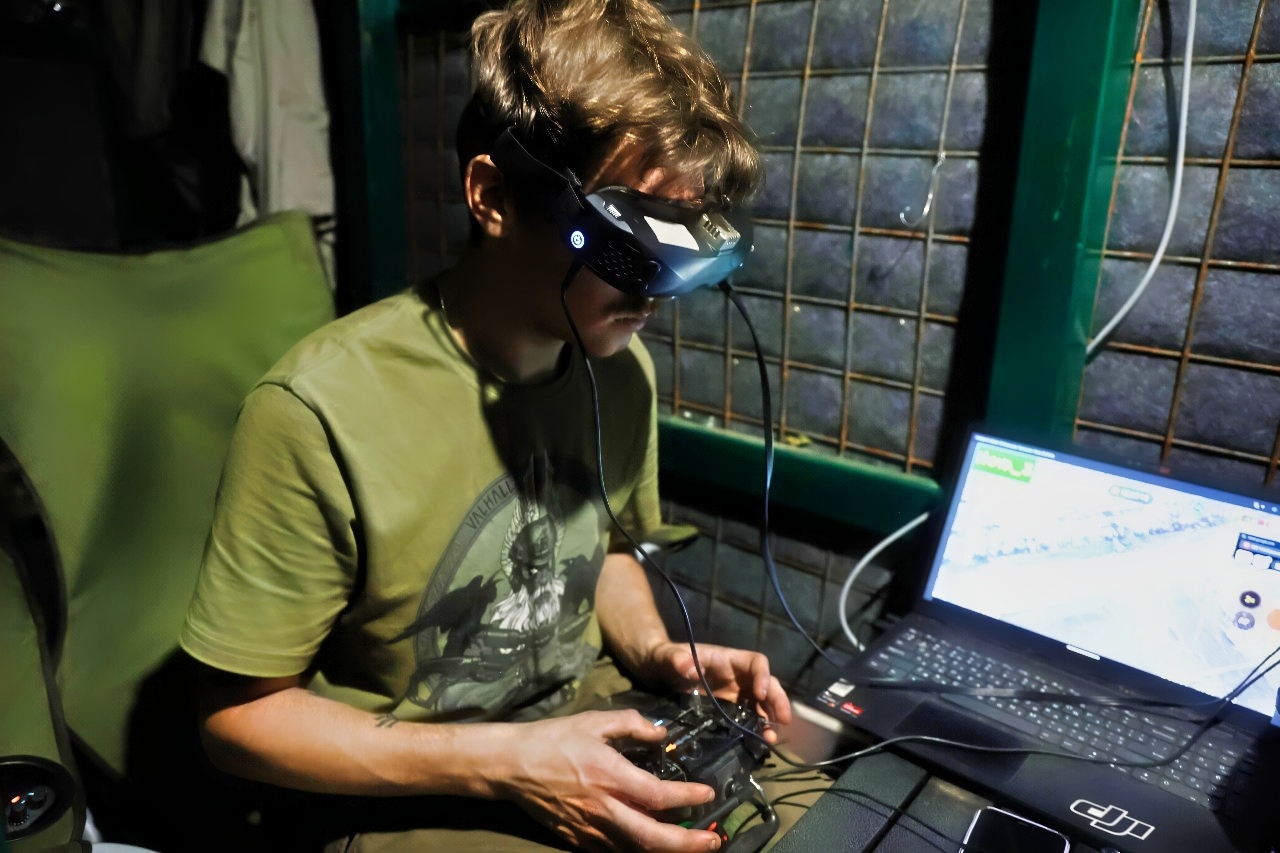
Bohdan, a drone pilot from the Unmanned Systems Battalion of Ukraine’s 110th Separate Mechanized Brigade, pilots an FPV drone in Donetsk Oblast during active battle operations. Photo: David Kirichenko
Kyiv Has Created Its Own Silicon Valley for New Military Hardware
Ukraine has taken on a Silicon Valley level of innovation that builds on the mantra of “move fast and break things.” The country now has the best military in Europe, and credit must be given to individual soldiers who, in the heat of fighting, take battlefield developments and lessons learned and immediately create new munitions that take a toll on Vladimir Putin’s military.
The Germans and Americans Are Slow as Molasses
Compare the pace of defense acquisition to that of the United States, where even as few as two new weapons systems can take up to ten years. Germany, a manufacturing powerhouse, produces no more than 20 new pieces of military hardware per year, Bowman pointed out.

T-84 Tank from Ukraine War. Image Credit: Creative Commons.
Ukraine Is Not Slowed by a Deep Bureaucracy
The Ukrainian government has given the Ukrainian military carte blanche to develop weapons ideas and hurriedly deploy them on the battlefield in a way that has astounded military observers.
Do you remember when the Ukrainian defense forces were pounding the table for arms imports at the beginning of the war? The country is still happy to accept donations, but it has now created a domestic arms industry that is pumping out materiel right and left. Bowman estimated that Ukraine releases six new weapons systems each day.
That is a blistering pace that may just help win the war. The same soldiers who are serving in combat draw on battlefield exploits and can quickly tinker with and engineer new weapons without a stifling bureaucracy and overeager legislators who would ordinarily slow the process.
Is Ukraine Even Better at Defense Innovation than China?
Even China, which has fewer restrictions on the pace of defense acquisition, is not as quick to produce new weapons as the Ukrainians.
“Put it all together, and [there is] a defense procurement ecosystem that is completely unrecognizable compared with anywhere else in Europe,” said Keir Giles, an associate fellow of Chatham House, the Telegraph noted.
Ukraine First Geared Up In 2014
One expects a high level of military ingenuity from the 2022 invasion, but Ukraine actually started innovating after the Russian annexation of Crimea in 2014. They were stung by Russian hybrid warfare and vowed that they wouldn’t be taken advantage of again. Then they placed much emphasis on anti-tank missiles and one-way attack drones on the Donbas frontlines.
Their aerial reconnaissance efforts improved significantly. The Ukrainians decided to use the United States for its overhead satellite imagery intelligence and to deploy indirect artillery fire to stymie Russian armor. This helped the defenders make a tough stand at the beginning of the invasion.
Ukraine Took Advantage of Outdated Russian Tactics
Ukraine also discovered that the Russians were still using Soviet-era frontal assaults. The defenders could employ kamikaze loitering munitions to dive at the tops of Russian tanks, where the armor is thinnest.
Javelin anti-tank missile systems poured in from the United States, and the Russians stumbled into kill zones that were well-prepared with intense Ukrainian ambushes. Thousands of Putin’s tanks and armored personnel carriers were destroyed.
“It’s not from scratch,” Giles said. “Some industries and innovations have obviously been kick-started by the war, but Ukraine had already spent eight years before the full-scale invasion developing these capabilities; there is a deep reservoir of experience, particularly in outsourcing to private industry, that Ukraine has built upon rather than invented,” Giles told the Telegraph.
Innovate Fast or Die Trying
Then the Ukrainians opted for that Silicon Valley-style innovation style I noted above. The idea was to fail fast. If a new weapon worked, produce it in numbers and keep improving its basic firepower. If the arms systems performed less than desired, discard them.
New munitions did not have to undergo stifling bureaucratic and legislative oversight, thereby making the usual defense procurement process unnecessary.
Plus, the Ukrainians are simply “certified smart” in the STEM fields, and it seems that all soldiers are engineers and tinkerers who are never satisfied with a weapon that can always be improved upon.
This is much different than the United States. Battlefield innovations seem to happen quickly for top-tier special operations forces, but many weapons systems for conventional ground troops come from lengthy top-down requests for proposals. Industry responds to a need.
A prototype is built, and then testing and evaluation ensue, often without feedback from individual soldiers or marines until later in the development schedule. The whole process can take years.
In Ukraine, military personnel see the need for a solution and often build it themselves, then they pick from a smorgasbord of weapons depending on the mission.
Using a Menu at a Technological Marketplace
“Ukraine’s defense ecosystem is turbocharged by initiatives like the Brave1 military tech marketplace, where units purchase what they know works well,” explained Robert Tollast, a research fellow at the Royal United Services Institute. “Their will for survival and lethality drives efficiency,” the Telegraph UK reported.
After the war, books will be written about how Ukrainians fought, with new battlefield innovations developed on the fly.
This could be a sign that a scrappy group of handy, creative soldiers can take a tough defensive stand against superior forces and develop new solutions without waiting years.
This acquisition process for new military hardware may become the goal for many militaries seeking the best weapons, tested on the battlefield first, before a large defense contractor struggles to bring munitions to the front lines that may not be effective in the first place.
The Ukrainians have won the battle of innovation; let’s see if that victory can create more pressure on the Russians to call it quits and head to the negotiation table.
About the Author: Brent M. Eastwood, PhD
Author of now over 3,500 articles on defense issues, Brent M. Eastwood, PhD, is the author of Don’t Turn Your Back On the World: A Conservative Foreign Policy and Humans, Machines, and Data: Future Trends in Warfare, plus two other books. Brent was the founder and CEO of a tech firm that predicted world events using artificial intelligence. He served as a legislative fellow for US Senator Tim Scott and advised the senator on defense and foreign policy issues. He has taught at American University, George Washington University, and George Mason University. Brent is a former US Army Infantry officer. He can be followed on X @BMEastwood.


