

American President Donald Trump is now claiming that a peace deal with Iran is at hand. It is hard to know if this is real. Trump has declared dozens of times since mid-April that the war is almost over.
It is possible that the deal remains so vague that no player sees it as truly binding. Israel is also deeply upset that Trump negotiated this over its head. It could act as the spoiler before Friday.

(April 14, 2018) An MH-60S Sea Hawk helicopter assigned to the “Chargers” of Helicopter Sea Combat Squadron (HSC) 14, prepares to onload cargo during a replenishment-at-sea between the aircraft carrier USS John C. Stennis (CVN 74) and the fleet replenishment oiler USNS Henry J. Kaiser (T-AO 187). John C. Stennis is underway with Carrier Air Wing (CVW) 9 conducting routine, tailored ships training availability and final evaluation problem. (U.S. Navy photo by Mass Communication Specialist 3rd Class William Ford/Released)
But more important is how much the deal has pushed into the future. The final disposition of Iran’s nuclear program is undetermined. The possibility of Iranian tolls on traffic through the Strait of Hormuz has not been definitively rejected.
Indeed, Iran fought its way into that lucrative opportunity, so it would be surprising if Tehran were to give it up. This may account for the rumors of a US indemnity – a bribe to Iran to open the Strait. That will be packaged as ‘reconstruction,’ and Trump will try to fob it off onto US allies. But the notion that Iran will be paid for the war is shocking. It is increasingly hard to see how this is not a strategic defeat for the US.
The Limits of Airpower and Iran War
As many analysts noted throughout the war, the Trump administration lacked a coherent strategy for the conflict.
That is, it lacked a realistic linkage of means to goals. Trump repeatedly spoke about ‘unconditional surrender,’ ‘regime change,’ and uprising by the Iranians, and so on. He declared large goals, and many hawks and neoconservatives in Trump’s party shared that expansive framing, as did Israel. Many in the West would like to see the clerical regime in Tehran fall.
But the means by which the administration pursued that huge objective – air power – were woefully insufficient. It was apparent almost from the war’s start that the only way to overthrow Iran’s deeply entrenched regime was a ground invasion. Trump, wisely, rejected that option. Like most Americans now, he is deeply wary of US ground wars in the Middle East. Invading Iran would have been a far greater challenge than the Iraq invasion of 2003. Iran is three times the size. A US invasion could easily have become a quagmire, which would have ruined Trump’s presidency and legacy.

USS Blue Ridge (LCC-19). Image Credit: U.S. Navy.
But without a credible ground option, Trump was left with only airstrikes. Airpower alone does not have a good record as a coercive tool, especially against large countries that can absorb punishment.
Vladimir Putin is learning that lesson himself in Ukraine at this moment. There is a reason why every previous administration had chosen not to bomb Iran despite deep American hostility toward Iran and the regular use of US airpower elsewhere in the Middle East.
It is a mark of Trump’s chaotic governing style and disinterest in detail that these previous lessons were ignored.
Iran’s Anti-Access/Area Denial Strategy Worked Surprisingly Well
Iran won the conflict – or, more correctly, did not lose it – because it used its smaller force to maximum effect. Instead of fighting the Americans symmetrically – fighter-to-fighter, ship-to-ship – it pressed on the vulnerable points of the coalition opposing it.
It closed the Strait of Hormuz with minimal force. After striking a few ships, the threat of further strikes on shipping and the consequent spiraling gas prices were enough to push Trump to halt the war and seek an exit.
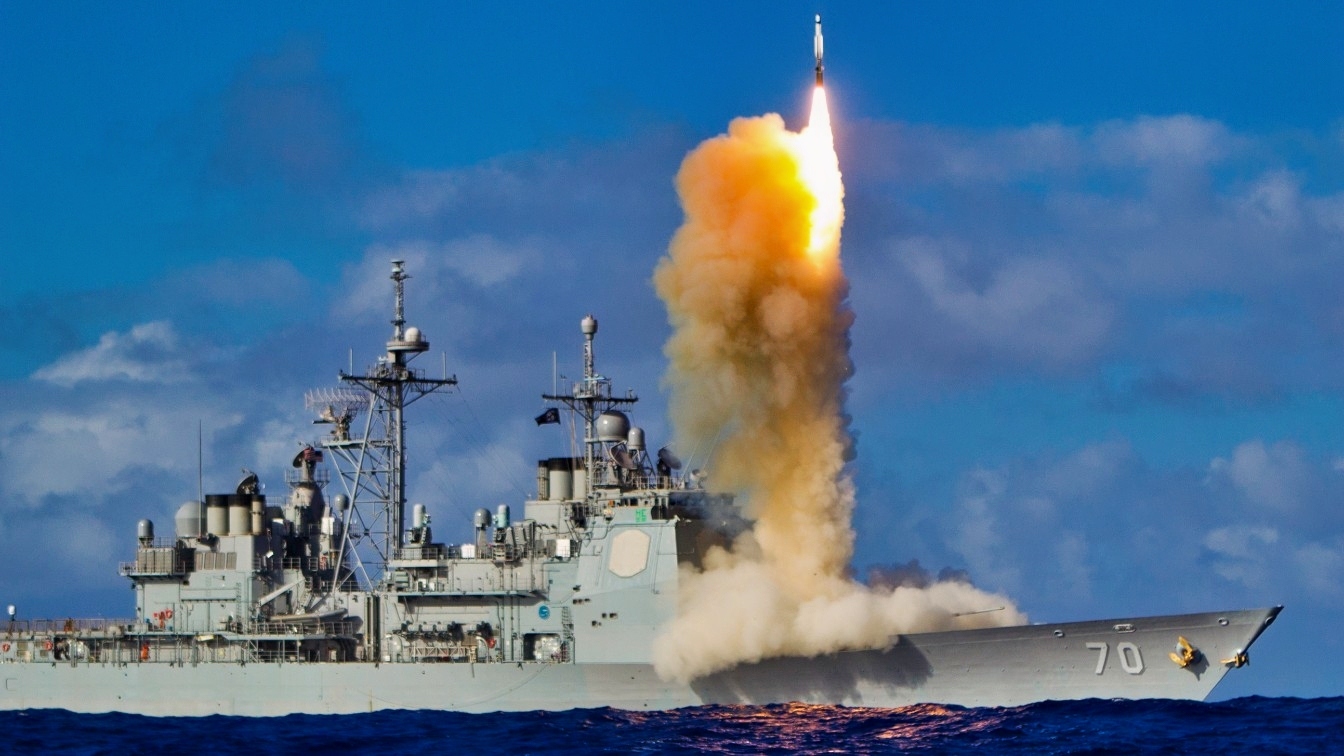
Worse, all that low-cost but effective Iranian airpower – drones and missiles – keeps the US fleet at a distance in the Gulf of Oman. Surface ships are slow, large targets for massed, cheap airpower.
In a tight space like the Strait, Iran would almost certainly have scored some hits had the US Navy tried to force the waterway to escort tankers. A US ship on fire, perhaps sinking, after being swarmed by Iranian airpower, would have instantly become the dominant televisual image of his administration.
This anti-access/area-denial success was a major test of the concept for China in East Asia. Like Iran, China knows that fighting the Americans symmetrically is very difficult.

Zumwalt-Class U.S. Navy Image.
Like Iran, it is building a drone and missile fleet to prevent the US Navy from sailing too close to China to support Taiwan or South Korea in a conflict. If a smallish middle power like Iran can back off the US Navy with threats of massed, cheap airpower, it is unsettling to think what vastly wealthier China will be able to do.
Overstretched
The large, background lesson of the war is that the US is reaching for goals in the Persian Gulf that it cannot attain without far more violence and expense. And it is quite clear now that the US public does not support this.
The Iran War was hugely unpopular. The US is overstretched there; it cannot achieve its goals without levels of force and expense that the country will not accept.
It is time to adopt a smaller, more retrenched posture so that the US can focus on more pressing issues, such as China.
Author: Dr. Robert Kelly, Pusan National University
Dr. Robert E. Kelly is a professor of international relations in the Department of Political Science and Diplomacy at Pusan National University in South Korea. His research interests focus on Security in Northeast Asia, U.S. foreign policy, and international financial institutions. He has written for outlets including Foreign Affairs, the European Journal of International Relations, and the Economist, and he has spoken on television news services such as the BBC and CCTV. His personal website/blog is here; his Twitter page is here.


chuanpu-the-pu
June 16, 2026 at 8:33 am
Generally, or fatefully, or karma-cally, Iran is totally different from china.
The US onslaught against Iran was carried out at the endless urging or unholy behest of AIPAC and netanyahu.
The coming US onslaught against china will be caused solely by the great American heartland’s desire to snuff out a rival. A deeply historic mission with deep endgame meaning.
(Snuff out somebody=kill/murder him.)
Like the desire to snuff out the Indian nations of north america. A job or task with religious-like obligation.
That’s the difference between Iran and china.
One-World-Order
June 16, 2026 at 9:11 am
What are the US deep state main objectives in the western pacific, today.
The deep state has never forgotten its ignominious failures in Korea an Vietnam.
Who to BLAME for those horrible failures.
The US has been secretly growing or establishing arms depots in Japan, Philippines and very, very recently, in south-eastern Australia.
Those arms depots are also meant to accommodate containerized nuclear weapons.
What exactly are those weapons.
They are tactical nukes hidden and transported in containers, or secured ‘mobile vaults’.
The US deep state reckons use of nukes, especially tactical nukes, is totally legit, in the vast western pacific.
That’s because the intended victim is especially large in size, think of a Burmese python trying to swallow an adult crocodile.
Impossible, totally impossible, unless somebody cuts up the croc into pieces.