

The American war against Iran has entered a weird phase. As the US searches for an exit, Israel and Iran are increasingly freelancing – ignoring America to fight a slow-motion war against each other. Both have long prepared for this and are ideologically committed to it. US President Donald Trump has set in motion forces he can no longer control.
Unless Trump is willing to escalate substantially – either by invading Iran to force it to terms, or by reducing US aid to Israel to pressure it (at the risk of a huge backlash from his own party) – America will become increasingly sidelined in a conflict Trump very obviously wants to end.
The B-2 Spirit flies over the Rose Parade at Pasadena Ca., Jan. 1, 2024. The Rose Parade is a parade of flower covered floats, marching band, and equestrian units that is produced by the Tournament of Roses. (U.S. Air Force photo by Airman 1st Class Bryce Moore)
Trump’s Unhappy Choice on the Iran War
Trump obviously no longer wants to fight the war. By his own admission, he is bored by it. His real interests have always been domestic. He cares about his ballroom; he worries about the midterms in the fall; he is energized by his vendettas and purges inside the Republican party. His foreign policy ventures – Venezuela, Iran, maybe Cuba – were to be ‘splendid little wars’ to bump off regional troublemakers – not protracted, unwinnable conflicts of the sort the US has fought for decades.
Trump now faces a choice – either to take full possession of a war he started and make his best effort to win, or fade away and accept a default Iranian victory. Because Trump wants neither of these outcomes, the war is now in a weird limbo phase.
Trump does not want to risk a ground invasion to achieve a decisive victory – because it could easily become a quagmire repeat of the 2003 Iraq War. But he also does not want to withdraw and accept Iranian control of the Strait of Hormuz and retention of its nuclear program. That outcome would be worse than President Barack Obama’s Iran deal, and Trump would be criticized mercilessly for that, which he seems to be aware of.
At least until the elections, Trump will likely defer this choice. He will pursue this quasi-war – the US blockade of the Gulf of Oman, coupled with occasional airstrikes like we saw this week.
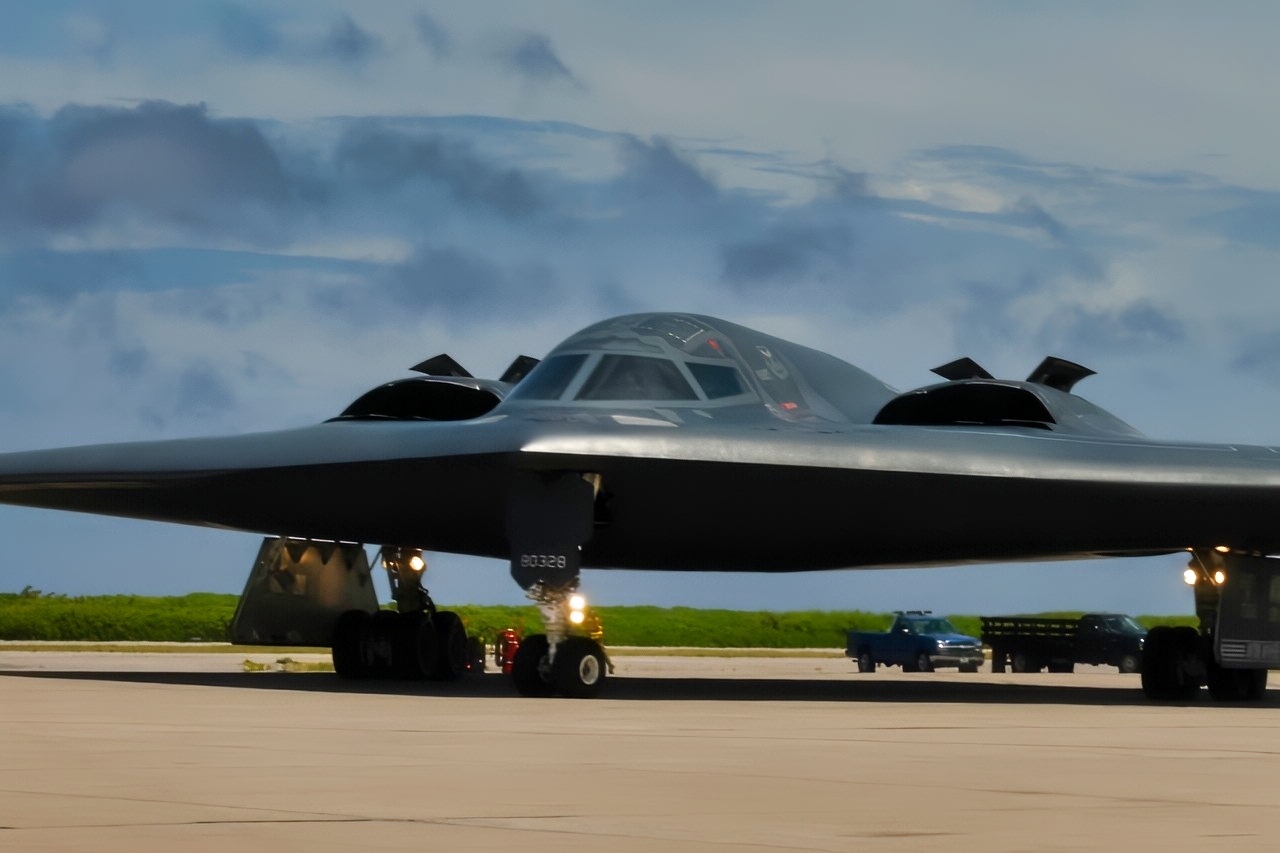
A B-2 Spirit Stealth Bomber, deployed from Whiteman Air Force Base, Missouri, taxis for take off at Naval Support Facility Diego Garcia, in support a Bomber Task Force mission, Aug. 26, 2020. BTF missions allow U.S. Strategic Command to provide persistent, long-term bomber presence to aid in U.S. Indo-Pacific Command’s commitment to a free and open Indo-Pacific. (U.S Air Force photo by Tech. Sgt. Heather Salazar)
He will not want to tolerate claims of a US defeat before the election. But dithering as he has since he suspended US airstrikes two months ago will not end the war on satisfactory terms. At this point, no one believes Trump when he says a peace deal is close. Neither Iran nor Israel is acting that way.
What Does a Peace Deal Look Like Now?
At some point, Trump will have to accept a deal to exit the war.
A permanent US blockade of the Gulf of Oman would have a massive negative impact on the world economy, for which most would blame Trump. Gas prices in the US – about which Americans are very sensitive – will remain elevated until the blockade ends, and given that oil stockpiles are running down, a price shock this summer is possible. A US commitment to an indefinite war with Iran is also expensive and diverts US military resources from more pressing theaters, most obviously East Asia.
Given that Iran – more specifically, its radical, autocratic government – appears willing to carry the costs of America’s limited war and blockade, the US will likely have to accept a balance-negative deal to halt the conflict.
Some have even made the accusation that the US is paying Iran not to fight. If the accusation was true, Trump would never admit that, but Iran has been demanding a war indemnity from the US as part of a final deal. It looks like the US is open to that. And that is not that bad, given the alternatives. Simply bribing Iran would be better than acceding to its geopolitical demands.
The two big concessions Tehran will likely seek are tolls on Hormuz traffic and retention of its nuclear program in some form. Trump can probably get some movement from Iran on support for its proxies. Iran will need to concede on that anyway to avoid indefinite war with Israel over Hezbollah in Lebanon. But on Hormuz and nukes, Iran will likely be implacable.

A U.S. Air Force B-2 Spirit, assigned to the 509th Bomb Wing, Whiteman Air Force Base, Mo., is flanked by two U.S. Air Force F-22 Raptors, assigned to the 1st Fighter Wing, Joint Base Langley-Eustis, Va., while conducting a flyover over the White House in Washington, D.C., July 4, 2025. The B-2 provides penetrating flexibility and effectiveness inherent in manned bombers. (U.S. Air Force photo by Airman 1st Class Geneva Nguyen)
Iran fought its way into control of the Strait of Hormuz and would be foolish to give it up. That is a huge strategic victory. Indeed, this is why so many analysts argue that Trump has lost the war despite the devastation the US bombing wrought.
Iran can extract rents from Strait traffic by doing nothing more than not threatening transiting tankers. So long as the world is dependent on carbon exports from the Gulf, this is an easy source of money.
Similarly, two waves of US-Israeli strikes on Iran in a year have illustrated the value of nuclear weapons. If Iran had had them, the US and Israel would not have attacked. Trump will not pry that from the Iranians at this point without actually invading the country.
How Trump will end this is unclear. I bet he will pay – a lot if necessary – to get some flexibility on the nukes and Hormuz. But Iran probably will not budge. So, the US will leave after the election, but the weird limbo war will still be unresolved and open-ended.

B-2 Bomber Elephant Walk. Image Credit: Creative Commons.
Iran will control the Strait and retain its uranium, but the US will not admit that. Others will simply pay the energy tolls. That status quo might be durable.
The larger lesson from this whole mess, of course, is that the US should stop trying to police the Middle East and just get out.
Author: Dr. Robert Kelly, Pusan National University
Dr. Robert E. Kelly is a professor of international relations in the Department of Political Science and Diplomacy at Pusan National University in South Korea. His research interests focus on Security in Northeast Asia, U.S. foreign policy, and international financial institutions. He has written for outlets including Foreign Affairs, the European Journal of International Relations, and the Economist, and he has spoken on television news services such as the BBC and CCTV. His personal website/blog is here; his Twitter page is here.


