


Congratulations to the 50,000 U.S. forces deployed to U.S. Central Command. The United States and Iran signed a Memorandum of Understanding that could reshape the Middle East – if Iran behaves.
After decades of escalating aggression, more than 13,500 strikes carried out during Operation Epic Fury flattened Iran’s power projection capabilities and ended their path toward a nuclear weapon.
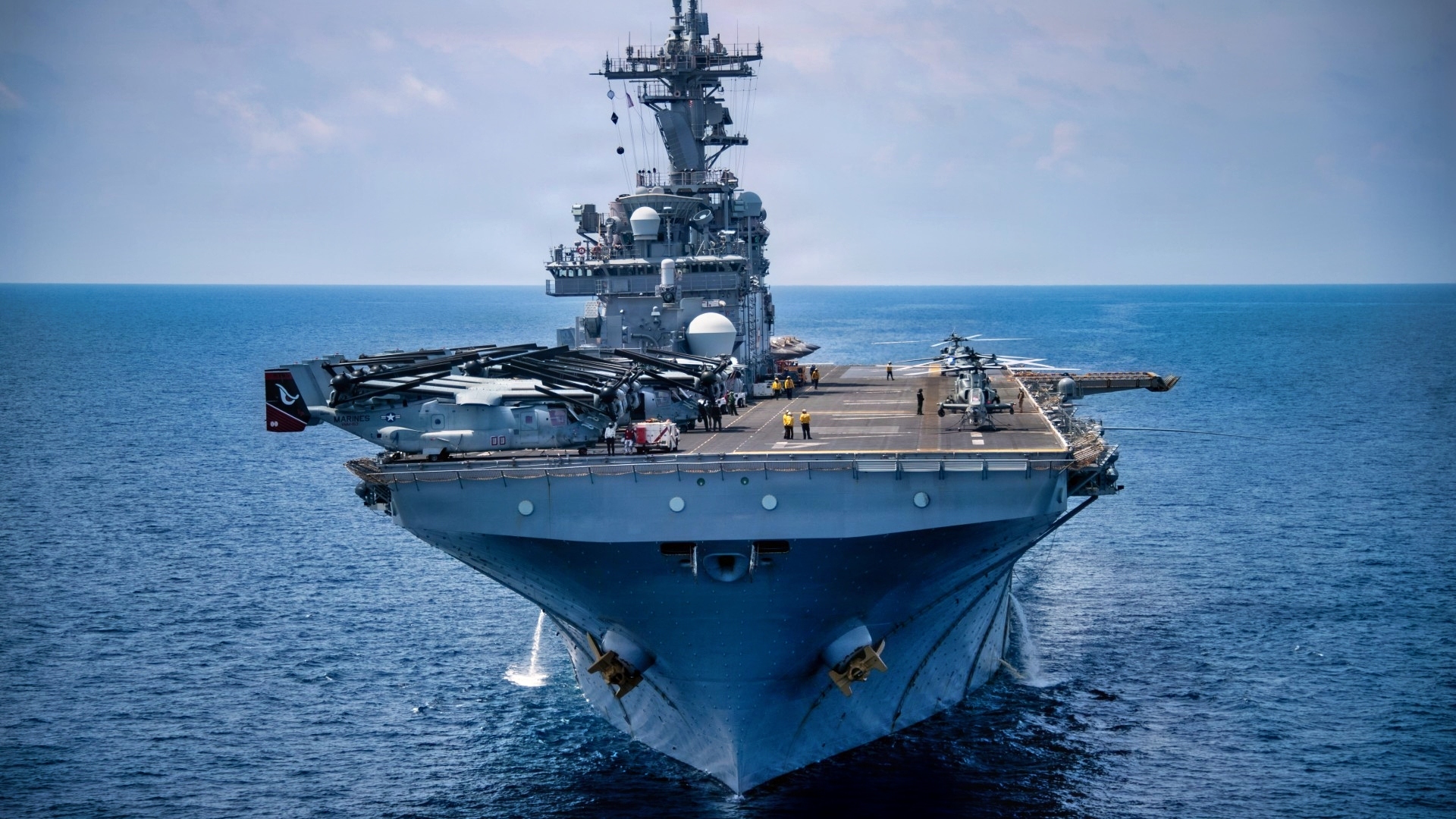
Wasp-class amphibious assault ship USS Boxer (LHD 4) transits the South China Sea, June 8, 2026. Boxer, flagship of the Boxer Amphibious Ready Group, is underway with the 11th Marine Expeditionary Unit in the U.S. 7th Fleet area of operations. U.S. 7th Fleet, the Navy’s largest forward-deployed numbered fleet, routinely interacts and operates with allies and partners to preserve a free and open Indo-Pacific. (U.S. Navy photo by Mass Communication Specialist Seaman Eliora Sims)
But U.S. forces can’t pack up their gear just yet.
The aircraft carriers USS Abraham Lincoln and USS George H.W. Bush, the amphibious assault ship USS Tripoli, several destroyers, and land-based F-16s, F-35s, and F-15Es are still on call.
So are the A-10s and Apache helicopters patrolling the Strait of Hormuz.
U.S. Central Command’s job is not over.
“If I don’t like their behavior, we’ll go right back to dropping bombs in the middle of their heads,” Trump said during his meeting with Egypt’s president on the sidelines of the G7 on June 17.
Here’s what could go awry – and why U.S. Central Command must keep hefty forces in place this summer to exert visible pressure on Iran as negotiations unfold.
The Nuclear Dust
The heart of the deal is Iran’s commitment not to procure or develop nuclear weapons.
The MOU also commits to negotiations on the so-called nuclear dust: the 1,000 pounds of highly-enriched uranium illegally produced by Iran starting back in 2021. (They originally purchased 550 tons of raw uranium from South Africa back in the 1980s.)
The MOU calls for the “minimum methodology to be down-blending on site under the supervision of the IAEA.”
Another option is to load the material into heavy-duty cylinders for transport by road, rail, sea, or air to Kazakhstan or another location, where it can be fed back into fuel rods for civilian nuclear power plants.
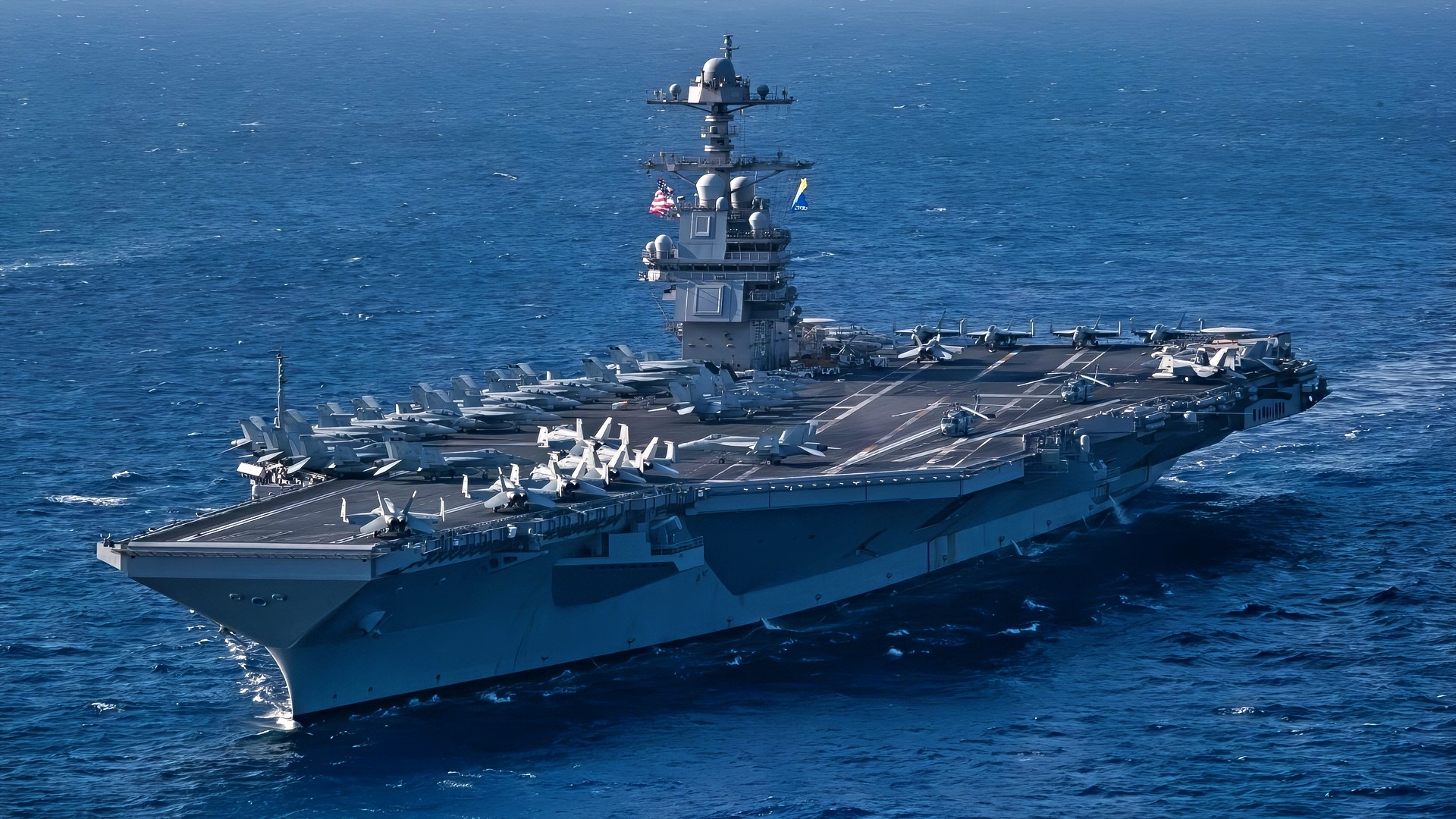
USS Gerald R. Ford Aircraft Carrier At Sea. Image Credit: Creative Commons.
Administration officials have consistently spoken about the 24/7 surveillance of sites at Natanz, Fordow, Esfahan, Pick Axe mountain, etc., that are connected to Iran’s enrichment activities.
The U.S. Space Force and airborne ISR will have to continue to watch every move.
If negotiations falter, then U.S. Central Command must have contingency plans to go get it. This would look a little like the April rescue of the downed F-15E crew: hundreds of aircraft in place, live fire buffers, and special operations forces backed up by the U.S. Army and Marine Corps.
Snatching the enriched material without Iran’s cooperation would require holding territory and an airlift route for several days. Hence, the plan is to negotiate.
Drone Watch
Drone strikes remain perhaps the biggest threat. If Iran launches drones at ships or Gulf states, the MOU will be in peril.
Drone attacks were the scourge of Operation Epic Fury, and Iran violated the ceasefire many times after April 8. In the UAE alone, air defenses engaged 2,012 drones (mixed in with 438 ballistic missiles and 19 cruise missiles) through April 1, 2026.
Iranian Shahed drones hit two Amazon Web Services data centers in the UAE in early March, and another drone attack targeted an AWS data center in Bahrain on April 1.
Iran didn’t stop drone attacks after the ceasefire.
A pumping station for Saudi Arabia’s East-West massive oil pipeline to the Red Sea was struck on April 8, hours after the ceasefire took effect. Then, on May 17, Iran struck the backup electrical generator at the Barakah Nuclear Power Plant in the UAE.
This is part of the reason that land-based airpower and the aircraft carriers will remain in place. F-16s on patrol in CENTCOM have been loaded for shooting down drones: extra drop tanks, and not one, but two wing-mounted guns, adding to their internal gun.
Apache helicopters are also in the counter-drone fight. The Army has been developing counter-drone tactics and a new proximity detonation munition for the AH-64E’s vicious 30 mm chin gun.
Escorting the Shippers. Perhaps the number one sign of how the situation is going will be ship traffic. Having hundreds of vessels cowering in the Persian Gulf was an unforeseen outcome of Iran’s drone and missile attacks.
While the U.S. Navy retained tactical dominance, the shippers dropped anchors. Random Iranian drone strikes and fast boat maneuvers kept the Strait clogged.
However, in late April, two U.S. Navy destroyers transited the Strait, and, as it turns out, the U.S. CENTCOM continued clearing operations. “Project Freedom never stopped,” Secretary of War Pete Hegseth told CBS News Face the Nation on June 14.
The enhanced surveillance of the Strait of Hormuz dubbed Project Freedom began in early May. “We are employing U.S. ballistic-missile defense capable destroyers, over 100 land and sea-based aircraft, multi-domain unmanned platforms, meaning under the sea, on the sea, and from the air … and 15,000 service members to extend this defensive umbrella across the Strait of Hormuz to protect our forces, and also as a commitment to defend commercial shipping,”
Admiral Brad Cooper, Commander, U.S. Central Command, said May 4. Hegseth said ships carrying over 125 million barrels of oil have moved out through the Strait in recent days.
Now, commercial shippers are eager to get underway.
Maritime Executive reported ample evidence that “both oil and LNG tankers in ballast are pre-positioning towards the Gulf area, in expectation that traffic will resume imminently,” but also cautioned mariners are in “wait-and-see” mode pending instructions on when ships can use the normal Traffic Separation Scheme of outbound or inbound lanes.
Moving traffic out of the Strait will be like exiting a parking garage after a football game.
There are many ships to move, and some are still awaiting routes and destination berths. Hegseth forecast a 30-day period to return Very Large Crude Carriers, container ships, and bulkers to routine transits.
This means several weeks more of tough duty for U.S. Navy sailors. Some of the guided missile destroyers have been at sea for months; for example, USS Delbert Black (DDG 119) left her homeport of Mayport, Florida, on January 3.
The aircraft carrier USS Gerald R. Ford set a record for the longest deployment since the Vietnam War, launching over 12,000 aircraft from her new catapults before being relieved by USS George H. W. Bush.
And if Iran still misbehaves? Seize Kharg Island.
The 31st MEU aboard USS Tripoli and elements of the 82nd Airborne deployed to the region train constantly for air assault. Control of 90% of Iran’s oil flow would be the ultimate leverage if the mullahs do not abide by the MOU.
About the Author: Rebecca Grant, PhD
Dr. Rebecca Grant is a National Security Analyst based in Washington, D.C., and Vice President of the Lexington Institute. She has over 20 years of experience working with the United States Air Force, United States Navy, and top aerospace clients. In addition, Dr. Grant has often appeared on television as a national security expert for Fox News, Fox Business, Newsmax, News Nation, and CNN, and as a series regular on The Smithsonian’s Air Warriors. Her latest documentary is The History Channel’s World War II with Tom Hanks. Dr. Grant also writes on China, Russia, and other technology and national security topics for Fox News Opinion. Her military books include 75 Great Airmen (with Lt. Gen. Chris Miller), The B-2 Goes to War, and Battle-Tested: Aircraft Carriers in Afghanistan and Iraq. Dr. Grant graduated from Wellesley College and earned a PhD in International Relations from the London School of Economics, University of London.


bish-bish
June 18, 2026 at 10:35 pm
The US today has its military stationed everywhere on the planet, even right on the front porch of other nations.
Thadda fault of japs. Hell to japs. Recall Halsey’s words.
In the persian gulf region, the US military stations its forces not just in the Arabian sea, but also on the soil of Kuwait, Bahrain, UAE and saud.
That, however, makes the gulf Arabs, who by the way, are now accustomed to living a life of grand luxury, vulnerable targets for hostile firepower.
Gulf Arabs don’t want their shiny top notch space-age facilities hit by cheap drones and missiles.
In the far-off future, those facilities could again be hit, with missiles carrying thermo warheads. Made and sold by north Korea.
One-World-Order
June 19, 2026 at 12:56 am
The US intense concentration of military power in the gulf region represents a great danger to peace and prosperity in the whole entire middle east region.
It also helps to increase the US annual budget deficit. Which is like giving more rope to a man to hang himself.
The US is so concentrating and increasing military force in the arctic region, THUS helping to aid global warming.
But the greatest worry is the increasing determination to set up unfettered military power in the western pacific.
US is today setting up massive arms and ammo depots in japan and philippines. The latest additions are the upcoming secret sites in south-eastern australia.
The sites are to to facilitate the transport and storage of nuclear weapons (b61, B83) hidden in secure storage vaults built inside shipping containers.
Thus, the presence of US concentrated military power everywhere around the eorld poses a great danger to the world and to humanity.
Dr. Hujjatullah M.H.B. Sahib
June 19, 2026 at 8:28 am
How can the mullahs really mull the MOU if the harassing MEU is primed to mow the Kharg Island, as this alarmist write up muses ? The annoying fact remains that the U.S. had previously bombed out the pre-eminant mullah who dedicatedly kept Iran from going nuclear lethal. Won’t this malignant legacy conspire to trap if not also to decimate the special forces that would potentially be expended to foolishly uncover and recover the nuclear dusts ?