

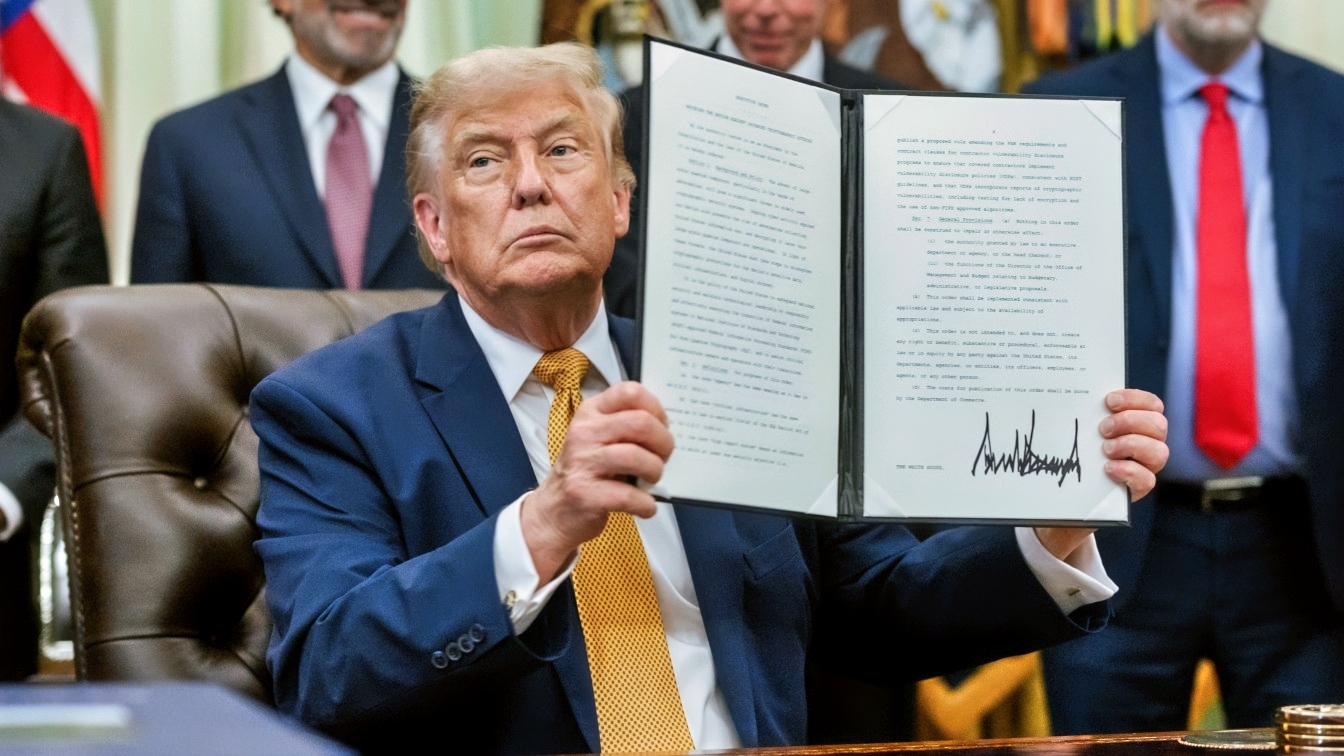
The latest round of friction within the NATO alliance will see American Secretary of Defense Pete Hegseth leading a review of the American troop presence in Europe. Slated to last for six months, the close examination of how deeply America will be involved in European defense in the future has caused some consternation on the European side of the alliance. But what would a revised American role in Europe look like exactly? What kinds of shortcomings could a truncated American presence on the continent create — what gaps would be left for the European to fill?
Prospects for A Full American Pullout of NATO
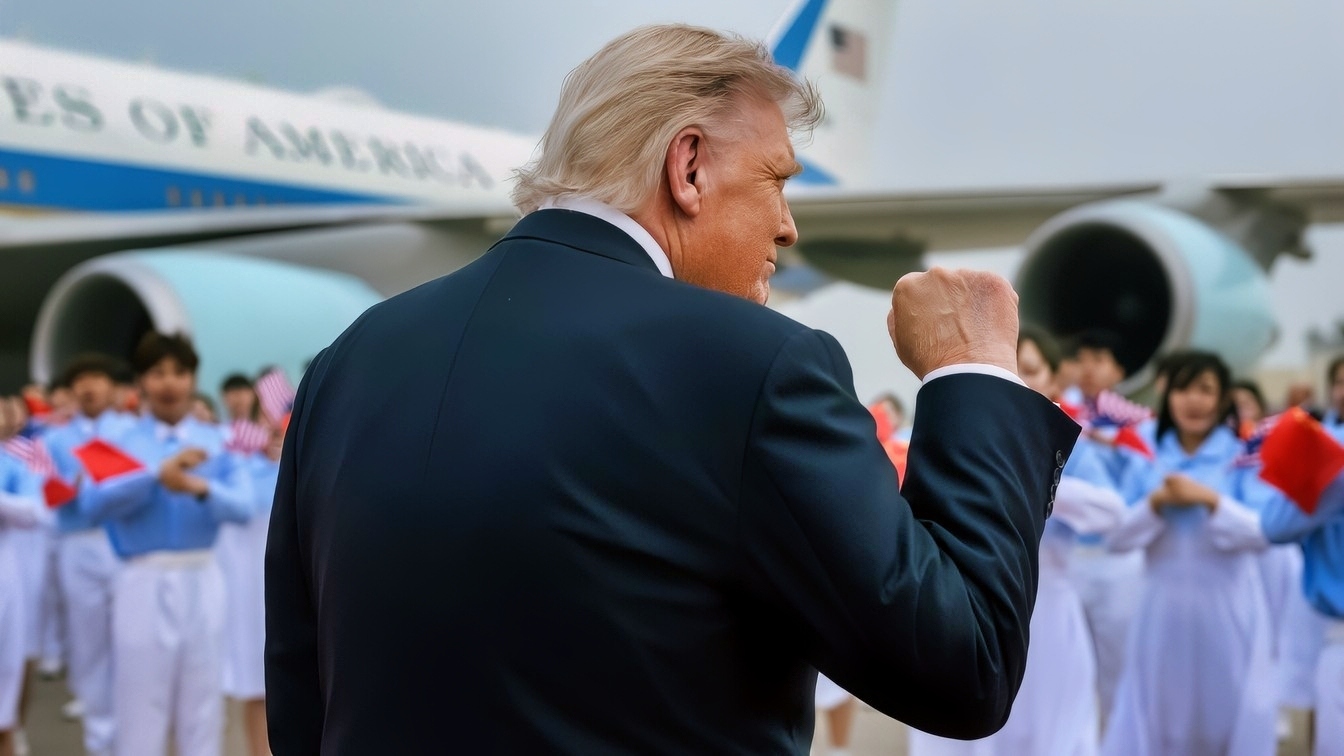
President Donald J. Trump greets Ambassadors David Perdue and Xie Feng, Executive Vice Minister of Foreign Affairs Ma Zhaoxu and Minister of Foreign Affairs Wang Yi at Beijing Capital International Airport, China on Friday, May 15, 2025, before boarding Air Force One en route Washington, D.C. (Official White House Photo by Daniel Torok)
A complete withdrawal of the United States is, despite the bluster from Washington, exceedingly unlikely. In 2023, the U.S. Congress passed legislation that explicitly prevents any sitting U.S. President from withdrawing or otherwise suspending the American commitment to the NATO alliance. An exception is carved out if a two-thirds majority of the Senate backs withdrawal from the alliance.
Then-President Joseph Biden signed the legislation into law. But that has not prevented the current American President, Donald Trump, from shaking his rhetorical fist at the NATO alliance.
Speaking to Reuters, a wire service, President Trump said that he would certainly reconsider the American commitment to NATO over what he called NATO allies’ tepid support of his war in Iran.
“I’ll be discussing my disgust with NATO,” the president said. When queried about his broader intentions of an American withdrawal, the president was blunt. “Oh, absolutely without question,” the president said. “Wouldn’t you do that if you were me?”
The Consequences of a Withdrawal
While an American pullout would indeed be a strategic shock for Europe, it would not immediately spell the downfall of the alliance. Rather than simply losing manpower, however, the alliance would lose a network of enablers, command links, and the all-important nuclear umbrella that makes NATO so potent.
NATO’s eastern flank would be the hardest-hit, as would NATO’s air and maritime domains and the alliance’s command-and-control architecture.
Current alliance planning counts on a major American role in intelligence, surveillance, and reconnaissance (ISR), as well as tanker support, strategic airlift, missile defense, and electronic warfare.
Therein lies the crux of the issue — the American support to the alliance is not so much about the number of soldiers the United States has stationed on the continent, though certainly an important factor, but about the key force-multiplying systems American troops operate — the eyes and ears of the alliance, as well as specialized refueling and heavy-lift roles.
One of the largest apparent gaps would be in strategic deterrence and the role of the bomb. American extended deterrence and nuclear sharing are the central pillars of the NATO alliance.
Without access to American nuclear weapons, the remaining NATO members would have to lean much more heavily on French and British nuclear forces, which are optimized for national deterrence rather than continent-wide, umbrella protection.
Capabilities Reduced — but not Defenseless
Europe would be far from a sitting duck, however. A number of NATO members have significantly bolstered their defenses since the full-scale Russian invasion in 2022, and the alliance’s spending targets have moved upward.
As a whole, NATO’s land forces, air defenses, and defense industries are much more robust than they were even just a few years ago.
If given enough time, NATO could eventually replace in part the capabilities lost by an American withdrawal. But even the continent’s most capable countries would likely struggle to replace most American capabilities at speed.
In some areas in particular, European space-based ISR could take up to a decade to fully assume the overwatch role the United States now holds.
The Broader Take: Diminished and Fragmented
A potentially difficult outcome of an American pullout from the NATO alliance would be not just the alliance’s military weakness but also deep political fragmentation. As was previewed during the damaging American-led global trade war, individual states could seek one-to-one guarantees from Washington, whereas some European countries could conceivably band together around a common European defense pillar.
As with the gradual evolution of languages, fragmentation could jeopardize collective defense planning, as individual countries opt for systems and standards optimized for their own national defense rather than for the defense of the entire continent.
In short, an American withdrawal from NATO would be damaging to Europe but wouldn’t risk a total takeover of the continent by a foreign adversary. Instead, Europe would become slower to react, have a decreased military reach, lower deterrence, and degraded situational awareness, particularly at the strategic level.
Given enough time, the European countries could conceivably plug a hypothetical America-sized gap in the alliance, but hammering out the details could prove to be contentious.
Thankfully, the prospects for an American abandonment of Europe are slim.
About the Author: Caleb Larson
Caleb Larson is an American multiformat journalist based in Berlin, Germany. His work covers the intersection of conflict and society, focusing on American foreign policy and European security. He has reported from Germany, Russia, and the United States. Most recently, he covered the war in Ukraine, reporting extensively on the war’s shifting battle lines in the Donbas and writing about its civilian and humanitarian toll. Previously, he worked as a Defense Reporter for POLITICO Europe. You can follow his latest work on X.


