


Last week, the Ukrainian Air Force (PSU) confirmed that it shot down a Russian Su-35 multirole fighter jet that was on combat patrol on the eastern front.
“Today, another Russian air terrorist was eliminated,” the PSU announced in a post on Telegram.
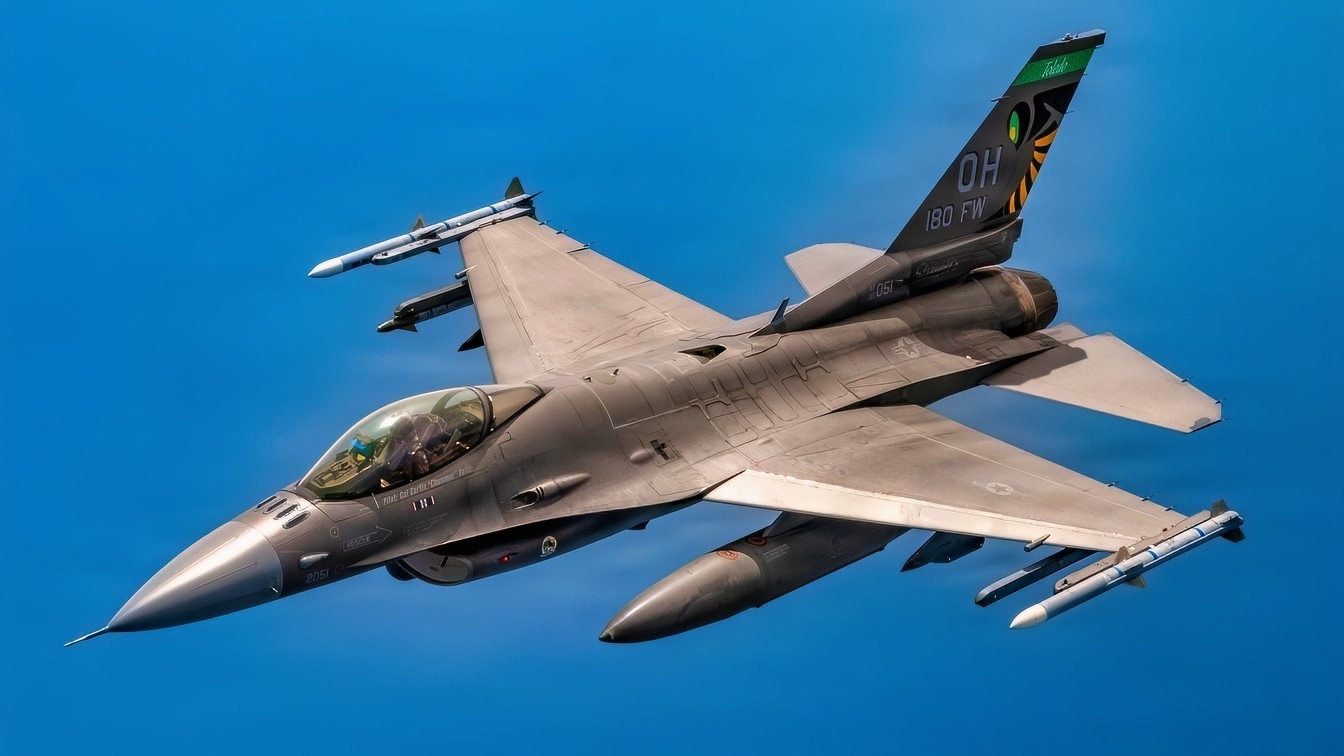
An F-16 Fighting Falcon, assigned to the 180th Fighter Wing, flies alongside a KC-135 Stratotanker with the 121st Air Refueling Wing over the skies of Canada, May 20, 2026. The F-16 Fighting Falcon can fly more than 500 miles, but the KC-135 can extend its radius beyond that and deliver airpower anywhere, anytime, globally. (U.S. Air National Guard photo by Airman 1st Class Taylor Warehime)
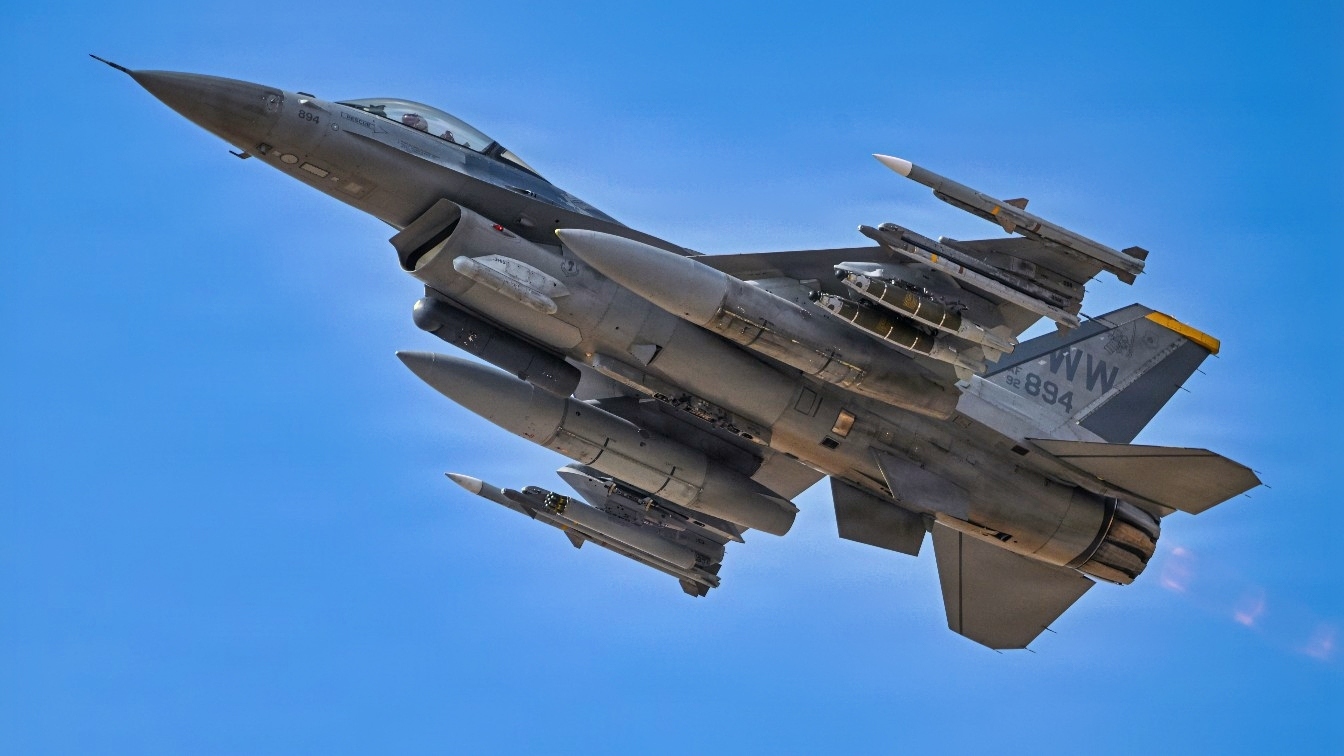
A U.S. Air Force F-16 Fighting Falcon takes off from a base in the U.S. Central Command area of responsibility May 21, 2026. (U.S. Air Force photo by Staff Sgt. Justin W. Moore)
Ukraine is bringing down one of these fighters, which is touted as one of the Russian Air Force’s VKS’s most advanced combat aircraft.
Since the February 2022 invasion of Ukraine, this aircraft has been pressed into service for air superiority missions and interdiction strikes against Ukrainian targets on the ground.
The destruction of this Su-35 announcement comes after a 26 June attack on the Russian-occupied region of Crimea that destroyed a Russian Mikoyan MiG-29 fighter jet at Belbek aerodrome.
This attack was later credited to the Ukrainian military’s Main Intelligence Directorate (HUR) in a report on 4 July.
That successful strike was followed on 3 July by a drone assault on the Saki aerodrome, one of the other main military aircraft facilities on the peninsula.
Seven aircraft were reported destroyed, including the Su-30SM and Su-30, which share many of the same design characteristics as the Su-35.
All these losses combined amount to financial setbacks suffered by Moscow’s military that, from just these three incidents alone, would total in the hundreds of millions of dollars.
Since the war against Ukraine began, Russia has lost 436 fixed-wing aircraft and 353 helicopters, according to figures compiled by the Ukraine General Staff.

Su-35. Image Credit: Creative Commons.
Caught In a Trap
A Su-35 air superiority fighter was reported to have been shot down on 7 July in the Kursk region of Russia during what is being called an ambush operation.
There remains some confusion, however, as to how and with what weaponry the Su-35 was downed.
The PSU stated the shootdown involved a Patriot long-range air defense system. The US-made air defense battery was reportedly deployed close to the border specifically for the purpose of just such a surprise attack.
The operation was reportedly carried out as an integrated trap: a Ukrainian F-16 flew a pattern mimicking that of an aircraft dropping laser-guided bombs, thereby decoying the Su-35 into the Patriot’s engagement zone.
This prompted the Russian pilot to pursue an intercept course, which provided the air defense unit’s crew with the necessary targeting telemetry until the aircraft was within the range envelope of the ground-based Patriot system.
This more widely accepted version says that the Su-35 was shot down by the Patriot, but Ukrainian military experts say the Russian fighter was actually shot down by a PSU F-16 pilot.
In this version, it is believed that the Russian aircraft was hit by a US-made AIM-120 AMRAAM missile from an American-made fighter, rather than by the Patriot battery.
Hard to Replace
For years now, Russia has avoided sending its Su-57 stealth fighter into any contested Ukrainian airspace.
This is to keep the aircraft and its on-board systems from falling into the hands of Western nations should it be shot down over Ukraine.
This has made the Su-35 the workhorse of the VKS in the Ukraine conflict, with at least 9 of this type lost and other Ukrainian claims of as many as 25 kills.
Whatever the numbers are, they will not be easy for the VKS to replace due to very low production rates at the Komsomolsk-na-Amure plant, which manufactures the aircraft.
In December 2025, Russia’s United Aircraft-Building Corporation (OAK) reported it had delivered a new, seventh batch of Su-35S aircraft to the Russian military, but no exact numbers were specified.
It is estimated that only 15 to 18 Su-35S aircraft will be delivered in 2025, while total deliveries in 2024 were 15 across four batches.
About the Author: Reuben F. Johnson
Reuben F. Johnson has thirty-six years of experience analyzing and reporting on foreign weapons systems, defense technologies, and international arms export policy. Johnson is the Director of Research at the Casimir Pulaski Foundation. He is also a survivor of the Russian invasion of Ukraine in February 2022. He worked for years in the American defense industry as a foreign technology analyst and later as a consultant for the U.S. Department of Defense, the Departments of the Navy and Air Force, and the governments of the United Kingdom and Australia. In 2022-2023, he won two awards in a row for his defense reporting. He holds a bachelor’s degree from DePauw University and a master’s degree from Miami University in Ohio, with a specialization in Soviet and Russian studies. He lives in Warsaw.


