


The Houthis, the Shia terror group based in Yemen, struck Saudi-flagged oil tankers in the Red Sea, marking the opening of a new, adjacent theater in the war with Iran and simultaneously sending the price of oil to a two-month high — and marking the opening of a new front in the war in Iran.
While the Tehran-backed Houthis have mostly sat out the current conflict with Iran, their decision to jump into the fray and aid their patron Iran was likely prompted by several dovetailing events. The bombing of Yemen’s international airport in the capital, Sanaa, allegedly by Saudi warplanes provided the initial impetus for the decision, as did the renewed attacks against Iranian targets by the United States, strikes that are entering their second week following the precarious truce struck when Tehran and Washington agreed to the terms of a vaguely worded memorandum of understanding. Though intended to bring an end to the war in Iran, the text of that document is effectively over.

F-35I Adir High in the Sky. Image Credit: IDF/Creative Commons.
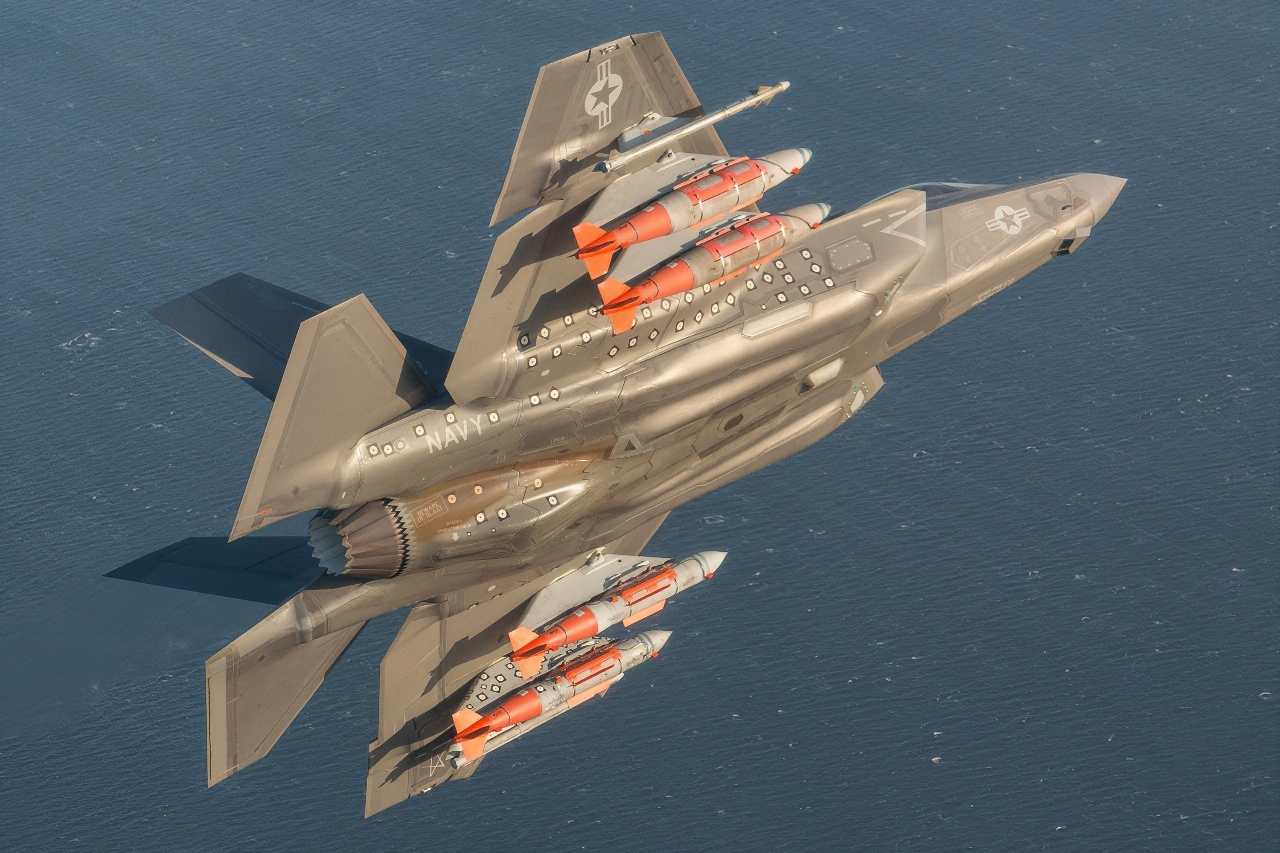
Billie Flynn, F-35 Pax River ITF, conducts an external GBU-31 and AIM-9x buffet and flutter test flight (Flt 592) from Naval Air Station Patuxent River, Maryland, April 4, 2018, in an F-35C test aircraft, CF-2. Photo courtesy of Lockheed Martin.
But Houthi involvement in the war relieves some pressure on Iran. According to reporting by Reuters, Tehran flew “commanders, military advisers and missile- and drone-related equipment” affiliated with Iran’s Islamic Revolutionary Guard Corps to Yemen just days before the Houthis declared their embargo of Bab al-Mandeb.
The Bab al-Mandeb Strait
Though overshadowed by its larger cousin, the Strait of Hormuz, which before the conflict with Iran erupted transported about a fifth of the world’s oil, the Bab al-Mandeb is not exactly a small waterway. Though certainly narrower than the Strait of Hormuz, Bab al-Mandeb has increased in importance since the bottling of Hormuz by Iran. According to data attributed to Kepler, approximately 6.2 million barrels of oil have transited the Bab al-Mandeb since the war began, a figure that is attributable partly to redirected oil flows via the East-West pipeline to Yanbu, a Saudi port on the Red Sea.
Speaking to CNN, Helima Croft, the Managing Director and Head of Global Commodity Strategy at RBC Capital Markets, explained that Saudi utilization of the East-West pipeline has diverted 4 to 5 million barrels of oil per day that would have been transported via Hormuz before the war.
But, Croft explained, “If that route [the East-West pipeline] becomes inoperable, then the oil supply disruption becomes more serious, and we start talking again about a ‘no way out’ situation.”
An Expanding War?
Overnight, the Houthis claimed responsibility for attacks on a pair of Saudi oil tankers in the Red Sea, a move that sent the price of oil to $100 per barrel and marked the first time oil had reached those heights since May.
The strikes on the vessels effectively ended an unofficial truce that existed between Riyadh and the Houthis for several years. In response to the Houthi attacks, American President Donald Trump threatened the Islamist group.
Writing on Truth Social following the Houthi attacks, the president struck a defiant note. “A year ago the United States of America attacked, very powerfully, the Houthis, for their interference with commerce and trade, by shooting at ships. Since that time, and during our conflict with Iran, they have acted very responsibly. Unfortunately, now they are starting up again, shooting at two Saudi Arabian ships last night,” the president declared.
“Please let this TRUTH serve to represent that if they do this again,” President Trump added, “the U.S. will hold Iran responsible, in that the Houthis are a Surrogate and/or Proxy of Iran, and major military punishment will be inflicted upon Iran and, of course, the Houthis, themselves, who I am very disappointed with in that they have, until now, acted very professionally and smart.”
A Stretched U.S. Navy
The United States Navy is currently tasked with blockading Iran’s ports on the Persian Gulf, a formidable task. While the White House seemingly hoped that the American naval presence there would persuade shipping companies and maritime ensurers that the strait would be safe to navigate, that argument is apparently a hard sell, judging by the few transits of the Strait of Hormuz to date. In the meantime, strikes on Iran continue.
Posting to X, formerly Twitter, United States Central Command provided details about yesterday’s strikes, the 13th straight night of strikes against Iranian targets. “CENTCOM targeted Iranian military command centers, drone storage facilities, communication networks, coastal surveillance sites, and maritime capabilities to further diminish the threat Iran poses to civilian mariners and commercial vessels transiting the Strait of Hormuz.”
“The international waterway remains open for transit despite recent attacks from Iran’s Islamic Revolutionary Guard Corps. Commercial vessels continue to freely navigate the strait with U.S. military support,” Central Command said, adding that “more than 50,000 U.S. service members are currently operating across the Middle East.”
About the Author: Caleb Larson
Caleb Larson is an American multiformat journalist based in Berlin, Germany. His work covers the intersection of conflict and society, focusing on American foreign policy and European security. He has reported from Germany, Russia, and the United States. Most recently, he covered the war in Ukraine, reporting extensively on the war’s shifting battle lines from Donbas and writing on the war’s civilian and humanitarian toll. Previously, he worked as a Defense Reporter for POLITICO Europe. You can follow his latest work on X.


