

Is the Strait of Hormuz, one of the world’s most important chokepoints, returning to normal? Crude oil exports through the strait have returned to prewar levels, according to CNBC-cited data. Seven-day averages, as of last Monday, were 13.5 million barrels per day through the strait, roughly matching the prewar crude baseline.
More notably, total crude exports from the Middle East region, including the Persian Gulf and Red Sea, reached 19.5 million bpd—above the prewar baseline of roughly 17 million bpd. The uptick in exports has occurred despite tumultuous circumstances, i.e., Iran repeatedly declaring Hormuz closed, US naval blockades, and the ongoing war. But the headline numbers obscure an important metric: while crude has recovered, refined fuels have not. So global consumers are likely to still feel economic pain, even as oil begins moving from the Persian Gulf again in meaningful quantities.
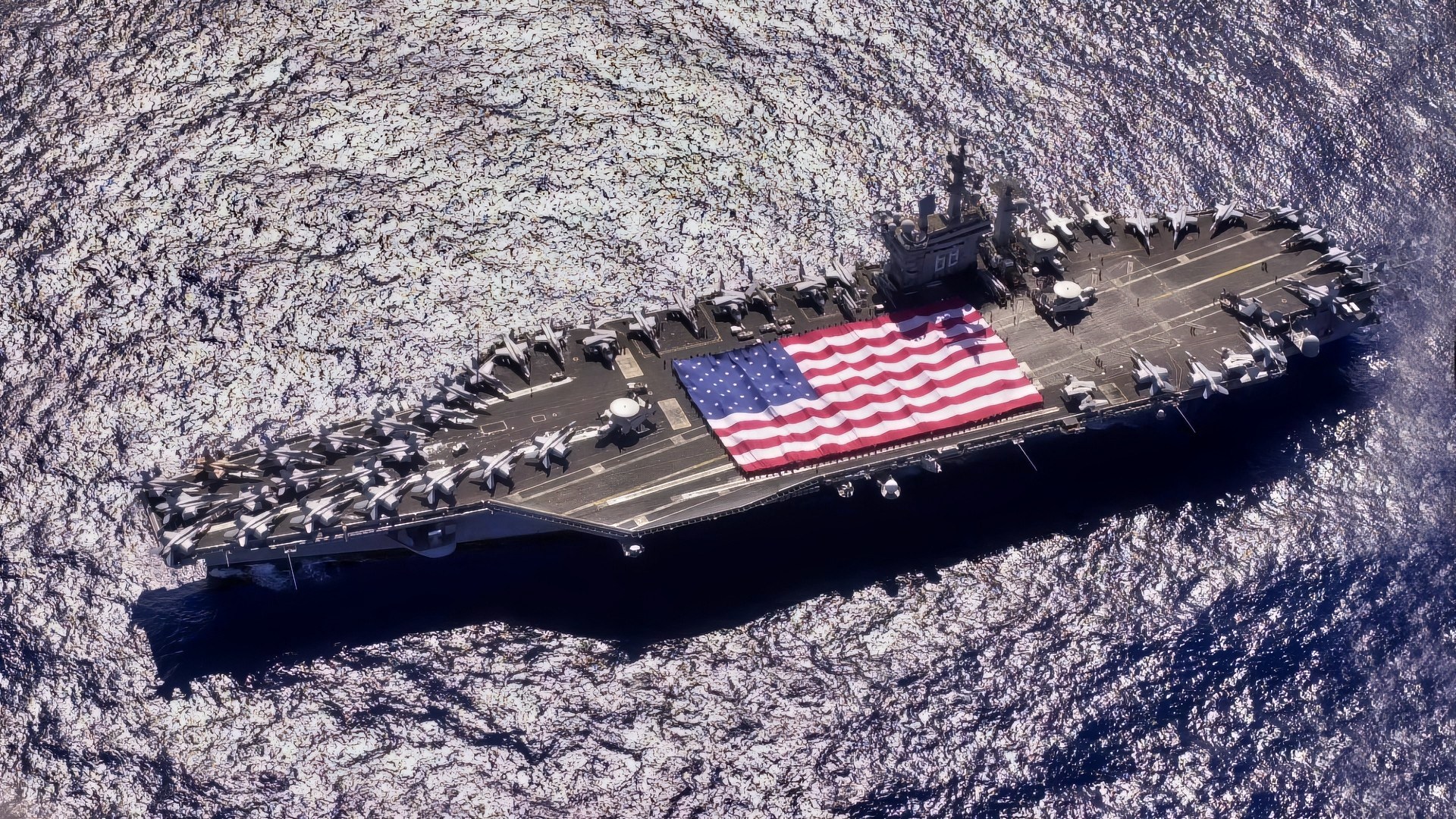
Pacific Ocean (November 3, 2003) — During Tiger Cruise aboard USS Nimitz (CVN 68), Nimitz and Carrier Air Wing Eleven personnel participate in a flag unfurling rehearsal with the help of fellow tigers on the flight deck. The Nimitz Carrier Strike Force and Carrier Air Wing Eleven (CVW-11) are in route to Nimitz homeport of San Diego, California after an eight-month deployment to the Arabian Gulf in support of Operation Iraqi Freedom. U.S. Navy photo.
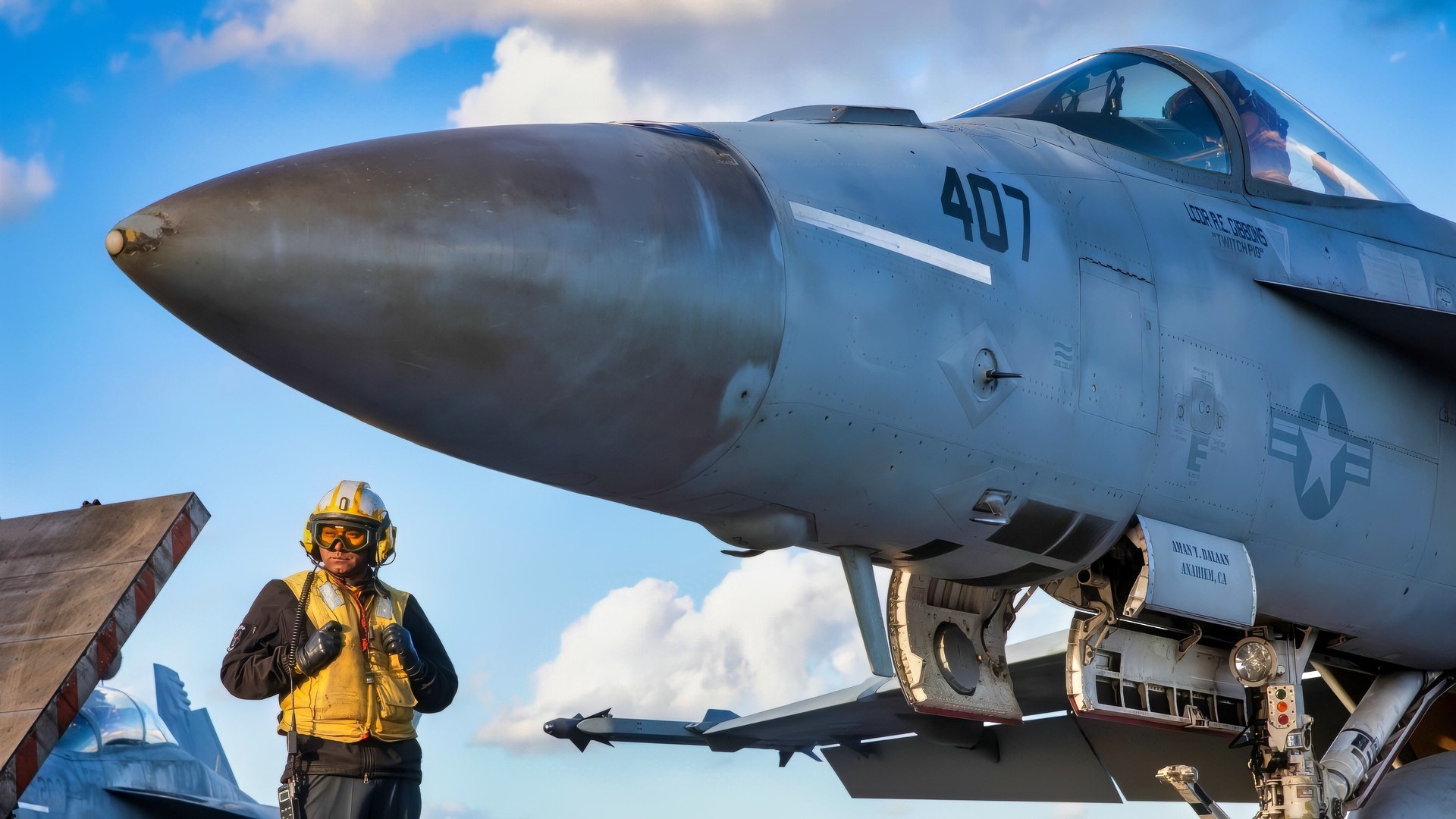
Aviation Boatswain’s Mate (Aircraft Handling) 1st Class Jose Mejiacastro, assigned to Air Department aboard the world’s largest aircraft carrier, USS Gerald R. Ford (CVN 78), prepares to signal to a Carrier Air Wing 8 F/A-18E Super Hornet attached to Strike Fighter Squadron 87 on the flight deck, Sept. 26, 2025. Gerald R. Ford, a first-in-class aircraft carrier and deployed flagship of Carrier Strike Group Twelve, is on a scheduled deployment in the U.S. 6th Fleet area of operations to support the warfighting effectiveness, lethality and readiness of U.S. Naval Forces Europe-Africa, and defend U.S., Allied and partner interests in the region. (U.S. Navy photo by Mass Communication Specialist 2nd Class Mariano Lopez)
Recovering Crude
To boost crude exports, Gulf producers and the US military have essentially built a workaround around the disrupted Strait using three key mechanisms. First, tankers are receiving US protection.
Second, ship-to-ship transfers are occurring outside of the strait. Third, pipeline bypass capacity has increased.
These changes have mitigated Iran’s ability to fully control the strait. Indeed, Tehran appears to be losing influence over oil flows, as substantial volumes now pass through the strait.
This does not mean the security environment has normalized; it means the supply chain has adapted to an abnormal security environment.
Tanker Shuttles
Perhaps the most interesting operational detail from the Strait is that more than 70 percent of crude crossing Hormuz in August switched tankers off the UAE or Oman.
Rather than a conventional tanker sailing from a Gulf producer all the way to Asia, small shuttle tankers carry crude through the dangerous Hormuz passage, reach the Gulf of Oman, and transfer their cargo to another vessel—a larger tanker that continues the long-distance journey abroad.
This method limits larger ocean-going tankers’ exposure to Iranian attacks. With the US military protecting the shuttle operation, it further reduces risk. This effectively creates a maritime relay system through contested waters. It’s a clever fix, though inefficient.
The relay system is expensive, time-consuming, and demands a major commitment from the US military.
Accordingly, the system may not be a long-term solution. But for now, it works.
Pipeline Bypass
Saudi Arabia and the UAE also use pipelines to route more crude entirely around the Strait.
Today, roughly 40 percent of Gulf crude bypasses Hormuz through pipelines—a huge increase from about 17 percent prewar. The Saudi East-West pipeline moves oil towards the Red Sea and Yanbu, avoiding the Strait, while the UAE’s pipeline routes to Fujairah.
The war shows why Gulf states invested in bypass infrastructure, offering an alternative around Hormuz, a geographic chokepoint in a highly sensitive region. Of course, the pipelines are not invulnerable.
Saudi’s pipeline was damaged by a drone strike launched from Iraq earlier in September, forcing a temporary shutdown.
But Refined Fuels
Crude oil recovery through the Strait can make the overall energy picture look healthier than it is. Refined-product flows through Hormuz remain suppressed. Prewar flow was about 3.6 million bpd.
The current seven-day average?
Just 677,000 bpd.
That’s about 81 percent below prewar levels. Combined crude and refined products, the outflow is about 14.2 million bpd, or about 80 percent of the prewar 17 million bpd baseline.
This is important. Diesel matters to the global market. Consumers don’t put crude oil in trucks, for example. Refineries transform crude into diesel, gasoline, jet fuel, heating fuels, and petrochemical feedstocks. So, exporting plenty of crude doesn’t automatically solve the shortage of finished products consumers are experiencing worldwide.
The situation remains a global fuel crisis.
The fuel needed to power trucks, agricultural machinery, construction equipment, and industrial machinery remains in short supply.
About the Author: Harrison Kass
Harrison Kass is a writer and attorney focused on national security, technology, and political culture. His work has appeared in Tablet, City Journal, The Hill, The Spectator, and The Cipher Brief. He holds a JD from the University of Oregon and a master’s in Global & Joint Program Studies from NYU. More at harrisonkass.com.


