

Trump Can Seize Kharg Island. He Can’t Seize Its Customer: Venezuela keeps coming up in the Kharg Island conversation, and not by accident. When Trump posted on Truth Social Thursday that the United States would at some point take “total control” of Iran’s oil and gas markets — Kharg Island and “other oil infrastructure points” — he made the comparison explicit. Washington did it to Venezuela, he said. It can do it to Iran.
That comparison is worth taking seriously because Trump is not wrong that the Venezuela operation worked. Since the January raid that removed Maduro — an operation Trump himself ordered and has repeatedly cited as a model — the United States has effectively been running Venezuelan oil exports. Crude flows to Gulf Coast refineries.

U.S. Army Training Official U.S. Army Photo.
Revenues now park in a Treasury account. Delcy Rodríguez, governing in Maduro’s absence, has opened the country’s oil sector to foreign investors under terms Washington prefers. It is a remarkable arrangement, less a regime change than a hostile takeover of a national revenue stream, and it is exactly the template Trump has in mind for Iran.
There is a logic to it. If you can capture the infrastructure that generates an adversary’s hard currency, you have done something more durable than a sanctions regime, which leaks, or an air campaign, which ends. Energy capture as a doctrine has real appeal.
The problem is that Venezuela and Iran are not the same deal, and the difference has almost nothing to do with military power.
The Denial Mission Is Already Done
Before getting to what the blockade cannot accomplish, it is worth establishing what the blockade already has.
The U.S. Navy has been effective.
Since the blockade went into effect in April, exports through Kharg have collapsed. UANI tracked zero crude shipments passing through the blockade during the entire month of May.
Tankers have been piling up at anchor near the island since early June, unable to move.
Treasury Secretary Bessent publicly noted that Kharg’s storage was full — at roughly $170 million in lost daily revenue, the pressure on Tehran is real and mounting. CENTCOM reported on June 10 that U.S. forces have redirected 134 commercial ships and disabled eight others since the blockade began.
The denial mission, in other words, is largely accomplished. The blockade has already done what a seizure is supposed to do: cut Tehran off from its export revenue. Iran cannot sell what it cannot ship.
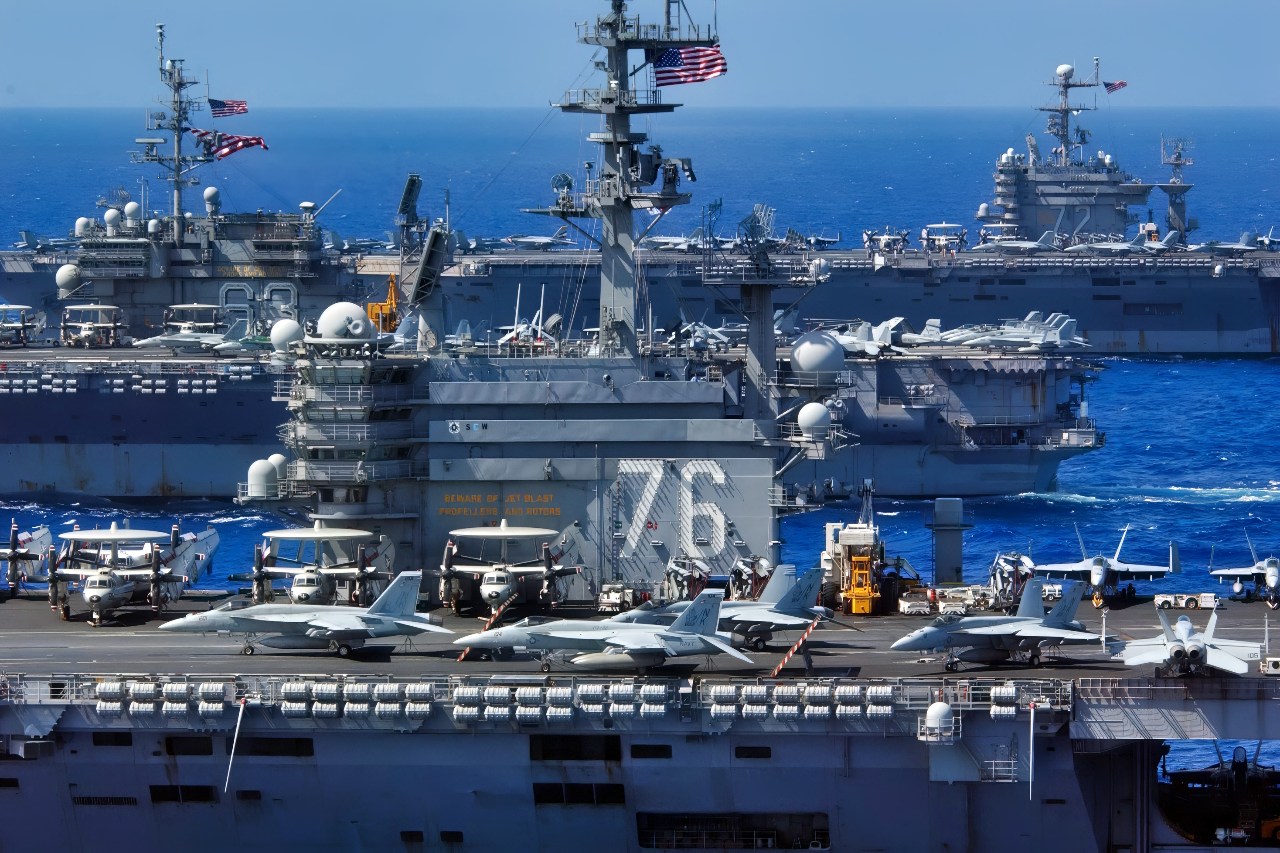
USS Ronald Reagan (CVN 76), USS Kitty Hawk (CV 63), and USS Abraham Lincoln (CVN 72) cruise side-by-side in the Philippine Sea June 18, 2006, during exercise Valiant Shield 2006. The joint exercise consists of 28 naval vessels, more than 300 aircraft, and approximately 20,000 service members from the Navy, Army, Air Force, Marine Corps and Coast Guard. (U.S. Navy photo by Chief Photographer’s Mate Spike Call) (Released)
So what would seizing the terminal actually add? The answer is an operating problem.
Kharg’s Oil Has One Serious Buyer
Venezuelan crude is heavy. Gulf Coast refineries were built, many of them, to process exactly that grade. When Washington seized control of Venezuelan exports, there was a buyer waiting — one that is also the enforcer. The economics closed in a circle. Revenue that had flowed to Caracas started flowing to Washington instead because the United States sat at both ends of the transaction.
Iranian crude does not work that way. Before the war, roughly 90% of what remained of Kharg was heading to Asia, and the overwhelming share of that was going to China — specifically to the independent “teapot” refineries in Shandong Province that have been the backbone of Iran’s sanctions-evasion architecture for years.
Not American refineries. Not allied refineries. Chinese refineries.
That is not a logistical footnote. It is the entire problem with the Venezuela analogy.
If U.S. forces took Kharg, they would hold a terminal connected by pipeline to Iran’s major producing fields, capable of processing and loading crude. What it could not do, under present American policy, is sell that crude to the only buyer who wants it in volume. The Treasury Department has already sanctioned five refineries for processing Iranian crude and warned banks that they face exposure for financing the same transactions.
The whole architecture of maximum pressure is built around denying Iran access to its customers. Seizing the terminal and then selling its crude would mean either dismantling that architecture or finding alternative buyers for oil grades that Chinese independent refiners have been purchasing mostly because no one else particularly wanted them.
The Venezuela model worked because the United States was the customer. At Kharg, the customer is the country Washington is simultaneously sanctioning. Beijing has already invoked blocking rules against the teapot sanctions and shows no sign of compliance; it would simply stop buying rather than negotiate under duress, leaving the terminal with no revenue stream at all.
That is not a problem amphibious assault solves.
What the Walk-Back Actually Reveals
There is something worth noticing in Thursday’s timeline. Trump posted the Kharg threat in the morning. By the time he sat down with Fox News, the register had shifted: he was not sure “America has the stomach” for it. The hedging is being read as bluster cycling back toward reality, which is probably right. But the hesitation points to something beyond the mined shoreline, or the MANPADs Iran has repositioned onto the island since the March strikes, or the prospect of casualties in a contested amphibious landing.
The deeper problem is that the strategic logic doesn’t close even if the assault goes perfectly. A clean seizure — no casualties, oil infrastructure intact — runs straight into the buyer problem. Who purchases the crude, on what terms, and what does that do to the broader posture toward Beijing? The Venezuela analogy has no answer to those questions. It was built for a situation where the enforcer and the customer were the same party.
At Kharg, they are on opposite sides of the same sanctions wall, and the beach itself has been mined for months.
Iran’s leverage in this war was never really located on the island itself. It was located in the fact that China still wants the oil. Washington has spent months trying to build a barrier between Tehran’s barrels and Beijing’s refineries. Seizing the terminal would not move that barrier. It would just place American soldiers on the wrong side of it.
About the Author: Dr. Andrew Latham
Andrew Latham is a professor of international relations and political theory at Macalester College in Saint Paul, MN. You can follow him on X: @aakatham.


telangpu chuanpu
June 12, 2026 at 1:38 pm
President trump says a peace deal with Iran is possible by this weekend, now being early afternoon Friday 12 june 2026.
Probably, that’s a load of bull, especially from trump, who likes to provide totally misleading information to the media.
But a raid on kharg will force Iran or the IRGC to set the whole persian gulf region ablaze.
Bye-bye, Arab sheikhs and trump relationship.
FRED ADAMS
June 13, 2026 at 1:03 pm
“What it could not do, under present American policy, is sell that crude to the only buyer who wants it in volume.”
In a world where oil prices have escalated two-fold, US sale of oil from Kharg is unquestionably assured. Unless there is something “dirty” about Iranian oil that allows only China to process it, a ridiculous idea. Others wait in line to acquire that oil, especially now that Russian production has been significantly reduced by Ukraine.
Would Kharg be another Okinawa? Doubt it.
Blocking Iranian revenue by denying them the straits and increasing the passage of oil from other countries through the straits are choking Iran. Give them time to die.
Charlie Montross
June 13, 2026 at 4:46 pm
Instead of “taking” Kharg Island to deny Iran any profits from its oil, mine the waters around the island.
Deny tankers from getting to Kharg with sea mines with preset timers. When the mines self detonate, the Navy can remine the waters as needed or desired.