

Could America Run Out of Oil Due to the War in Iran? President Donald J. Trump has apparently lost the plot when it comes to the Iran War. On the one hand, he has pushed for obtaining a ceasefire with the Islamic Republic of Iran. Of course, this was after he started an unprovoked war with Iran. What’s more, Trump has punctuated that ceasefire with declarations that he was going to annihilate the entire ancient Persian civilization and that the Iranians were “scum.”
The real reason that President Trump is upset is less because of his fears that Iran will acquire nuclear weapons, and more because the Iranians are demonstrating control over the Strait of Hormuz, one of the most important waterways for world trade.

The Nimitz-class aircraft carrier USS Dwight D. Eisenhower conducts rudder turns during sea trials. Dwight D. Eisenhower completed a nine-month planned incremental availability at Norfolk Naval Ship Yard on June 10 and is scheduled to resume underway operations this summer.
The Strait of Hormuz Is the Real Battlefield: Oil Is the Prize
You see, since the start of the war, the Iranians have managed to blockade the Strait of Hormuz, choking off 100 million barrels of oil per week from getting through. Sure, the Iranian blockade has not been total.
But even after Trump entered into the Memorandum of Understanding (MoU) with Iran a few weeks back, shipping never reached its prewar level of 140 ships passing through the Strait per day.
That shortage of shipping has had profound impacts on the global economy and on the potential stability of the political systems of countries dependent on energy (and fertilizer and other industrial inputs) from the region.
The United States has succeeded in preventing a precipitous increase in fuel costs at the pump for ordinary Americans, thanks to the implementation of emergency release measures from America’s nearly 400-million-barrel-strong Strategic Petroleum Reserve (SPR).
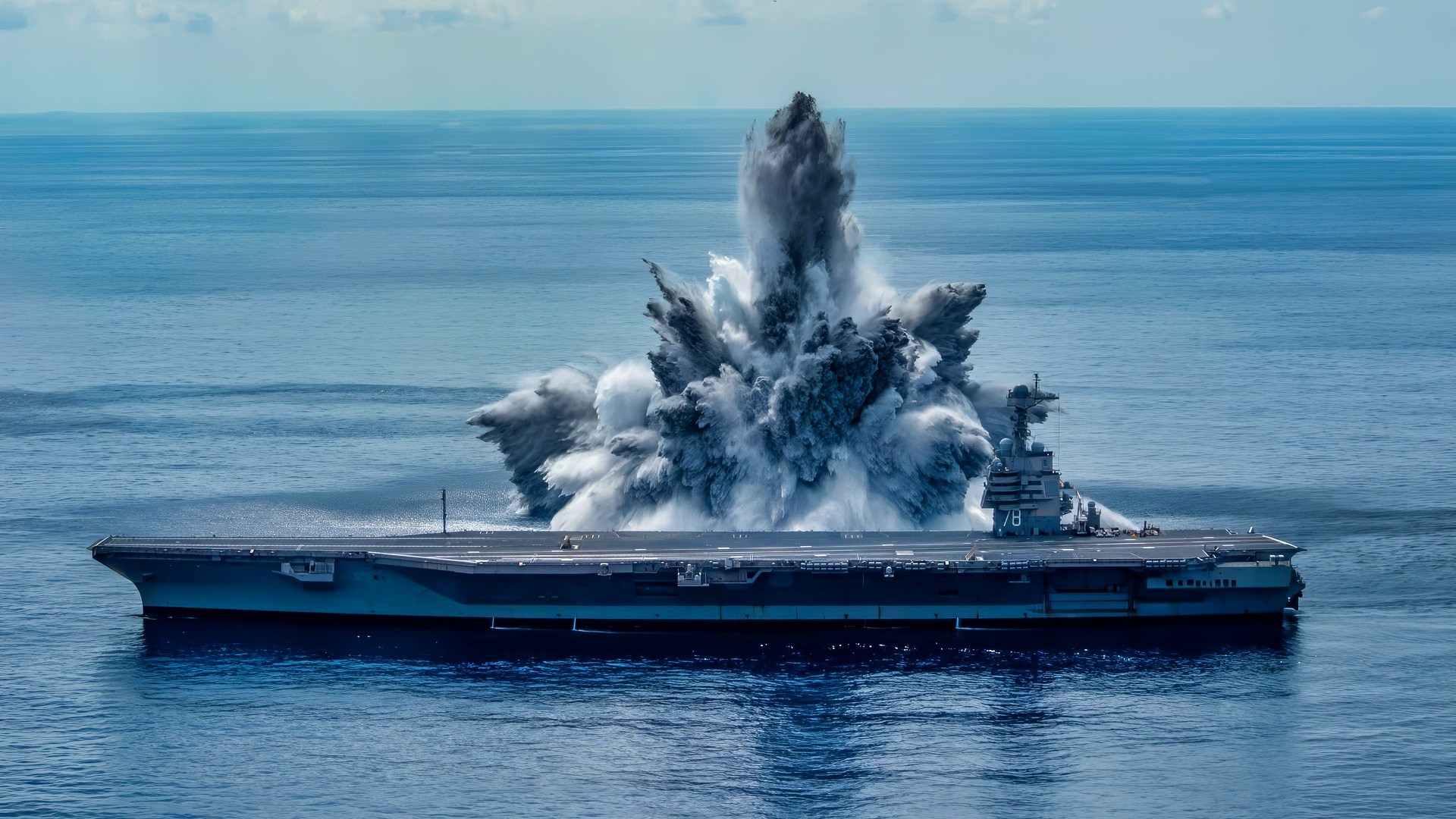
The aircraft carrier USS Gerald R. Ford (CVN 78) successfully completes the third and final scheduled explosive event of Full Ship Shock Trials while underway in the Atlantic Ocean, Aug. 8, 2021. The U.S. Navy conducts shock trials of new ship designs using live explosives to confirm that our warships can continue to meet demanding mission requirements under harsh conditions they might encounter in battle. (U.S. Navy photo by Mass Communication Specialist 3rd Class Novalee Manzella)
America’s Energy Buffer Is Running Out
The longer the blockade goes on, though, the faster the US government drains its SPR.
Once drained, if energy is not flowing through the Strait, the United States faces a situation in which demand exceeds supply, leading to massive price spikes for ordinary Americans. And we’re talking about days, possibly weeks. Not months. That will have profound economic impacts and severe political consequences for the Republican Party heading into the midterm election cycle this Fall.
These two crises faced by President Trump–the economic coupled with the political in short order–were daunting problems to overcome to begin with.
But if, as President Trump has explicitly stated, the Memorandum of Understanding (MoU) is, in fact, over, then trying to mitigate the twin near-term economic and political consequences of his war of choice against Iran is impossible. Surely, Trump would not allow this to occur, if for no other reason than purely self-interested reasons.
The Escalation Trap Has No Easy Exit
Yet, one cannot help but think of former US Secretary of Defense Robert McNamara’s 11 lessons from The Fog of War. Number two on that list was McNamara’s lesson (having learned it the hard way from the Vietnam War) that “Rationality will not save us.” Per McNamara’s dictum, “Human fallibility, when combined with high-stakes scenarios […] means that luck, rather than intellect, ultimately prevents catastrophe.” In this case, luck might be running out for the arrogant Trump administration.
Trump finds himself trapped in an endless loop of escalation-to-deescalation that, in turn, leads to more escalation. On its own, it’d be a tiring sequence of events. But the depletion of America’s energy stockpiles to their lowest levels in decades is the factor no one is paying much attention to. Trump cannot get off the merry-go-round, and that merry-go-round is edging closer to the cliff.
Soon, no one will be able to stop gravity from taking its course.
The president appears to understand that his escalations against Iran risk the implosion of the American system. But Trump cannot countenance unilaterally standing down–especially when the Iranians will absolutely exert total control over the Strait of Hormuz if Trump does that. Nevertheless, the Iranians are exerting relative control over the Strait by threatening military action, which forces shippers to avoid using it, thereby adding to insurance costs and the time required to transport goods globally.
None of that really harms the most self-sufficient Iran.
Trump is locked in. He won’t stop the war. The Iranians don’t have to stop the war because they understand the longer it lasts, the graver the damage both to the American economy and to President Trump politically, and the more advantageous a position they find themselves in.
A Painful Fall Is Coming
For those of you soothing yourselves and your audiences and/or clients with soothing sounds and promises that the war will end soon, wake up and taste the bitter reality. The United States is still engaged in the war. It’s too late to stop the really damaging aspects of this Strait of Hormuz closure from negatively impacting the country and the global economy, and the United States is in for a truly painful Fall.
The forty-seventh president is not a master of this conflict. Events overcome him. And we are all going to pay for his miscalculations sooner than the Wall Street wizards and the military ‘experts’ at the Pentagon assume.
About the Author: Brandon J. Weichert
Brandon J. Weichert is the Senior National Security Editor. He also manages The Weichert Brief on Substack. Weichert also hosts “National Security Talk” on Rumble. He is the author of four bestselling national security books, the most recent of which is A Disaster of Our Own Making: How the West Lost Ukraine (Encounter Books). Follow him via Twitter/X @WeTheBrandon.


