


The USS Gerald R. Ford (CVN-78) is concluding a 317-day deployment, marking the longest carrier deployment in the post-Vietnam era. The original plan was for a seven-month deployment—but at eleven months, the Ford’s deployment was repeatedly extended due to global crises, underscoring both the flexibility and the fragility of US carrier operations. Now, the Ford heads to port for what will likely be a year-or-more maintenance cycle.
USS Gerald R. Ford Aircraft Carrier Deployment: Why Eleven Months?
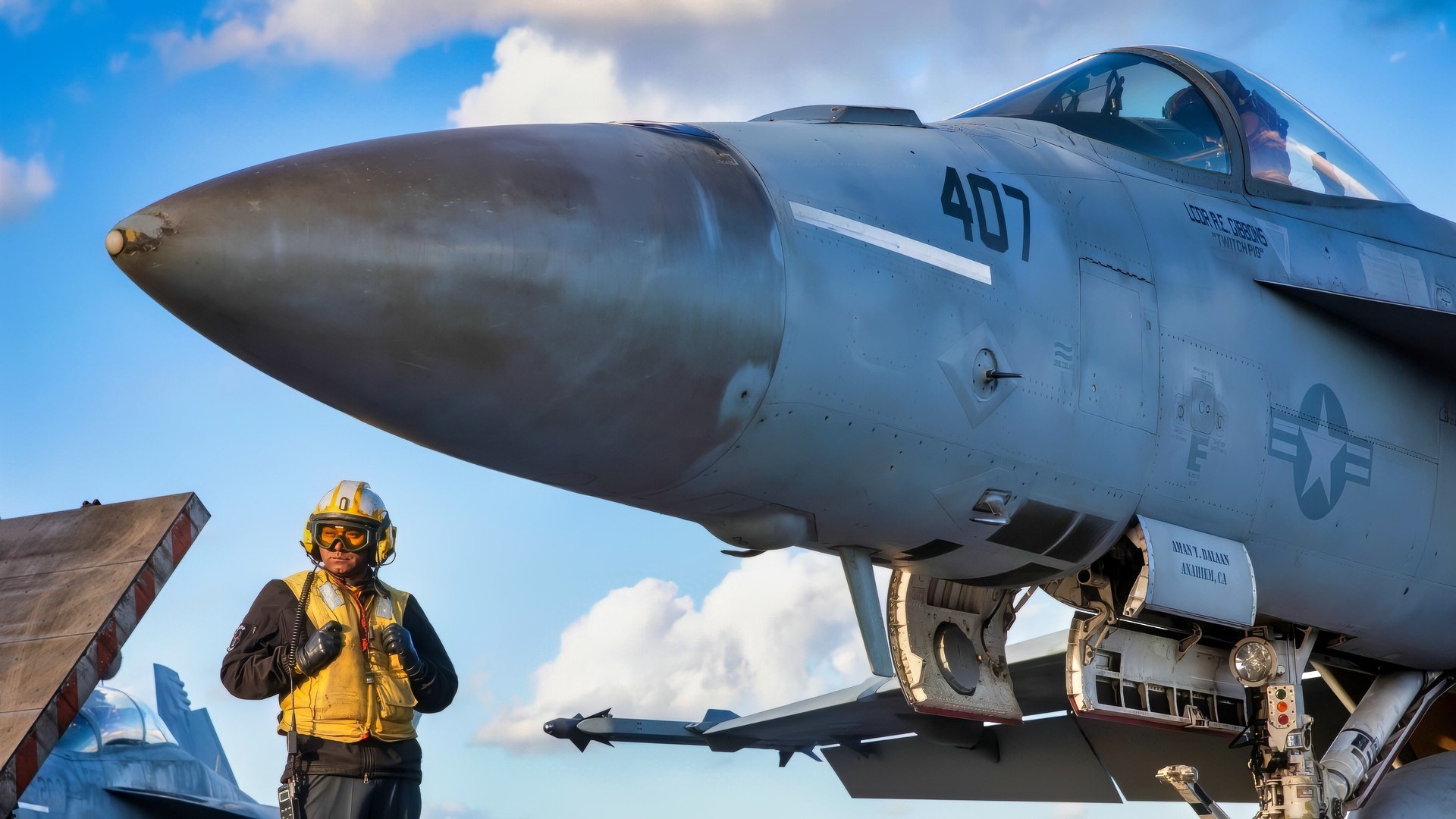
Aviation Boatswain’s Mate (Aircraft Handling) 1st Class Jose Mejiacastro, assigned to Air Department aboard the world’s largest aircraft carrier, USS Gerald R. Ford (CVN 78), prepares to signal to a Carrier Air Wing 8 F/A-18E Super Hornet attached to Strike Fighter Squadron 87 on the flight deck, Sept. 26, 2025. Gerald R. Ford, a first-in-class aircraft carrier and deployed flagship of Carrier Strike Group Twelve, is on a scheduled deployment in the U.S. 6th Fleet area of operations to support the warfighting effectiveness, lethality and readiness of U.S. Naval Forces Europe-Africa, and defend U.S., Allied and partner interests in the region. (U.S. Navy photo by Mass Communication Specialist 2nd Class Mariano Lopez)
The primary driver for Ford’s eleven-month deployment was Operation Epic Fury. The Ford served as the anchor of the US’s Red Sea blockade, intercepting oil shipments and pressuring the Iranian economy.
But before Epic Fury, the Ford was rerouted to the Caribbean to support operations leading to the capture of Venezuelan President Maduro. Again and again, the Ford’s deployment was extended; the Pentagon assessed that the withdrawal of the most sophisticated carrier in the world would lead to instability. So, the Ford remained deployed because no acceptable replacement was available.
What the Ford Did
The reason a carrier exists is to launch aircraft. And with the efficient EMALS launching system, the Ford launched hundreds of sorties, targeting the Iranian mainland and the Persian Gulf.
The Ford and her aircraft also protected global shipping lanes, especially energy routes.
Earlier in the deployment, the Ford integrated with NATO forces in the Atlantic and High North, offering strike, deterrence, and logistics support. Across three regions, the Ford acted as a mobile airbase and command node, the most prominent and capable ship of her type in the world.
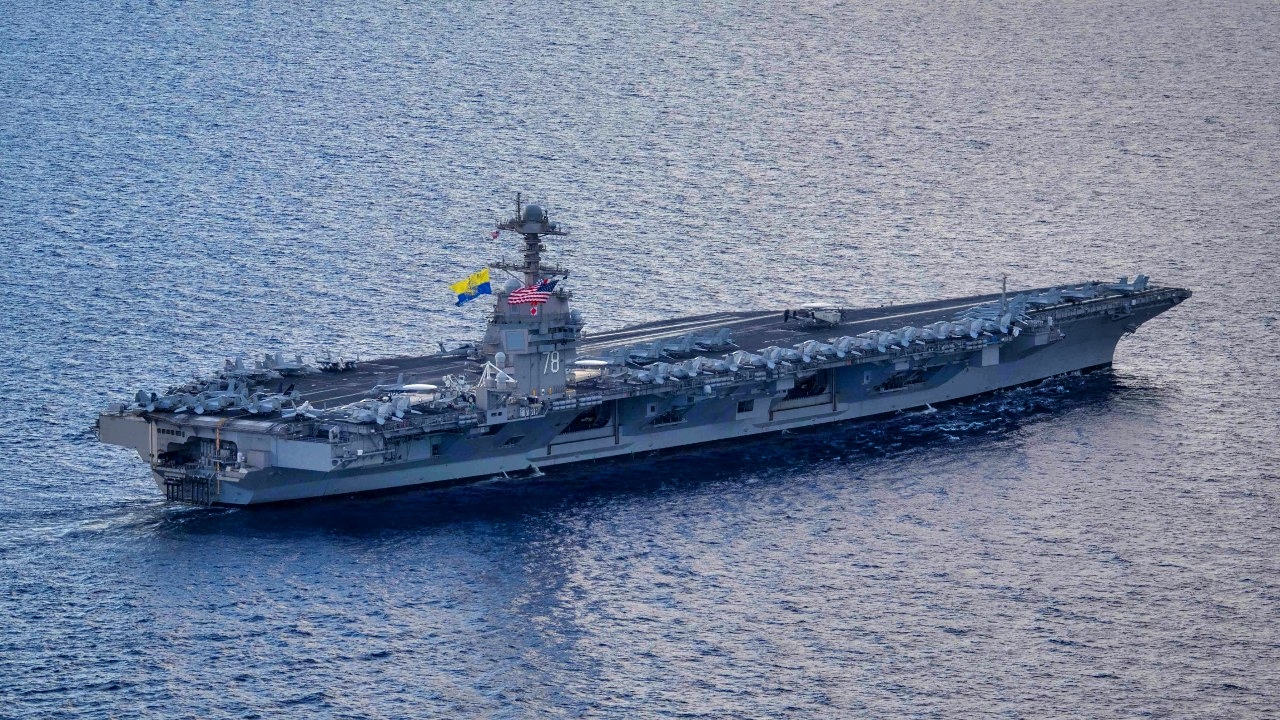
The world’s largest aircraft carrier USS Gerald R. Ford (CVN 78) sails in the Mediterranean Sea, Dec. 31, 2023. The U.S. maintains forward deployed, ready, and postured forces to deter aggression and support security and stability around the world. (U.S. Navy photo by Mass Communication Specialist 2nd Class Jacob Mattingly)
The Real Cost
But deploying for eleven months straight is no simple endeavor. With a crew of 4,500 sailors and a near-continuous operational tempo, the strain placed on the sailors, aviators, and vessels alike is significant.
The burden was exacerbated in March 2026 when a laundry facility fire destroyed 100 berths, damaged 1,000 mattresses, and displaced 600 sailors. Plumbing failures also cropped up—specifically, 205 breakdowns in a four-day period relating to the vacuum sewage system.
The irony of basic plumbing issues plaguing a $13 billion supercarrier is rich. But irony aside, the deployment stressed both crew morale and ship systems to the limit.
Technical Strain
The EMALS catapult system is still new; the Ford is the first carrier in service ever to feature EMALS. And while EMALS was designed to last 4,166 launches between failures, the actual endurance has been just 181 launches per breakdown.

USS Gerald R. Ford Aircraft Carrier. Image Credit: Creative Commons.
Over the course of the eleven-month deployment, EMALS failures were regular. The also-novel Advanced Arresting Gear (AAG) was also placed under heavy strain.
The weapons elevators, newly designed for the Ford, had reliability issues; some of the 11 elevators have been nonfunctional. At the heart of all these technical issues is the fact that the Ford is a first-in-class ship, with non-mature systems being worked out in real time.
Breakdowns were inevitable under ideal circumstances; under the weight of an eleven-month deployment, the novel systems struggled. Combat operations have, of course, accelerated the wear. And while the Fords’ advanced systems proved powerful, they also proved themselves fragile under the sustained combat conditions of Epic Fury.
Post-Deployment Maintenance
The Ford will likely be unavailable in port for 12–18 months due to necessary maintenance. The Planned Incremental Availability (PIA) will address several issues. Repairing fire damage from the March 2026 incident is a priority, which will include rebuilding the laundry system and restoring berthing.
The plumbing system needs to be overhauled. Some components will need to be redesigned, while acid flushes (costing $400,000 each) will be necessary.
The EMALS and AAG will need inspection and full system recalibration. The flight deck will need to be stripped and reapplied with non-skid coating. The hull will need corrosion treatment. Some of this is routine—but much of it is deep reconstruction after extreme usage.
The Human Side
But deep maintenance of the vessel is only part of the equation; the crew needs to recover, too. Extended leave will be an immediate priority to facilitate family reunification. Then, the crew will transition to a post-deployment phase, with training cycles and reduced operational tempo.
The Navy understands that such a long deployment results in fatigue and morale decline. So crew recovery is as critical as mechanical repair in order to get the Ford operational again.
Strategic Gap
The Ford will be unavailable until 2027 or 2028. This places a replacement strain on the USS George H.W. Bush and disrupts maintenance cycles.

MEDITERRANEAN SEA (Feb. 21, 2017) The aircraft carrier USS George H.W. Bush (CVN 77) transits the Mediterranean Sea in support of Operation Inherent Resolve. The George H.W. Bush Carrier Strike Group is conducting naval operations in the U.S. 6th Fleet area of operations in support of U.S. national security interests. (U.S. Navy photo by Mass Communication Specialist 3rd Class Daniel Gaither/Released)
The result could be a domino effect, with delays cascading across the fleet. While the Ford is in maintenance, the Navy will have a reduced surge capacity; in the event of a major conflict, the US will have fewer available carriers.
The US deterrence signal is also diminished, with adversaries observing US maintenance vulnerabilities. And with fewer carriers available, the remaining carriers will have to do more, potentially leaving them overworked. The takeaway is that one extended deployment creates a multi-year readiness consequence, underscoring how interwoven the entire fleet is, and how fragile deployment and maintenance cycles are.
Industrial and Budget Implications
The cost of maintaining the ultra-complex Ford-class is higher than the cost of maintaining the Nimitz-class. Fixing their EMALS, AAG, and weapons elevators is more technically demanding and time-intensive—and more expensive.
US shipbuilding capacity is already strained; the intensive maintenance time dedicated to the Ford will further strain the industrial infrastructure, imposing an opportunity cost that will delay the production and maintenance of other ships and submarines. Funding is finite, too; funds dedicated to Ford maintenance will be diverted from other projects, such as the construction of new vessels.
Bigger Takeaways
The US doctrine, which demands a constant global presence across multiple theaters, inherently requires extended deployments. This places enormous stress on the carrier, a vital instrument in realizing the US global presence.
While the US has eleven supercarriers, far more than any other nation on Earth, the ambitious scope of US policy often demands carrier availability beyond what the existing eleven can supply.
Ford’s latest deployment and the upcoming maintenance cycle raise questions about the sustainability of a carrier-centric strategy—especially as carriers become more vulnerable to A2/AD networks.
During the last eleven months, the Ford performed impressively but also demonstrated how costly the deployment and sustainment of exquisite carriers can be.
About the Author: Harrison Kass
Harrison Kass is a writer and attorney focused on national security, technology, and political culture. His work has appeared in City Journal, The Hill, Quillette, The Spectator, and The Cipher Brief. He holds a JD from the University of Oregon and a master’s in Global & Joint Program Studies from NYU. More at harrisonkass.com.


Peter wolf
May 13, 2026 at 12:40 pm
Translation : “Will be out of service indefinitely”.