

Key Points and Summary – Boeing’s X-32 experimental stealth fighter lost the Joint Strike Fighter competition to what would become the F-35 due to several critical weaknesses.
-Its short-takeoff and vertical-landing (STOVL) system was less effective than its rival’s; its large delta wing reduced maneuverability, and its bulky design was poorly suited for aircraft carrier operations.
-A final, influential factor was its “unsightly” aesthetics; the jet’s unconventional “duck-like” appearance created a negative perception that, combined with its technical shortcomings, contributed to its ultimate defeat in the historic contest.
The Boeing X-32 Was Much More Than ‘Unattractive’ for a Fighter
The Boeing X-32 was a highly experimental stealth fighter designed to participate in the Joint Strike Fighter (JSF) program.
The fighter featured several unconventional design elements that set it apart from its competitor, the X-35 (which later became the F-35).
Unfortunately, the Air Force decided against adopting the X-32, instead opting with the X-35.
While the X-32 had several interesting features, the cons outweighed the pros, and the fighter simply was not what the Air Force was looking for.
The X-32 and the Joint Strike Fighter Program
The X-32 was designed to compete in the JSF program.
Boeing’s approach emphasized cost-efficiency, manufacturing simplicity, and component commonality across different variants. The aircraft featured a large, one-piece carbon fiber delta wing and was powered by a Pratt & Whitney YF119-PW-614 afterburning turbofan engine. This engine was capable of producing up to 43,000 pounds of thrust with afterburner, giving the X-32 a top speed of around Mach 1.6.
Boeing built two prototypes: the X-32A, designed for conventional takeoff and landing (CTOL) and carrier-based operations, and the X-32B, intended to demonstrate short takeoff and vertical landing (STOVL) capabilities.
Lack of STOVL Capability
One of the most significant weaknesses of the X-32 was its STOVL design. The JSF program placed a high priority on STOVL capabilities, particularly for the U.S. Marine Corps and the U.K. Royal Navy. Boeing’s initial STOVL concept relied on a direct lift system, where the engine’s thrust was redirected downward through a swiveling nozzle. While this approach was mechanically simpler than Lockheed Martin’s shaft-driven lift fan system, it proved to be less effective in practice.
The direct lift system resulted in poor hover stability and limited payload capacity, which were major drawbacks for STOVL operations. Furthermore, Boeing had to significantly redesign the X-32B prototype to meet STOVL requirements, causing delays and raising concerns about the feasibility of the design. In contrast, the X-35B’s lift fan system provided better balance, efficiency, and control during vertical flight, giving it a clear advantage.
Structural Design Limitations
Another major issue with the X-32 was its aerodynamic and structural design. The aircraft’s large delta wing was chosen to reduce manufacturing costs and increase internal fuel capacity. However, this design introduced several aerodynamic challenges. The wing’s high sweep angle allowed for a thick cross-section, which was beneficial for housing fuel and electronics but created excessive drag and reduced maneuverability at transonic speeds.
Additionally, the one-piece carbon fiber wing was difficult to fabricate and posed risks in terms of structural integrity and repairability. These issues made the X-32 less agile and more vulnerable to damage compared to the X-35, which featured a more conventional wing and tail configuration. The X-35’s design offered superior agility and was easier to maintain, making it more attractive to military planners.
Incompatible with Aircaft Carriers?
Another important weakness was the X-32’s poor performance on aircraft carriers. The JSF program required the aircraft to perform catapult launches and arrested landings on aircraft carriers, which demanded robust landing gear, precise control, and compact dimensions.
The X-32’s bulky fuselage and wide delta wing made it less ideal for carrier deck operations. Its design limited visibility from the cockpit and made it harder to maneuver on crowded flight decks.
Moreover, the aircraft’s tail-less configuration raised concerns about directional stability during carrier landings. These limitations made the X-32 less appealing to the U.S. Navy, which placed a high priority on carrier compatibility. The X-35, with its more traditional layout and better handling characteristics, was better suited for naval operations.
Aesthetics and Perception
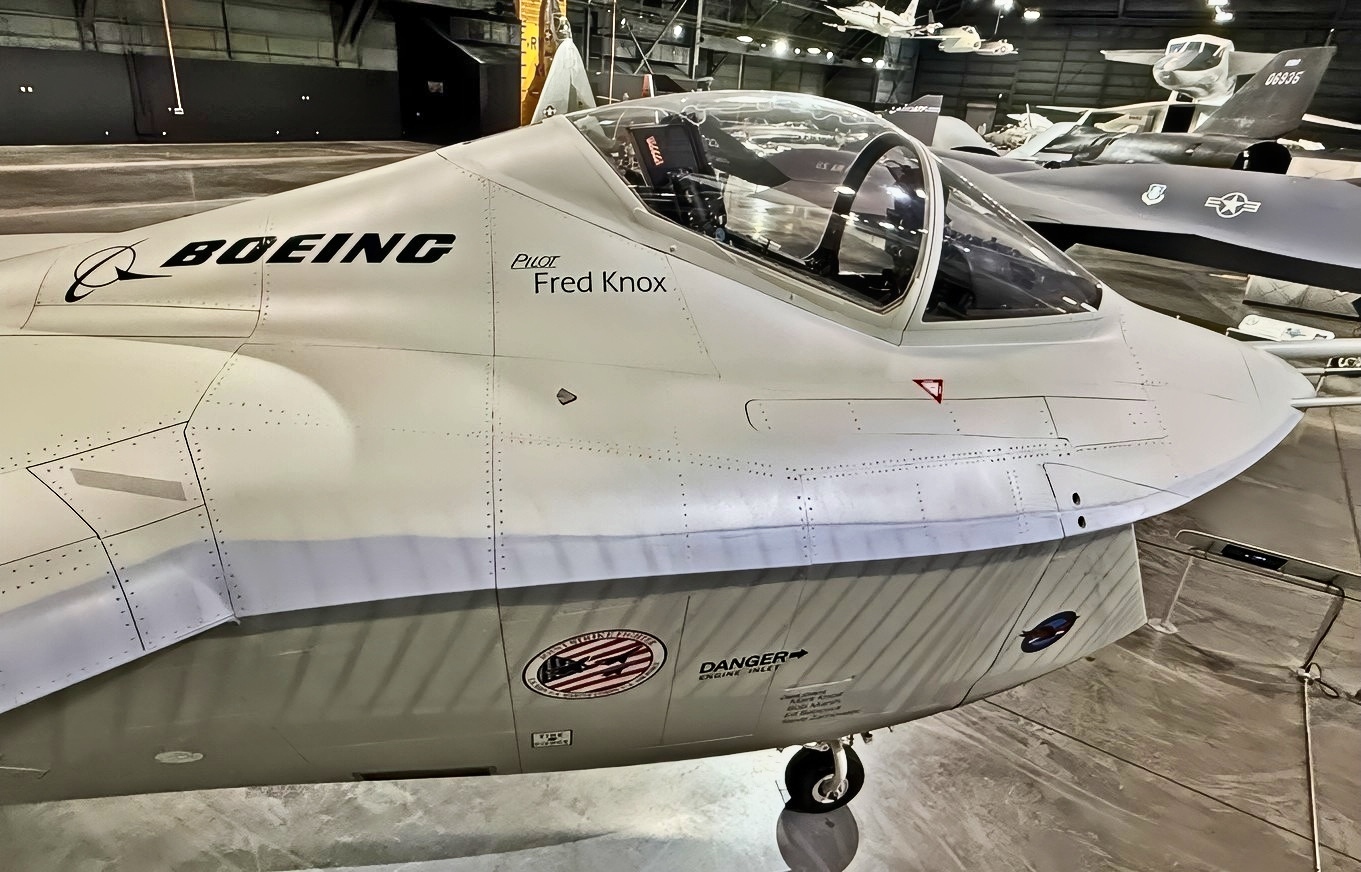
Finally, as funny as it may seem, the X-32 was heavily disadvantaged by its unsightly aesthetics.
To put it another way, the plane simply looked unappealing.
While not a technical flaw, the aircraft’s appearance played a subtle but influential role in its rejection.
The X-32 was often criticized for its odd, “duck-like” look, with a bulbous nose and wide fuselage that gave it a less sleek and modern appearance compared to the X-35.
Additionally, the fighter’s bulky frame made it look less maneuverable than it was, further hurting its reputation.
Aesthetics were not the deciding factor in the JSF competition, but they did play a minor role in the aircraft’s perception. This aesthetic disadvantage affected public and internal perception, especially when both aircraft were showcased side by side. In high-profile defense competitions, perception and confidence in a design can influence decision-making. The X-35 resembled a traditional fighter jet and inspired greater confidence in its capabilities. Boeing’s X-32, despite its engineering merits, struggled to overcome the stigma of its unconventional appearance.]
The Boeing X-32: Stuck In A Museum
Despite criticisms, the Boeing X-32 was a bold and innovative attempt to meet the ambitious goals of the JSF program. It demonstrated advanced manufacturing techniques, a commitment to cost efficiency, and a willingness to challenge conventional design norms. However, its weaknesses ultimately led to its defeat. Lockheed Martin’s X-35 offered a more refined and capable solution, especially in areas critical to the JSF mission.
The X-35’s lift fan system, superior agility, and better carrier compatibility gave it the edge needed to win the contract and evolve into the F-35 Lightning II, which is now the cornerstone of the U.S. air fleet.
It seems the Boeing X-32 will be stuck in museum duty forever. You see her fully restored at the U.S. Air Force Museum in Dayton, Ohio. We just visited the exhibit, and the restoration work was truly amazing to see.
About the Author: Isaac Seitz
Isaac Seitz, a Defense Columnist, graduated from Patrick Henry College’s Strategic Intelligence and National Security program. He has also studied Russian at Middlebury Language Schools and has worked as an intelligence Analyst in the private sector.
Military Problems
No F/A-XX Fighter? Say Goodbye to the Aircraft Carrier


