

Key Points and Summary – China is building a layered kill web—PL-15 air-to-air missiles, HQ-9/22 surface-to-air systems, long-wave radars, KJ-500 AEW, and space-based ISR—to threaten America’s new B-21 Raider.
-Simulations claiming hypersonic intercepts say little about real outcomes: detection at long range is not fire-control quality, and the Raider’s very-low-observable shaping, thermal management, electronic warfare, and flexible routing complicate tracking and terminal engagement.

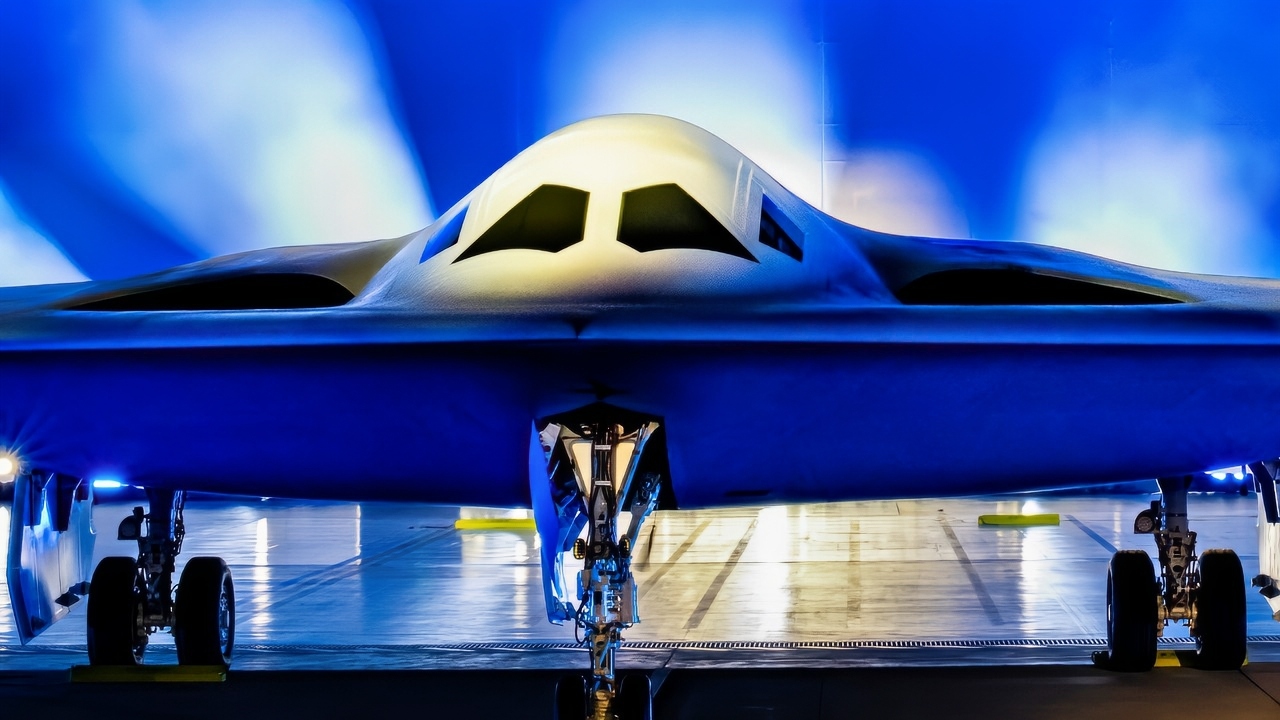
B-21 Raider. Image Credit U.S. Air Force.
-Designed to launch stand-in weapons, coordinate with drones, and operate in distributed waves, the B-21 aims to saturate defenses.
-China’s network is dangerous, especially against predictable patterns, but Raider survivability rests on stealth plus tactics—not stealth alone. Backed by allies and standoff fires.
The B-21 Raider Has a China Problem
The American B-21 Raider is the newest strategic bomber that is currently in use by the United States Air Force. Presently in low-rate initial production, around 100-150 are planned to be produced throughout the aircraft’s service life.
As one of the most technologically sophisticated bombers ever built, the B-21 is a significant threat to all of America’s adversaries, especially China. China, for its part, has been investing heavily in advanced air defense systems, hoping to maintain a credible posture of deterrence.
But how threatening are China’s air defenses to a platform as capable as the B-21?
Chinese Hypersonics vs. the B-21 Raider
Even before the B-21 took its first flight, China had been concerned with the aircraft’s development.
Before its first flight, China boasted that it was able to intercept and shoot down a B-21 during a simulation using hypersonic air-to-air missiles, namely the PL-15. It is important to note that simulations should always be taken with a grain of salt, as real-life combat scenarios can rarely be perfectly simulated.
How China managed to simulate a B-21 is also up for debate and can easily skew the results of any simulation. Regardless, Chinese experts have claimed that hypersonic air-defense missiles are more than a match for the new bomber.
The PL-15 is currently China’s premier air-to-air missile. It has a BVR range of around 200-300 km, although the export version reportedly has a reduced range of around 150km.
It has a top speed of around Mach 5+, putting it within the hypersonic range.
The J-20, J-35, J-10C, J-16, and numerous other Chinese aircraft can carry it.
It is guided by a miniature AESA radar that has both active and passive tracking capabilities. This, on paper, makes it suitable for targeting stealth aircraft like the B-21, although its combat use remains limited.
Factoring in China’s Surface-to-Air Arsenal
Moving on to surface-to-air platforms, the HQ-9 series, particularly the HQ-9B and HQ-9C variants, are central to China’s long-range surface-to-air missile (SAM) capabilities. The HQ-9B has a range of up to 300 kilometers and is capable of intercepting aircraft, cruise missiles, and tactical ballistic missiles.

The B-21 Raider was unveiled to the public at a ceremony December 2, 2022 in
Palmdale, Calif. Designed to operate in tomorrow’s high-end threat environment, the B-21 will play a critical role in ensuring America’s enduring airpower capability. (U.S. Air Force photo)
It uses the HT-233 phased-array radar, which has been upgraded to improve tracking and engagement capabilities. The HQ-9C, a newer variant, features slimmer missiles that allow for more to be loaded per launcher, and it incorporates enhanced radar and anti-stealth capabilities. These systems are often compared to the U.S. Patriot and Russian S-400 systems, though their true effectiveness against stealth aircraft remains a subject of debate.
The HQ-22 is a medium-range SAM system with a range of around 170 kilometers. It is designed to engage aircraft, drones, and cruise missiles. Though less advanced than the HQ-9 series, it fills an essential niche in China’s layered defense strategy. The HQ-26 and HQ-29 are newer systems with limited public data, but they are believed to be high-altitude interceptors with capabilities similar to the Russian S-500 and American THAAD systems.
These systems are intended to engage ballistic missiles and possibly hypersonic threats, suggesting a growing Chinese interest in countering advanced U.S. strike platforms.
The Role of Ground-Based Radars
China’s air defense network is not limited to missile systems. It includes a wide array of sensors, radars, and electronic warfare platforms. Phased-array radars operating in S-band, C-band, and meter-wave frequencies are deployed to detect stealth aircraft.
These are supported by airborne early warning (AEW) platforms like the KJ-500A and electronic warfare aircraft such as the J-16D. The integration of artificial intelligence into command and control systems allows for rapid threat assessment and response. Additionally, China has invested in space-based intelligence, surveillance, and reconnaissance (ISR) assets, which extend its detection capabilities beyond the horizon.
Against this backdrop, the B-21 Raider has its work cut out for it. Luckily, the aircraft is well-suited for the challenge. Designed to penetrate advanced air defenses, the B-21 incorporates next-generation radar-absorbent materials and a dramatically reduced radar cross-section across multiple frequency bands.
Unfortunately, most of the technical details on the aircraft’s stealth capabilities are classified. It is built with an open architecture, allowing for rapid upgrades and modular payload configurations. With an estimated range of 9,600 kilometers and a payload capacity of around 10 tons, the B-21 is capable of delivering both nuclear and conventional weapons deep into contested territory.
The B-21: Designed to be Undetectable
The B-21’s survivability is enhanced by its ability to operate in contested environments with minimal support. It is designed to launch stand-in weapons from within enemy airspace, meaning it can deliver precision strikes without relying on standoff platforms. Its stealth profile is optimized for evading detection by radar systems like those used in the HQ-9 and HQ-22. Moreover, the B-21 is expected to operate in swarms or waves, overwhelming enemy defenses through distributed operations and coordinated strikes.
AS impressive as the B-21 is, China’s missile systems do pose a credible threat to the B-21, particularly if the bomber is operating without support or in predictable patterns. Meter-wave radars, while less precise, can detect stealth aircraft at long ranges.
However, detection does not guarantee interception. The B-21’s low radar cross-section, electronic warfare support, and terrain-following flight profiles make it extremely difficult to engage, especially during the terminal phase of its mission.
The real question is whether air-launched systems like the PL-15 or PL-17 can successfully track the aircraft over long ranges.
About the Author: Isaac Seitz
Isaac Seitz, a Defense Columnist, graduated from Patrick Henry College’s Strategic Intelligence and National Security program. He has also studied Russian at Middlebury Language Schools and has worked as an intelligence Analyst in the private sector.
More Military
The New B-21 Raider Is Far More Than Just A ‘Stealth Bomber’
The ‘New’ Arleigh Burke–Class Flight III Destroyer Has a Message for the U.S. Navy
France’s Mirage 2000: The Best Fighter You Never Heard of Fighting Putin in Ukraine
The SR-71 Blackbird Changed the U.S. Military Forever
SR-72 Darkstar: Why Won’t the Air Force Show Us This Mach 6 Plane?


