

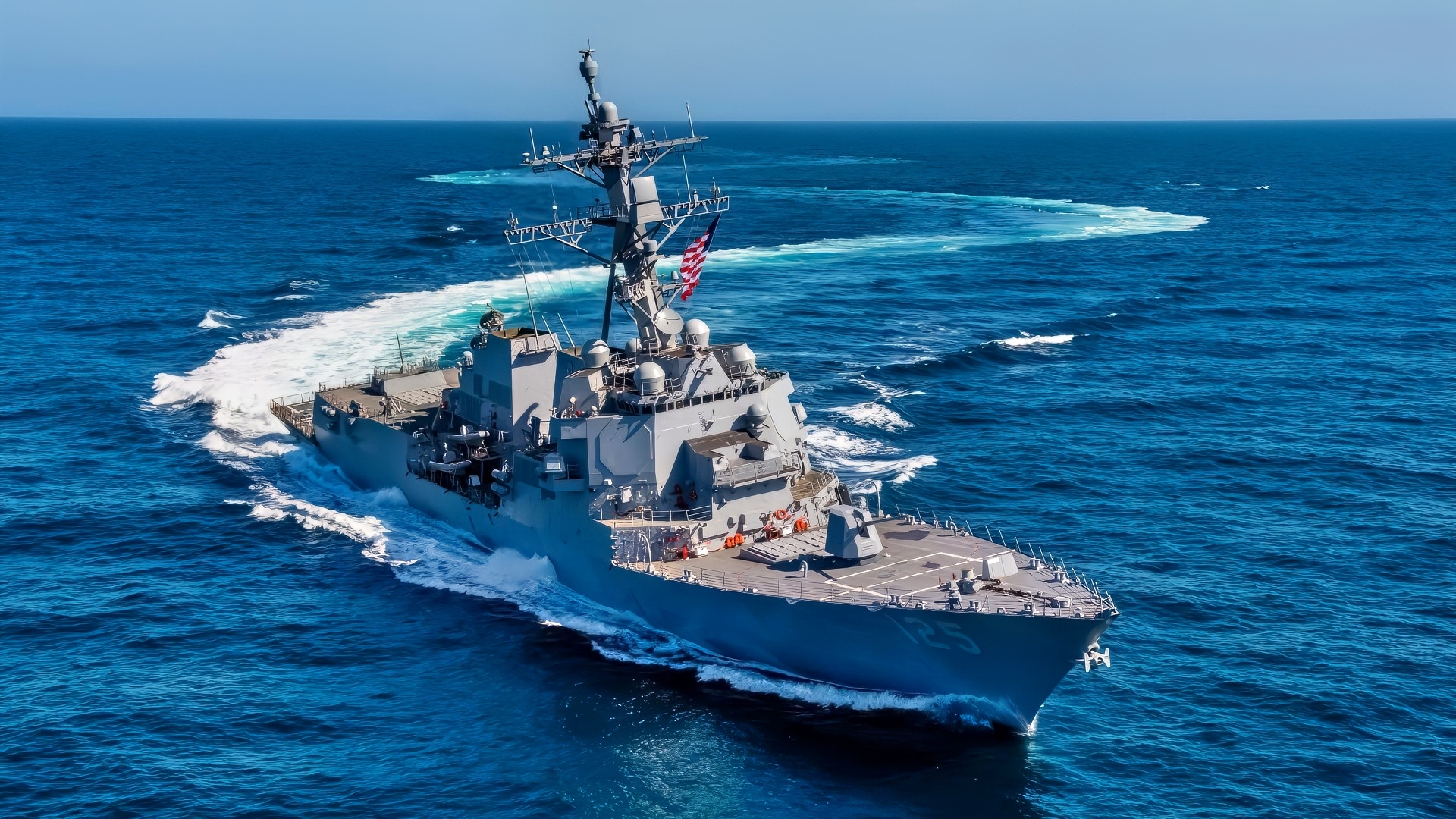
Key Points and Summary – The Navy’s Arleigh Burke-Class Flight III Destroyers were conceived after plans for a new cruiser died, leaving a gap in integrated air and missile defense.
-The answer: re-engineer the proven DDG-51 hull with the AN/SPY-6 radar, Aegis Baseline 10, and major power and cooling upgrades.
-Flight III keeps the Burke’s 96-cell VLS and multi-mission DNA but adds the sensitivity and computing to manage ballistic, cruise, and hypersonic-class threats.
-The first ship, USS Jack H. Lucas (DDG-125), joined the fleet in 2023, with more hulls in the pipeline.
Flight III is the Navy’s air-defense backbone until DDG(X) arrives in the 2030s.
Arleigh Burke-Class Flight III: The Destroyer The Navy Had To Build
By the early 2010s, the Navy had a problem and a deadline. The Ticonderoga-class cruisers—the service’s big, Aegis-equipped air-defense commanders—were aging out.
A next-gen cruiser (CG(X)) meant to replace them had been canceled after cost and risk ballooned.
The Zumwalt-class destroyer program was a mess.

Zumwalt-class Guided Missile Destroyer USS Michael Monsoor (DDG 1001) transits the Pacific Ocean, June 25, 2022. Twenty-six nations, 38 ships, four submarines, more than 170 aircraft and 25,000 personnel are participating in RIMPAC from June 29 to Aug 4 in and around Hawaiian Islands and Southern California. The world’s largest international maritime exercise, RIMPAC provides a unique training opportunity while fostering and sustaining cooperative relationships among participants critical to ensuring the safety of sea lanes and security on the world’s oceans. RIMPAC 2022 is the 28th exercise in the series that began in 1971.
Meanwhile, adversaries were fielding faster, stealthier, more numerous missiles, from low-flying sea-skimmers to maneuvering ballistic and hypersonic-class threats designed to punch through legacy radars and overwhelm defenses.
The Navy didn’t have time—or budget—for a clean-sheet large surface combatant.
Instead, it chose an evolutionary leap on a proven hull: upgrade the Arleigh Burke into Flight III, centering the ship around a far more powerful radar and a new Aegis baseline to deliver integrated air and missile defense (IAMD).
In short: keep building the destroyer you can afford and crew, but rebuild its “brain and eyes” for a different era.
And, at least for now, the plan seems to be working.
Why The Original Burkes Weren’t Enough Anymore
The early Arleigh Burke Flights (I/II) were optimized for the high-end Cold War fight and its aftermath. Even the Flight IIA—an excellent all-rounder—carried the SPY-1D(V) radar whose architecture dates back decades. That radar and its supporting power/cooling margins were never designed for today’s multi-vector raid problem: simultaneous ballistic, cruise, and now hypersonic-class threats; dense electronic attack; and cluttered sea and air pictures near shore.
Three issues stood out:
Sensitivity And Discrimination. Modern threat sets require a radar with dramatically greater raw sensitivity and better discrimination to pull small, fast, low-RCS objects out of clutter—while also tracking exo- and endo-atmospheric ballistic targets.
Power And Cooling Headroom. A bigger, digitally steered radar needs serious electrical power and chilled water, plus distribution architecture that scales without starving weapons, sensors, or hotel loads.
Computing And Integration. The combat system needed a generational jump to fuse more tracks, manage bigger engagements, and support IAMD tactics across the strike group.
Flight III is the Navy’s answer on all three.
What Arleigh Burke-Class Flight III Destroyers Actually Changes
The changes are truly special. Here is a rundown:
The Radar: AN/SPY-6 “AMDR”
The centerpiece is AN/SPY-6(V)1, a fully digital, gallium nitride–based S-band radar built from modular Radar Modular Assemblies (RMAs).
On Flight III destroyers, four fixed arrays—each composed of 37 RMAs—deliver a quantum leap in sensitivity and dynamic range. Practically, that means more reliable detection and tracking in heavy clutter, better ballistic-missile discrimination, and improved resistance to jamming and saturation raids. The array is also scalable, a design choice that lets the Navy field SPY-6 variants across multiple ship classes.
The Combat System: Aegis Baseline 10
All that radar data is useless without the software and computing to exploit it. Aegis Baseline 10 is the integration layer that turns SPY-6’s raw performance into IAMD—simultaneous anti-air warfare and ballistic missile defense, with smarter track management, larger raid handling, and more efficient weapon-target pairing. Think of Flight III as a sensor-computer revolution inside a familiar hull.
Power, Cooling, And Distribution
To feed the radar and future growth, Flight III replaces and uprates key parts of the ship’s electrical plant. New AG9160 ship service gas-turbine generator sets supply significantly more electrical power. A re-architected power conversion system and enlarged chilled-water/air-conditioning plants support the radar’s demand while leaving margin for other sensors and electronics.
The result: a destroyer with real HM&E headroom, not a zero-sum trade between radar and everything else.
Weapons And Sensors You Know—With Room To Grow
Flight III keeps the class’s 96-cell Mk 41 VLS, supporting the Navy’s staple weapons (Standard Missile family, ESSM, Tomahawk, ASROC).

3rd Multi-Domain Task Force (3MDTF) conducts the first Mid-Range Capability live fire exercise outside of the continental United States successfully sinking a maritime target with a Standard Missile-6 Force during Exercise Talisman Sabre 25 on July 16, 2025. US Army photo
The ship retains the SQQ-89(V)15 undersea combat system and towed arrays for ASW, and it fields the SEWIP electronic-warfare upgrades as they roll through the fleet. The big change isn’t the launcher count—it’s the ship’s ability to find, classify, and manage threats earlier and more reliably, buying time for both hard-kill and soft-kill options.
How We Got Here: From CG(X) To Flight III
The cancellation of CG(X) forced a choice: accept a shrinking high-end air-defense capacity or insert next-gen radar and computing into a ship the Navy already builds well. The DDG-51 program office, industry, and the Aegis enterprise spent the 2010s grinding through the engineering—land-based integration testing, electrical-plant “light-offs,” and SPY-6/Aegis lab work—to prove the concept before the first Flight III hull ever went to sea.
In parallel, the Navy locked in a new multiyear procurement (MYP) to keep two yards—Ingalls in Mississippi and Bath Iron Works in Maine—building Flight IIIs on a repeatable cadence. That kept the industrial base warm and the per-ship cost predictable.
The First Flight III Ships And Today’s Fleet Picture
The lead Flight III, USS Jack H. Lucas (DDG-125), delivered in mid-2023 and was commissioned on October 7, 2023. It later arrived in San Diego to join U.S. 3rd Fleet. Additional Flight III hulls are in the water or advancing through build milestones:
DDG-126 Louis H. Wilson Jr. (first Flight III from Bath Iron Works) is deep into construction.
DDG-128 Ted Stevens has launched from Ingalls and continues post-launch outfitting.
DDG-129 Jeremiah Denton was christened in 2025; several more Flight IIIs (DDG-130 and beyond) are in various stages at BIW and Ingalls under the current MYP and exercised options.
As the Ticonderoga cruisers draw down toward the end of the decade, Flight III Burkes are the fleet’s air-defense backbone, filling the gap with more modern sensors and computing—even if they lack a cruiser’s extra command spaces.
Arleigh Burke-Class Flight III Destroyer: What It Brings to the Table
A lot, as it would seem:
Real IAMD At Destroyer Scale
A SPY-6/BL10 ship can manage bigger raids with more demanding track files while simultaneously running ballistic-missile defense. That matters in the Western Pacific and the North Atlantic, where U.S. ships may face massed, multi-axis attacks combining ballistic, cruise, and hypersonic-class threats with heavy electronic warfare.
Earlier Warning, Better Pairing
Sensitivity buys time. The earlier a destroyer sees and classifies a threat, the more shots-on-goal it can create within its engagement envelope, and the more efficiently it can allocate SM-2/SM-6/ESSM across the raid. Add cooperative engagement and the strike group’s shooters get cleaner cues sooner from the Flight III’s radar picture.
Survivability Through Margin
The most underappreciated Flight III feature is margin—electrical, thermal, and computing. That margin translates to reliability and growth. It means the radar stays up under stress, the ship runs cooler on hot days in the Gulf, and the Navy can spiral in new processing, EW tricks, and weapons without hitting a wall.
Present-Day Reality: What’s Working, What’s Hard
On the plus side, the Navy has fielded the first Flight III and is funding a run large enough to matter, with SPY-6/Aegis testing maturing in step. The radar’s modular design is already spreading across other ship classes, trimming logistics and training friction. And the Burke production base—after pandemic dislocations—is again delivering visible milestones.
The hard parts are familiar:
Industrial Pace. Bath Iron Works and Ingalls juggle labor pipelines and supplier delays. Multi-year deals help, but schedule pressure is real.
Cruiser Retirement Cliff. Even with Flight III, the Navy loses the Ticonderoga’s command space and some air-defense commander billets as those hulls decommission.
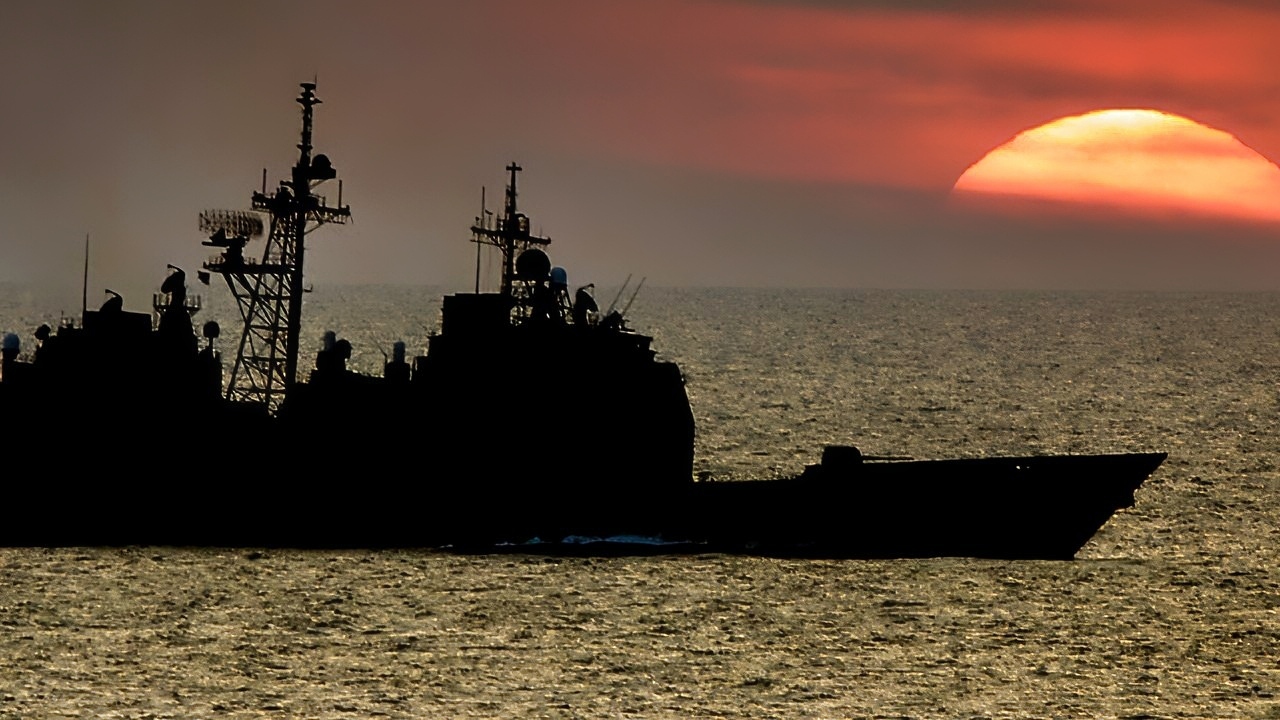
The Ticonderoga Class Cruiser USS Normandy (CG 60) steams at sunset in the Atlantic Ocean while operating with the USS George Washington battle group on May 18, 2000. The Normandy, homeported in Norfolk, Va., is participating in a Joint Task Force Exercise with the battle group.
(DoD photo by Petty Officer 2nd Class Shane McCoy, U.S. Navy. (Released))
Directed-Energy And Big Missiles. There’s only so much a DDG-51 hull can host. Flight III’s margins are generous for sensors and computing, but truly power-hungry future systems—large directed-energy weapons or very-large-diameter hypersonic launchers—point to a bigger ship.
How Flight III Fits With The Rest Of The Fleet
Think of the Navy’s surface combatant family like this:
–Zumwalt-Class gets a deep-strike makeover with conventional prompt strike and niche roles.
-Flight I/II/IIA Burkes remain multi-mission workhorses; some receive SPY-6 derivatives and combat-system refreshes.
-Flight III Burkes are the front-line air-defense/IAMD nodes with the radar and compute to anchor a carrier or expeditionary group.
-DDG(X), slated for the 2030s, will reclaim the space, power, and growth margins of a true large surface combatant—starting from Flight III’s sensor/weapon baseline, then growing beyond it.

(Aug. 22, 2023) Gunner’s Mate 2nd Class Chase Allen maintains the barrel of a Mark 45 5-inch light-weight gun on the fo’c’sle of the Arleigh Burke-class guided-missile destroyer USS Paul Hamilton (DDG 60) in the Pacific Ocean, Aug. 22, 2023. Paul Hamilton is deployed to the U.S. 3rd Fleet area of operations. (U.S. Navy photo by Mass Communication Specialist 2nd Class Elliot Schaudt)
-In practice, that means Flight III carries the Navy’s near-term air-defense burden while bridging to DDG(X).
Flight III By The Numbers (Typical)
Displacement: ~9,500+ tons (full load varies by ship)
Length/Beam: ~509 ft / 66 ft
Propulsion: 4 × LM2500 gas turbines, 2 shafts
Electrical Plant: New AG9160 generator sets, re-architected conversion/distribution
Radar: AN/SPY-6(V)1 (4 fixed arrays, 37 RMAs each)
Combat System: Aegis Baseline 10 (IAMD)
VLS: 96 cells (Mk 41)
Mission: Integrated air and missile defense, ASW, surface strike, maritime security
(Figures are representative; exact specs vary by hull and modernization lot.)
What The Future Holds
More Flight IIIs Are Coming. The current multi-year deal funds a healthy pipeline at both yards, and recent option exercises extend that run. Expect several Flight IIIs to commission through the late 2020s and into the early 2030s.
SPY-6 Software Keeps Maturing. The Navy is already iterating SPY-6 modes, clutter rejection, and track-management algorithms. You will see steady software-driven performance gains without changing the hardware.
Weapons Spiral. The SM-6 family, ESSM Block 2, Tomahawk improvements, and evolving decoy/EW packages will keep the VLS relevant. Flight III is about better cueing and pairing, not just more tubes.
DDG(X) On The Horizon. Navy leadership is clear: Flight III cannot host everything the service wants in the 2030s and beyond—especially large power-hungry systems. DDG(X) is the long-term answer, but it will be years before the first ship joins the line, and there a lot of challenges with costs and timeline issues.
Until then, Flight III is the “good enough now” solution the fleet needed.
Bottom Line on Arleigh Burke-Class Flight III Destroyer
Flight III is what happens when the Navy chooses pragmatism over perfection. Rather than wait for a gold-plated cruiser to replace the Ticonderogas, the service rebuilt a ship it knows how to build—but with a new sensor/computing core that changes the fight.
The result is a destroyer that sees farther, sorts smarter, and commands the air picture under intense pressure.
It won’t do everything tomorrow’s Navy wants—but it does the most important things right now, and it’s arriving in numbers that matter.
About the Author: Harry J. Kazianis
Harry J. Kazianis (@Grecianformula) is Editor-In-Chief and President of National Security Journal. He was the former Senior Director of National Security Affairs at the Center for the National Interest (CFTNI), a foreign policy think tank founded by Richard Nixon based in Washington, DC. Harry has over a decade of experience in think tanks and national security publishing. His ideas have been published in the NY Times, The Washington Post, The Wall Street Journal, CNN, and many other outlets worldwide. He has held positions at CSIS, the Heritage Foundation, the University of Nottingham, and several other institutions related to national security research and studies. He is the former Executive Editor of the National Interest and the Diplomat. He holds a Master’s degree focusing on international affairs from Harvard University.
More Military
France’s Mirage 2000: The Best Fighter You Never Heard of Fighting Putin in Ukraine
The SR-71 Blackbird Changed the U.S. Military Forever
SR-72 Darkstar: Why Won’t the Air Force Show Us This Mach 6 Plane?


