

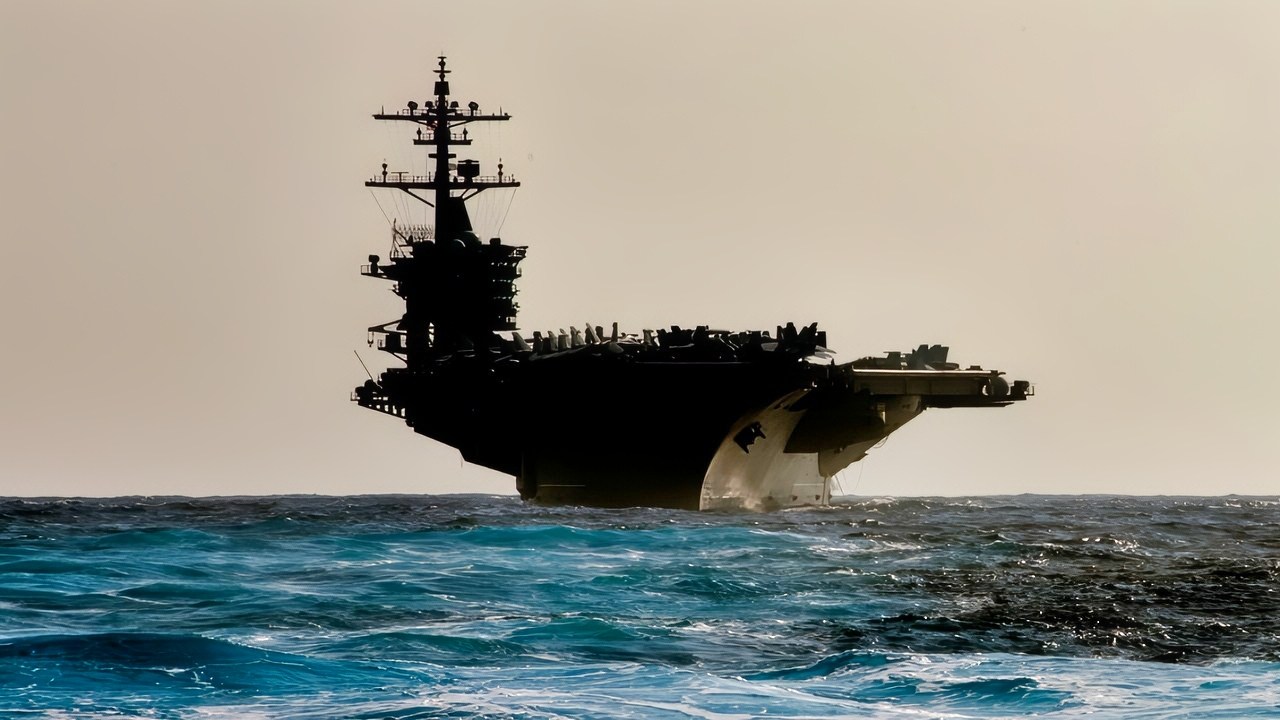
China or Iran doesn’t need to sink U.S. Navy aircraft carriers to neutralize them — they just need to light them on fire. A burning carrier cannot conduct flight operations. A flight deck rendered inoperable strips the carrier of its strategic purpose. The USS Nimitz has suffered three major disasters at sea that prove the point.
USS Nimitz: When America’s Most Iconic Supercarrier Became an Inferno –
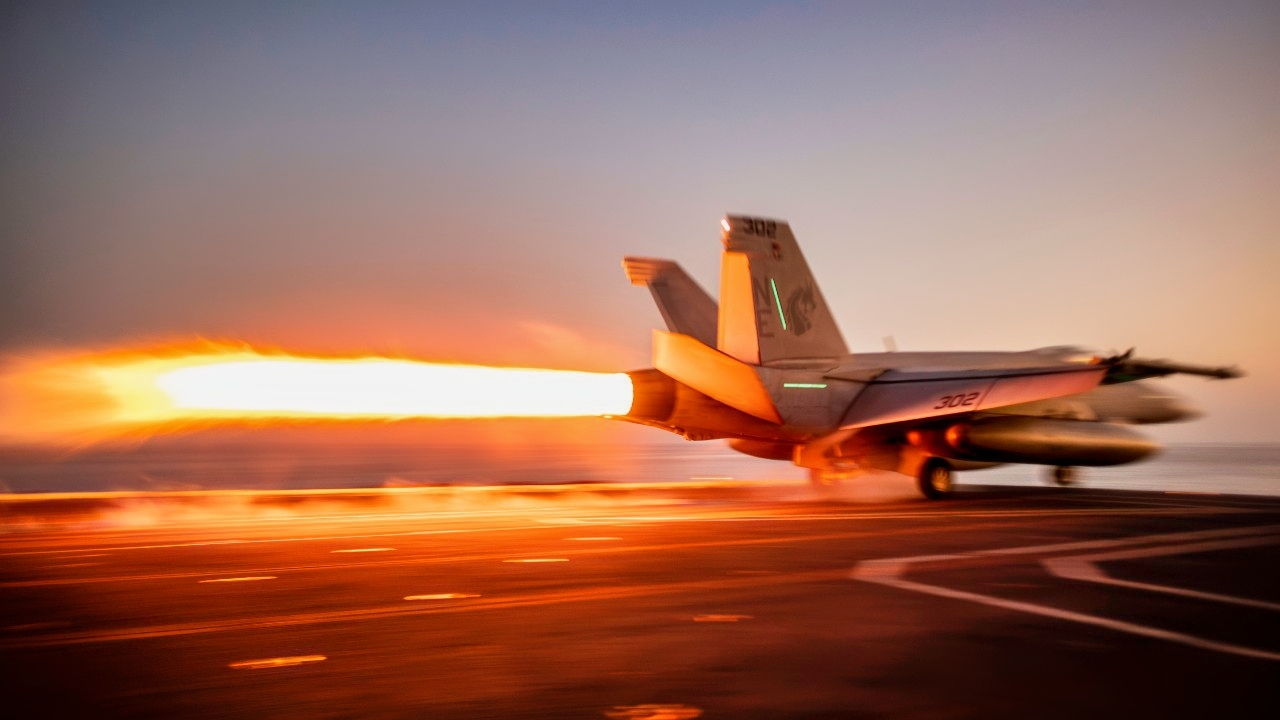
250429-N-FS097-1154 U.S. CENTRAL COMMAND AREA OF RESPONSIBILITY (April 28, 2025) An F/A-18E Super Hornet, attached to Strike Fighter Squadron (VFA) 192, launches from the flight deck of the Nimitz-class aircraft carrier USS Carl Vinson (CVN 70) in the U.S. Central Command area of responsibility. (Official U.S. Navy photo)
America’s Nimitz-class nuclear-powered supercarrier replaced the Kitty Hawk-class aircraft carrier decades ago. The namesake of this class, the USS Nimitz, was supposed to be retired this year, but the United States Navy just can’t seem to retire this vessel.
Even though newer ships in the Nimitz-class were built and an entirely new breed of aircraft carrier—the Ford-class—has now hit the High Seas, the Nimitz and the other ten carriers of her class continue to prove themselves the best modern carrier the United States has built.
Despite its decades of admirable service to the country, however, the Nimitz-class is not without its accidents.
At times, ships of this class have collided with other ships and lost aircraft after performing a high-speed evasive maneuver to avoid an incoming missile. Such is the nature of naval service aboard a massive, highly complex warship that serves as the tip of the spear for the US Navy’s surface warfare fleet.
Three Disasters That Reveal the Truth About Aircraft Carriers
Three disasters aboard the Nimitz come to mind.
The USS Nimitz, as the namesake of this class of carrier, has served the longest. Three major disasters aboard this ship highlight the inherent dangers of serving on a floating air base. The first was the so-called “Night of Flaming Terror” in 1988, when an accidental firing of a 20mm cannon caused damage.
In 1996, there was a failure of the USS Nimitz’s arresting cable in the Gulf of Thailand, causing significant damage and deaths aboard the leviathan warship.
Night of Flaming Terror
During a night landing off the Florida coast in 1981, an EA-6B Prowler lost control and crashed into a parked aircraft on the deck of the USS Nimitz. The impact triggered massive fuel fires and a series of deadly explosions within seconds.

Aircraft Carrier Nimitz-Class Back. Image Credit: Creative Commons.
Fourteen people died, and multiple parked aircraft were destroyed or severely damaged, causing massive losses in US tax dollars, to the tune of $60 million (in 1981, that was a large amount of money). This event underscored the vulnerability of even the best-designed flattop.
After all, the Nimitz-class carriers were designed with key lessons from previous disasters on older carrier systems in mind.
Lessons Written in Fire: How Earlier Carrier Disasters Informed the Nimitz Design
The USS Forrestal fire in 1967 is one of the most iconic peacetime shipboard fires in American history. In that case, 134 sailors were killed after an accidental rocket launch on the flight deck caused a fuel tank rupture and triggered multiple bombs to detonate.
In 1966, the USS Oriskany had a flare mishap that led to an internal fire, killing 44 people. Just three years later, the USS Enterprise had an incident in which one of the onboard rockets overheated, resulting in explosions and fuel spreading through the ship’s decks, leaving 28 people dead and more than 300 injured.
The pattern in those previous fires aboard older carriers was that a small fire triggered larger conflagrations across the ship. The crews of those older boats were poorly prepared for such a contingency (especially in peacetime). Therefore, the hard lessons learned from those disasters aboard those ships were applied to the design and management of the Nimitz-class carriers.
Fighting the Inferno at Sea
When the “Night of Flaming Terror” began off the coast of Florida in 1981, the Nimitz deployed damage control teams immediately. Nimitz’s crew employed compartment-sealing techniques to contain any fire. It used copious amounts of water from readily available fire hoses, all aimed at containing the fires before they reached either the munitions or fuel stores.
Nevertheless, the incident is remembered as the “Night of Flaming Terror.”
That’s because investigations into the incident determined that, even with immediate fire-control operations underway, the Nimitz’s Aqueous Film-Forming Foam (AFFF) washdown system, which smothers the flight deck in fire-suppressing foam, did not fully activate for nearly three minutes—critical time in any fire on a ship like the Nimitz—while part of the system discharged only seawater due to a breakdown.
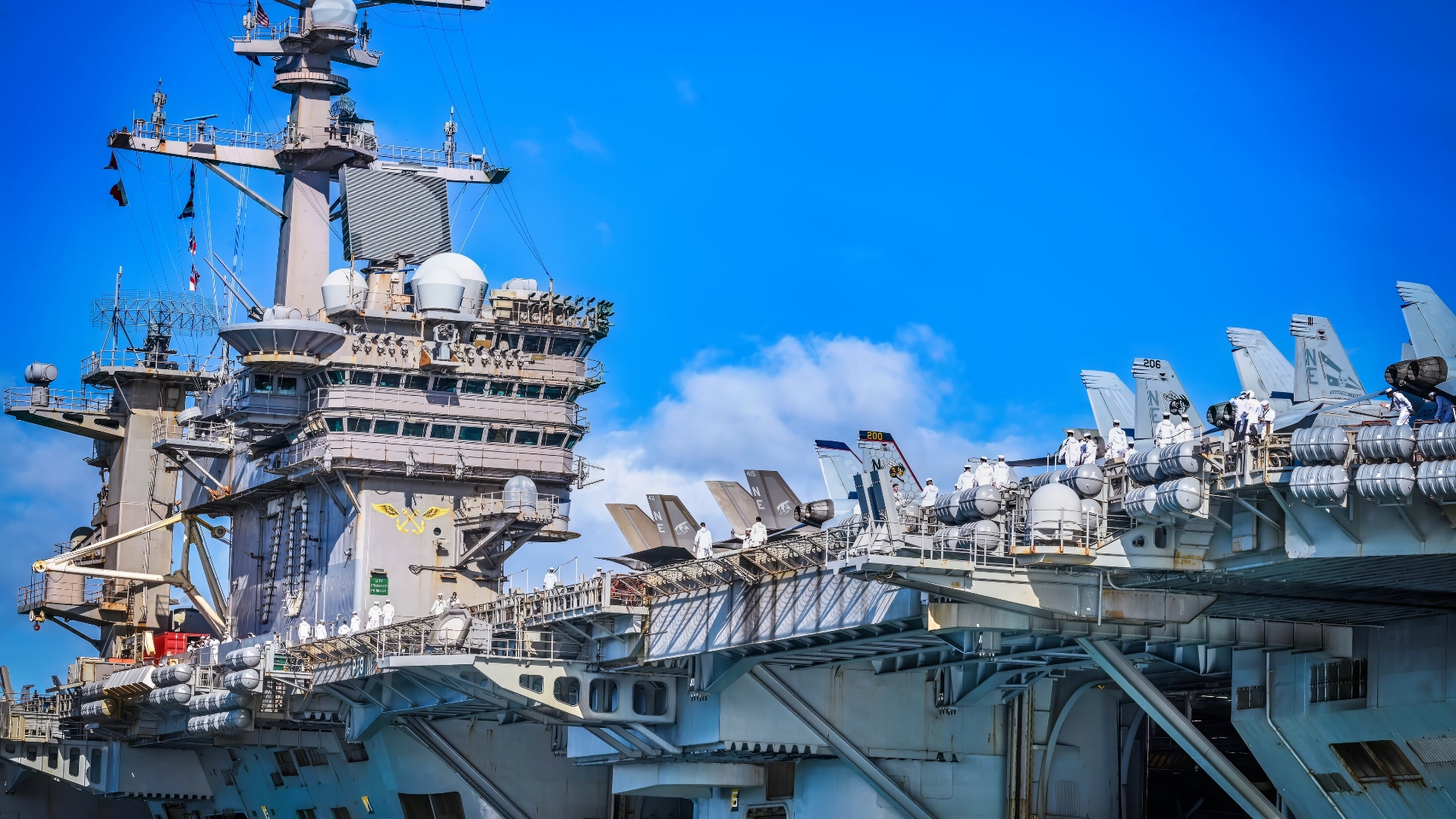
The Nimitz-class aircraft carrier USS Carl Vinson (CVN 70) arrives in Joint Base Pearl Harbor-Hickam, Hawaii, for a scheduled port visit, July 30, 2025. Vinson, the flagship of Carrier Strike Group ONE, is underway conducting routine operations in the U.S. 3rd Fleet area of operations. (U.S. Navy photo by Roann Gatdula)
Ultimately, the crew got the fire under control only to learn that ordnance was buried under the wreckage of the planes, which eventually detonated, causing additional injuries and damage onboard.
1988 Misfire: When One Mistake Ignites Chaos
On November 30, 1988, while operating in the North Arabian Sea as part of Operation Earnest Will, a mission that ran from 1987 to 88 to protect Kuwaiti-owned tankers from Iranian attacks, a parked A-7E Corsair on the deck of the USS Nimitz experienced an accidental misfire of its 20mm cannon.
The A-7 was undergoing routine maintenance of the plane’s electrical system when human error by the ordnance crew triggered the onboard disaster.
That misfire led to a nearby KA-6D Intruder being hit by the 20mm cannon, sparking a massive fire that spread to six other aircraft on the flight deck. According to people who were aboard the Nimitz at the time, the real damage was caused by High-Explosive Incendiary (HEI) rounds hitting the KA-6D Intruder while it was parked. Those explosive rounds hit the Intruder’s right drop tank, sparking the fire.
Petty Officer Second Class Douglas Scott Dimberg was killed in the misfire, and another sailor died from severe burn injuries. Multiple planes were affected by the fire because every bird was packed tightly on the ship. Some were thrown overboard into the ocean, while others were brought back to California when the Nimitz returned and were disassembled at a US Navy facility in Alameda.
As a result of this incident, the Navy effectively rewrote how it handled loaded weapons while underway and how it conducted maintenance procedures.
1996 Cable Accident: The Snapback Nightmare
The primary purpose of an aircraft carrier, as its name suggests, is to serve as a mobile, floating air base. Carriers do not carry many weapons; they deploy the air wing to attack enemy targets on distant battlefields. The flight deck on a carrier is much smaller and more compact than an average runway. Warplanes are designed to land and take off from carriers because of the tight runway.
Plus, the carrier is always in motion, which adds complexity to flight deck operations.
To assist pilots during takeoff, a catapult system pushes planes off the deck more quickly. For landings on a carrier, a cable system essentially catches a landing plane with a hook and then helps pull it back as it hits the flight deck. During high-tempo operations, a carrier’s complex systems are under severe strain. The chances of any or all these systems, irrespective of how well they’re designed and maintained, failing at a critical moment are high.
During the 1996 Taiwan Strait Crisis, President Bill Clinton deployed US Navy aircraft carriers, including the USS Nimitz, to prevent China from blocking the Strait of Taiwan. While the Nimitz, along with the USS Independence, was conducting flight operations in the Gulf of Thailand in response to Chinese military operations near Taiwan, a crisis involving the Nimitz’s arresting cable occurred.
The arresting cable is roughly two inches thick and is made of steel. This is not the rope with which you played tug-of-war in school. This cable is designed to instantly absorb tremendous amounts of kinetic energy from a speeding warplane.
Think about it: the tailhook on a landing Navy bird catches this nearly two-inch-thick steel cable, which brings the bird from 150 miles per hour to zero mph in seconds. If that tense, thick steel line snaps under that immense tension, snapback occurs.
Snapback is every deckhand’s fear. When an arresting cable snaps under strain, it recoils at lethal speeds and whips madly across the deck. That steel cable becomes a giant blade, whipsawing across the deck. It moves so quickly and unpredictably that no one on the deck can react before its lethality is felt.
During the 1996 operations on the Nimitz, one of those cables broke, and the nightmare became reality. While the Navy takes great care to ensure the safety of all its flight crew and flight deck operators, the flat top is a crowded, bustling space during flight operations.
Flight deck crews wear brightly colored vests to indicate their roles and enhance safety. Yellow shirts are directors; green shirts operate the gear; red shirts handle ordnance for planes and helicopters; and others direct landings.
But these heroic professionals are working mere feet from an arresting gear cable that could become a destructive weapon at any moment.
Working so close to such a dangerous system means that if a cable snaps back during landings, it will kill and maim many of the hardworking deckhands. One sailor was killed in this horrific snapback, and four more were injured. Interestingly, a similar event occurred on the Nimitz a year earlier (though it did not injure as many). Despite that earlier incident, snapbacks are rare but hard to avoid.
The Navy conducted an in-depth safety review and investigation of the 1996 incident. But sometimes these accidents are unavoidable. It’s the nature of carrier flight operations—especially during high-tempo, high-stress missions.
The Hard Truth About Aircraft Carriers in War
Ultimately, the three disasters highlighted in this essay underscore the inherent dangers faced by the men and women who serve aboard our forward-deployed carriers. It also shows that, no matter what precautions the Navy takes, accidents are unavoidable.
What’s more, the fires aboard carriers demonstrate that aircraft carriers do not have to be sunk to be neutralized. All they have to do is burn, rendering flight deck operations impossible and negating the carrier’s strategic impact and tactical usefulness.
Burning a carrier or rendering its flight deck inoperable during combat operations is much easier than most people think. That’s why the Pentagon has been keeping its carriers as far as possible from the ranges of Iranian anti-ship ballistic missiles (ASBMs) during the current war with Tehran. If accidents during peacetime are as lethal and devastating as this essay has shown, imagine the destruction caused by enemy fire to a carrier.
About the Author: Brandon J. Weichert
Brandon J. Weichert is the Senior National Security Editor. Recently, Weichert became the editor of the “NatSec Guy” section at Emerald.TV. He was previously the senior national security editor at The National Interest. Weichert is the host of The National Security Hour on iHeartRadio, where he discusses national security policy every Wednesday at 8 pm Eastern. He hosts a companion show on Rumble entitled “National Security Talk.” Weichert consults regularly with various government institutions and private organizations on geopolitical issues. His writings have appeared in numerous publications, among them Popular Mechanics, National Review, MSN, and The American Spectator. And his books include Winning Space: How America Remains a Superpower, Biohacked: China’s Race to Control Life, and The Shadow War: Iran’s Quest for Supremacy. Weichert’s newest book, A Disaster of Our Own Making: How the West Lost Ukraine, is available for purchase wherever books are sold. He can be followed via Twitter/X @WeTheBrandon.


