

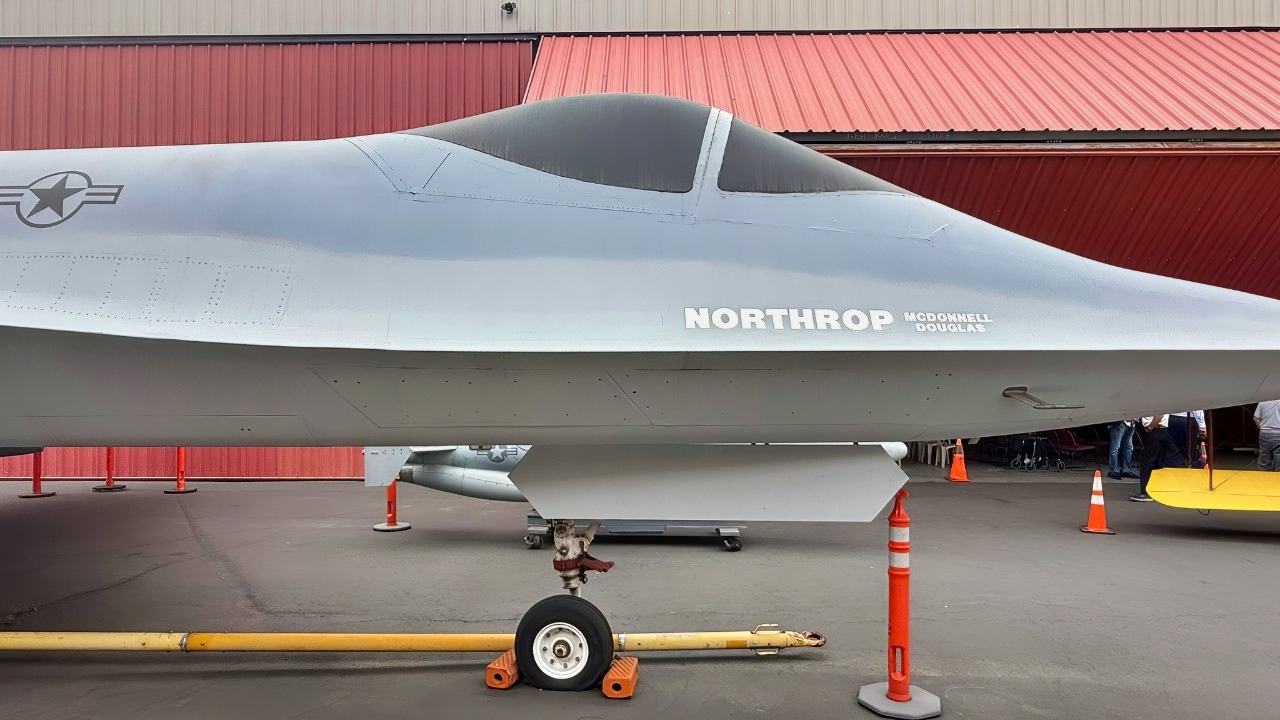
Key Points and Summary – This analysis pits the legendary YF-23A Black Widow II, a U.S. stealth fighter prototype from the 1990s, against China’s modern, operational J-20 Mighty Dragon.
-The YF-23, which famously lost the Advanced Tactical Fighter competition to what became the F-22, is highlighted for its potential superiority in raw speed, ceiling, and its revolutionary all-aspect stealth design.
-The J-20, however, is a complete and mature weapon system with advanced sensor fusion and electronic warfare capabilities.
-While the aircraft are closely matched on paper, the author concludes that any engagement would ultimately be decided by pilot training.
YF-23A vs. the Chinese J-20, Who Wins?
The YF-23A Black Widow II and J-20 are both advanced stealth fighter aircraft; however, both were designed with different philosophies and operational roles.
The YF-23A, known as the Black Widow II, was a prototype stealth fighter developed by Northrop and McDonnell Douglas for the US Air Force’s Advanced Tactical Fighter (ATF) program in the late 1980s and early 1990s.
Although it lost the competition to the YF-22 (which became the F-22 Raptor), the YF-23 was notable for its advanced stealth technology and unique design, featuring a blended wing-body configuration and canted vertical tails.
Northrop and McDonnell Douglas’ YF-23 was an outstanding aircraft, but suffered from the lack of presentation to the decision makers of the program. Otherwise, history may have turned out quite differently.
While the YF-23 was designed with superior stealth and speed capabilities, the J-20 is in production and has a larger operational capacity.
Meet The YF-23A Black Widow II Stealth Fighter
The YF-23 had a sleek, stealthy design and innovative features; the Black Widow incorporated technologies like advanced radar-absorbing materials, a revolutionary diamond-shaped wing, and an emphasis on reduced infrared signatures.
It used a blended wing-body and S-duct engine intakes to reduce its radar cross-section.
The aircraft was powered by two Pratt & Whitney YF119 or General Electric YF120 engines, enabling supercruise. The aircraft could utilize supercruise capability, which meant it could maintain supersonic speeds without using fuel-guzzling afterburners, offering advantages in range and fuel efficiency.
The YF-23A Black Widow II could reach speeds of up to Mach 2.2 at high altitudes, flying over distances of 2,424 nautical miles (2,789 miles / 4,489 km), according to Aerotime Hub. Its combination of speed, agility, and stealth made it a fierce competitor.
While Lockheed’s YF-22 had a visually impressive design, the YF-23 truly stood out with its extraordinary appearance. It featured diamond-shaped wings that contributed to reduced radar visibility, and its slim side profile reminded one of the SR-71 Blackbird spy plane.
Meet The Chinese J-20 Mighty Dragon Stealth Fighter
The Mighty Dragon is China’s frontline fifth-generational stealth fighter. It can also reach Mach 2 speed, powered by its Shenyang WS-10C thrust vectoring turbofan engines, which produce 33,000 pounds of thrust. However, the YF-23 would have been slightly faster at Mach 2.2.
The J-20 features a blended fuselage with low radar cross section, low jet engine intakes, canard delta configuration, modern fly-by-wire (FBW) system, diverterless supersonic inlet (DSI), V-shaped tail, and tail fins.
The J-20 is designed primarily for air superiority and long-range interception missions, with a strong emphasis on stealth, sensor fusion, and advanced avionics.
It is a large twin-engine aircraft with internal weapons bays, radar-absorbent materials, and a shape optimized for low radar cross-section. These features allow it to penetrate deep into contested airspace and engage high-value targets while remaining difficult to detect.
The J-20 replaced the Su-27SK, the Flanker-B, Su-30MKK, Su-30MK2, and the Su-30MK2 Flanker-G aircraft.
The J-20 has a JLJ-5 AESA radar for better survivability and situational awareness. It is longer than the YF-23, measuring 69 feet, with a slightly smaller wingspan of 43 feet. The combat range is 1,200 miles, and the ceiling is 52,000 feet, which is lower than the YF-23’s ceiling, which was at 55,000 feet.
The J-20 was designed to fly deep into enemy airspace and provide air dominance in a multi-threat environment. The Mighty Dragon is China’s number one fighter, although there are two other stealth fighters in development by China’s Air Force.
Another advantage of the J-20 is its ability to collect intelligence, surveillance, and reconnaissance data, as well as conduct electronic warfare duties to spoof and jam enemy radar.
The J-20 is referred to as a deterrence platform by the Chinese. However, China’s ambitions are not defensive; it wants to exert pressure on other nations and expand its circle of influence. It needs the J-20 for air superiority in the First Island Chain, encompassing the East and South China Seas, as well as the Taiwan Strait.
Who Wins In an Air Battle Between The YF-23 And the J-20?
Both aircraft are outstanding in their own right. The YF-23 has the edge in overall speed, stealth, and ceiling. The J-20 doesn’t have a gun for close-range dogfights, relying on missiles for longer-range engagements.
However, the aircraft are so closely matched that in the end, it will come down to the training of the pilots. American pilots are the best trained in the world, but the Chinese pilots are rapidly improving with their combat skills.
About the Author: Steve Balestrieri
Steve Balestrieri is a National Security Columnist. He served as a US Army Special Forces NCO and Warrant Officer. In addition to writing on defense, he covers the NFL for PatsFans.com and is a member of the Pro Football Writers of America (PFWA). His work was regularly featured in many military publications.
Military Affairs
China’s Stealth Air Force Has 1 Mission


