


Key Points & Summary on H-20: What it is: A subsonic, flying-wing stealth bomber meant to give China a true air leg of the nuclear triad while reaching deep into the Pacific with conventional standoff weapons.
What we know: Official U.S. assessments say >10,000 km range, nuclear and conventional roles, and a debut “sometime in the next decade,” while Chinese officials hint it will be unveiled “soon.” Expect a B-2/B-21-style profile.
Why it matters: Puts Guam, parts of Hawaii, and theater logistics hubs at risk from stealthy, standoff salvos—especially as China’s tanker fleet grows.
Caveats: Big questions remain on engines, signatures, mission systems integration, and training for sustained long-range ops
This Is Being Created for 1 Purpose: To get to stealth bomber parity (or close to it) with the U.S. Air Force.
China’s H-20: The Bomber Beijing Wants You to Fear—And Why It’s Not Here Yet
For years, Beijing has teased a ghost under a sheet: a flying-wing silhouette that looks suspiciously like America’s stealth bombers.
The name is H-20, and the pitch is simple: give the People’s Liberation Army Air Force an actual long-range stealth bomber that closes the last gap in China’s power-projection toolkit.
The promise is revolutionary. The reality—so far—is rumor, hints, and a handful of official breadcrumbs.
What the H-20 Is Supposed to Be
Strip away the hype and you get a clear outline. The H-20 is assessed to be a low-observable, subsonic, flying-wing heavy bomber built by XAC under AVIC, designed to carry both nuclear and conventional payloads.
This isn’t a “better H-6.” It’s a different animal: internal bays, stealth shaping, and long legs to push beyond the first and second island chains. The goal is deterrence, yes—but also standoff strike: think air-launched cruise missiles and other precision weapons, not lobbing unguided iron.
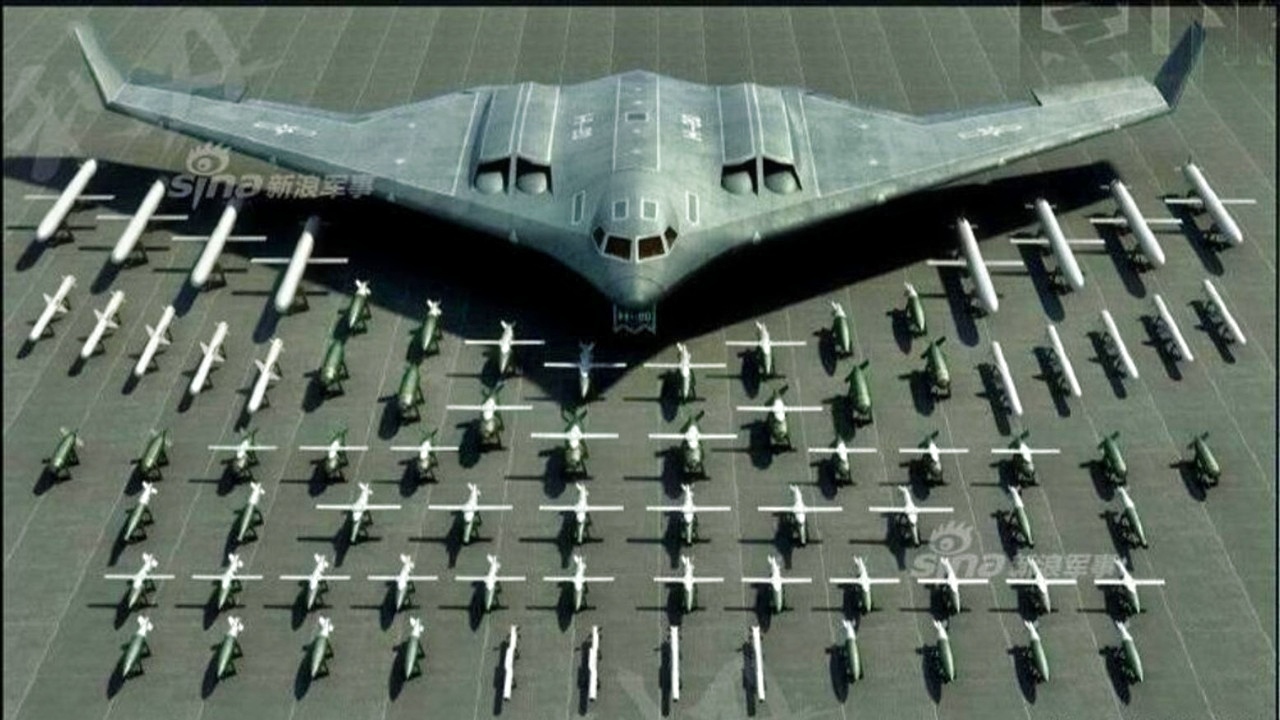
H-20 Bomber. Chinese Internet Social Media Screenshot.
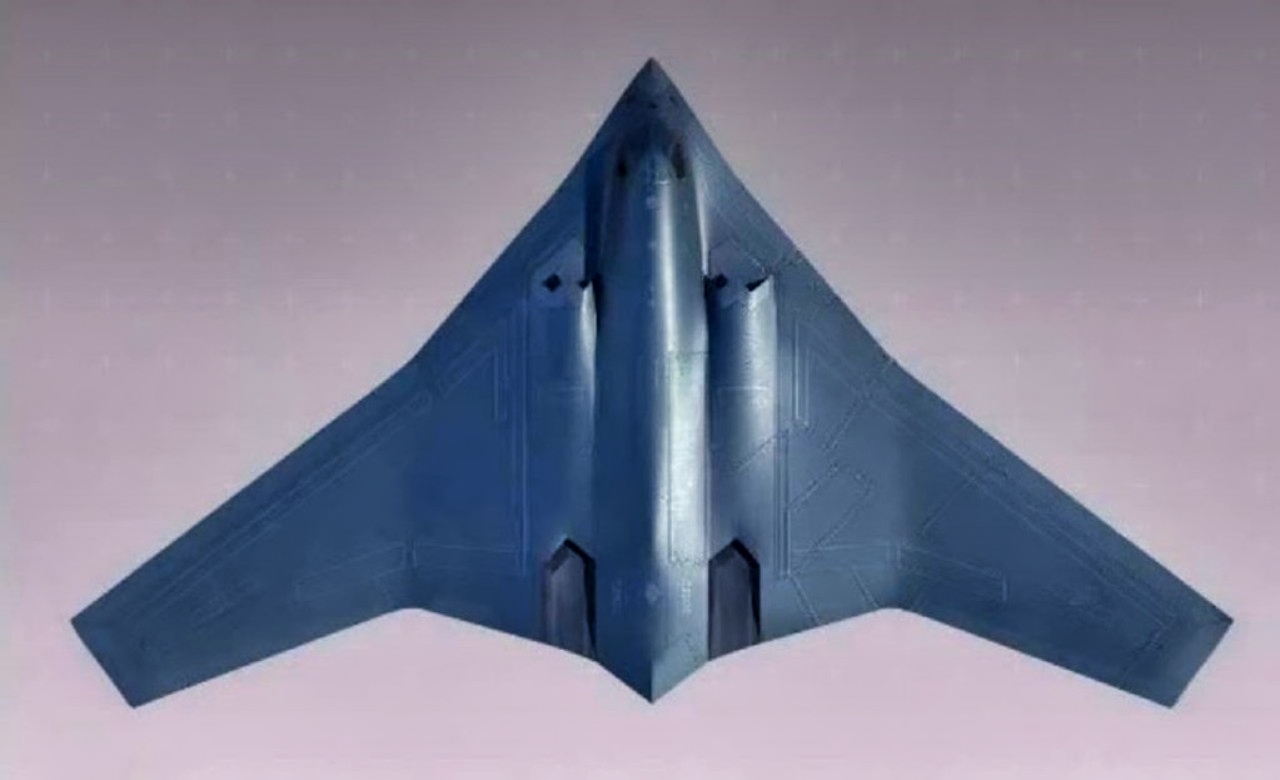
H-20 Bomber from China Artist Rendition. Creative Commons.

China’s H-20 Stealth Bomber. Image Credit: Creative Commons.
Range, Payload, and the Numbers That Matter
On range, you’ll see two bands in credible sources. One set of assessments anchors around 8,500 km; another—more recent U.S. government reporting—says “more than 10,000 km” without tanking. Both agree refueling would extend reach dramatically.
On payload, the open record is cautious: multi-ton internal carriage for mixed loadouts rather than a single “magic number.” What matters operationally isn’t the raw tonnage so much as how many standoff weapons a stealth platform can launch from outside dense air defenses—and whether its sensors and datalinks can tie into China’s kill web to get those weapons to the right place on time.
Why Beijing Wants It: A Real “Strategic Air Force”
China has long had bombers, but not a strategic bomber in the modern sense. That began to change with the H-6N—refuelable and nuclear-capable—re-establishing an air-leg.
The H-20 is the step that turns the PLAAF into a “strategic air force” in fact, not just in slogans: a service that can conduct independent, long-range campaigns, present the leadership with non-ballistic options, and complicate U.S. planning across the Pacific.
It is also a budget fight: carriers grab headlines for the Navy; a stealth heavy bomber is how the PLAAF stays in the same political weight class.
The Timeline: “Soon”… and “Sometime Next Decade”
Here’s where reality intrudes. In March 2024, a PLAAF deputy commander publicly hinted the H-20 would be “unveiled shortly.”
Yet U.S. assessments published later that year cautioned that a public debut—and meaningful capability—may land “sometime in the next decade.”
Trade press still riffs on “by the end of the decade”, but the official U.S. line is more conservative. Translation: expect a reveal before you should expect a force. Even if a prototype does appear, mass production, training, tactics, and real multi-ship employment take years.
Engines, Signatures, and the Hard Parts
Stealth airframes are only half the battle. Engines matter—both for thermal/IR signature and for the fuel efficiency a global-reach bomber needs.
China is improving its indigenous engine base (you see it on the Y-20 and J-20), but integrating a quiet, efficient, reliable powerplant into a stealth bomber is a different tier of difficulty.

China’s J-20 Fighter. Image Credit: Creative Commons.
Then there’s the mission system: sensors, EW, datalinks, and the software glue to fuse it all without spiking emissions. And you don’t just build one airplane; you build hangars, tooling, crews, tanker capacity, and concepts of employment—an ecosystem. Beijing is moving those pieces, especially Y-20 tankers, but knitting them together for sustained operations across the Pacific is non-trivial.
The Kill Chain It Needs to Work
A stealth bomber is a node, not a solo act. To find and fix targets at long range, the H-20 will rely on China’s growing web of space-based sensors, over-the-horizon radars, maritime patrol assets, and fusion centers that pass targeting to aircrews in near-real time. Expect tactics that emphasize low-observable ingress to a release line, salvo launch of long-range air-launched cruise missiles, then egress under tanker cover. The point is not dogfighting—it’s arriving unannounced, firing from outside the hardest SAM rings, and letting the weapons do the dangerous work.
A Quick Wargame: Guam on a Bad Night
Picture a moonless window in the Philippine Sea. Two H-20s depart central China at night under emissions control, stepping stone to a tanker track southwest of Okinawa, then drop to a quiet, fuel-efficient altitude.
A forward ELINT trawl has already mapped radar rotations. At the release line—still well outside the densest air defenses—they kick a salvo of stealthy cruise missiles aimed at runways, fuel farms, and C2 nodes on Guam. If the timing stacks with cyber and spoofing, defenders see too many tracks too late. Even with decent interception rates, runway craters and shattered fuel lines mean sorties pause. It’s not a war-winner. It’s a campaign-shaper—and that’s the point.
What We’ve Actually Seen
Beyond official reports, the public trail is thin by design. State videos in 2018 and 2021 teased a covered flying-wing silhouette and sparked speculation; Zhuhai 2024 drew “will it show?” chatter—but the no-show underscored how tightly Beijing is holding this card.
Expect the first reveal to be carefully managed imagery, not a close-up walkaround. That’s consistent with how the U.S. rolled out the B-21—and how China has handled the J-20 across early phases.
What Could Go Wrong—for China on J-20?
Plenty.
Concurrency risk. If prototypes, production, and tactics development overlap too aggressively, you pay later in reliability and readiness. The LCS saga is the naval cautionary tale; bombers are far less forgiving.
Engine and material science gaps. Stealth lives and dies on repeatable manufacturing tolerances, RAM coatings, and low-signatures across RF and IR bands. A bomber’s surfaces are big; keeping them low-observable after weather and maintenance is hard.
Training and sustainment. A strategic bomber force isn’t a photo op. It’s an enterprise: aircrew pipelines, mission planners, maintenance, tanker scheduling, and long-range recovery bases. Building that muscle takes years.
What Goes Wrong—for Us—If It Works
If China gets the H-20 right, cost-imposition flips. Instead of cheap DF-26s threatening fixed bases, you add reusable stealth delivery that can sortie again tomorrow.
That forces the U.S. and allies to spend more on dispersal, rapid runway repair, fuel resilience, and integrated air and missile defense across the theater—while also protecting tankers and AWACS that keep our own strike packages alive.
A credible H-20 shrinks the sanctuary around Guam and puts pressure on Hawaii’s enabling infrastructure in a contingency.
How the U.S. and Allies Answer
The response isn’t one shiny object. It’s a web.
-Range and survivability parity: B-21 fielding and long-range weapons that let us fire first from safer lanes.
-Sensing and C2: More E-7-class airborne C2, passive sensors, and multi-path cueing that doesn’t betray itself with loud emissions.
-Base resilience: Hardening, alternative runways, deception, fuel distribution that can take a punch.
-Kill the tankers: Targeting YY-20 tracks in a fight to starve H-20s of reach.
-Allied geography: Dispersal across Japan, the Philippines, Australia—turning a few big targets into many smaller, resilient ones.
So—How Close Are We, Really?
Here’s the sober take. Yes, senior Chinese officers have dangled the word “soon.” Yes, you should expect a reveal in the near term.
However, the most authoritative public assessments I would bank on still indicate that meaningful capability will arrive in the 2030s, not next Tuesday.
When you finally see the H-20 on screen, remember: one prototype is not a force to be reckoned with.
The tell will be the quiet stuff—tanker counts, bomber crew training cycles, long-range exercises, and how quickly the program moves from sizzle reel to multi-ship tactics with standoff weapons.
That’s when the Pacific map really starts to bend.
Verdict
The H-20 is the last piece in Beijing’s long-range puzzle: the reusable, stealthy hammer that lets China threaten bases and logistics nodes far from its shores while rounding out a true triad. It will not erase America’s advantages overnight.
But if China solves the engine, integration, and enterprise problems—and pairs the bomber with tankers, targeting and a thick magazine of standoff weapons—the H-20 becomes a campaign-shaping platform that forces the U.S. and its allies to spend more, disperse harder, and think differently about sanctuary.
Expect a reveal. Expect more theater pressure. And expect the real test—training and sustainment—to take time.
About the Author: Harry J. Kazianis
Harry J. Kazianis (@Grecianformula) is Editor-In-Chief and President of National Security Journal. He was the former Senior Director of National Security Affairs at the Center for the National Interest (CFTNI), a foreign policy think tank founded by Richard Nixon based in Washington, DC. Harry has over a decade of experience in think tanks and national security publishing. His ideas have been published in the NY Times, The Washington Post, The Wall Street Journal, CNN, and many other outlets worldwide. He has held positions at CSIS, the Heritage Foundation, the University of Nottingham, and several other institutions related to national security research and studies. He is the former Executive Editor of the National Interest and the Diplomat. He holds a Master’s degree focusing on international affairs from Harvard University.
More Military
Yamato-Class: The Biggest Battleship Ever Was a Mistake
Littoral Combat Ship: The U.S. Navy’s Greatest Mistake


