


Key Points and Summary – Russia’s Su-35 represents the absolute zenith of conventional fourth-generation fighter design, a “king-killer” built for raw power and breathtaking agility.
-With its powerful engines and three-dimensional thrust-vectoring, it is a “supermaneuverable” and dangerous dogfighter.
-Its massive Irbis-E radar and long-range R-37M missiles make it a potent beyond-visual-range hunter.
-However, its combat record in Ukraine has exposed a fatal flaw: the non-stealthy airframe is highly vulnerable to modern surface-to-air missiles.
-The Su-35 is the ultimate expression of a dying breed, a magnificent predator being rendered obsolete by the realities of 21st-century warfare.
The Su-35 Is One Powerhouse Fighter Jet
In the high-stakes world of aerial combat, there are fighters built to be invisible assassins and others built to be unrivaled brawlers.
Russia’s Sukhoi Su-35S Flanker-E belongs firmly in the latter category.
It is not a stealth aircraft, nor was it ever intended to be.
It is something else entirely: the absolute zenith of conventional, fourth-generation fighter design, a machine that takes the legendary airframe of the Su-27 Flanker and elevates it to a level of raw power and breathtaking agility that can challenge any aircraft in a visual-range dogfight.
The Su-35 represents a fascinating and dangerous branch of fighter evolution. While the United States invested trillions in the fifth-generation dream of stealth, sensor fusion, and networked warfare, Russia took a more pragmatic path.
Faced with economic turmoil and technological hurdles, they chose to perfect what they already had, creating a “4++ generation” fighter that could bridge the gap to their own troubled stealth program.

Su-35. Image Credit: Creative Commons.
The result is a machine that is both a relic and a predator—a throwback to the era of the dogfight, yet equipped with a suite of modern electronics and weapons that make it a formidable threat.
To underestimate the Su-35 based on its lack of stealth is a profound mistake. This aircraft was designed to be a king-killer, a specialized air superiority hunter with the maneuverability to evade missiles and the powerful sensors to find its prey from afar.
Its story is a testament to Russian design philosophy, and its capabilities are a stark reminder that in the violent physics of air-to-air combat, sometimes raw power and agility can create a lethality all their own.
From Soviet Super-Fighter to Modern Gap-Filler
The lineage of the Su-35 stretches back to the heart of the Cold War.
Its ancestor, the Su-27 Flanker, was the Soviet Union’s brilliant answer to America’s F-15 Eagle. The Su-27 was a massive, powerful, and incredibly agile air superiority fighter that shocked the West when it was first revealed.
The Soviet design bureau, Sukhoi, knew they had a masterpiece on their hands—an airframe with almost limitless growth potential.
The first aircraft to bear the Su-35 designation (then known as the T-10M) emerged in the late 1980s as a dramatically upgraded Su-27, featuring canards, new engines, and advanced avionics. It was intended to be the Soviet Union’s ultimate air dominance fighter.
The collapse of the Soviet Union, however, shelved those ambitions. For nearly two decades, the project lay dormant as Russia’s economy and military-industrial complex crumbled. It wasn’t until the mid-2000s, with Russia’s resurgence under Vladimir Putin, that the program was resurrected, but with a new purpose. Russia’s fifth-generation fighter program, the Su-57, was proving to be a slow, expensive, and technologically fraught endeavor.

Su-35. Image Credit: Creative Commons.
The Russian Air Force needed a modern, capable fighter to bridge the significant gap between their aging Cold War-era fleets and the distant promise of a true stealth aircraft.
The answer was the Su-35S.
This new machine was a complete redesign of the original concept. It removed the canards of the 1980s prototype, compensating with a new generation of incredibly powerful engines equipped with three-dimensional thrust vectoring.
Its airframe was reinforced with titanium alloys, its internal fuel capacity was increased, and its entire avionics suite was ripped out and replaced with a modern, digital “glass” cockpit. This was not merely an upgrade; it was a fundamental rebirth, creating a fighter that could be produced quickly and in numbers, giving Russia a credible near-peer competitor to the latest Western fourth-generation jets like the F-15E and the Eurofighter Typhoon.
The Physics-Defying Su-35 Fighter Brawler: Supermaneuverability
The single most terrifying attribute of the Su-35 is its almost supernatural agility. This is a massive aircraft, yet it can perform aerial maneuvers that seem to defy the laws of physics.
This “supermaneuverability” is the product of three key elements: a brilliantly designed airframe with inherent aerodynamic instability, a sophisticated fly-by-wire control system, and—most importantly—its two Saturn AL-41F1S engines.
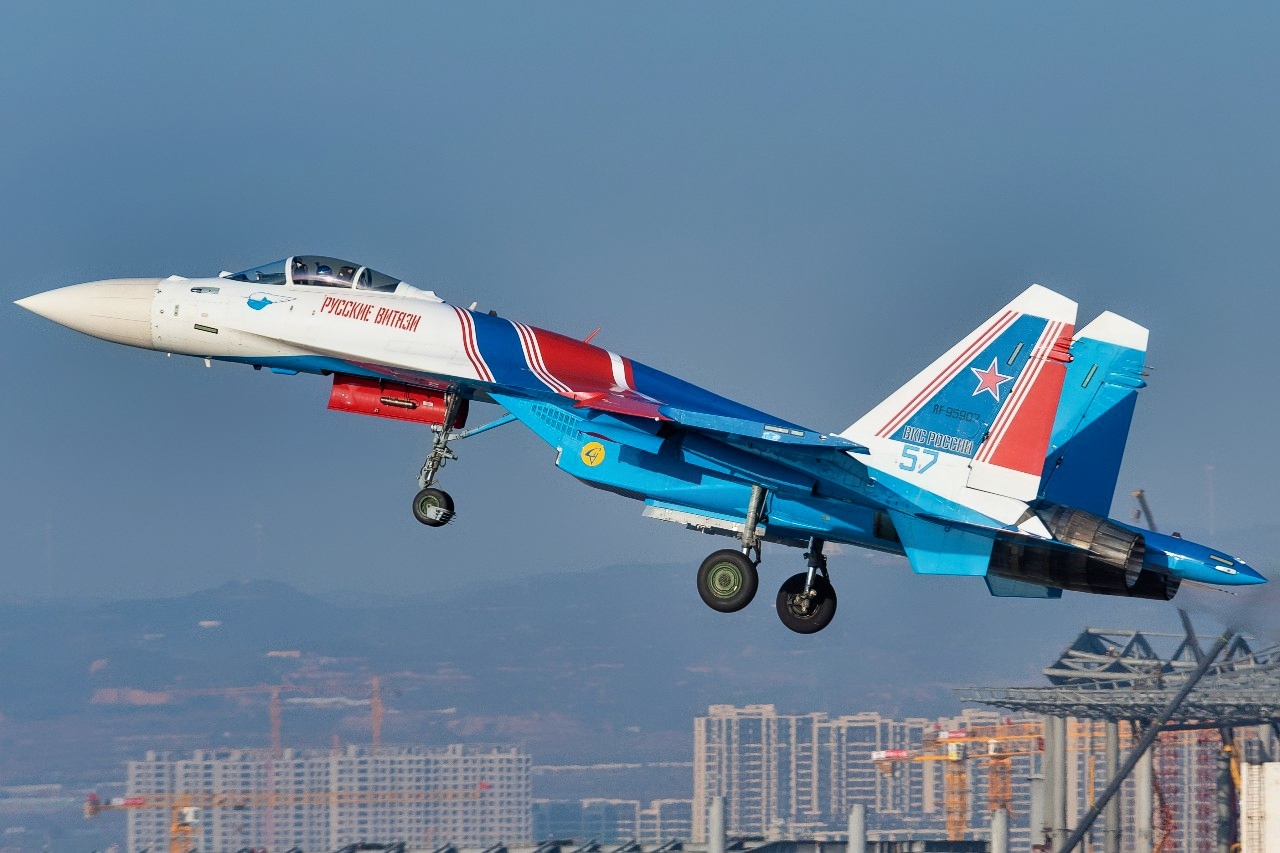
These are not just engines; they are beasts. Each can produce over 31,000 pounds of thrust in afterburner, giving the Su-35 a thrust-to-weight ratio greater than 1:1. But their true magic lies in their three-dimensional thrust-vectoring nozzles. These nozzles can move independently, directing the engine’s immense thrust in any direction, not just straight back. This gives the pilot an incredible degree of control over the aircraft’s attitude, independent of its direction of travel.
Su-35. Image Credit: Creative Commons.
It is this capability that allows the Su-35 to perform its famous, physics-defying post-stall maneuvers. In a classic maneuver like the Pugachev’s Cobra, the pilot can pitch the aircraft’s nose up and beyond 90 degrees, turning it into a giant airbrake, before dropping the nose back down and accelerating away. In combat, this could be used to force a pursuing enemy fighter to overshoot, or to rapidly point the Su-35’s nose at a target to get a quick missile shot.
While the tactical utility of such maneuvers is a subject of intense debate among pilots, there is no question that they make the Su-35 an incredibly unpredictable and dangerous opponent in a close-range, visual dogfight. It can change direction and point its weapons in ways that a conventional fighter simply cannot.
The Far-Seeing Hunter: Radar and Sensors
While its dogfighting prowess is legendary, the Su-35 is also designed to be a capable beyond-visual-range hunter. Its primary sensor is the Tikhomirov Irbis-E (Snow Leopard), a massive Passive Electronically Scanned Array (PESA) radar.
The Irbis-E is a brute-force piece of engineering, capable of pumping out enormous amounts of power. This gives it a staggering detection range, with Russian sources claiming it can track a typical fighter-sized target from up to 400 kilometers away.
The PESA technology is a generation behind the Active Electronically Scanned Array (AESA) radars found on modern Western fighters like the F-35 and F/A-18E/F. A PESA radar has a single transmitter, making it easier to detect and jam compared to the multiple, difficult-to-jam signals of an AESA. However, what the Irbis-E lacks in subtlety, it makes up for in raw power. It can also mechanically steer its antenna, giving it a much wider field of regard than a fixed AESA radar.
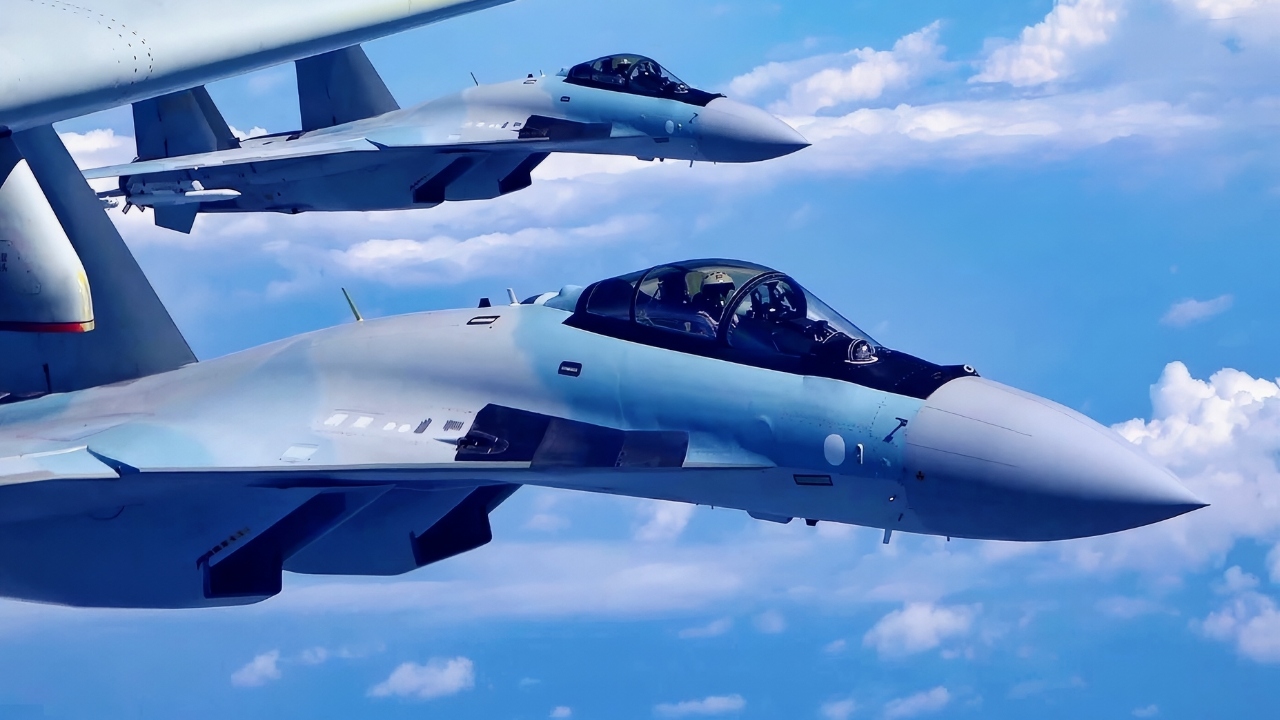
Complementing this powerful radar is the OLS-35, a sophisticated infrared search and track (IRST) system. Housed in a glass dome in front of the cockpit, the OLS-35 can passively scan for and track the heat signatures of enemy aircraft from dozens of kilometers away.
Su-35 from China. Image Credit: Chinese Air Force PLAAF.
This is a critical capability. It allows an Su-35 pilot to hunt for targets without turning on their own powerful radar, which would act like a giant electronic beacon, announcing their presence to the enemy.
A pilot could use the IRST to find a target, get a firing solution, and launch a missile in complete electronic silence, giving the target no warning until the missile’s own seeker goes active in the terminal phase of its flight.
The Long-Range Sniper: A Heavy Arsenal
The Su-35 was designed to be an air superiority fighter, and it carries the weapons to back up that mission. It boasts 12 hardpoints and can carry a massive air-to-air payload of over 17,000 pounds. Its primary weapons are from the Vympel R-series of missiles.
For close-in fights, it carries the highly agile, heat-seeking R-73. For beyond-visual-range combat, its main weapon is the R-77-1 (NATO code: AA-12 Adder), an active radar-homing missile comparable to the American AMRAAM.
But its most dangerous weapon is the R-37M (NATO code: AA-13 Axehead). This is a monstrously large, very-long-range hypersonic missile designed to kill high-value assets like AWACS aircraft, tankers, and bombers. With a reported range of up to 400 kilometers, the R-37M allows the Su-35 to act as a long-range sniper, threatening the critical support aircraft that are the backbone of American and NATO airpower.
The combination of the powerful Irbis-E radar and the extreme range of the R-37M creates a deadly partnership. In a potential conflict, Su-35s could be used to patrol friendly airspace and “shoot down the network,” targeting the vulnerable command-and-control and refueling aircraft that are essential for any large-scale Western air campaign.
A Contested Legacy: Combat in Ukraine and an Uncertain Future
The Su-35S first saw combat in Syria, where it flew top cover for Russian strike aircraft. It performed well in this relatively permissive environment, demonstrating its maturity as a platform and projecting an intimidating presence that deterred any potential interference from coalition aircraft.
Its performance in the full-scale war in Ukraine, however, has been a far more mixed and revealing story.
On one hand, the Su-35 has been credited with the majority of Russia’s air-to-air kills, using its powerful radar and long-range R-77-1 and R-37M missiles to shoot down Ukrainian fighters and bombers from standoff distances. It has proven that it is, indeed, a lethal beyond-visual-range platform.
On the other hand, the Su-35 has also suffered significant and well-documented losses. At least two dozen have been confirmed shot down (numbers do vary based on source, please note), almost all of them by Ukrainian surface-to-air missile (SAM) systems like the S-300 and the American-made Patriot.
These losses have exposed the fundamental vulnerability of a non-stealth aircraft in a modern, high-intensity conflict. While the Su-35’s electronic warfare suite is potent, it has not been enough to consistently defeat the sophisticated, overlapping network of Ukrainian air defenses.
The Su-35 has been forced to operate at low altitudes to avoid detection by long-range SAMs, putting it within the lethal envelope of shorter-range systems.
Su-35 Fighter Faces the Future
This combat record has likely tarnished its reputation on the export market and highlights its core dilemma. It is arguably the most capable conventional dogfighter in the world, but the age of the dogfight may be over.
The future of air combat is about avoiding detection and killing the enemy before they ever know you are there. While the Su-35 will continue to serve as the backbone of the Russian Air Force for years to come—a necessary stopgap until the Su-57 can ever be produced in meaningful numbers—its struggles in Ukraine have written its epitaph.
It is the ultimate expression of a dying breed, a magnificent and deadly predator that is nonetheless being rendered obsolete by the new, invisible realities of 21st-century warfare.
About the Author: Harry J. Kazianis
Harry J. Kazianis (@Grecianformula) is Editor-In-Chief and President of National Security Journal. He was the former Senior Director of National Security Affairs at the Center for the National Interest (CFTNI), a foreign policy think tank founded by Richard Nixon based in Washington, DC. Harry has over a decade of experience in think tanks and national security publishing. His ideas have been published in the NY Times, The Washington Post, The Wall Street Journal, CNN, and many other outlets worldwide. He has held positions at CSIS, the Heritage Foundation, the University of Nottingham, and several other institutions related to national security research and studies. He is the former Executive Editor of the National Interest and the Diplomat. He holds a Master’s degree focusing on international affairs from Harvard University.
More Military
Russia’s Su-34 Fullback Is a Punisher Bomber
China’s New H-20 Stealth Bomber Is Coming


Paul W. Tibbets Jr
September 2, 2025 at 3:31 pm
The Su-35 was obsolete vs. peers the day it rolled off the assembly line. Nice try. Do better.