

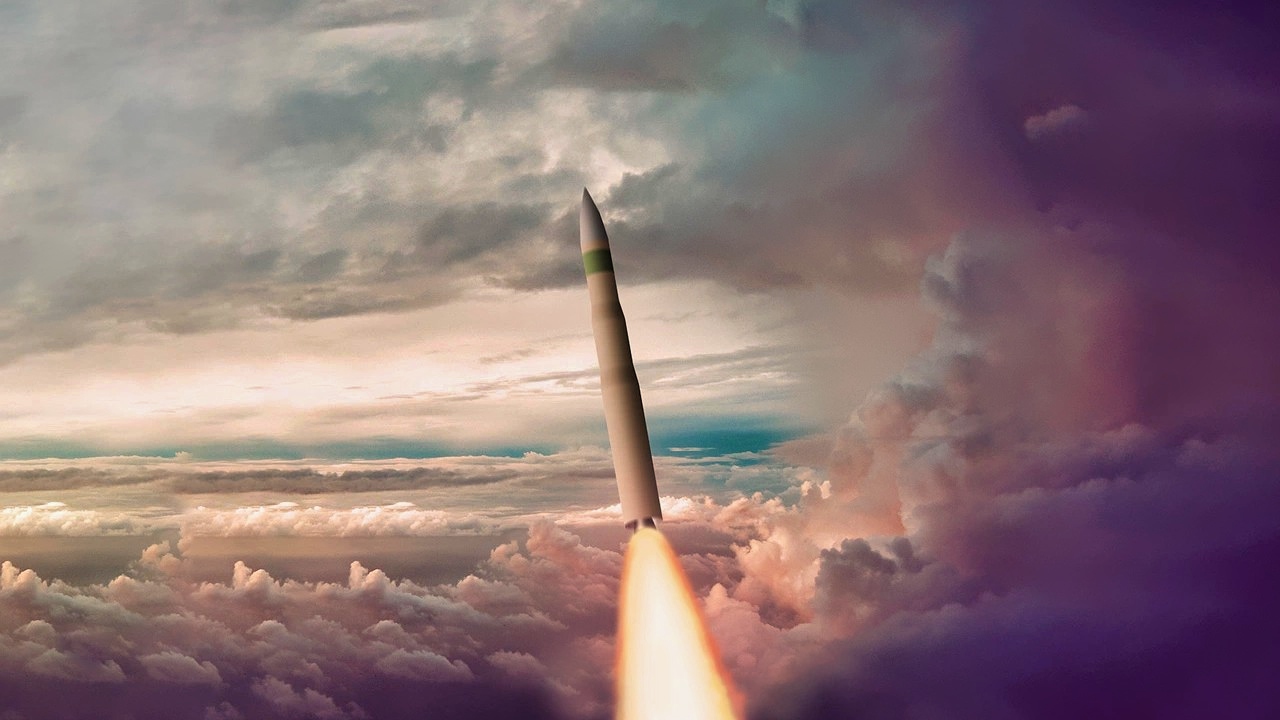
Key Points and Summary – The LGM-35A Sentinel, slated to replace Minuteman III, faces soaring costs and delays.
-A 2024 review found an 81% jump to $141B, triggering a Nunn-McCurdy breach. The DoD retained the program, citing no viable alternative, while the GAO states that the Air Force lacks a comprehensive transition risk plan.

Sentinel ICBM. Image Credit: Creative Commons.
-Restructuring is underway, with a new Milestone B targeted by mid-2027 and USAF still aiming for operational capability by 2050.
-Meanwhile, stage-two motor tests progressed, as old silos are being retired for new builds in MT/WY/ND, and critics question the value of the land-based leg compared to subs and bombers.
-Despite turbulence, USAF leaders insist: “We’ll get Sentinel done.”
America’s New LGM-35A Sentinel ICBM Isn’t Cheap
The LGM-35A Sentinel is an intercontinental ballistic missile system expected to replace the Minuteman III in the U.S. nuclear force structure – the Minuteman III has been in place since the 1960s. The U.S. Air Force requested $4.1 billion for “Sentinel research, development, test, and evaluation” for Fiscal Year 2026, with billions more included in the “One Big Beautiful Bill” act.
However, the Sentinel program is widely seen as troubled in development and wildly over budget.
A Troubled System
Back in the summer of 2024, according to the Federal News Network, a Congress-mandated review of the Sentinel program found that its price tag had jumped 81 percent, to $141 billion. Earlier in the year, the Department of the Air Force had informed Congress that the Sentinel program had “exceeded baseline cost estimates.” This placed it in breach of the Nunn-McCurdy Act, whose provisions kick in when the cost of a program grows by 25 percent or more.
However, then-Undersecretary of Defense for Acquisition and Sustainment William LaPlante said the program would continue, because no alternatives were available.
“Based on the results of the review, it is clear that a reasonably modified Sentinel program remains essential to U.S. national security and is the best option to meet the needs of our warfighters,” LaPlante said.
This month, the Government Accountability Office (GAO) released a report called “Air Force Actions Needed to Expeditiously Address Critical Risks to Sentinel Transition.”
The GAO report stated that while the Air Force had “developed planning documents for the transition from Minuteman III to Sentinel,” it had yet to develop a risk management plan.
“The transition was planned to begin in fiscal year 2025, but those plans are on hold while the Department of Defense (DOD) restructures the Sentinel program,” the report said.
In July, the New York Times reported that, during the controversy over the new Air Force One jet President Donald Trump was in the process of accepting from Qatar, it had been discovered that the cost of renovating the plane appeared to have been tucked “inside an over-budget, behind-schedule nuclear modernization program” – the Sentinel program.
The Times, citing “congressional budget sleuths,” noted that $934 million for the plane came from a different budget, while Air Force officials conceded that the funds had been transferred from the Sentinel program, which again was described as a “massively-over-budget, behind-schedule program.”
The Times also reported that the Air Force announced earlier this year it would be necessary to dig new silos for the Sentinel project – in Montana, Wyoming, and North Dakota – because the silos used for the Minutemans are “ leaking and crumbling.” The Times previously reported, back in 2019, that the Air Force had finally updated the nuclear command-and-control system, which, before the upgrade, still used floppy disks.
The Minot Daily News reported this week that the first Minuteman III missile silo has been taken offline in Wyoming, in preparation for the Sentinel system.
“Air Force Global Strike Command continues to move forward to enhance our command and control, improve security, integrate new technologies, and ultimately, ensure a weapon system that can respond to an increasingly complex world,” an Air Force spokesperson told the newspaper.
This week, at the Air and Space Forces Association’s annual conference in Maryland, Brig. Gen. William Rogers provided an update on the ongoing restructuring of the Sentinel B program.
“We’ll Get Sentinel Done”
According to a Breaking Defense report from the conference, Rogers said restructuring is “expected to culminate in a new Milestone B decision by mid-2027.” He added that the Air Force has “every intention” to have the program operational by 2050, as planned.
“We’ll get Sentinel done, I am confident,” Rogers told Breaking Defense, indicating that it would be finished before a service life extension for the Minuteman III.
“So that date, I charged the team to plan to 2050 because, not because I don’t think I’m gonna crush that date with Sentinel. I have every intention of beating that,” Rogers told the outlet during an interview on the sidelines of the conference.
Milestone B, which Breaking Defense describes as “DoD parlance for the approval of a program to enter engineering and manufacturing development,” was rescinded for the Sentinel B program, but a new decision is expected by 2027.
A July Test
The Air Force and Northrop Grumman announced in July that they had completed a full-scale qualification test of the stage-two solid rocket motor for the LGM-35A Sentinel intercontinental ballistic missile.
The test was conducted by the 717th Test Squadron at the Arnold Engineering Development Complex at Arnold Air Force Base in Tennessee.
“This test reflects our disciplined digital engineering approach and the continued momentum behind the Sentinel program,” Brig. Gen. Rogers said at the time.
“We’re not just testing hardware — we’re proving that our models are accurate, our development timeline is achievable, and the system will be ready to deliver when called upon.”
Questioning the Project
In 2021, the Bulletin of the Atomic Scientists asked the question: “Why is America getting a new $100 billion nuclear weapon?” The Bulletin article asked why the government was spending “roughly $100 billion” to build the successor to Minuteman III.
“The [Sentinel’s] detractors include long-time peace activists, as you’d expect. But many of the missile’s critics are former military leaders, and their criticism has to do with those immovable silos,” the authors wrote. “Relative to nuclear missiles on submarines, which can slink around undetected, and nuclear bombs on airplanes – the two other legs of the nuclear triad, in defense jargon – America’s land-based nuclear missiles are easy marks.”
That “roughly $100 billion” figure has grown substantially in the years since.
About the Author: Stephen Silver
Stephen Silver is an award-winning journalist, essayist, and film critic, and contributor to the Philadelphia Inquirer, the Jewish Telegraphic Agency, Broad Street Review, and Splice Today. The co-founder of the Philadelphia Film Critics Circle, Stephen lives in suburban Philadelphia with his wife and two sons. For over a decade, Stephen has authored thousands of articles that focus on politics, national security, technology, and the economy. Follow him on X (formerly Twitter) at @StephenSilver, and subscribe to his Substack newsletter.
More Military
‘Built for the Impossible Missions’: The A-29 Super Tucano’s Secret Is Out
The J-20A Stealth Fighter: Better Than F-22?
KC-46: The Air Force’s Most Important Plane for a Reason
The F-15EX Eagle Doesn’t Need to Be Stealth
China’s J-20S Stealth Fighter: Just an F-22 or F-35 Copy? Nope.


