


Key Points and Summary – South Korea’s KF-21 Boramae and the U.S. Navy’s F/A-18E/F Super Hornet share F414 engines and AESA radars, but differ in design and mission.
-The lighter, lower-RCS KF-21 adds IRST and promises better thrust-to-weight, favoring it in beyond-visual-range fights, especially with modern sensor fusion and future block upgrades.

KF-21. Image Credit: Creative Commons.
-The Super Hornet counters with proven APG-79, robust EW, JHMCS, carrier toughness and superb high-alpha handling that shines in close-in dogfights.
-Neither is truly stealth; external stores raise signatures. In a straight duel, BVR leans KF-21; WVR is situational—pilot skill, loadout, and tactics decide. Range, sensors, and training shape the winner each time.
KF-21 vs Super Hornet: Who Wins at BVR and WVR?
The KF-21 Boramae is the latest fighter for the South Korean Air Force. It is categorized as a “4.5-generation” fighter with future upgrades aiming to reach full stealth capabilities. The aircraft closely resembles the F-35 in many regards, which gives it a lower radar cross-section than most other aircraft.
The F/A-18E/F Super Hornet, on the other hand, is a heavily modernized version of the F/A-18 Hornet. It included better avionics, minimal stealth features, and electronic warfare suites.
Both fighters are competent, but which fighter would win in a one-on-one fight?
The KF-21 vs. the F/A-18E/F
The KF-21 Boramae is a 4.5-generation fighter developed by Korea Aerospace Industries (KAI) with support from Lockheed Martin and other partners. It first flew in 2022 and is expected to enter service around 2026. It is designed to be modular and upgradeable, with future blocks aiming to incorporate internal weapons bays and enhanced stealth features.
The aircraft is powered by two General Electric F414 engines, the same type used in the Super Hornet, but the KF-21’s lighter airframe gives it a higher thrust-to-weight ratio. This translates into better acceleration, climb rate, and overall agility.
The F/A-18E/F Super Hornet, on the other hand, is a carrier-based multirole fighter developed by Boeing. It entered service in the early 2000s and has seen extensive combat use in Iraq, Afghanistan, and Syria. It is larger and heavier than the KF-21, with a reinforced airframe designed for the rigors of carrier operations.
The Super Hornet also uses two F414 engines, but its overall thrust-to-weight ratio is lower due to its heavier structure. Despite this, the aircraft is known for its excellent handling characteristics, especially at high angles of attack, which is crucial in close-range dogfights.

Members of the US Navy F/A-18F Super Hornet Demo Team performs a maneuver at the Wings Over South Texas Air Show. This year’s air show marks the first return of Wings Over South Texas to Naval Air Station Corpus Christi since 2019.
Avionics and Engine Performance
In terms of avionics, both aircraft are equipped with Active Electronically Scanned Array (AESA) radars. The KF-21 uses a domestically developed AESA radar, while the Super Hornet employs the Raytheon APG-79, a combat-proven system with high reliability.
The KF-21 also includes an Infrared Search and Track (IRST) system, which allows it to passively detect and track enemy aircraft without emitting radar signals.
This gives it an edge in stealthy engagements. The Super Hornet compensates with a mature electronic warfare suite and the Joint Helmet Mounted Cueing System (JHMCS), which allows pilots to lock onto targets simply by looking at them.
The KF-21 and the F/A-18 both use twin General Electric F414 engines, but their performance differs due to airframe design and weight.
The KF-21, being lighter and more aerodynamically optimized, reportedly has a higher overall speed than the F-18, though its exact specs are unknown.
In contrast, the Super Hornet, while robust and designed for carrier operations, is heavier and less nimble, resulting in slightly lower overall engine performance (I say slightly but by most accounts, their performance is more or less the same) in terms of raw maneuverability.
However, both aircraft benefit from the reliability and power of the F414, making them capable platforms in their respective roles.
Stealth and Armaments
Stealth is another area where the KF-21 has a theoretical advantage. While not a full fifth-generation stealth fighter, it incorporates radar-absorbent materials and shaping techniques to reduce its radar cross-section. However, without a weapons bay, the KF-21 has to carry its munitions on external hardpoints, which significantly compromises its stealth characteristics. Future variants are expected to include internal weapons bays, further enhancing its stealth profile.
The Super Hornet, by contrast, has minimal stealth features and a relatively large radar signature. However, it has received some upgrades such as s-duct-like air intakes, RAM coatings, and electronic warfare suites, which help jam enemy radars. It is nowhere near the level of a true stealth fighter, but it is stealthier than a base F-18.
When it comes to weapons, both aircraft can carry a wide array of air-to-air and air-to-ground munitions. The KF-21 is designed to use AIM-120 AMRAAMs, AGM-65 Mavericks, and precision-guided bombs. The Super Hornet boasts a broader combat record with similar weapons, including AIM-9X Sidewinders, Harpoons, and JDAMs. Its combat experience gives it an edge in terms of proven reliability and tactical flexibility.
Who Wins in 4 Words: The Context Totally Matters
In a one-on-one fight, several factors would determine the outcome. In a beyond-visual-range (BVR) engagement, the KF-21 has the upper hand.
Its reduced radar cross-section, modern sensors, and IRST system would allow it to detect and engage the Super Hornet before being seen. Assuming both aircraft are armed with similar missiles and piloted by equally skilled aviators, the KF-21’s stealth and sensor fusion would give it a decisive advantage.
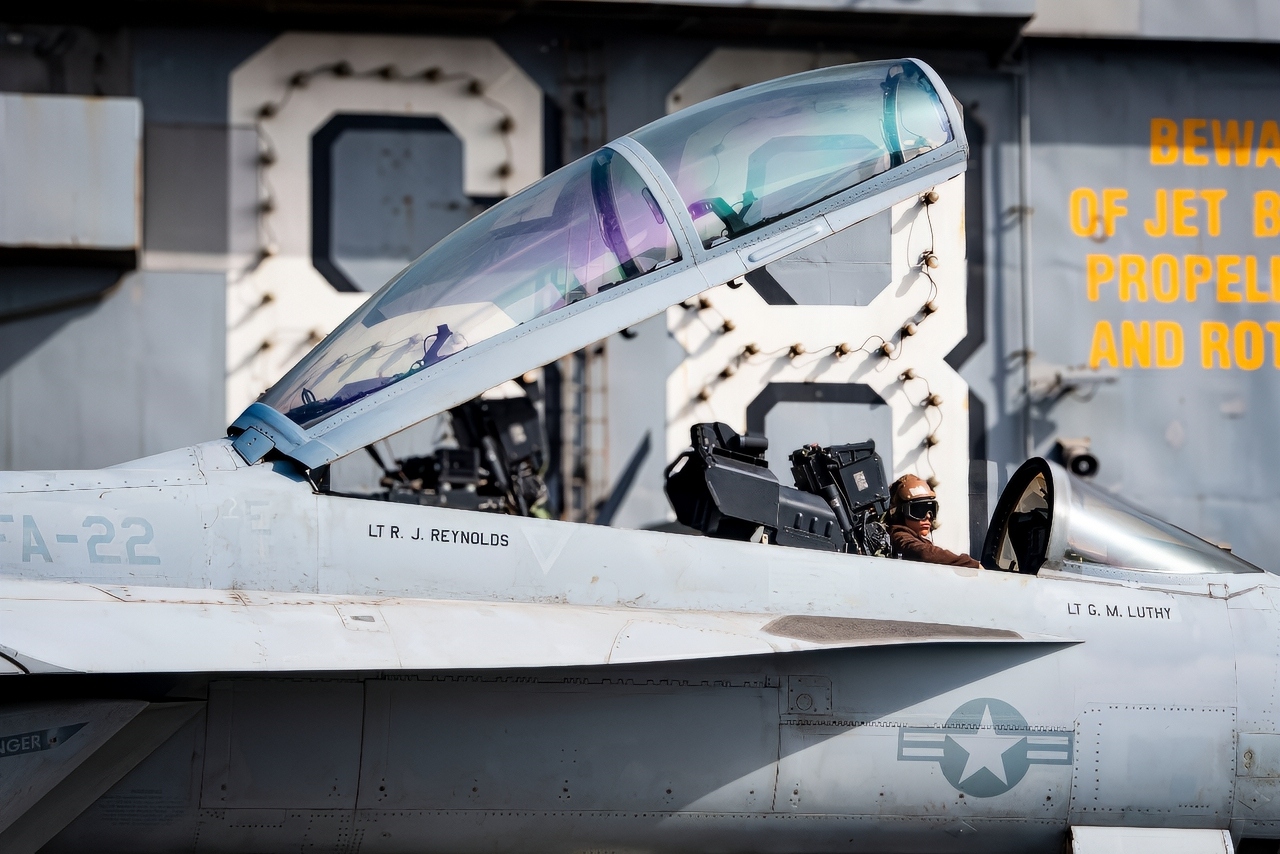
U.S. CENTRAL COMMAND AREA OF RESPONSIBILITY (July 22, 2025) An F/A-18F Super Hornet, attached to Strike Fighter Squadron (VFA) 22, taxis across the flight deck of the Nimitz-class aircraft carrier USS Nimitz (CVN 68) in the U.S. Central Command area of responsibility. (Official U.S. Navy photo)
In a within-visual-range (WVR) dogfight, the situation becomes more complex. The Super Hornet’s high-alpha performance and helmet-mounted targeting system make it a formidable opponent in close quarters. It can execute tight turns and maintain control at low speeds, which is ideal for dogfighting.
However, the KF-21’s superior thrust-to-weight ratio and lighter frame suggest it could outmaneuver the Super Hornet in sustained turning engagements. The outcome would depend heavily on pilot skill, situational awareness, and tactical execution.
About the Author: Isaac Seitz
Isaac Seitz, a Defense Columnist, graduated from Patrick Henry College’s Strategic Intelligence and National Security program. He has also studied Russian at Middlebury Language Schools and has worked as an intelligence Analyst in the private sector.
More Military
The B-2A Spirit Stealth Bomber Has a Message for Russia and China
China Has a Masterplan to Make the B-21 Raider Bomber Obsolete
The New B-21 Raider Is Far More Than Just A ‘Stealth Bomber’
The ‘New’ Arleigh Burke–Class Flight III Destroyer Has a Message for the U.S. Navy
France’s Mirage 2000: The Best Fighter You Never Heard of Fighting Putin in Ukraine


