

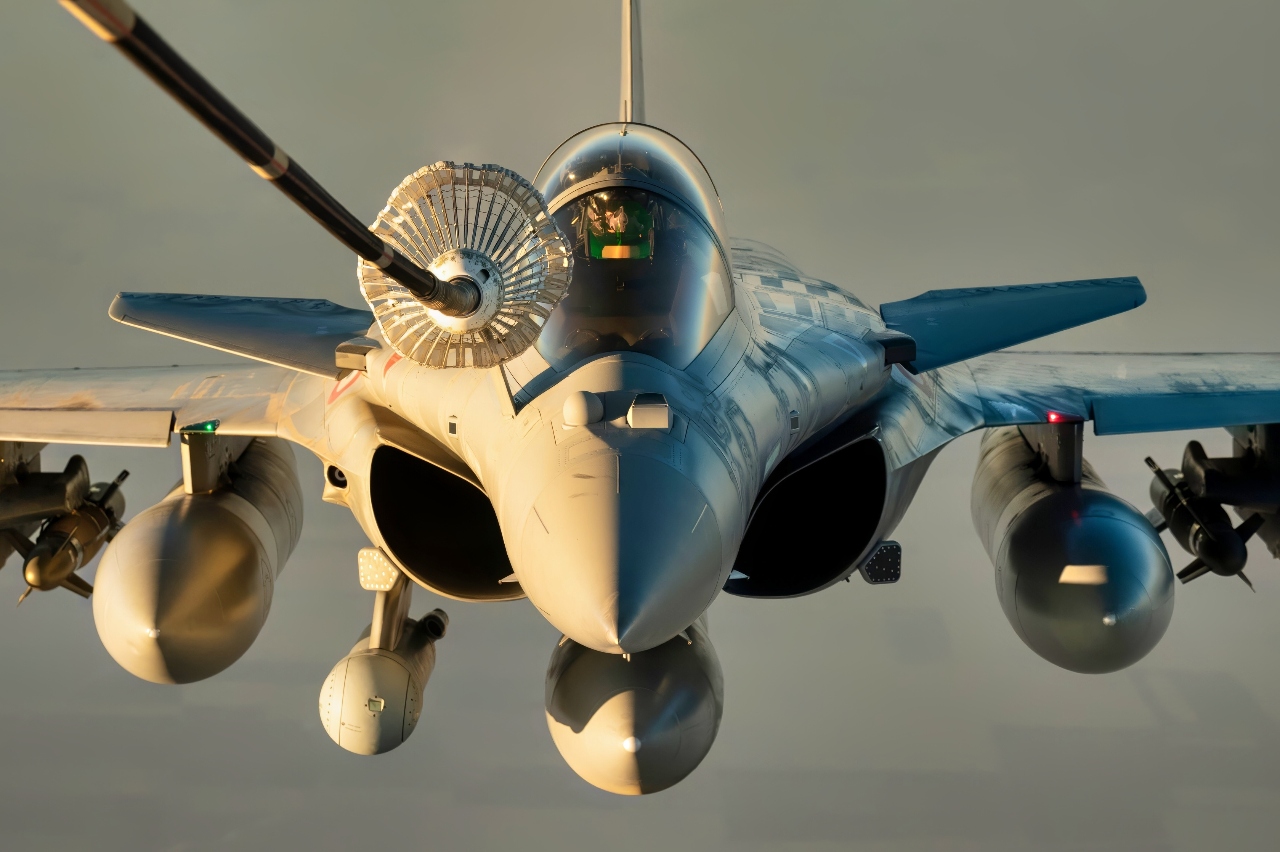
Key Points and Summary – Ukraine’s landmark deal for 100 Rafale fighters is about rebuilding its air force for the long term—but those jets will eventually have to face Russia’s Su-35s.
-On paper, both are top-tier 4.5-generation fighters: Rafale brings powerful AESA radar, the SPECTRA EW suite, and Meteor BVRAAMs, while the Su-35 counters with thrust-vectoring AL-41 engines, long-range Ibris-E radar, and R-37 missiles.

Sukhoi Su-35 Fighter. Image Credit: Creative Commons.

Su-35 Fighter from Russia. Image Credit: Creative Commons.
-At beyond-visual range, the outcome hinges on who detects and shoots first. In a close-in dogfight, the Su-35’s agility is fearsome, but Rafale’s sensors, missiles and pilot training could still tip the balance.
Dassault Rafale vs Su-35: Can France’s Fighter Help Ukraine Beat Russia in the Skies?
In recent news, Ukraine has signed a letter of intent with France to acquire 100 Dassault Rafale fighter jets.
Deliveries of these jets are expected to begin around 2029, meaning it will likely be a long while before the first Rafales arrive in Ukraine.
Once in Ukraine, however, the Rafale will have to contend with Russian air power, which has been a continuous challenge for the waning Ukrainian Air Force.
The Sukhoi Su-35 Flanker-E is currently Russia’s most advanced fighter jet behind the Su-57 Felon. Both the Rafale and the Su-35 are advanced 4+-generation fighter jets, but which fighter is more likely to win in a one-on-one fight?
France and Russia’s Strongest Fourth-Generation Fighters
The Dassault Rafale is a single-seat, twin-engine, multirole fighter.
It sports a canard delta-wing configuration to enhance mobility. It was designed and developed after France withdrew from the European Combat Aircraft project alongside Germany and the UK.
The aircraft entered service in 2001. Several variants of the fighter were designed, including the Rafale M, designed to operate from aircraft carriers.
France is the largest operator of the Rafale, but it has also been exported to multiple other countries, including India, Qatar, Greece, and the UAE.

Su-35 Fighter. Image Credit: Creative Commons.

Su-35 Fighter from Russia. Image Credit: Creative Commons.
With its combination of avionics, engine power, and weaponry, the Dassault Rafale is considered by many to be one of the strongest fourth-generation fighter jets in the world.
The Su-35, on the other hand, is a deep modernization of the legacy Su-27 Flanker platform.
The project was initially designated Su-27M and included canards similar to those of the Su-30SM; however, these were later removed in favor of thrust-vectoring engines. The project became a test bed for fifth-generation technologies while Russia developed its PAK-FA (Su-57) fifth-generation fighter. The Su-35 features fly-by-wire systems, thrust-vectoring engines, improved weapon control systems, state-of-the-art avionics, and several other improvements to the original Su-27.
The aircraft has been exported to Algeria and China, with Iran still waiting for its first deliveries.
Engine Performance
Both aircraft feature high-performance engines. The Dassault Rafale is equipped with two Snecma M88 engines, each providing up to 11,000 lb of thrust.
It can reach maximum speeds of Mach 1.8 and can supercruise at around Mach 1.4. In terms of range, it has a maximum combat range of around 1,000 nautical miles and a service ceiling of 15,835 meters (51,952 feet). The aircraft’s canard delta-wing layout gives it respectable maneuverability. This, combined with its speed and range, makes the Rafale ideal for long-range missions.
The Su-35 has two Saturn AL-41F1S turbofan engines with 2D thrust vectoring.
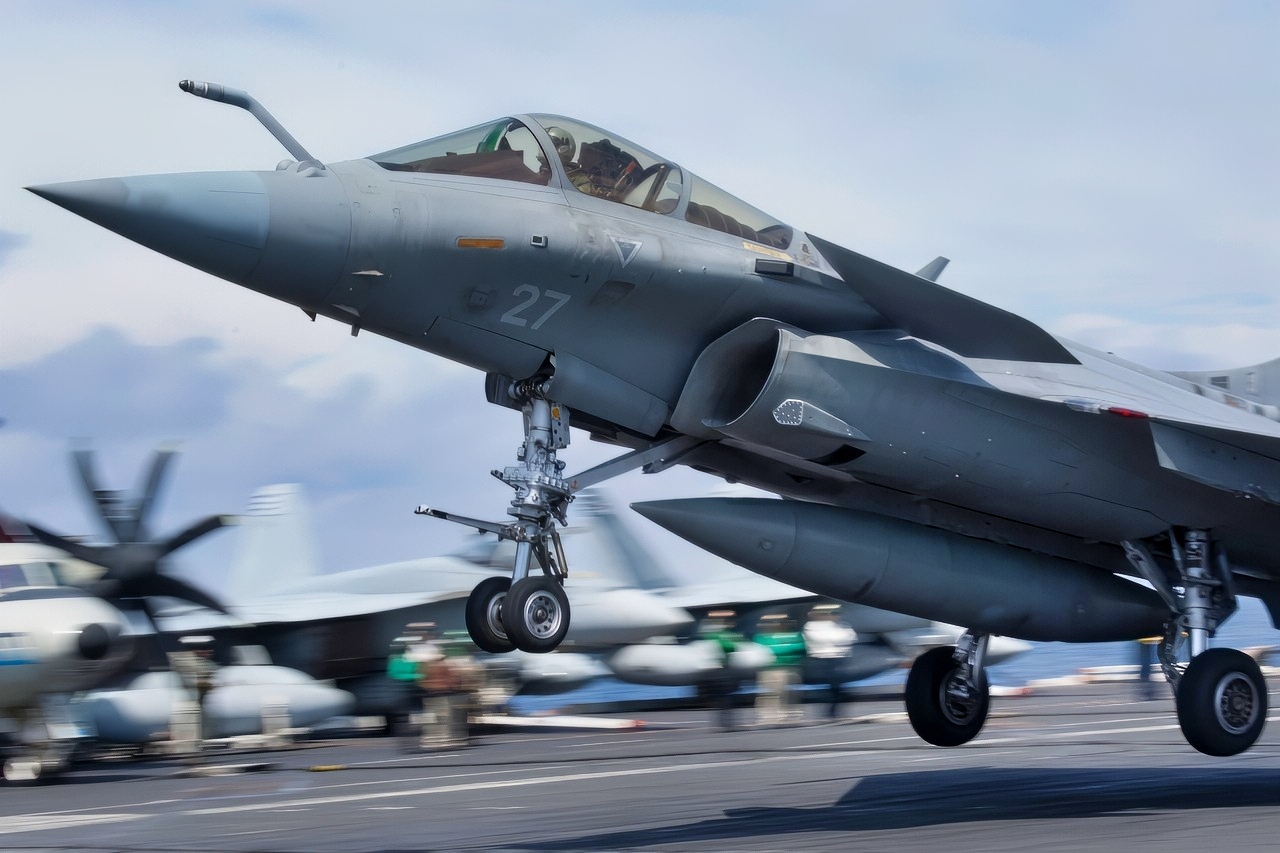
(July 3, 2018) A French Dassault Rafale M Fighter touches down on the flight deck aboard the Nimitz-class aircraft carrier USS Harry S. Truman (CVN 75). Harry S. Truman is currently deployed as part of an ongoing rotation of U.S. forces supporting maritime security operations in international waters around the globe. (U.S. Navy photo by Mass Communication Specialist 3rd Class Rebekah A. Watkins/Released)
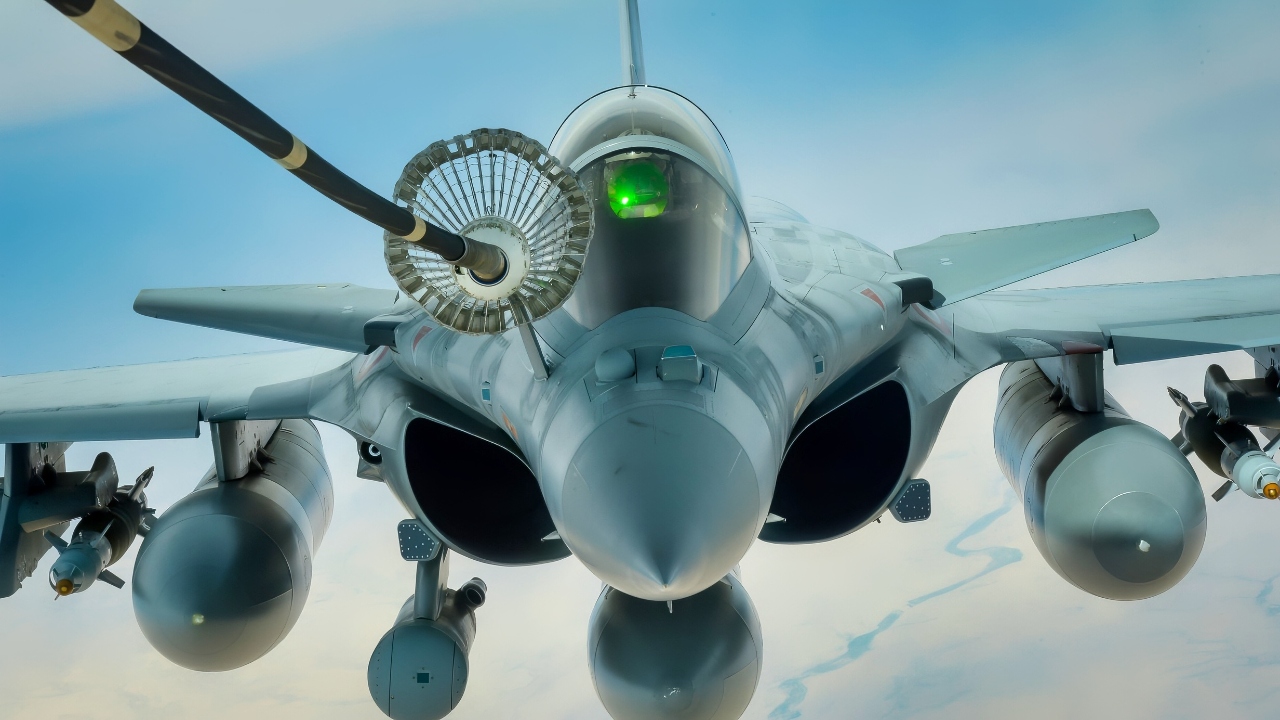
A French air force Dassault Rafale refuels from a U.S. Air Force KC-10 Extender from the 908th Expeditionary Air Refueling Squadron before conducting an aerial refuel during a Combined Joint Task Force – Operation Inherent Resolve mission March 20, 2017. The KC-10 provides aerial refueling capabilities for U.S. and coalition aircraft as they support Iraqi Security Forces and partnered forces as they work to liberate territory under the control of Islamic State of Iraq and Syria. (U.S. Air Force photo by Senior Airman Joshua A. Hoskins)
These engines provide 19,400 lb of thrust, allowing the aircraft to reach a maximum speed of Mach 2.25 and cruise at around Mach 1.1 without afterburners.
The Su-35 has a shorter range than the Rafale, with a maximum combat range of only 860 nautical miles, although it has a higher service ceiling at 18,000 meters (59,000 feet).
The Flanker series has always been characterized by its maneuverability despite its size, and the Su-35 is no exception.
With thrust vectoring, the fighter can perform insanely tight turns and other acrobatic maneuvers, enabling it to outmaneuver virtually any aircraft.
Avionics
Both aircraft feature sophisticated avionics. The Dassault Rafale is equipped with an RBE2-AA AESA radar developed by Thales.
This radar reportedly has a range of over 200 km against targets with a radar cross-section of 1 m2 and provides a scan area of around 140 degrees.
In addition to its radar, the Rafale features the SPECTRA electronic warfare system, a comprehensive suite of laser warning systems and missile jammers, all fully integrated with the radar.
The aircraft also features IRST to enhance its detection and tracking further.

Su-35. Image Credit: Creative Commons.
The Su-35 is also no pushover in the realm of avionics. It is equipped with the Ibris-E passive electronically scanned array (PESA) radar developed by Tikhomirov NIIP.
According to its designers, the Su-35’s radar can detect and track up to 30 targets and engage up to 8 simultaneously. When searching at narrower field-of-views, the radar can detect targets at up to 400 km and at wider FOVs, it can detect targets at around 200 km. The Su-35 is also equipped with the Khibiny electronic countermeasures system, which makes it harder for enemy aircraft to detect and track it. Like the Rafale, the Su-35 is fitted with IRST.
Who Wins in a Fight? In 4 Words: The Context Does Matter
In terms of weaponry, both aircraft are relatively evenly matched. The Rafale carries the MICA short- to medium-range missile, the Magic II, which is comparable to the AIM-9 Sidewinder, and the Meteor BVM missile, with a range of around 200 km.
The Su-35, however, can carry the R-27 family, which has a range of 40-130 km. It also has R-73 and R-73 for close-range engagements as well as the R-37 BVR missile, which has an estimated range of around 400 km.
Overall, the Dassault Rafale and the Su-35 are evenly matched in most areas. In a BVR engagement, victory depends on who gets the first lock on and who launches the first missiles.
In a more extended engagement, the Rafale may have the advantage due to its advanced avionics and EW systems.
In close-range combat, however, the scales flip more closely towards the Su-35s due to its high maneuverability.
However, depending on the pilot’s skill, the Rafale may be able to best the Flanker in close ranges.
About the Author: Isaac Seitz
Isaac Seitz, a Defense Columnist, graduated from Patrick Henry College’s Strategic Intelligence and National Security program. He has also studied Russian at Middlebury Language Schools and has worked as an intelligence Analyst in the private sector.
More Military
The Mach 15 X-43D ‘Hypersonic Scramjet’ Has a Message for the U.S. Air Force
Europe’s Future Combat Air System (FCAS) Stealth Fighter Is ‘Circling the Drain’
The Mach 2 B-58 Hustler Bomber Has a Message for the U.S. Air Force


