

Article Summary – The B-1B Lancer’s 2025 deployment to Misawa Air Base isn’t about flying straight into China’s dense A2/AD kill zone—it would not survive that fight.
-The non-stealth bomber’s large radar and IR signatures make it far too vulnerable to modern sensors, SAMs, and long-range missile strikes on bases and flight paths.
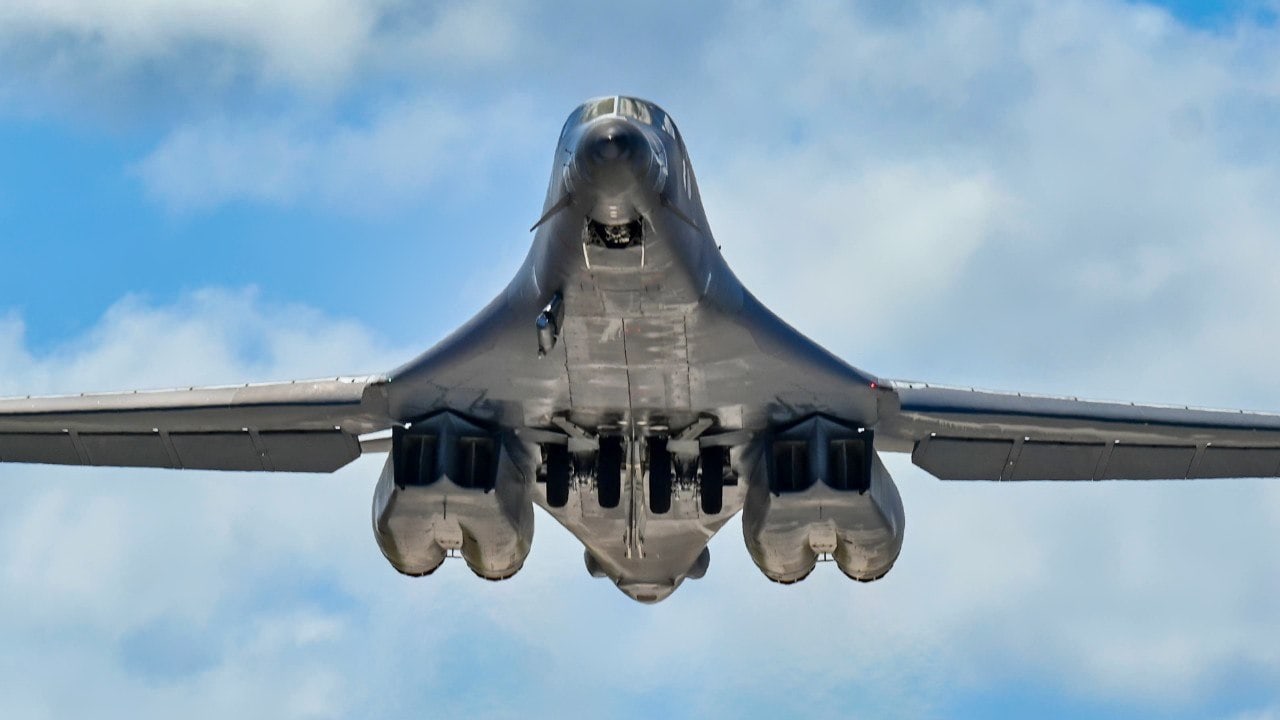
B-1B Lancer Bomber. Image Credit: Creative Commons.
-Instead, the B-1B in Japan is about Agile Combat Employment, joint training with Japan, and visible signaling that U.S. heavy bombers can operate forward as standoff shooters.
-From Japanese bases, Lancers can launch long-range weapons from outside the most lethal threat rings, complicating Beijing’s planning without committing to significant problems.
Here’s Why the B-1B Lancer Is In Japan
In April 2025, the B-1B Lancer made its first official “Bomber Task Force” deployment to Misawa Air Base in Japan – a product of the U.S. Air Force’s ongoing efforts to not only keep the aging B-1B alive, but to maintain a heavy bomber presence in the Indo-Pacific.
On the surface, dispatching a large non-stealth bomber close to China might look like preparation for combat – yet in a real war with the People’s Republic of China, the B-1B would simply fail to keep up.
Should a non-stealth bomber fly straight into the Chinese air-defense umbrella, it would be quickly destroyed.
Here’s Why It Wouldn’t Work
The B-1B Lancer is an iconic American bomber.
It’s undoubtedly still a formidable asset, but it’s old. The first Lancer flew in October 1984, and it remains in service thanks to a series of upgrades – but even then, this kind of aircraft isn’t designed to penetrate deep into a modern, layered air-defense network.
The bomber has large radar and infrared signatures that make it highly vulnerable in a peer-level contest.
Even after being reoriented for conventional strike missions – not nuclear – the Lancer simply doesn’t have what it takes to penetrate deep into a defended space. Especially not one overseen by one of the United States’ most powerful adversaries. Modern sensors would easily spot it, and defense systems would shoot it down.
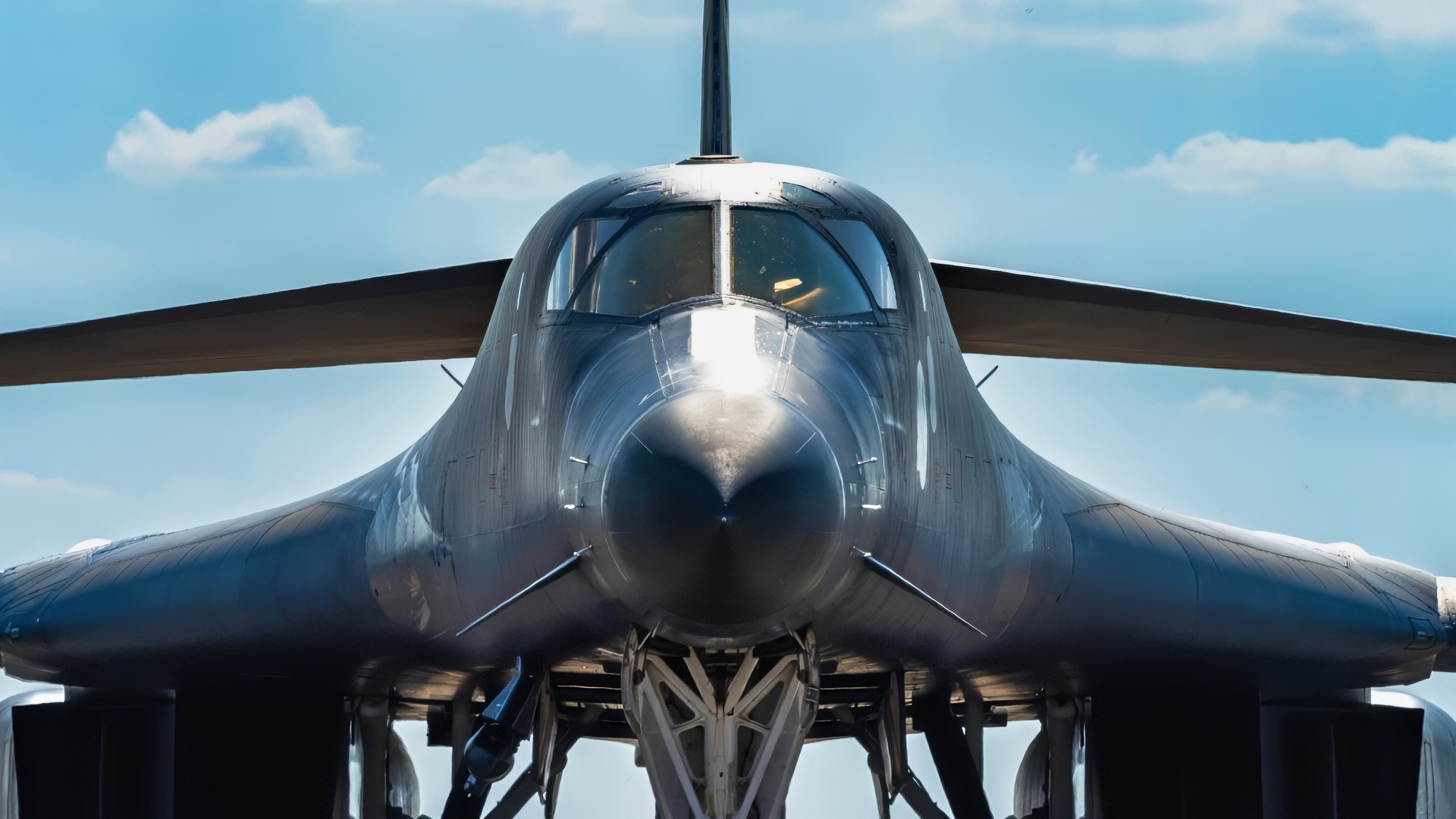
A U.S. Air Force B-1B Lancer assigned to the 345th Expeditionary Bomb Squadron is photographed after landing at Dyess Air Force Base, Texas, Aug. 22, 2025. Three bombers deployed for Bomber Task Force Europe with a total force integration team composed of roughly 30% active-duty and 70% reserve Airmen from the 7th Bomb Wing and 489th Bomb Group. (U.S. Air Force photo by Senior Airman Jade M. Caldwell)
It’s also worth noting that China has built a massive anti-access/area-denial (A2/AD) architecture that encompasses the First Island Chain and extends into the Western Pacific.
That means large parts of the maritime and airspace zones between China and Japan are within reach of Chinese ballistic missiles, long-range surface-to-air missiles (SAMs), radar networks, and sensors.
In effect, an area that once might have been relatively safe for the Lancer to pass through is now very much a contested zone protected by overlapping defense systems.
Thanks to China’s missiles and sensors, the B-1B could be engaged without ever actually entering the zone it’s targeting.
Chinese missile forces could already reportedly strike runways and taxiways at U.S. bases in Japan, severing bomber basing infrastructure and suppressing operations very early in a conflict.
Those same long-range systems mean that a bomber’s flight path into contested airspace is not only risky on ingress and egress (on its way in and flight out), but also on the home leg – the final stretch back to its base. At no point would the bomber be safe.
U.S. doctrine for the B-1B in a war with China already recognizes this risk, by the way: Bombers would launch from outside the densest threat zones, deliver standoff weapons, and avoid deep-penetration missions.
The B-1B wouldn’t survive, and so the intention is not to use them in such a way.
So, why deploy the B-1B to Japan at all?
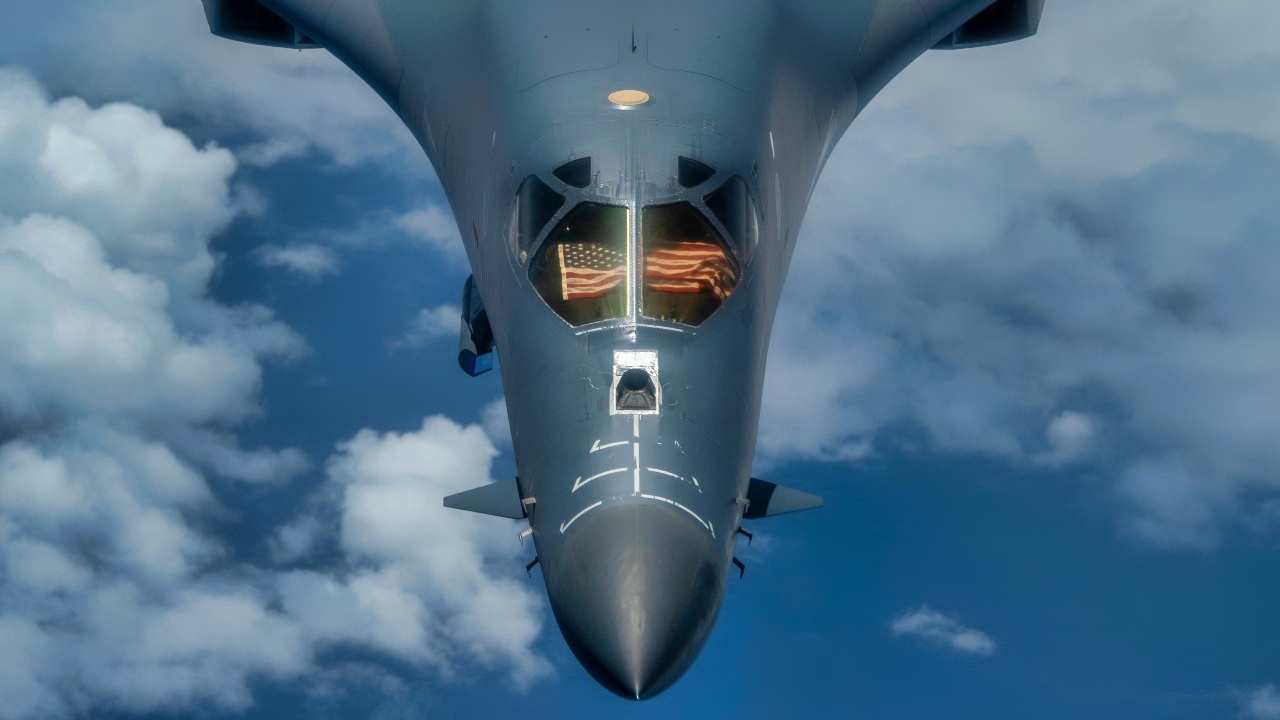
A 9th Expeditionary Bomb Squadron B-1B Lancer flies over the East China Sea May 6, 2020, during a training mission. The 9th EBS is deployed to Andersen Air Force Base, Guam, as part of a Bomber Task Force supporting Pacific Air Forces’ strategic deterrence missions and commitment to the security and stability of the Indo-Pacific region. (U.S. Air Force photo by Senior Airman River Bruce)
Why the Old B-1B Lancer Bomber Is In Japan
The B-1B isn’t in Japan to start a war with China, or in preparation to respond to a theoretical Chinese attack. Instead, the B-1B’s presence reflects forward posture, its value in training, alliance signaling, and general strategic utility.
In terms of training and distributed basing, forward deployments like this allow the U.S. Air Force to practice “Agile Combat Employment” (ACE) from forward airfields, to integrate with allied air forces, and to rehearse dispersal and rapid turnaround operations.
These are all essential in the Pacific given China’s long-range strike capacity and the likelihood that bases would come under immediate threat.
The bomber also plays an important strategic role, communicating to the PRC that U.S. heavy strike capability can indeed appear forward – without exposing itself to risk – and complicate China’s calculations.
The arrival of four B-1Bs at Misawa in April 2025 was reportedly one such visible show of force. And by embedding with Japanese forces, the mission here reinforces the U.S.-Japan security partnership and signals joint readiness.
Normalizing bomber presence is also a big part of the strategy. Rather than holding bombers in the continental United States until a crisis unfolds, the U.S. is using rotations to make forward posture predictable in the sense that China (and other adversaries) know that they can be quickly deployed, but ambiguous enough that they don’t always know where the bombers will be.
Creating that kind of uncertainty complicates any adversary’s planning when conducting a strike.

A U.S. Air Force B-1B Lancer flies in the U.S. Central Command area of operations, Oct. 25, 2019. The bomber flew directly from its home station of Ellsworth Air Force Base, S.D., demonstrating the U.S. Air Force’s ability to rapidly deploy strategic bombers anywhere in the world. U.S. Strategic Command regularly tests and evaluates the readiness of strategic assets to ensure we are able to honor our security commitments. (U.S. Air Force photo by Master Sgt. Joshua L. DeMotts)
And finally, the B-1B can be in Japan – so why not?
The B-1B can’t safely penetrate the inner A2/AD envelope, but it remains a valuable standoff platform.
It can be safely deployed in Japan, and the U.S. Air Force can use it for long-range strikes outside the densest threat zones.
The reality is this: the U.S. knows that the B-1B wouldn’t survive inside China’s defended zones – but the bomber doesn’t need to enter them to be effective.
About the Author:
Jack Buckby is a British author, counter-extremism researcher, and journalist based in New York who writes frequently for National Security Journal. Reporting on the U.K., Europe, and the U.S., he works to analyze and understand left-wing and right-wing radicalization, and reports on Western governments’ approaches to the pressing issues of today. His books and research papers explore these themes and propose pragmatic solutions to our increasingly polarized society. His latest book is The Truth Teller: RFK Jr. and the Case for a Post-Partisan Presidency.
More Military
Taiwan’s F-16V Fighter Was Built to Fight China’s Air Force
5 Places World War III Could Break Out in 2026
The X-37B Space Plane Is Breaking All the Rules and Makes Chinese Generals Sweat


