

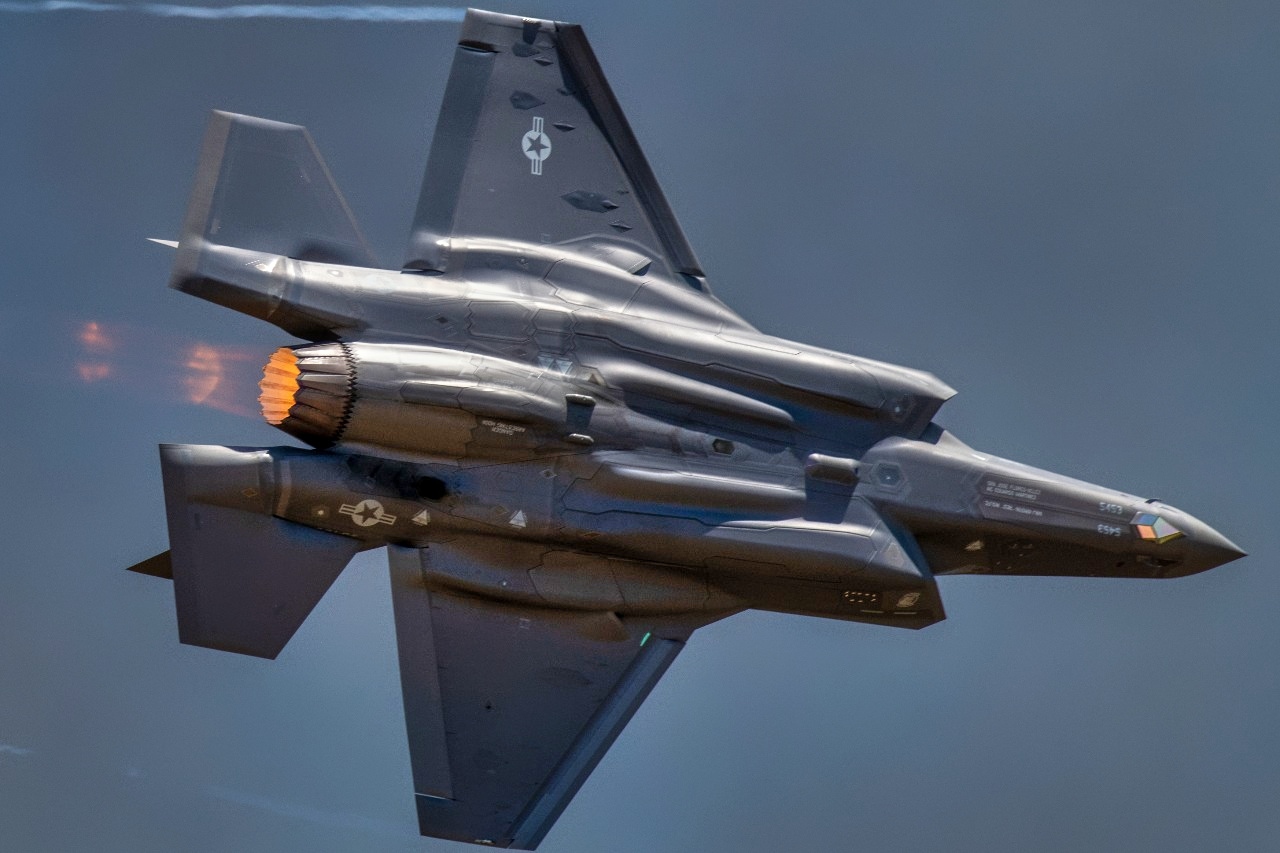
Key Points – Israel is the only country the US has approved to modify its F-35 stealth fighters, creating the unique F-35I “Adir” variant that proved devastatingly effective in the recent “Operation Rising Lion” strikes against Iran.
-The F-35I Adir has one special mission: to ensure Israel’s enemies, like Iran, feel the power of stealth technology and dominate the skies.
-These jets feature Israeli-made wings, a “plug-and-play” architecture for indigenous electronic warfare systems, and custom software, enhancing their survivability and lethality.
-The F-35I likely played a crucial role in the June 13th attacks, which reportedly killed top Iranian commanders, by penetrating and neutralizing Iran’s air defenses, clearing the way for follow-on strikes by other Israeli aircraft like the F-15I and F-16I.
Israel Tinkered with Its F-35I Adir Fighters
It’s the only country in the world that has received approval from the United States to modify its F-35s.
Israel’s F-35I is a specialized and unique variant of the F-35, with modifications that allow the stealth fighter to better integrate with Israeli weapons and other kit.
The fifth-generation jet is extremely capable — and used in Israel’s recent strikes against Iran.
Bombs Away
Though details about Israel’s attack on Iranian nuclear infrastructure continue to trickle in, the results of the strikes appear to be severe. Top Iranian Revolutionary Guard Corps leadership and some of Iran’s nuclear sites have either been killed or damaged.
The attack has been devastating to Iran’s military and political leadership. Though details are still trickling out, some of Iran’s most important figures, aside from Ayatollah Ali Khamenei, have been killed. Among the confirmed dead are Major General Mohammad Bagheri, the chief of staff of the Iranian armed forces and the second-highest commander behind the Ayatollah.
General Hossein Salami, commander in chief of the Revolutionary Guards, General Gholamali Rashid, deputy commander in chief of the armed forces, and General Amir Ali Hajizadeh, the head of the airspace unit of the Revolutionary Guards, were also killed in the Israeli attacks, along with at least one politician, Ali Shamkhani, and a pair of nuclear scientists. Details on further Iranian losses will no doubt come to light in the coming days.
Aerial Refueling for F-35I Adir
One of the weakest links in Israeli combat aviation, it has been argued, is the country’s air-to-air refueling capacity and, consequently, keeping Israeli jets in the air. Although Israel operates a small fleet of tanker aircraft, these airplanes —modified Boeing 707 commercial airliners and Lockheed C-130 turboprops —are aging platforms.
Israel’s ability to prosecute a large-scale air campaign in the Middle East, like Friday morning’s attack against Iran, was thought to be dependent on American refueling. Multiple American officials have denied American involvement in the strikes against Iran.
Video evidence of Israeli tankers fueling warplanes emerged on X, formerly Twitter, as well as multiple photographs of jettisoned Israeli external fuel tanks.
Israel’s fleet of specially modified F-15I and F-16I strike jets are equipped with conformal fuel tanks that bolt onto the jet’s fuselage, dramatically increasing range.
When combined with drop tanks, Israeli F-16s, and F-15s have a significantly longer range than their base configuration, a move that partially reduces dependence on tanker aircraft.
F-35I — Israeli Modifications
Israel’s fleet of F-35 aircraft are essentially a sub variant of the U.S. Air Force F-35A, the conventional take-off and landing F-35 variant.
Although the Israeli Air Force operates fewer than 40 of the stealth jets, they’re very unique.
In a break from the rest of the F-35 fleet worldwide, Israel’s F-35I wings are made indigenously in Israel, a modification concession given by the United States.
The reason behind this modification is that Israeli F-35s are equipped with their own electronic warfare systems, which enhance the stealth jet’s ability to survive on the battlefield. The jet’s onboard computer system is also optimized for operations with indigenous Israeli weaponry.
The AN/ASQ-239 electronic warfare countermeasure system, one which BAE Systems describes as “a next-generation electronic warfare suite providing offensive and defensive options for the pilot and aircraft to counter current and emerging threats. Its advanced technology optimizes situational awareness while helping to identify, monitor, analyze, and respond to threats.”
“Advanced avionics and sensors provide a real-time, 360º view of the battlespace, maximizing detection ranges and giving pilots evasion, engagement, countermeasure, and jamming options.”
Israeli F-35s then fly with a modified version of this electronic warfare suite, tailored to better serve the Israeli Air Force’s needs.
An Ongoing Campaign
In October of last year, Israel launched its Operation Days of Repentance, a series of three air strikes against over a dozen targets in Syria, Iran, and Iraq.
It was the biggest attack on Iran since the Iran-Iraq War in the 1980s. The attack was an overwhelming success, in large part because of Israel’s F-35Is and their stealth capabilities.
During that operation, F-35Is, as well as Israeli F-16Is and F-15Is, struck a number of sites in Iran. Those targets included a missile propellent production site, a number of Russian air defense batteries, as well as a UAV factory. Importantly, however, much of Iran’s fossil fuel infrastructure remained intact.
F-35I Adir Looks Almost Unstoppable
Although the United States and China are preparing to accept advanced sixth-generation aircraft into service, there is still a clear place for the fifth-generation F-35.
And while stealth is no panacea, with defensive measures against stealth a distinct possibility, for now, it appears that stealth is a formidable adversary.
About the Author: Caleb Larson
Caleb Larson is an American multiformat journalist based in Berlin, Germany. His work covers the intersection of conflict and society, focusing on American foreign policy and European security. He has reported from Germany, Russia, and the United States. Most recently, he covered the war in Ukraine, reporting extensively on the war’s shifting battle lines from Donbas and writing on the war’s civilian and humanitarian toll. Previously, he worked as a Defense Reporter for POLITICO Europe. You can follow his latest work on X.
Russia’s Bomber Forces
Tu-22M3: The Bomber Ukraine Hit With Drones


Pingback: Trump Might Start Bombing Iran At Any Moment - National Security Journal
Pingback: Israel Is Destroying Iran's F-14 Tomcat Fighters on the Ground - National Security Journal
Pingback: 'The Skies of Iran are Open': Israel's Air Force Flies with 'Impunity' - National Security Journal