


For the first time outside Japanese territory, Japan fired a Type 88 anti-ship missile during the Balikatan exercise on the Philippine island of Luzon, while U.S. Marines deployed Naval Strike Missiles from the Navy-Marine Expeditionary Ship Interdiction System within striking range of the Taiwan Strait. The 130-mile-range NMESIS battery and Japan’s first overseas Type 88 launch mark the largest joint demonstration of coalition sea-denial firepower the United States has ever staged in the First Island Chain. After nearly 20 years of watching China militarize the South China Sea, Washington is moving — and Beijing is already calling the deployment a maritime blockade network.
The Missiles Are Flying Near Taiwan and China

A U.S. Sailor prepares an F/A-18F Super Hornet aircraft for launch from the flight deck of the world’s largest aircraft carrier, Ford-class aircraft carrier USS Gerald R. Ford (CVN 78), while underway in the Caribbean Sea, Nov. 25, 2025. U.S. military forces are deployed to the Caribbean in support of the U.S. Southern Command mission, Department of War-directed operations, and the president’s priorities to disrupt illicit drug trafficking and protect the homeland. (U.S. Navy photo)
The United States finds itself in an increasingly disadvantageous position in what’s known as the First Island Chain of the Indo-Pacific (the region stretching from the Kamchatka Peninsula through Japan and Taiwan down to the Philippines).
As a result, the US and its allies in this region are desperately seeking to reassert deterrence. One of the ways the US and its partners, in this case the Philippines, are attempting to restore deterrence against China’s growing military power in the First Island Chain.
One such attempt to restore deterrence occurred during the recent maritime strike (MARSTRIKE) drills on the Philippine island of Luzon, which were part of the larger Balikatan exercises at the northern end of the archipelago. The Luzon Strait is a key strategic chokepoint since it sits so near to the Luzon Strait, a waterway that China would use if it ever decided to attack Taiwan.
Balikatan is No Longer Symbolic
Balikatan has evolved far beyond its original purpose: symbolic alliance drills. Today, they are multinational training missions that increasingly function as operational rehearsals for sea denial, missile warfare, dispersed basing, and coalition strike coordination against a peer adversary.
The US and Philippine forces were clearly practicing how best to strike Chinese ships from this location using systems such as the United States Army’s M30/31 Guided Multiple-Launch Rocket System (GMLRS).
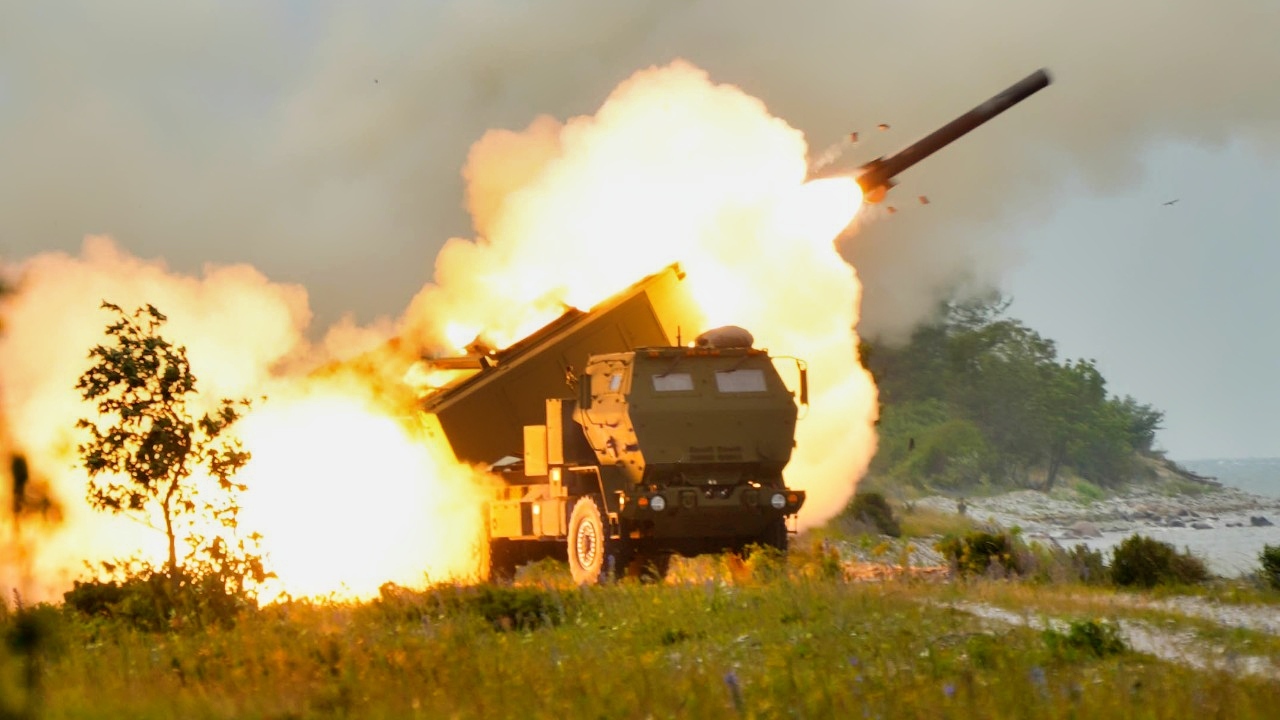
An Estonian Defense Forces M142 High Mobility Artillery Rocket System (HIMARS) fires a training rocket during a live-fire exercise in Undva, Estonia, July 11, 2025. U.S. Army elements from Bravo Battery, 1st Battalion, 14th Field Artillery Regiment, 75th Field Artillery Brigade, supporting Task Force Voit, assisted in the training process. The task force was originally formed in 2023 to support the Estonian Defense Forces in the creation of a HIMARS unit. Task Force Voit works closely with the Estonian Armed Forces, sharing critical defense strategies, training, and military readiness support. The presence of U.S. troops in the region serves as a cornerstone of NATO’s commitment to security in the Baltic region. The task force provides combat-credible forces to V Corps, America’s only forward-deployed corps in Europe. (U.S. Army photo by Staff Sgt. Rose Di Trolio)
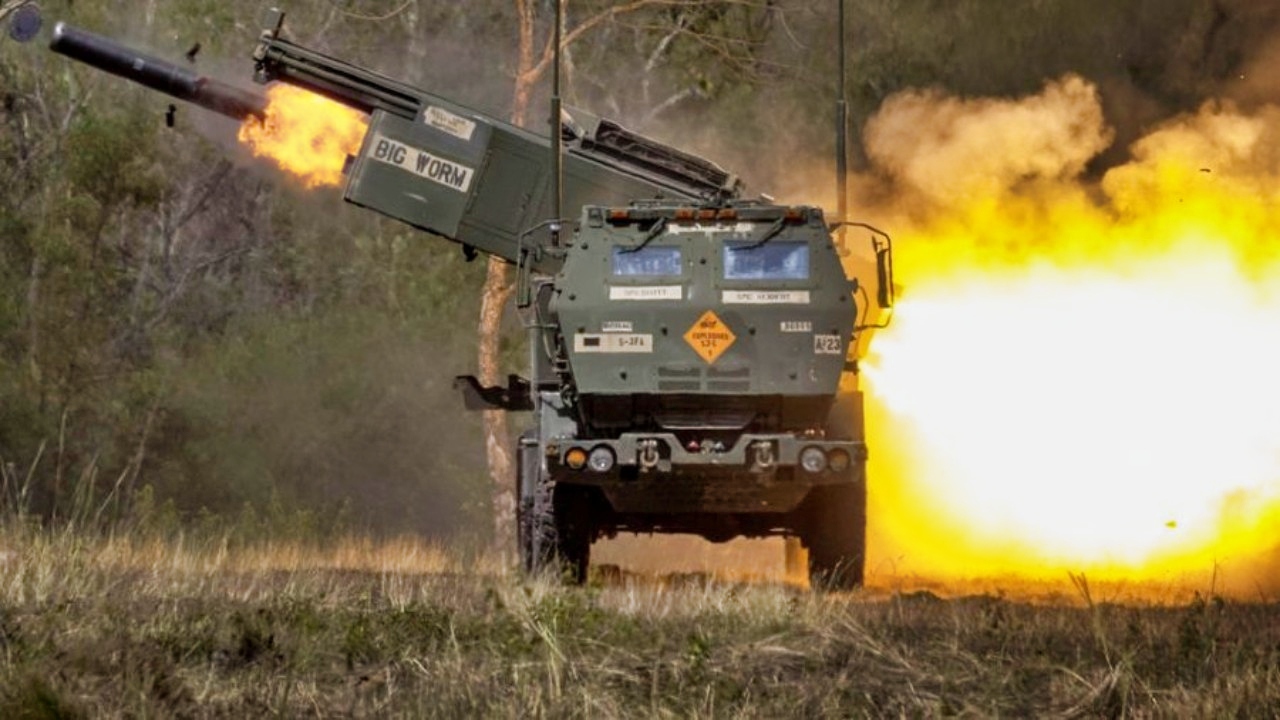
HIMARS. Image Credit: U.S. Government.

Tennessee Army National Guard Soldiers with Alpha Battery, 1-181st Field Artillery Regiment conduct a training exercise using the M142 High Mobility Artillery Rocket System (HIMARS) at Camp Shelby, Mississippi, June 9. The unit’s annual training enhances battalion readiness, focuses on mission-essential tasks and ensures Soldiers are proficient in critical skills. (U.S. Army National Guard photo by Sgt. Grayson Cavaliere)
GMLRS is an artillery round that is precise and used for a rapid strike. This weapon can hit targets up to 50 miles away. GMLRS rockets launch from M142 High Mobility Artillery Rocket Systems (HIMARS), which themselves can launch six guided or unguided 227mm artillery rockets or a single Army Tactical Missile System (ATACMS), according to The War Zone.
Another aspect of the wargame involved the use of anti-ship missiles launched from the US Marine Corps’ Navy-Marine Expeditionary Ship Interdiction System (NMESIS). The Marine Corps anti-ship NMESIS can deploy two Naval Strike Missiles (NSMs), with a range of 130 miles. NMESIS is built for low observability and is a highly mobile, rapidly deployable unit.
Interestingly, placing the NMESIS system in Luzon and demonstrating it there put the system within striking range of Taiwan, indicating that the US military was sending a clear signal to Beijing that it could target Chinese warships threatening Taiwan with the NMESIS battery.
Japan’s Return to Power
Not only were American and Philippine forces engaged in the drill, but so too were Japanese forces. In fact, the recent Balikatan exercise saw the Japanese fire a Type 88 missile for the first time outside Japanese territory.
If the Chinese weren’t fretting over the Marines’ deployment of the NMESIS to within strike range of the Taiwan Strait, if Beijing wasn’t worried that the Philippines practiced sinking an old World War II-era ship, then China’s rulers were undoubtedly irate over the prospects of their historical foes in Japan embracing militarism outside their borders so readily.
Japan has made other moves to reassert its military prowess outside of its territorial waters. Indeed, Tokyo has recently loosened the restrictions on Japanese military exports. Those restrictions, mind you, were imposed both by the victorious Americans and maintained by the Japanese themselves as part of their “Peace Constitution” framework following the end of WWII. The Japanese are today taking a much more provocative stance toward the increasingly belligerent Chinese.
The Philippines is Becoming a Frontline State
Taken together, these developments reveal three startling trends. The Philippines is transforming itself from a rear-area treaty ally into a frontline operational state. Japan is becoming an increasingly normal military power willing to participate in coalition missile operations.
The US Marine Corps is operationalizing its “stand-in-forces” concept: small, dispersed units armed with anti-ship missiles operating within China’s threat envelope. And coalition sea denial is becoming the core operational logic of Indo-Pacific deterrence. The Asia Times argues that the Philippines is becoming a “forward-deployed missile hub” for a US military containment of China. Beijing sees it that way, too. And it is likely to have the opposite effect, deterring China. These actions, however cathartic they might feel at the tactical level, are most likely to antagonize China.
China has indicated that the deployment of land-based anti-ship missiles near Taiwan and the Luzon Strait looks like the creation of a maritime blockade network designed to constrain the People’s Liberation Army Navy (PLAN)’s freedom of movement. Chinese officials have already complained publicly about the exercises, accusing Washington of seeking to destabilize the region.
Washington Realized the Problem Too Late
It’s an interesting move by the US-led alliance, though, which has steadily been losing the First Island Chain to China since the Obama administration ignored the first Chinese artificial islands in the South China Sea (SCS) in 2009.
Today, China has had nearly 20 years to build its position up to the point that the military balance of power has decisively shifted in China’s favor within the First Island Chain. What you are witnessing with the US, the Philippines, and Japan is an admirable effort that, if undertaken 10 years ago, would have made a difference, but will only serve to initiate the war we are supposedly working to avoid.
Yes, it’s a smart move to place systems and capabilities within the First Island Chain that will be harder for the Chinese to destroy or keep over-the-horizon, as their anti-access/area-denial (A2/AD) systems can currently do to conventional forms of US military power projection (such as with aircraft carriers). Yet these systems are nowhere near the number or capability to sustain the fight against China in the First Island Chain, rather than relying on conventional US military power projection.
A Strategy That Buys Time–and Little Else
These systems and tactics buy time and little else. Further, the Philippines, in particular, will be unable to sustain a real fight against China in the First Island Chain without significant input from the United States. The Japanese will do better. Even the Japanese, though, will struggle if US military backing is not available. All this is to say that seeking conflict in the First Island Chain now is irresponsible and only serves to hand the region over to the People’s Republic of China (PRC).
Clearly, Washington has finally realized–too late, of course–that its position in the First Island Chain has eroded. It is seeking to reestablish itself as a player there. But it’s too late. Not even Japan and the Philippines can help Washington achieve its goals there. An entirely new strategy is needed.
About the Author: Brandon J. Weichert
Brandon J. Weichert is the Senior National Security Editor at 19FortyFive.com. Recently, Weichert became the editor of the “NatSec Guy” section at Emerald. TV. He was previously the senior national security editor at The National Interest. Weichert hosts The National Security Hour on iHeartRadio, where he discusses national security policy every Wednesday at 8 p.m. Eastern. He hosts a companion show on Rumble entitled “National Security Talk.” Weichert consults regularly with various government institutions and private organizations on geopolitical issues. His writings have appeared in numerous publications, among them Popular Mechanics, National Review, MSN, and The American Spectator. And his books include Winning Space: How America Remains a Superpower, Biohacked: China’s Race to Control Life, and The Shadow War: Iran’s Quest for Supremacy. Weichert’s newest book, A Disaster of Our Own Making: How the West Lost Ukraine, is available for purchase at any bookstore. Follow him via Twitter/X @WeTheBrandon.


Dennis
May 8, 2026 at 1:24 pm
Where was this man in the 1977/1978 time when we of SAC were providing the deterrent forces? Where was this man when the Cold War was ongoing?
He is not telling those of MY age group a DAMN THING that was not known about Chinas’ threat. MAO was thinking this way- way back when, but he did not yet have the means.
This younger man is telling those of us that WE could have told him in that time. Unfortunately, HE was not yet as knowledgeable then. WE WERE.