


Key Points and Summary – Canada’s 88-jet F-35 deal is in “limbo” as Prime Minister Mark Carney’s government reviews the purchase amid “skyrocketing costs” (now $27.7B) and a “worsening” political relationship with President Trump.
-While the Canadian military proceeds “full steam ahead” with the 16 committed jets, a new, strategically timed push from Sweden’s Saab has complicated the decision.

A Swedish Air Force JAS 39 Gripen participating in NATO exercise Ramstein Flag 24 flies over the west coast of Greece, Oct. 4, 2024. Over 130 fighter and enabler aircraft from Greece, Canada, France, Hungary, Italy, Poland, Portugal, Romania, Spain, Sweden, United Kingdom and United States are training side by side to improve tactics and foster more robust integration, demonstrating NATO’s resolve, commitment and ability to deter potential adversaries and defend the Alliance. (U.S. Air Force photo by Tech. Sgt. Emili Koonce)
-Saab, needing to expand production for a 100+ jet order from Ukraine, is publicly “considering” building a Gripen assembly line in Canada, with Bombardier confirming talks.
This move pressures Ottawa by offering a domestic industrial alternative, even as the military warns a “mixed fleet” would be a costly logistical “nightmare.”
Canada’s Big F-35 Stealth Fighter Deal on the Rocks?
The Canadian government remains in a holding pattern regarding its decision on whether to proceed with the purchase of 88 F-35 fighter jets.
In 2022, under the government of then-Prime Minister Justin Trudeau, Canada agreed to purchase 88 F-35 fighter jets to replace Canada’s aging CF-18 Hornet fleet.
When Prime Minister Mark Carney came into office earlier this year, he ordered a review of the purchase. As things stand now, Canada has paid for four of the jets and committed to buying 16. The decision, pending the review, is to proceed with the rest of the purchase or to split the new fleet between the F-35s and jets from elsewhere.
Carney’s process, meanwhile, has taken place against the backdrop of worsening relations between the United States and Canada, with President Donald Trump imposing a succession of tariffs—sometimes in retaliation for television commercials—and even talking at times about wanting Canada to become the 51st American state.
Pending Review
The government review of the jet purchase, initially scheduled to wrap up by the end of the summer, continues. However, there have been some developments in that time.
In March, Canada’s then-Defence Minister, Bill Blair, said in an interview that the government was considering “alternatives” to the purchase. However, Blair left his position with Carney’s government shortly after.
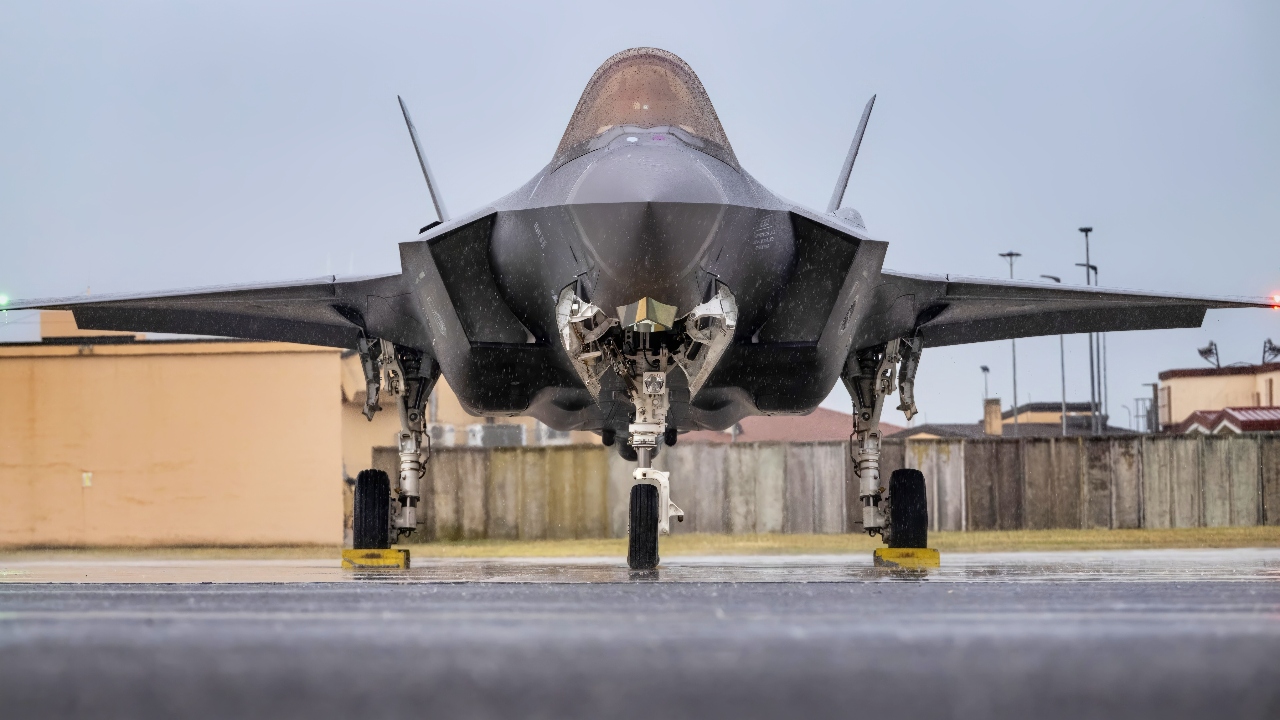
A U.S. Air Force F-35 Lightning II assigned to the 495th Fighter Squadron taxis pre-flight during exercise Combined Strike 25 at Aviano Air Base, Italy, Aug. 20, 2025. Combined Strike 25 is a readiness training with RAF Lakenheath’s 48th Fighter Wing F-15s and F-35s alongside Aviano’s 31st Fighter Wing F-16s. (U.S. Air Force photo by Senior Airman Joseph Bartoszek)
“It was the fighter jet identified by our air force as the platform that they required, but we are also examining other alternatives—whether we need all of those fighter jets to be F-35,” Blair said at the time.
In June, Auditor General Karen Hogan released a report stating that the jet plan was facing “skyrocketing costs, a shortage of trained pilots, and a lack of critical infrastructure,” with the listed cost of $19 billion having increased at the time to $27.7 billion.
In August, per Reuters, a defense review—not the same as the full government review ordered by Carney—reportedly “made the case” that Canada should stick with the F-35s.
By last month, with the decision on the government review still not in, Deputy Defence Minister Stefani Beck testified before a committee that Canada was “full steam ahead” on the F-35 purchase.
“What we have as direction is to continue with the contract… with the arrangements that we have in place until we hear otherwise,” Beck told the tri-party public accounts committee in the House of Commons in early October.
“What we have as direction is to continue with the contract … with the arrangements that we have in place until we hear otherwise,” Beck said in the hearing. “We are full steam ahead, full steam ahead, focused on making sure we’ve got the infrastructure, the pilots, the training in place for the arrival of those F-35s.”

An F-35A Lightning II, assigned to the 388th Fighter Wing, at Hill Air Force Base, UT, flies in formation with a Belgian Air Force F-16 Fighting Falcon on Sept 10, 2022, Kleine Brogel Air Base, Belgium. The F-35 Demo Team consists of approximately 15 total Airmen to include the pilot and commander, pilot safety officers, superintendent, team chief, maintenance Airmen, aircrew flight equipment specialists, and public affairs personnel. (U.S. Air Force photo by Staff Sgt. Thomas Barley).
During that hearing, it was clear that the Conservatives on the committee were in favor of proceeding with the purchase.
Lt.-Gen. Jamie Speiser-Blanchet, the new commander of the Royal Canadian Air Force, testified in the same hearing that while a “mixed” fleet would require additional costs and complications, others who testified before the committee stated that other countries operate mixed fleets.
Is Time Running Out?
In early October, The War Zone asked if “time is running out” for Canada’s fighter decision.
“Canada is still in the process of reviewing its future fighter fleet, officials have confirmed,” TWZ said of the decision.
“However, with a firm commitment to buy 16 F-35As, it’s looking increasingly difficult to make the case for Ottawa switching to a different manufacturer to complete the full replacement of its aging CF-18 Hornets. Canada currently has around 75 CF-18A/B+ jets and has also added 18 former Royal Australian Air Force (RAAF) F/A-18A/Bs, plus seven more as spares, to help bolster its fleet.
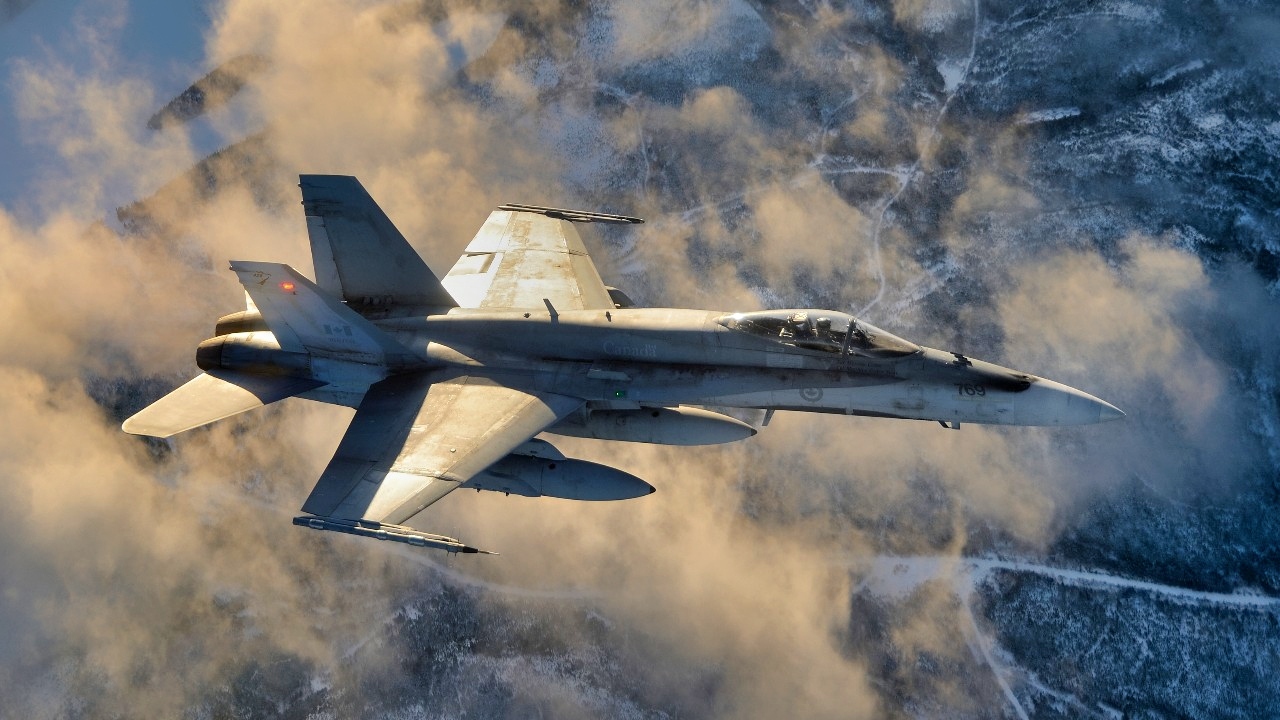
Canada Air Force CF-18. Image Credit: Creative Commons.
CBC reported on October 29 that while Canada had yet to announce a decision, Secretary of State for Defence Procurement Stephen Fuhr had testified last month that the F-35 review report by the Department of National Defence “has been sent to the Prime Minister’s Office.”
In the meantime, there’s a new push from Sweden for Canada to consider an alternative to the F-35.
“Gripen For Canada”?
According to a report this week in Eurasian Times, Saab is pitching its Gripen fighter jet as a possible alternative for Canada, should it opt not to go ahead with the full purchase of the F-35s.
The Gripen had been a contender for the contract that ultimately went to Lockheed Martin back in 2022.
“Late last month, Saab CEO Micael Johansson said the company wants to increase the multirole supersonic jet’s production capacity outside Sweden to ramp up production and meet demand from Ukraine, which is expected to acquire more than 100 Gripen-E fighters,” the Eurasian Times story said. “Micael said the company was considering Canada as its third production site, after Sweden and Brazil.”
Canadian aerospace giant Bombardier, according to a report in the Toronto Globe and Mail, also stated that it has been in talks with Saab to build the jets in Canada.
This would be contingent on Canada agreeing to such an arrangement. Additionally, the countries agreeing to have the jets built in Canada is a separate decision from whether Canada would buy them as a replacement for the F-35s, as Gripen recently received a lucrative contract to build fighter jets for use by Ukraine.
“We confirm discussions with Saab about the Gripen,” Mark Masluch, Bombardier’s senior director of communications, told The Globe and Mail. “Bombardier is open to providing local expertise if the government of Canada decides to go this route.”
A senior government official told the Toronto newspaper that a joint venture “is being worked out between Saab and Bombardier.”
Saab did not confirm that the talks were about that specific jet. Still, Saab Canada’s president, Simon Carroll, did confirm to the newspaper that “we are continuing discussions with Bombardier for a range of opportunities in Canada … to do manufacturing and further our scope of work with Bombardier.”
About the Author: Stephen Silver
Stephen Silver is an award-winning journalist, essayist, and film critic, and contributor to the Philadelphia Inquirer, the Jewish Telegraphic Agency, Broad Street Review, and Splice Today. The co-founder of the Philadelphia Film Critics Circle, Stephen lives in suburban Philadelphia with his wife and two sons. For over a decade, Stephen has authored thousands of articles that focus on politics, national security, technology, and the economy. Follow him on X (formerly Twitter) at @StephenSilver, and subscribe to his Substack newsletter.
More Military
Russia’s Submarine Fleet Summed Up Simply in 4 Words
The Air Force Sent A-10 Warthogs to China’s Doorstep
The Air Force’s B-2 Bomber Nightmare Has Arrived
The Navy Tried for 4 Weeks to Sink Their Own Aircraft Carrier


Chris
November 11, 2025 at 11:38 am
Given skyrocketing costs and the ongoing threats against its sovereignty, Canada would be foolish to continue with an all F-35 fleet. A mixed fleet would be less efficient, yes, but that doesn’t need to be the long-term solution. Pivoting to Saab for the remaining 72 planes would create jobs in Canada and cost less per plane, and there is no reason why an option for 16 additional Gripens couldn’t be included in the contract. When the firm order is delivered by Saab, trigger the option and sell off “gently used” Canadian F-35s to focus on a single-model European fleet.