

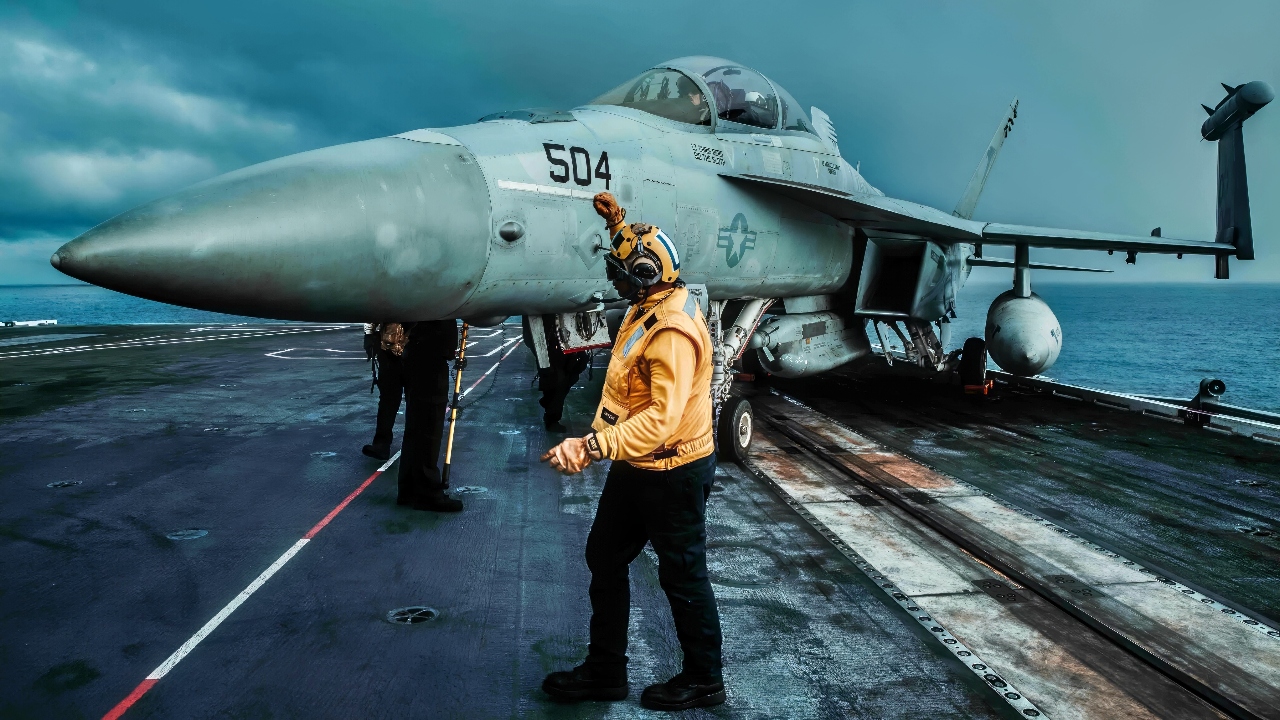
Key Points and Summary – While fighter jets often get the glory, the EA-18G Growler is arguably the most valuable aircraft on a U.S. Navy carrier.
-Its critical mission is not dogfighting but electronic warfare—suppressing enemy air defenses by jamming and spoofing radar.
-This capability is essential for the survival and success of every other naval aircraft in a strike package, including the F/A-18, F-35C, and the future F/A-XX.
-With a long, combat-proven service history and continuous upgrades, the Growler is the indispensable asset that makes modern naval air operations possible against sophisticated threats.
The EA-18G Growler: The Navy’s Most Important Plane?
We love discussing the US Navy’s fighter jets in different eras of warfare. The F-4N Phantom was certainly special during the Vietnam War. And who can forget the F-14 Tomcat during the Cold War? Then there is the F/A-18 E/F Super Hornet, which helped the Americans fight conflicts after 9/11. Now, the Navy even wants its sixth-generation ultra-stealth warbird called the F/A-XX.
But we may be overlooking an airplane that is just as important or may be even more significant. I’m referring to the Boeing EA-18G Growler – the Navy’s electronic warfare aircraft.
No naval mission from a carrier could be successful without the Growler. It may even be the most valuable airplane in the fleet.
How Many Hours Has It Flown?
This electronic warfare bird has flown with the F/A-18 for over 12 million cumulative flight hours. That’s an amazing total that shows the Navy would not ponder a mission without the Growler conducting spoofing and jamming of enemy sensors and radar.
Those 12 million hours equate to 500,000 days in the air. That means 1,370 years of continuous flight time for the two airplanes.
“When you call the roar of these aircraft ‘the sound of freedom,’ it holds real weight,” said Captain Michael Burks, program manager for the F/A-18 and EA-18G program office. “Throughout their service, the F/A-18 and EA-18G family has supported nearly every major U.S. military conflict of the past 20 years and continues to adapt to rapidly changing threat environments,” according to Defence-Blog.com.
The EA-18G Growler has undergone the beneficial Block II upgrades that have improved the electronic warfare capabilities even further.
Fighting China and Russia Would Not Be Possible Without the Growler
The Growler is built on the F/A-18 airframe, so it has similar performance, speed, thrust, acceleration, and climbing ability compared to the Super Hornet. But its job is not for dog-fighting. This airplane is about the suppression of enemy air defenses. This will be all-important should a conflict with China and Russia arise.
Growler Was Deployed In the Last Two Decades
The Growler replaced the EA-6B Prowler in the 2000s. The first Growler was in production in 2004. By 2006, it had made its first flight. It began flying off carriers in 2008 and was attached to an operational carrier squadron in 2010. The Growler’s first combat mission was Operation Odyssey Dawn over Libya in 2011. Each Growler costs $67 million.
Another encouraging aspect of the Growler is its ability to be updated along with the F/A-18 E/F. This means that as technology advances, electronic warfare capabilities will also improve over time.
The Growler is powered by two F414-GE-400 turbofan engines with 22,000 pounds of static thrust per engine. Its ceiling is 50,000 feet. The combat radius is over 850 nautical miles.
What Does It Feature?
“Along with the electronic attack suite, the Growler also features the APG-79 Active Electronically Scanned Array (AESA) radar. [It] integrates the latest electronic attack technology, including the ALQ-218 receiver, ALQ-99 jamming pods, communication countermeasures, and satellite communications. The AN/ALQ-249, the Next Generation Jamming Pod, is in final development and will be the successor to the long-serving ALQ-99 pods,” the Navy said in a profile.
EA-18G Growler – It Has a Bright Future
The Growler Capability Modification (GCM) Program will enhance these systems. The success of the Growler is critical as naval aviation progresses. The F/A-18 E/F Super Hornet is getting older. It will be replaced by the newfangled F/A-XX if the Navy has its way. There is also the F-35C naval version of the Lightning II that needs electronic warfare support. The Growler can also carry AMRAAMs for defense and the high-speed anti-radiation missile (HARM) to blast enemy targets.
The Navy has much confidence in the Growler. Without this platform, the carrier aviation wings would not be able to function, especially now with multiple threat environments that the Super Hornet and Lightning II must navigate for attacks.
The Growler also protects the strike group in general. The escort ships have the Aegis Combat System to shield against drone and missile attack, while the Growler can stay in the air and jam the radar of enemy aircraft. This has worked well in the waters off the coast of Yemen when Iran-backed Houthi terrorists have fired missiles and drones aimed at American aircraft carriers.
The Growler has been a stalwart aircraft. The pilots operating the platform have crucial missions that ensure the survivability of Naval fighter jets and other support aircraft. This is a stellar addition to the fleet that shows the F/A-18 platform has been so successful over the years.
With all of these attributes, the EA-18G Growler could be one of the most critical aircraft on an aircraft carrier. The aviators must always be ready for duty because nothing flies without its support. The Navy hopes to improve the Growler in the coming years as the service branch transforms into carrier warfare that could feature the F/A-XX someday. This means that the Growler has a bright future, and no strike group commander would allow aircraft to fly without the support of this outstanding electronic warfare bird.
About the Author: Dr. Brent M. Eastwood
Brent M. Eastwood, PhD is the author of Don’t Turn Your Back On the World: a Conservative Foreign Policy and Humans, Machines, and Data: Future Trends in Warfare plus two other books. Brent was the founder and CEO of a tech firm that predicted world events using artificial intelligence. He served as a legislative fellow for US Senator Tim Scott and advised the senator on defense and foreign policy issues. He has taught at American University, George Washington University, and George Mason University. Brent is a former US Army Infantry officer. He can be followed on X @BMEastwood.
Military Problems
No F/A-XX Fighter? Say Goodbye to the Aircraft Carrier


