

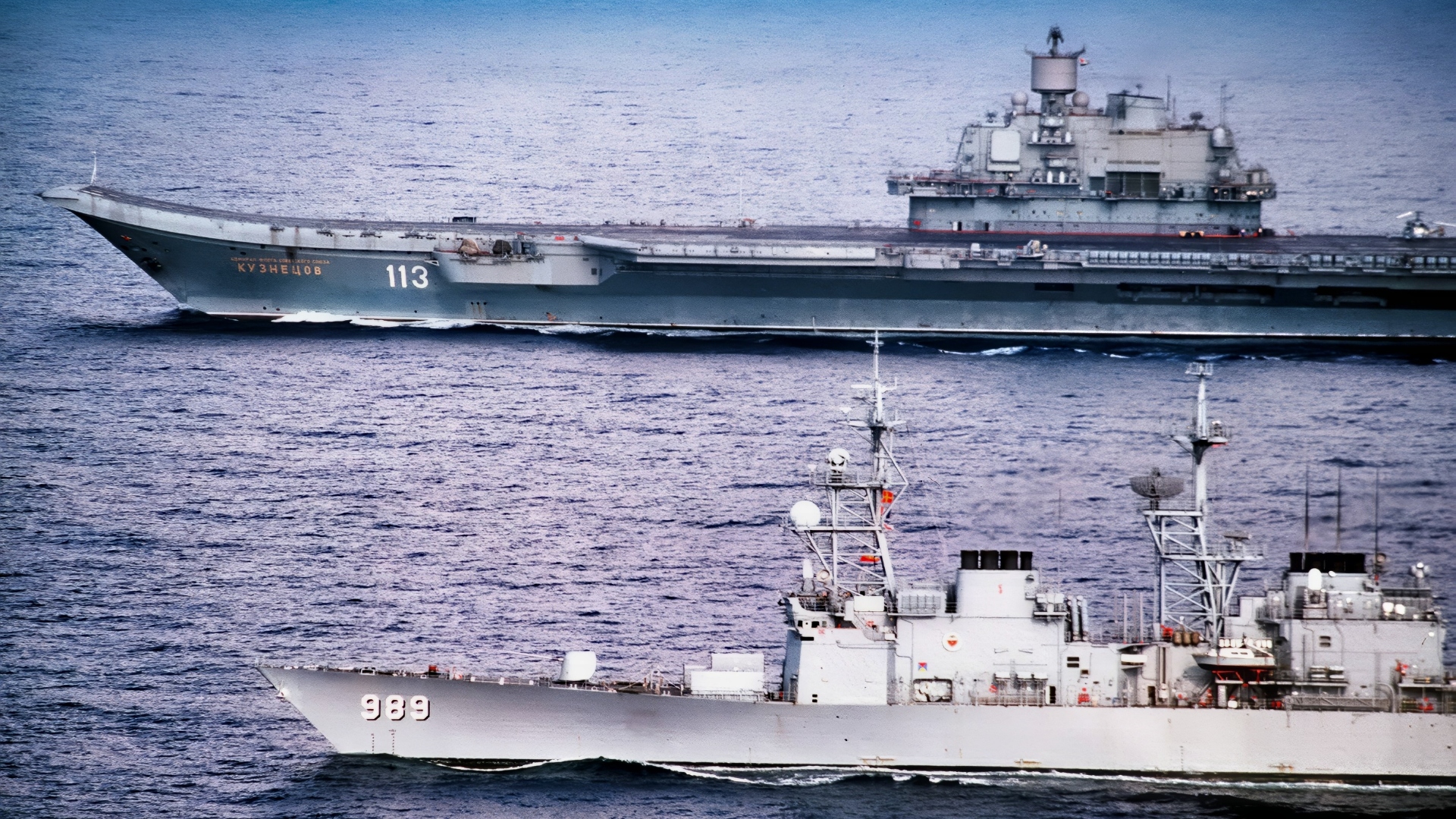
Key Points and Summary – Admiral Kuznetsov’s limbo makes a strategic point: Russia doesn’t need carriers. Its Arctic and Pacific “bastion” missions—sea denial, deterrence, NSR security—favor submarines, land-based air, and long-range missiles over deck aviation.
-Modern 22350 frigates, coastal Bastion batteries, and Yasen-M/Borei subs deliver cheaper, survivable firepower, while sanctions and yard limits make carrier reconstitution unrealistic.
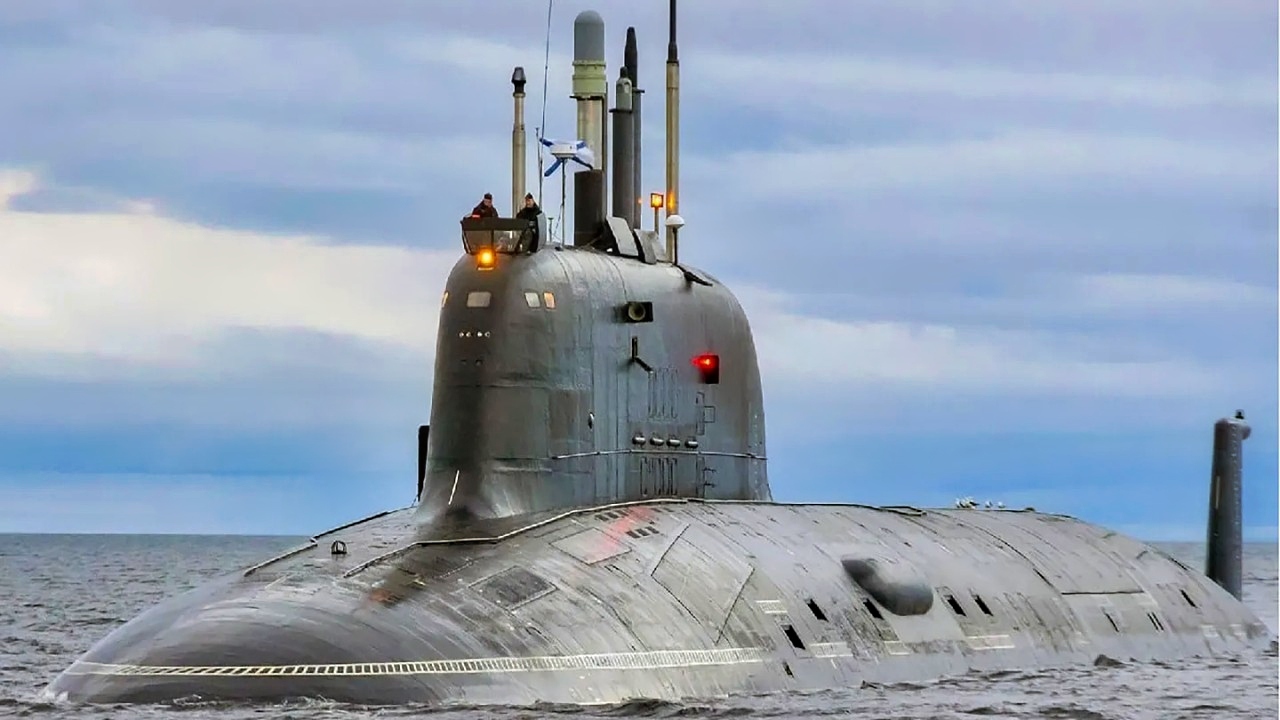
Yasen-Class Submarine from Russian Navy. Image Credit: Creative Commons.
-An air wing gap (no CATOBAR fighter or fixed-wing AEW) and Black Sea lessons—cheap sensors and smart munitions punishing large hulls—underscore the risk.
-Fund quiet subs, 22350s, magazines, and ISR/ASW instead. Kuznetsov’s retirement isn’t decline; it’s clarity: strategy starts with the map—and ends with the budget.
Russia’s Aircraft Carrier Quest Appears to Be Over…
Russia’s last aircraft carrier, the accident-prone Admiral Kuznetsov, looks set for retirement after a prolonged, inglorious limbo—seven years of drydock purgatory interspersed with fires, a sunken floating dry dock, a collapsed crane, and a long list of missed Request for Tender dates.
The symbolism is hard to miss, but the strategic point is starker: Russia does not need aircraft carriers. Geography, doctrine, industrial constraints, and the character of modern naval warfare combined make big-deck aviation a prestige sink that would cannibalize the very capabilities that actually secure Russia’s interests.
Start with the map. Russia’s fleets do not roam the world safeguarding distant SLOCs or screening expeditionary corps; they fight outward from fortified bastions in the Arctic and Far East. The mission set is sea denial, strategic deterrence, and protection of the Northern Sea Route—not power projection via deck aviation.
In those theaters, land-based aircraft, submarines, and long-range missiles turn the surrounding seas into engagement zones where volume of fire, sensor reach, and survivability matter more than the ability to cycle fighters from a moving airfield. A carrier adds prestige and a large target; it does not change the local balance of forces.

Sukhoi Su-33 launching from the Admiral Kuznetsov.
The weapons mix tells the same story. Modern Russian surface combatants—especially the 22350-class frigates—carry universal vertical launchers for Kalibr, Oniks, and Tsirkon missiles. Small corvettes punch far above their weight with land-attack and anti-ship salvos; Bastion coastal batteries ring key approaches with supersonic anti-ship fires; Northern Fleet units have even demonstrated hypersonic shots in home waters. In a fight where salvos, dispersal, and magazine depth dominate, the marginal ruble buys more deterrence by funding tubes and reloads than by funding a flight deck and its fragile air wing.
Submarines remain the core of that logic. The Borei-A ballistic missile force underwrites nuclear deterrence, while the Yasen-M attack boats provide a stealthy, survivable option for striking at sea and ashore.
The Kremlin’s recent commissioning of another Borei-A and public emphasis on continuing Yasen-M serial production make the tradeoffs explicit: every ruble sunk into a carrier program is a ruble not spent on quiet hulls with deep magazines—the very platforms that impose costs on NATO navies and complicate U.S. planning in the Norwegian Sea and North Pacific. Russia can double down on the fleet that fights, or it can chase a ship that photographs well. It cannot do both.
Industrial reality reinforces the strategic case. Sanctions constrict access to propulsion systems, electronics, finance, and insurance; skilled labor is finite; yards already struggle to deliver frigates on schedule.
Designing, powering, and protecting a modern carrier—or even a credible medium deck—would demand a supply chain and systems integration capacity Russia does not presently possess at scale. Kuznetsov’s refit saga was not an unlucky one-off.
It was a warning about atrophied industrial muscle colliding with an exquisite platform and the public embarrassment that follows. Strategy is the art of choosing; industrial policy is its accountant. Both point away from carriers.
What Happens Now?
What about a smaller aviation ship? Moscow has already chosen a more sensible “aviation-lite” path for limited expeditionary needs: helicopter assault ships able to embark rotors and unmanned systems for vertical assault, ASW, mine countermeasures, and disaster response in closed seas.
That niche makes sense. It does not require catapults or a new fixed-wing fighter; it does not demand the elaborate training and sustainment ecosystem of an American or Chinese carrier program; and—crucially—it does not cannibalize the submarine, missile, and coastal defense investments that matter in Russia’s home theaters.

Sukhoi Su-33 launching from the Admiral Kuznetsov.
The war in the Black Sea drives the lesson home. A determined regional adversary, armed with sea-skimming missiles and swarming surface drones, forced a larger fleet to disperse, harden, and adapt without ever contesting the sea in classical terms.
In that environment, a slow, high-value carrier hull is not a symbol of mastery; it is an invitation to catastrophe. The empire of the cheap sensor and the smart munition is expanding faster than any navy can grow steel. Big decks thrive where you control the threat envelope. Russia does not—and cannot—control the envelope near NATO’s air and missile networks.
What About the Fighters and Planes?
There is also the air-wing problem. Kuznetsov’s STOBAR configuration capped launch weights and precluded fixed-wing early warning; the fleet relied on helicopters where others fly E-2s.
The Su-33s are aging out, the MiG-29K buy was modest, and there is no credible, near-term path to a catapult-capable naval fighter, let alone a fixed-wing AEW aircraft. Reconstituting a serious carrier air wing would require not just a ship but a multi-decade industrial and training architecture. In wartime budgets and under sanctions, that is a fantasy.
Status arguments will persist. Great powers, the line goes, have carriers; China is building them; Russia sits on the UN Security Council and should not be the only permanent member without a deck on the horizon. But strategy is not cosplay.
China’s carriers support a maritime-industrial state that protects vast trade flows and projects its presence across multiple theaters.
Russia’s comparative advantage is different: ambush from concealment, fires from dispersed nodes, deterrence through undersea survivability and long-range strike, and land-based aviation operating from sanctuary. The Russian navy does not need to resemble the U.S. Navy to hurt the U.S. Navy. It needs to make the arithmetic of approach prohibitively costly—and it already has the tools to do so.

A Sailor directs an F/A-18E Super Hornet from the “Kestrels” of Strike Fighter Squadron (VFA) 137 on the flight deck of the aircraft carrier USS Nimitz (CVN 68) in the South China Sea, May 12, 2025. Nimitz is underway in the U.S. 7th Fleet area of operations on a scheduled deployment, demonstrating the U.S. Navy’s unwavering commitment to a free and open Indo-Pacific. (U.S. Navy Photo by Mass Communication Specialist Seaman Apprentice Franklyn M. Guage)
Time for Russia to Say Goodbye to Aircraft Carriers
Which brings us back to Kuznetsov. Saying goodbye to the ship is not merely an admission of fiscal and industrial reality; it is tacit acceptance of a clearer naval identity.
Suppose Moscow channels scarce money and talent toward additional Yasen-M hulls, faster 22350 production, fatter missile magazines, integrated coastal defenses in the Arctic and Pacific, and a modernized maritime patrol, ASW, and UAV enterprise.
In that case, it will achieve the fleet’s doctrine, which actually imagines: one that denies, deters, and occasionally surprises. That force will not look glamorous on a parade poster. It will resemble the practical application of Russian geography and the age of the affordable sensor.
The choice is stark but straightforward. Either build a navy that can fight where Russia must fight—close to home, under allied ISR umbrellas, amid hypersonic fires and swarming drones—or build a floating symbol of a bygone era.
In a world that rewards dispersion, stealth, and magazine depth, Russia’s last carrier is not a harbinger of decline. It is a relic of confusion—useful mainly as a reminder that strategy begins with the map, and ends with the budget.
About the Author: Dr. Andrew Latham
Andrew Latham is a Senior Washington Fellow with the Institute for Peace and Diplomacy, a non-resident fellow at Defense Priorities, and a professor of international relations and political theory at Macalester College in Saint Paul, MN. You can follow him on X: @aakatham. He writes a daily column for National Security Journal.
More Military
Stop Saying America Is ‘Losing’ the 6th-Generation ‘NGAD’ Fighter Race
The U.S. Navy’s Arleigh Burke Flight III Destroyer Is No Battleship (But Better)


