

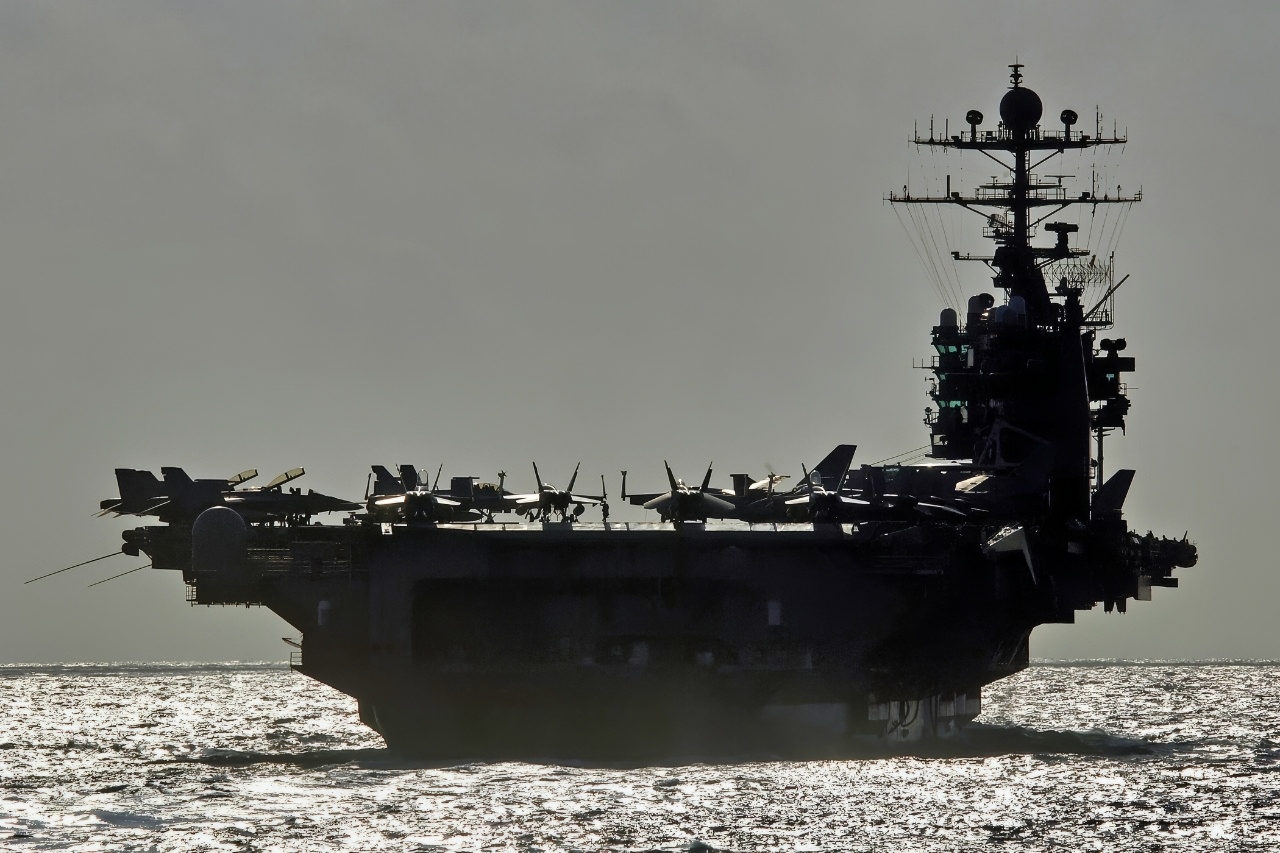
Key Points and Summary – Anti-ship missiles and cheap drones have revived a once-unthinkable idea: stop building U.S. Navy aircraft carriers.
-Citing Moskva’s loss, Houthi swarms, and China’s DF-21D/DF-26B, critics warn one sunk flat-top could end the program.

The Ford-class aircraft carrier USS Gerald R. Ford (CVN 78) and the Italian aircraft carrier ITS Cavour (CVH 550) transit the Atlantic Ocean March 20, 2021, marking the first time a Ford-class and Italian carrier have operated together underway. As part of the Italian Navy’s Ready for Operations (RFO) campaign for its flagship, Cavour is conducting sea trials in coordination with the F-35 Lightning II Joint Program Office’s Patuxent River Integrated Test Force to obtain official certification to safely operate the F-35B. Gerald R. Ford is conducting integrated carrier strike group operations during independent steaming event 17 as part of her post-delivery test and trials phase of operations.
-Alternatives—amphibs with F-35B, Air Force B-2/B-21 strikes on mobile launchers, more subs, and large-scale unmanned air/sea systems—reduce risk but can’t fully replace carrier reach, sortie volume, and deterrence. Politics also constrain any pivot.
-The pragmatic path is transformation, not abandonment: harden carriers with layered air/missile/drone defenses, distribute aviation across more decks, and integrate unmanned teams—while accepting that carriers remain central to U.S. power projection.
Canceling and Replacing Aircraft Carriers: The Unthinkable Could Become a Fact of Life
What if the U.S. Navy cancelled the Ford-class aircraft carrier program and stopped building new flatops?
This could be a plausible outcome, especially if one were ever sunk.
This is, after all, the age of anti-ship missiles that are more dangerous than ever and cheap-to-produce combat loitering drones that could sneak past a carrier strike group’s defenses and do massive damage.
Asymmetric warfare could kill a carrier. Take the sinking of the Russian flagship Moskva in the Black Sea at the beginning of the war in Ukraine.
The Ukrainians have no navy to speak of, but they were able to use two shore-based Neptune anti-ship missiles to destroy the modern warship. The Neptune is the Ukrainian version of the Russian Kh-35 anti-ship cruise missile.
Are Drones and Anti-ship Missiles Making Carriers Obsolete?
It hasn’t been smooth sailing for American aircraft carriers lately.
Two carrier strike groups were menaced by missiles and drones launched by Houthi terrorists in Yemen in the Red Sea. While no ship was hit, some close calls required hurried evasive maneuvers. The USS Carl Vinson and USS Harry S. Truman were able to depend on the excellent Aegis Weapons Systems to fight off attacks. Airplanes from both carriers were able to destroy at least 800 Houthi targets.
China Will Be Able to Threaten Carriers More Than the Houthis
But the Chinese rocket forces and their modern carrier-killing missiles will not be as easy to defend against. The carrier strike groups during a conflict in the Indo-Pacific could lose ships.
A flatop could be eliminated due to missiles, drones, enemy airplanes, torpedoes, or sea mines. The Chinese DF-21D and DF-26B anti-ship ballistic missiles are the primary weapons for these types of threats.
We Must Face the Facts that an Aircraft Carrier Could Be Sunk
There is a clear and present danger that a U.S. Navy aircraft could be lost. This would be a punch in the gut to the entire way we look at naval warfare. A sinking would be catastrophic, and the general public would be shocked and infuriated.
This could force the Navy to give up on carriers and just keep the current ones in action. That means no more would be built. But what would replace aircraft carriers if the Navy transitions away from them?
Other Amphibious Ships and the Air Force Could Pick Up the Slack
There are still American amphibious ships that can launch F-35B short vertical take-off and landing fighter jets.
However, that doesn’t solve the problem of anti-ship missiles and drones. Naval aviation would still suffer greatly if these ships were destroyed.
The Navy would have to curtail its aviation activity and depend on the U.S. Air Force’s supply of F-35As, F-22s, and F-15EXs as the modern go-to fighters. We would lose the carrier-based F-35Cs and F/A-18 E/F Super Hornets. This would be a big blow to U.S. strategy, operations, and tactics in East Asia, the Middle East, and Eastern Europe.
The Air Force could focus on taking out the mobile missile launchers that threaten American flat-tops. That would mean strikes by the B-2 Spirit stealth bomber and later the B-21 Raider radar-evading airplane that could remove Chinese or Russian missiles someday.
But these are mobile launchers that can shoot and scoot, making them more challenging to hunt down. There would be some Chinese and Russian anti-ship launchers that could survive and still place the aircraft carrier in jeopardy.
Does this mean the aircraft carrier is totally obsolete and needs to be cancelled and replaced? The Navy would save a significant amount of money, and sailors could be redeployed if so. More submarines could be built, which is one way that the United States could keep its competitive edge.

Sailors prepare to man the rails as Nimitz-class aircraft carrier USS Carl Vinson (CVN 70) arrives at Joint Base Pearl Harbor-Hickam for Exercise Rim of the Pacific (RIMPAC) 2024, June 25. Twenty-nine nations, 40 surface ships, three submarines, 14 national land forces, more than 150 aircraft and 25,000 personnel are participating in RIMPAC in and around the Hawaiian Islands, June 27 to Aug. 1. The world’s largest international maritime exercise, RIMPAC provides a unique training opportunity while fostering and sustaining cooperative relationships among participants critical to ensuring the safety of sea lanes and security on the world’s oceans. RIMPAC 2024 is the 29th exercise in the series that began in 1971. (U.S. Navy photo by Mass Communication Specialist 2nd Class Leon Vonguyen)
However, for sheer firepower and sea domination, the Navy has few options to replace the carriers. U.S. Navy doctrine has been dependent on carriers since World War II. This would take a completely fresh look at naval warfare.
Politically, it may not be possible to replace flat-tops. Members of Congress serving on the two Armed Services Committees would be frustrated and scratching their heads at the decision. Cancelling future Ford-class flat-tops would be a decision that must come from the president himself. Donald Trump could choose to focus more on unmanned sea drones that can launch remotely piloted vehicles.
The Answer May Be to Transform the Navy Into a Mainly Unmanned Force
This may be the only option to replace carriers. Focus on unmanned combat drones. The U.S. Navy could employ drones on frigates and destroyers. Submarines could launch them as well. This could create aerial bombardments without the loss of live sailors. Nobody wants to see 3,000 people on a carrier perish.
Unmanned warfare is thus one of the only ways to replace carriers. The other option is to build more manned submarines that can launch Tomahawk cruise missiles. Then the Americans would have to depend on bombers from the Air Force to take out anti-ship missile launchers.
None of these options is good. The Navy still needs to operate carriers even if some believe they are obsolete. There is no other way to project power and deliver lethality anytime, anywhere. Unmanned warfare may be the future of the Navy, but carriers cannot be replaced easily.
It would take some courageous and creative minds to cancel the building of carriers and wage warfare with only the Air Force, sea drones, and submarines.
That would not work as well as a carrier strike group. That means the Navy should emphasize the survivability of carriers and make sure that enemy anti-ship missiles and drones do not ever sink a flat-top, or focus on the reality of a naval force without carriers.
About the Author: Brent M. Eastwood
Brent M. Eastwood, PhD is the author of Don’t Turn Your Back On the World: a Conservative Foreign Policy and Humans, Machines, and Data: Future Trends in Warfare plus two other books. Brent was the founder and CEO of a tech firm that predicted world events using artificial intelligence. He served as a legislative fellow for US Senator Tim Scott and advised the senator on defense and foreign policy issues. He has taught at American University, George Washington University, and George Mason University. Brent is a former US Army Infantry officer. He can be followed on X @BMEastwood.
More Military
China’s J-20S Fighter: The Secret Is Out
China’s New J-36 Fighter Has 1 Mission
America Wants ‘Drone’ Aircraft Carriers


