

Shortly before getting a tenuous 60-day ceasefire with the Islamic Republic of Iran, US President Donald J. Trump gloated at a press conference in the White House Oval Office about how he was presiding over the largest covert commercial-maritime operation in history.
According to the White House, under the cover of darkness, Gulf oil producers loaded supertankers. Thanks to this daring wartime operation, oil reached Asia, Europe, and elsewhere, explaining why the world never faced the truly catastrophic collapse in oil supplies that everyone feared.

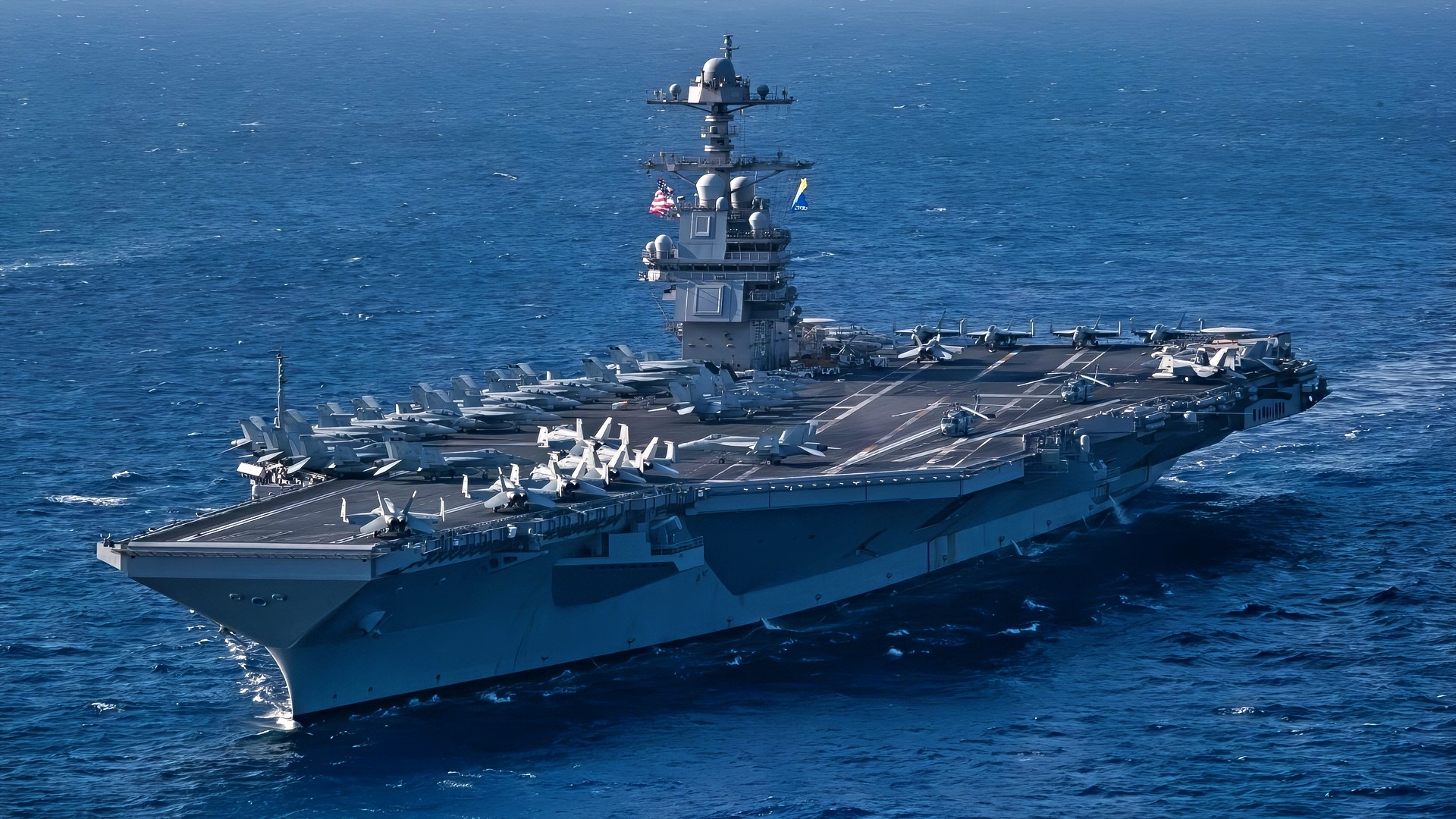
ATLANTIC OCEAN (Oct. 29, 2019) USS Gerald R. Ford (CVN 78) conducts high-speed turns in the Atlantic Ocean. Ford is at sea conducting sea trials following the in port portion of its 15 month post-shakedown availability. (U.S. Navy photo by Mass Communication Specialist 3rd Class Connor Loessin)
It sounds too good to be true. Or, at least it sounds exaggerated.
That’s because it probably is.
The fact that Donald Trump was the man spinning this tale during very tense ceasefire negotiations is indicative less of a man gloating and more of a man desperate to get a ceasefire with Iran.
It’s reminiscent of President Trump’s outlandish claims about having employed “discombobulator” weapons in the much-ballyhooed early morning raid on Caracas, Venezuela, that resulted in the capture of Venezuelan President Nicolas Maduro and his wife.
In the Venezuela case, there is ample evidence suggesting that much of that operation’s success can be attributed less to America’s purported wünderwaffe and more to the presence of at least one well-placed covert American source operating at the highest levels of the Venezuelan regime.
But, discombobulator weapons sell better to a news media that prefers dazzling spectacle to hard-boiled spycraft.
How the Offshore Oil Network Supposedly Worked
Going back to the Iran War and the claims of a massive covert operation to move the Gulf oil supplies in the middle of the night, Reuters describes how this operation came about because of Iran’s sudden blockade of the Strait of Hormuz on the first day of the war.
Rather than have large tankers transit as they normally would, the US response was to send smaller tankers through the dangerous area.
These smaller tankers were moved at night and under extensive US military surveillance.
They then conducted ship-to-ship transfers off the coasts of Oman and the United Arab Emirates (UAE).
The oil was transferred onto Very Large Crude Container (VLCC) supertankers that were waiting outside the most dangerous waters.
Those VLCCs then went to Asia. In essence, Washington claims to have built an offshore logistics network around Iran’s blockade.

PERSIAN GULF (March 20, 2009) The Los Angeles-class attack submarine USS Hartford (SSN 768) is underway in the Persian Gulf after a collision with the amphibious transport dock ship USS New Orleans (LPD 18). Hartford sustained damage to her sail,
but the propulsion plant of the nuclear-powered submarine was unaffected by
this collision. (U.S. Navy photo/Released)
In essence, the Americans embraced the same tactics that Iran’s “shadow fleet” of tankers and cargo ships has long utilized to evade American and Western sanctions on their oil trade. Tankers turned off transponders, and sailing reduced lighting.
The ship-to-ship transfers were a tactic borrowed from Iran, too.
The Iran War, it seems, is not without a sense of irony.
Washington and Tel Aviv went to war against Tehran partly to stop their flouting of the sanctions regime imposed upon the Islamic Republic over the decades.
Instead, the Americans ended up employing the exact same sanctions evasion techniques to keep the world economy afloat, as Iran blocked a waterway through which roughly 20 percent of the world’s oil flowed.
The Numbers Don’t Support the Hype
Of course, there is much exaggeration in the White House’s claims. After all, we can track how much oil was moved out of the region before and after the Iranian blockade.
Even Trump admitted in his Oval Office statement on the matter that they moved 100 million barrels of oil out of the region since the war began.
That’s 100 million barrels of oil per month. Before the war, 20 million barrels per day moved through the Strait of Hormuz.
That means that roughly 100 million barrels used to move through the Strait of Hormuz per week before the war.
In other words, less than 10 percent of the regular movement of oil has passed through the Strait since February 28.

Ford-Class Aircraft Carrier. Image Credit: Creative Commons.
The whole thing is a gimmick concocted by Trump.
From a logistical standpoint, it is indeed impressive that such a stopgap was created. From an economic point of view, it helped cushion some of the worst effects of the oil shortage caused by worldwide blockades and war.
It did little to mitigate the US strategic defeat.
From a diplomatic standpoint, though, it was a cunning attempt to gain leverage over the Islamic Republic to expedite the signing of a ceasefire that remains shaky at best (and technically is an informal 60-day ceasefire until a formal signing between Vice-President JD Vance and the Iranian representatives in Geneva, Switzerland, on Friday).
How Iran Won the Hormuz Battle
But the Iranian blockade was stunningly successful for a few reasons. The first was that Iran didn’t really physically blockade the Strait. Yes, they deployed some mines.
The wildest aspect of Tehran’s blockade was its lack of naval assets to stop the flow of goods through the Strait. Instead, Tehran merely threatened that they were going to blockade the Strait of Hormuz.
That simple threat was more than enough to get the risk-averse shipping insurance firms, like Lloyd’s of London, to cancel their insurance contracts with the shipping firms that regularly utilize the Strait of Hormuz, thereby killing any hope of maintaining the trade flows out of the Mideast for as long as the war lasted.
Iran let the West effectively psyche itself out of using the Strait, giving Tehran the time and space it needed to pressure the rest of the world into stopping the war before either Washington or Tel Aviv wanted to stop fighting.
Meanwhile, the US and its partners in the Gulf had to establish secret convoy systems, drone surveillance networks, helicopter overwatch, and offshore transfer hubs just to move a tiny fraction of the normal Gulf exports, indicating that Iran beat the United States in this area, too.
For all the hoopla about the blockade running from Trump, it still did not stop the global price of oil from spiking nor did it prevent the rapid depletion of the world’s energy reserves–including the energy buffers here in the United States (which is why many analysts say that, despite the fact America has a tenuous 60-day ceasefire with Iran, we are still in for a summer of economic pain as America’s energy stockpiles reach their lowest since the Reagan administration!)
If moving less than 100 million barrels of oil over the course of more than 100 days required that much effort, what happens during a US-China War, when China could potentially blockade the Taiwan Strait?
The United States didn’t reopen the Strait of Hormuz. America created a very complex temporary workaround that was marginally helpful. That tells us all we need to know today about the limits of US military power in the age of economic and industrial-scale warfare.
About the Author: Brandon J. Weichert
Brandon J. Weichert is Senior National Security Editor. He also manages The Weichert Brief on Substack. Weichert also hosts “National Security Talk” on Rumble. He is the author of four bestselling national security books, the most recent of which is A Disaster of Our Own Making: How the West Lost Ukraine (Encounter Books). Follow him via Twitter/X @WeTheBrandon.


