

In January of this year, Iran’s regime faced its biggest protests in years as anger spread over spiraling prices and a crumbling economy.
The regime murdered thousands in a vicious crackdown.

Iran’s Drones That Russia Is Using. Image Credit: Creative Commons.
Now, despite its bellicose talk, the country’s military has been battered by war and suffocated by a U.S. naval blockade; the country is now in even worse shape economically as Washington and Tehran once again have an uneasy truce after fresh fighting last week.
Iran’s Central Bank reported that the annual inflation rate jumped to around 57.7 percent year-on-year in June. The consumer price index for goods and services jumped 7 percent in the month of June.
This is Iran’s highest inflation rate since 1942, during World War II, when the collapse of food supply chains triggered soaring prices.
According to the Statistics Center of Iran, the price of food, beverages, and tobacco in the country jumped about 130 percent in May.
But how much longer can the tough-talking regime withstand the economic hardships with an already fragile, shattered economy?
US and Israeli Bombing, Naval Blockade, Only Part Of The Issue
While the US and Israeli bombing campaign that began on February 28 did damage to the regime’s massive petroleum hubs at Mahshahr and Assaluyeh, including a devastating strike on the South Pars complex, which accounted for more than 48 percent of Iran’s pre-war petrochemical output, the naval blockade proved equally damaging.
The US naval blockade dropped Iranian oil exports to zero in May. The Foundation for Defense of Democracies’ (FDD’s) Center on Economic and Financial Power (CEFP) estimated that the combined daily economic damage from the blockade ran at approximately $435 million per day.
But that is only part of the problem. Because rebuilding Iran, with fiscal support from the other Gulf countries and the West, will come at a cost to the regime.
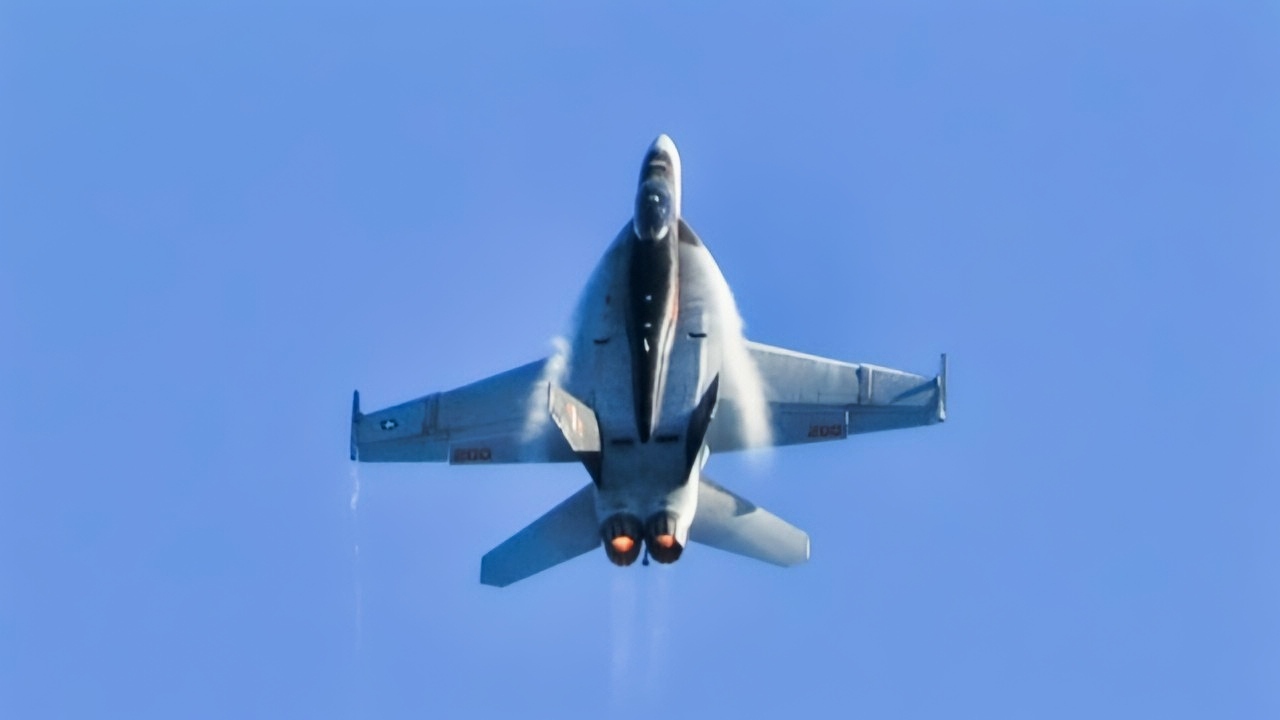
A U.S. Navy F/A-18E Super Hornet aircraft assigned to Strike Fighter Squadron (VFA) 147 performs maneuvers above the aircraft carrier USS Nimitz (CVN 68) during the departure of Carrier Air Wing (CVW) 11 Dec. 10, 2013, in the Pacific Ocean. CVW-11 fixed wing aircraft flew off the Nimitz to return home after being deployed to the U.S. 5th, 6th and 7th Fleet areas of responsibility. (U.S. Navy photo by Mass Communication Specialist Seaman Apprentice Kelly M. Agee/Released)
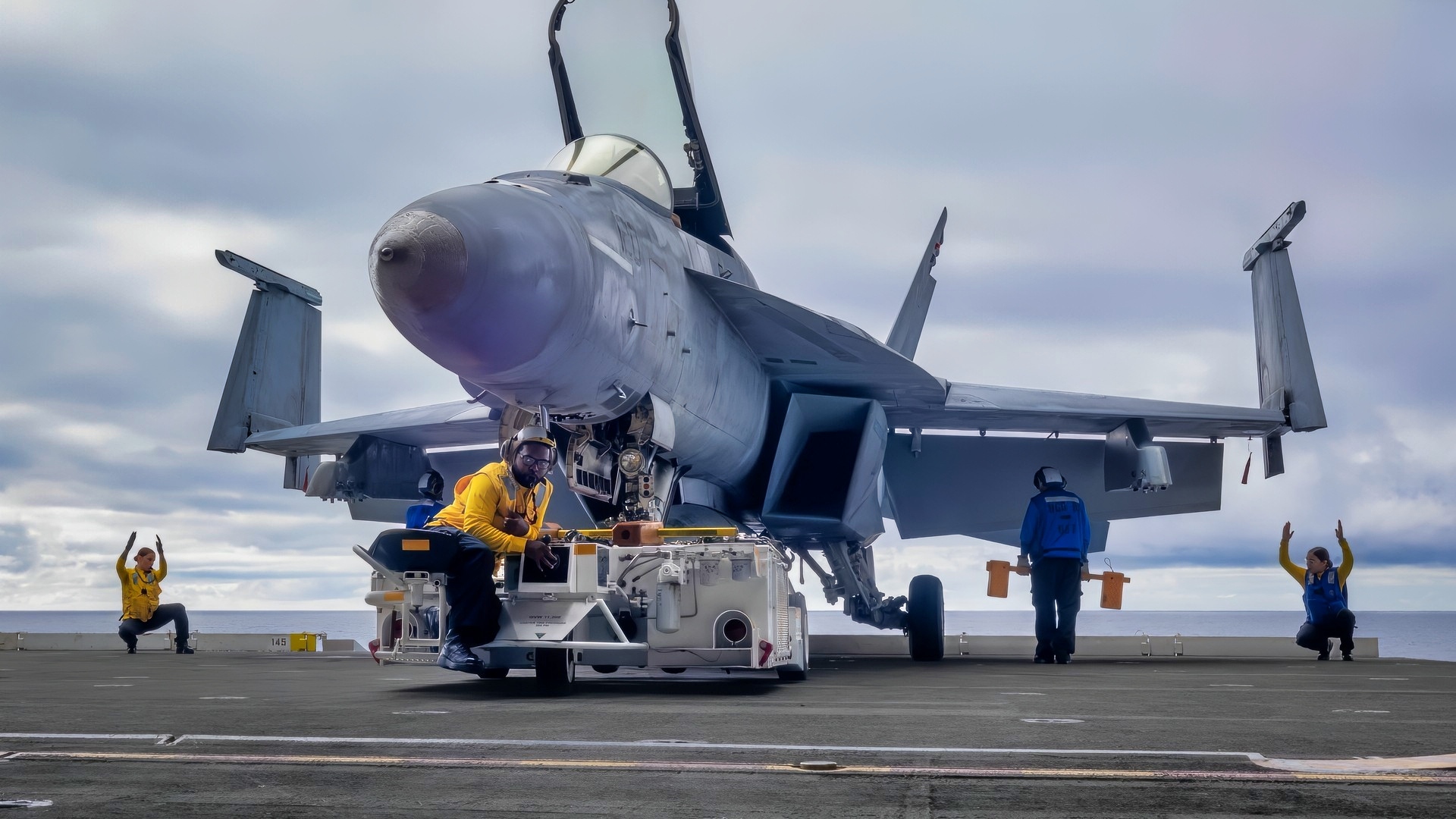
ATLANTIC OCEAN (Aug. 13, 2025) Sailors transport an F/A-18E Super Hornet attached to the “Gladiators” of Strike Fighter Squadron (VFA) 106 onto an aircraft elevator aboard the Nimitz-class aircraft carrier USS George H.W. Bush (CVN 77). George H.W. Bush is underway conducting carrier qualifications and routine operations in the Atlantic Ocean. (U.S. Navy photo by Mass Communication Specialist Seaman Apprentice Kayleigh Tucker)
Among those are the immediate stop of its quest for a nuclear weapon, dissolution of the IRGC, stopping the support for its proxy terror organizations (Hezbollah, Hamas, Houthis, and Iraqi militias), human rights reform, and capping its ballistic missile program. The regime will not accept those.
However, after decades of chanting “Death to America”, “Death to Israel,” the regime has to face its choices. Iran’s economy is not collapsing because of Israel or the United States.
The economy is suffering because the Islamic Republic chose jihad over jobs, centrifuges over citizens, and terror proxies over food for the people.
Overreliance on Petrodollars Has Also Tanked The Economy
An Al Jazeera report stated that ordinary Iranians are suffering due to poor planning by government officials.
A university lecturer named Mahoud told Al Jazeera, “You might hear here about inflation exceeding 300 percent for some goods, and you might think it is a sudden shock caused by the war.
But the truth is that these figures would not have been possible without structural diseases accumulated over decades of reliance on oil revenues.
“The country used to cover its wounds with petrodollars, and now that the effect of the anesthetic has worn off, all the ailments have surfaced at once.”
He added, “What worries me is not just the price hikes, but the experts’ estimates of the consequences of flawed economic policies that have not yet emerged, because they have effectively hidden behind the noise of the war.
“This means we are standing on the edge of an iceberg; what we see now is only the tip.
To make matters worse, we are stuck in a state of neither war nor peace, and this state of suspension is the worst poison that can afflict an exhausted economy.”
Iran’s Insistence On Fees For The Strait Is Not A Solution
Iran’s proposed tolls on the Strait of Hormuz are ultimately unviable because the strait is an international waterway, not a man-made canal, making any unilateral charges illegal under international law.
The United States and other global powers outright reject Iran’s attempts to charge for transit, viewing such actions as an unacceptable violation of the freedom of navigation.
Because the strait passes through the territorial waters of Oman and Iran, it falls under the UN Convention on the Law of the Sea, which guarantees unhindered transit passage.
Iran would not be charging ships for a service, as occurs when ships pass through the locks in the Suez or Panama canals.
It would be charging vessels for exercising a pre-existing right of transit through an international strait in an open (albeit narrow) body of water.
What it sees as leverage will not yield control, as nations will seek alternative routes to circumvent the Strait, such as the pipelines that Saudi Arabia and the UAE are expanding.
And other countries will purchase oil elsewhere (The US, Canada, Venezuela, and others).
Only China Is Buying Iranian Oil
US Treasury Secretary Scott Bessent said earlier on Tuesday that, despite the US lifting sanctions on Iranian oil, no country other than China has purchased Iranian oil.
“We were ordered to lift the sanctions on Iranian oil. What’s really interesting is that outside China, which was buying Iranian oil during the sanctions, nobody has bought Iranian oil,” Bessent said in an interview with Fox News.
“The Iranians thus far have not been able to sell their oil because people are worried: ‘Will sanctions snap back? Could the Treasury come after us?’ So they’re still selling to China at a discount,” he added.
Economic Pressure Is Rising
Iran’s economy is teetering on the brink of collapse. Everyday essentials are becoming unaffordable for the average citizen. Year-over-year food inflation has breached 115 percent, with red meat and poultry prices up nearly 178 percent and milk, cheese, and eggs up over 151 percent.
The International Monetary Fund (IMF) projects the Iranian economy will contract by 6.1 percent, severely exacerbating unemployment and business closures.
The compounding effects of strikes, supply shortages, and international blockades have left as many as two million Iranians out of work.
Hundreds of thousands have applied for unemployment benefits, which the regime is finding increasingly harder to pay. The system is so overworked that it keeps crashing.
Seaborne trade has dried up, and the regime cannot currently pay its troops. The Iranian rial is dropping to historic lows.
Global economists have warned that Iranian society cannot sustain annual inflation above 25 percent, which could lead to escalating social discontent and widespread protests over the falling currency.
At the beginning of the year, just prior to the current conflict, the US dollar traded at around 1.35 million rials on Tehran’s open market.
The renewed tensions between Iran and the United States last week, however, pushed the exchange rate even higher, approaching 1.7 million rials per US dollar.
This crushing economic crisis is not survivable, despite Iran setting itself up to withstand such a crisis. Tehran needs to make an agreement, or it will sink.
About the Author: Steve Balestrieri
Steve Balestrieri is a National Security Columnist. He served as a US Army Special Forces NCO and Warrant Officer. In addition to writing on defense, he covers the NFL for PatsFans.com and is a member of the Pro Football Writers of America (PFWA). His work was regularly featured in many military publications.


