

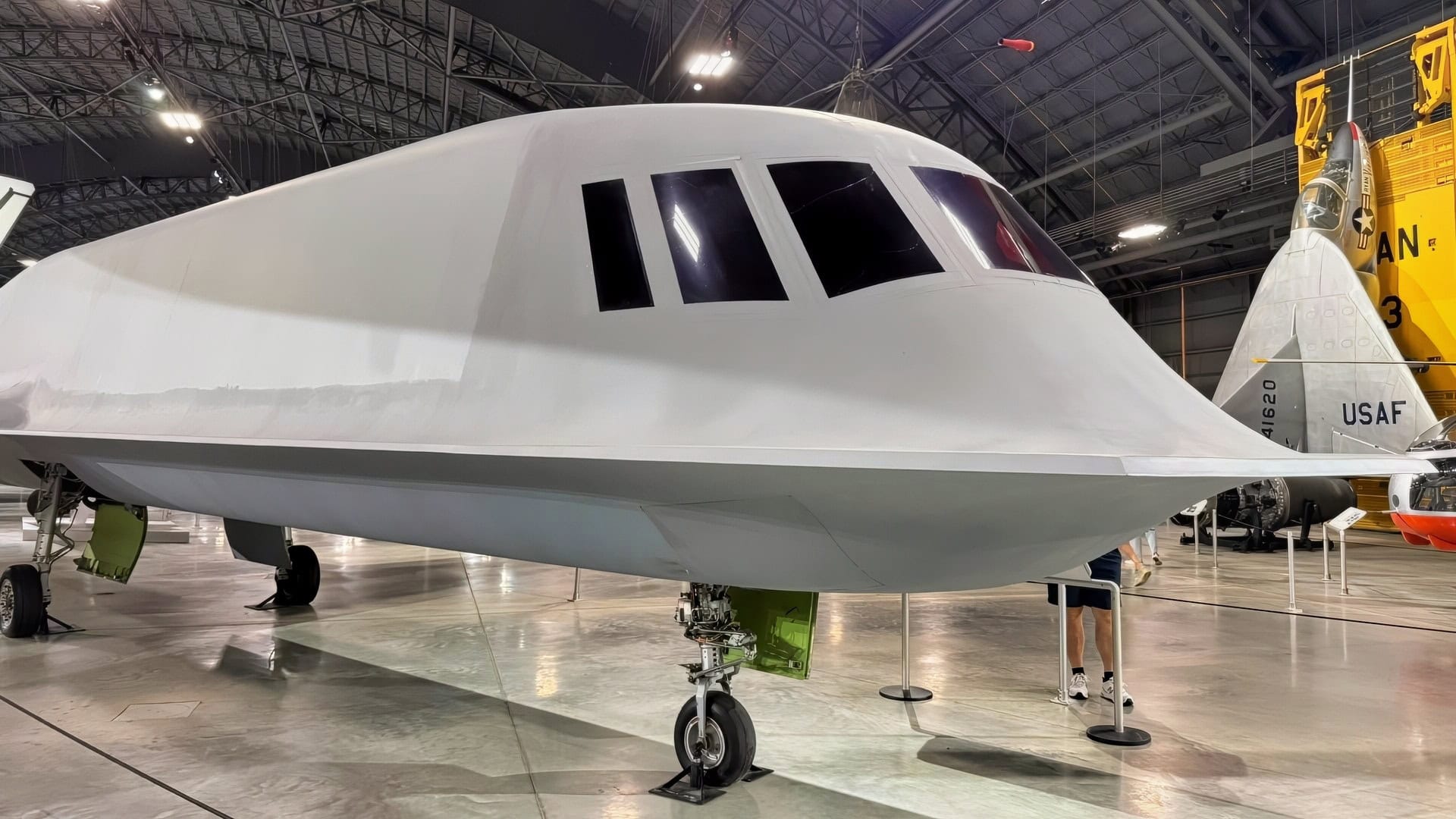
Northrop’s Tacit Blue stealth research demonstrator made its first flight from Groom Lake — better known as Area 51 — in 1982, eventually making approximately 130 test flights so classified that the U.S. Air Force did not publicly acknowledge the program’s existence until the mid-1990s. Nicknamed “the Whale” for its bulbous, ungainly appearance, the aircraft was described by one Northrop engineer as “arguably the most unstable aircraft man had ever flown” — so aerodynamically marginal it could not fly without continuous computerized flight-control corrections. Tacit Blue’s curved-surface stealth design and low-probability-of-intercept radar work went on to shape the B-2 Spirit stealth bomber and the E-8 Joint STARS surveillance aircraft.
Tacit Blue Was the DNA for the B-2 Spirit Stealth Bomber
Tacit Blue, designed by Northrop, was one of the oddest-looking aircraft ever to have flown.
Though not a prototype aircraft — it was not intended for service or mass production — the research aircraft exerted an outsized influence on American stealth technology.

Right Up Front B-2 Bomber USAF Museum. Image by Harry J. Kazianis/National Security Journal.
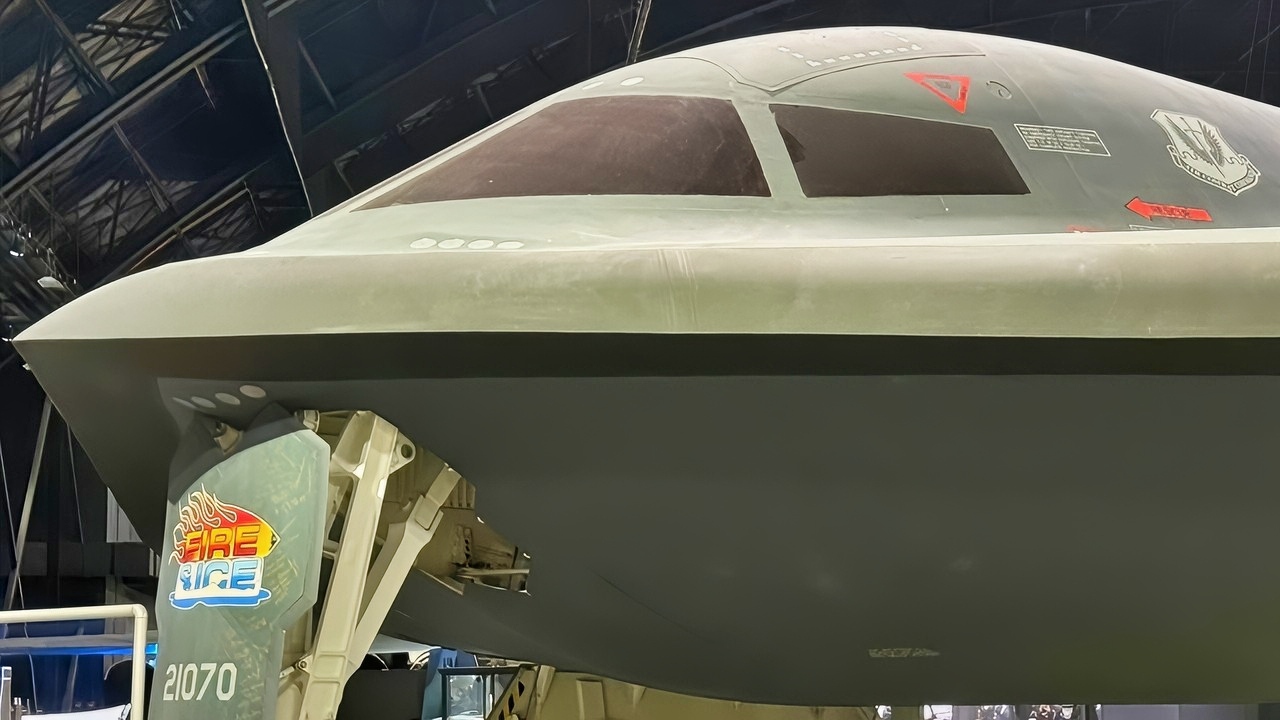
The Mighty B-2 Spirit Stealth Bomber. Image Credit: National Security Journal.
Officially speaking, Tacit Blue was an experimental demonstrator aircraft developed with assistance from DARPA for the U.S. Air Force.
Unofficially, Tacit Blue was called the Whale because of its rounded, particularly ungainly look. Though seemingly incapable of flight — one top Northrup engineer famously said “at the time [Tacit Blue] was arguably the most unstable aircraft man had ever flown,” — its numerous flights validated and refined some bleeding-edge aerospace concepts.
A Problem
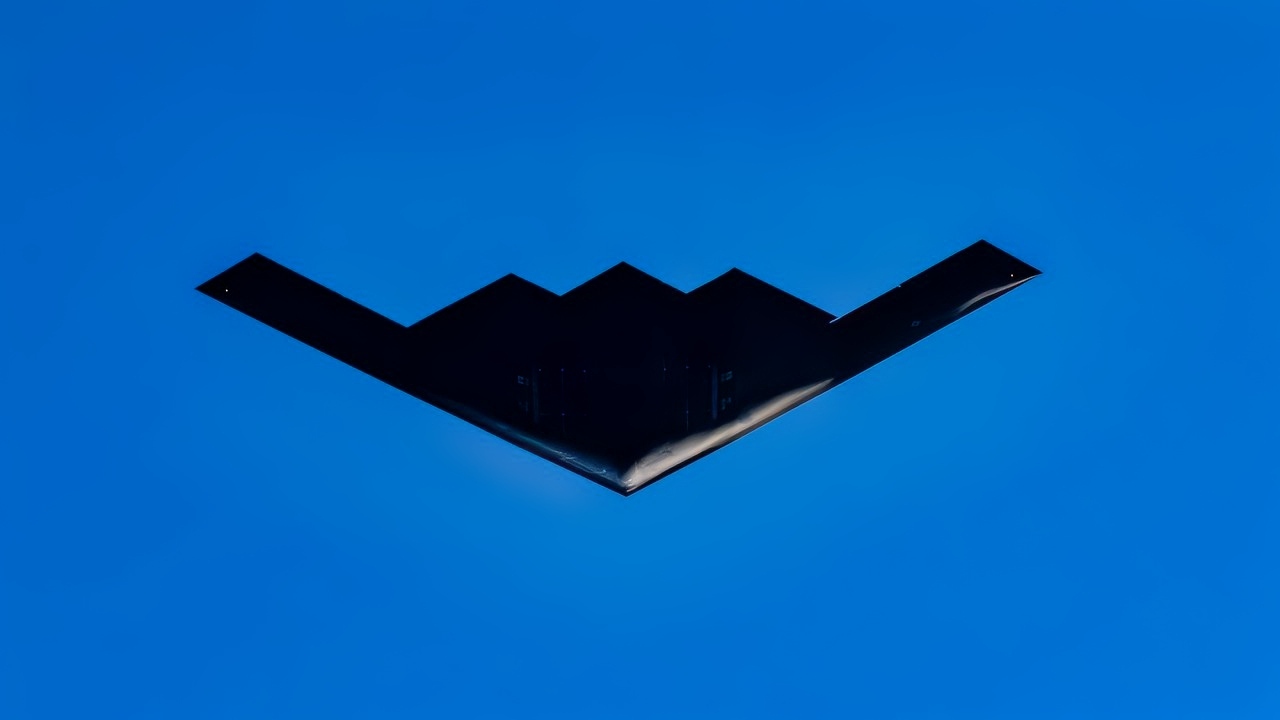
The B-2 Spirit flies over the Rose Parade at Pasadena Ca., Jan. 1, 2024. The Rose Parade is a parade of flower covered floats, marching band, and equestrian units that is produced by the Tournament of Roses. (U.S. Air Force photo by Airman 1st Class Bryce Moore)
Tacit Blue was a response to a serious Cold War issue. NATO planners believed that, should the Soviets launch a land offensive into Western Europe and NATO countries, enormous Warsaw Pact armored formations would move quickly into the heart of Europe while protected, and in some cases hidden, by dense Soviet air defense assets. The United States and NATO needed an aircraft that could keep an eye on the battlespace from relatively close range without being detected or shot down.
Though NATO had a variety of reconnaissance aircraft available, they flew too high and in predictable patterns, or were easily detectable by enemy radar. Tacit Blue was built to answer a question: could an aircraft, though carefully shaped, be difficult to detect by enemy radar? Taking that question one step further, could an aircraft be undetectable by radar?
Reconnaissance — Not Combat
Unlike earlier stealth forays, like the F-117 Nighthawk, Tacit Blue would not be a combat aircraft. It would also eschew the Nighthawk’s faceted surfaces for a smooth, rounded design, aided by computer design.
It would be a significant validation of computer-aided design, influencing the B-2 Spirit program.
Tacit Blue was a small aircraft, bulbous, and with stubby wings. Its engines were buried within the fuselage, hidden from enemy radar, and its tail surfaces were angled to control radar reflections.
The airplane’s stability was so poor that the aircraft would not have been able to fly without computerized flight control corrections.
Into the Air
Tacit Blue first flew in 1982, taking off from Groom Lake — better-known as Area 51 — where it would go on to make around 130 test flights. It would remain highly classified through the 1980s, not to be publicly acknowledged until the mid-1990s, once some of the concepts it had pioneered migrated to other aerospace projects.
Far-reaching Influence
Tacit Blue’s influence on other projects was remarkable — and aided more than just stealth aircraft.
One article, published by Air & Space Forces Magazine in 1996, explained that Tacit Blue’s flights were far-reaching, and “led to crucial advances in low-observable (LO) and radar technologies. For instance, its curved surfaces live on in the shape of the Air Force’s B-2 stealth bomber. Certain aspects of its ultrasophisticated intercept radar helped lead to the powerful electronic “eyes” on today’s E-8 Joint Surveillance and Target Attack Radar System (Joint STARS) aircraft, among other systems. The now-defunct Triservice Standoff Attack Missile (TSSAM) was basically a small Tacit Blue turned upside down.”
The jet’s influence extended well beyond stealth shaping, however. Tacit Blue would feed into the development of airborne ground surveillance that would eventually emerge in systems like JSTARS. Tacit Blue also reinforced growing confidence in low-probability-of-intercept radar techniques and battlefield connectivity, which would be important after the Cold War.

A B-2A Spirit bomber assigned to the 509th Bomb Wing conduct aerial operations in support of Bomber Task Force Europe 20-2 over the North Sea March 12, 2020. Bomber missions enable aircrews to maintain a high state of readiness and proficiency, and validate U.S. global strike capability. (U.S. Air Force photo/ Master Sgt. Matthew Plew)
Fast forward to today, and the only Tacit Blue airfare is on display at the National Museum of the United States Air Force. In fact, the top image in this article is from a recent visit we made to see it last year.
Even decades after it first took off, the airplane looks futuristic.
Rather than a cutting-edge stealth platform, Tacit Blue looks like a mishmash of disparate aerospace concepts that somehow made their way onto a single platform. Speaking in 1996, Arthur L. Money, then the assistant secretary of the Air Force for Acquisition, explained that “this program [Tacit Blue] has provided the Air Force and the nation with extraordinary advances.” And, he added, “this technology continues to protect our men and women in uniform, now and for years to come.”
About the Author: Caleb Larson
Caleb Larson is an American multiformat journalist based in Berlin, Germany. His work covers the intersection of conflict and society, focusing on American foreign policy and European security. He has reported from Germany, Russia, and the United States. Most recently, he covered the war in Ukraine, reporting extensively on the shifting battle lines in Donbas and writing about the war’s civilian and humanitarian toll. Previously, he worked as a Defense Reporter for POLITICO Europe. You can follow his latest work on X.


