

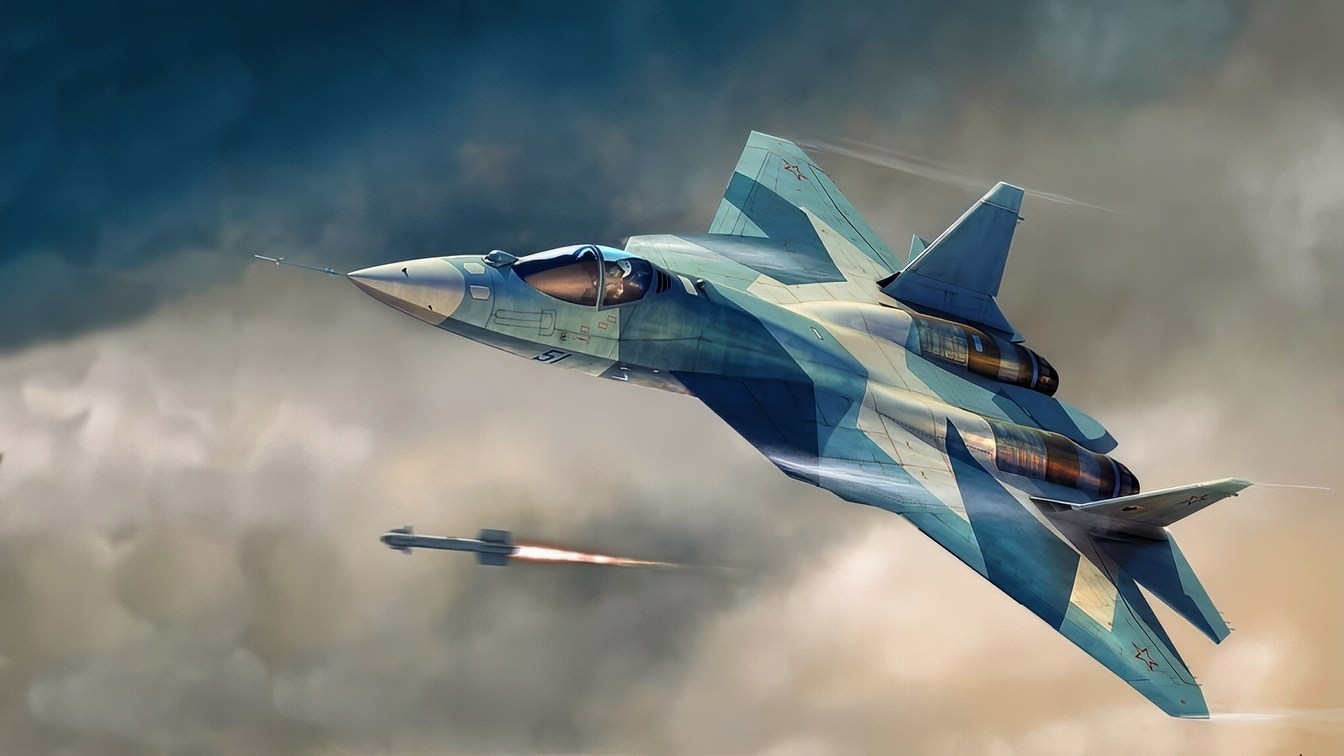
Russia’s air force is now decisively falling behind the West in the single most important fighter technology of the modern era: the Active Electronically Scanning Array radar.
While the United States fields AESA radars on the F-22, F-35, F-15EX, F-16E/F, and F/A-18E/F—and every modern European fighter from the Eurofighter Typhoon to the Rafale to the Gripen has one too—Russia has produced just one AESA radar, the N036 Byelka, and only on the troubled Su-57.
Russia’s Air Force Has a Radar Problem

Su-57 Felon Stealth Fighter. Image Credit: Creative Commons.
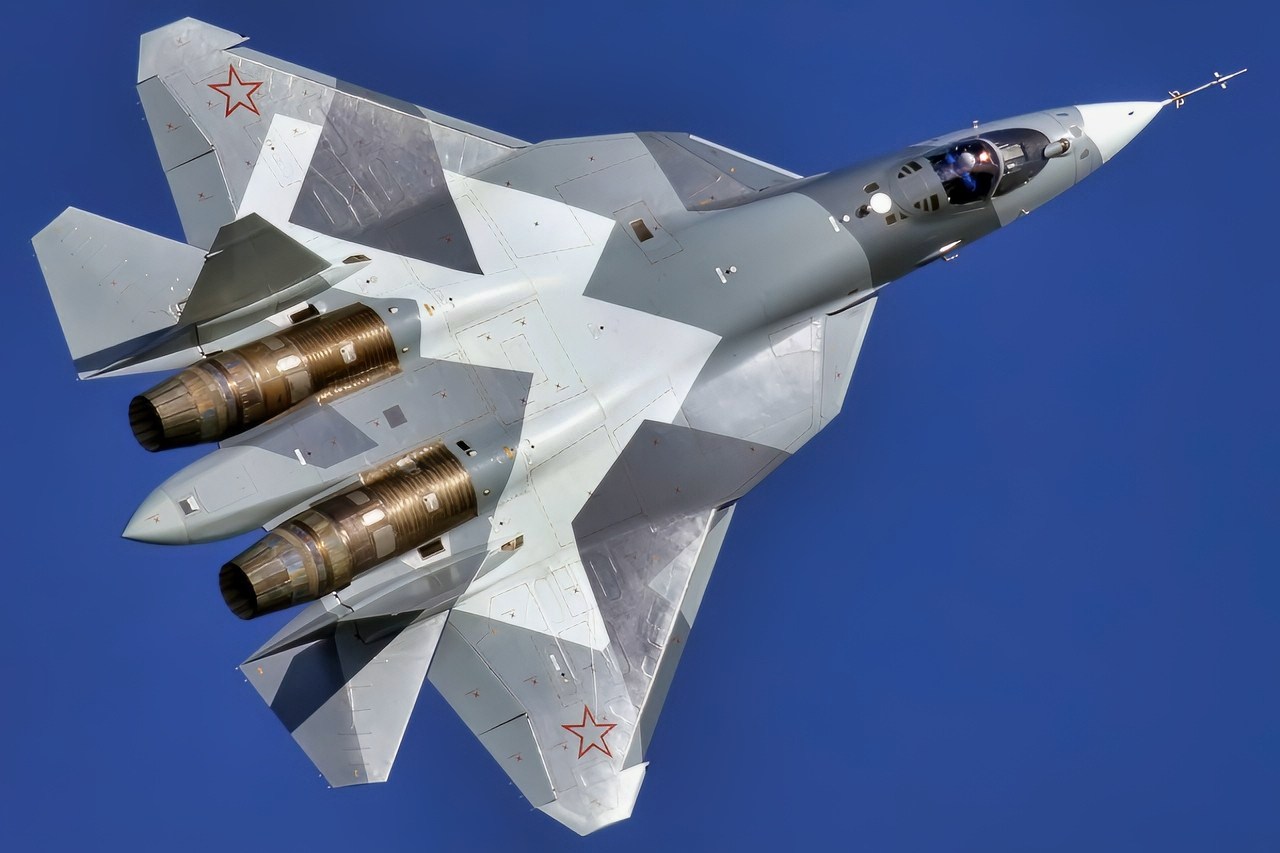
Su-57 Felon Back in 2011. Image Credit: Creative Commons.
In the present day, when a war rages in the skies over Ukraine, one of the debated issues is what the latest, most modern fighter aircraft offer that older-generation Mikoyan MiG-29s, Sukhoi Su-27s, and older F-16s and Mirage 2000s lack. Answering that question requires examining how the systems on board the new 5th-generation models make the difference in the 21st century.
What is the coin of the realm in the jet fighter business has changed over the years as technology and other aspects of the combat aircraft world have evolved. What is the signature performance characteristic by which these jets are judged has changed as the Cold War wound down, as the analog age gave way to the digital one, and as the distance at which sensors and weapons could successfully engage an enemy target has grown progressively greater.
Going back to the 1980s, there was still an emphasis on the close-in, air combat maneuvering (ACM), or “dog-fighting”, aspect of fighter aviation. This was a challenge for Western aircraft manufacturers, as, for the first time since jets entered combat, Russian (then Soviet) aircraft designers were finally building platforms that could match the close-in air-to-air performance for which Western designs were so proficient.
Not long after the Berlin Wall came down, teams of specialists from several NATO nations – and even teams from some “other” countries came to the newly reunited Germany to conduct a complete examination and evaluation of the Mikoyan MiG-29s in their possession. These had been left behind in the former German Democratic Republic (GDR) after the collapse of the Soviet Bloc.
These teams examined 24 of these aircraft, which were built for a Warsaw Pact nation’s export version of the fighter, and came up with a comprehensive set of observations on the pros and cons of the MiG.
A member of one of the NATO-nation teams told me years later that a central conclusion was that “inside of the AIM-9, infrared (IR)-guided missile envelope, the MiG-29 was the best dogfighting aircraft that we had ever seen.
This was in the day when the ‘kings’ of the dog-fighting universe at the time were the US F-16, the Dassault Mirage 2000 and the soon-to-be everywhere Rafale.” So back at that moment, as he explained, “every time you were trying to sell an aircraft to this country or that, the number one issue was ‘which aircraft turns tighter and can sustain a 9-G maneuver longer than the others. It was still more about the ‘steel on steel’ aspects of air warfare than the electronics they carried on board.
Then There Was Active-Homing BVR
The next shoe to fall, so to speak, was when the 1st-generation of beyond visual range (BVR) active-homing air-to-air missiles (AAM) came on the market. The first one to make the biggest splash was the US AIM-120 Advanced Medium Range AAM or AMRAAM. The advanced active-homing seeker technology was something the US Government was not keen to have exported to just any nation – largely over fears that the missile could fall into the wrong hands and possibly be compromised.
This near-monopoly by the US did not last for long. France’s MBDA was not far behind with the development of its MICA (Missile d’Interception, de Combat et d’Auto-défense) series of “fire and forget” missiles. Following those designs were the appearance of Russian active-homing designs, the Vympel R-77 and its export version, RVV-AE.
Suffice to say, it was now a new world in fighter aviation that everyone was now talking about. The debate was now how easy it is to kill someone from dozens of miles away instead of within visual range. The days of one-on-one battles with both jets struggling to get into position to be able to have a firing solution on the other seemed to be over.
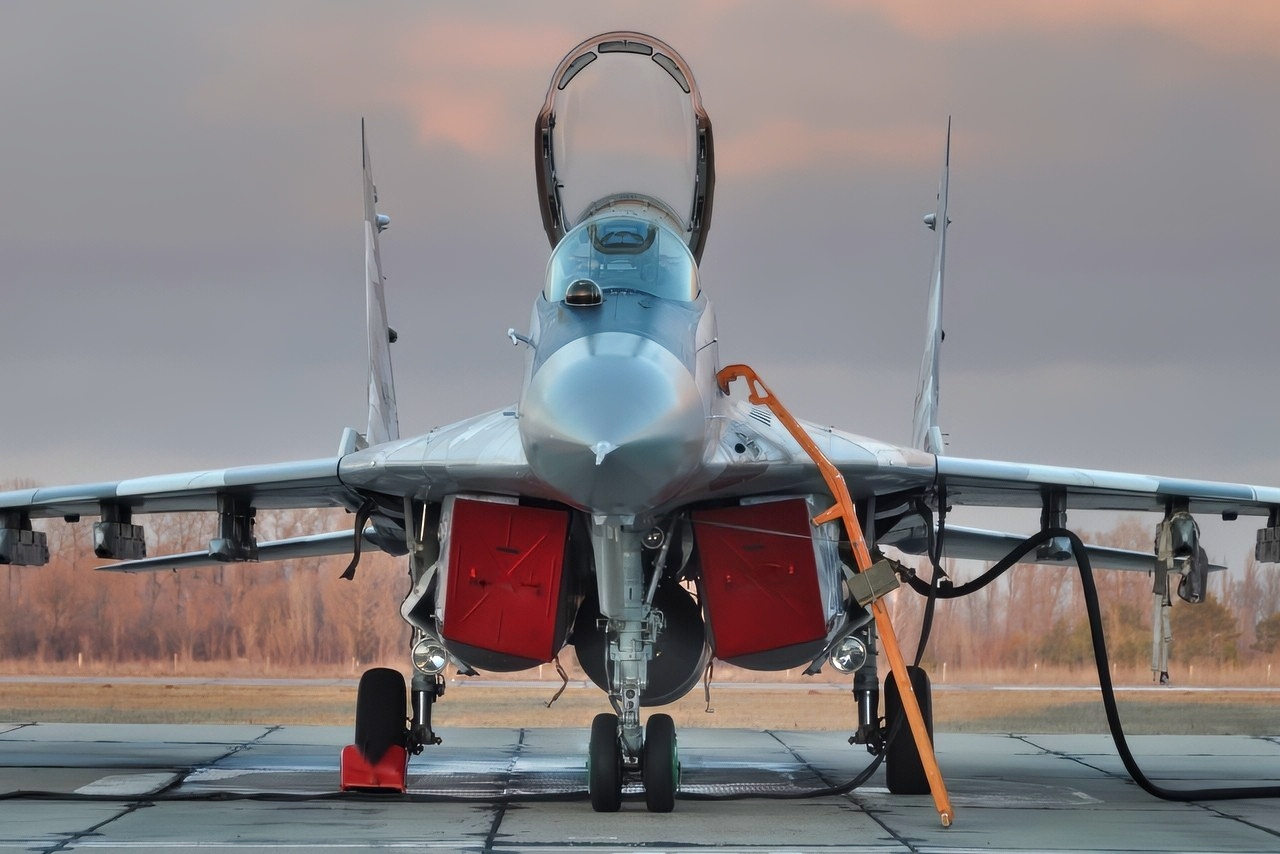
MiG-29 Fighter. Image Credit: Creative Commons.
The most famous engagement in that 1970s era of dogfighting is that between USNR Cdr. Randy Duke Cunningham and a North Vietnamese double-ace nicknamed “Col. Toon,” who may or may not have actually been a real person, in May 1972. Cunningham, in the heavier twin-engine F-4 Phantom, v. the North Vietnamese pilot in a single-engine MiG-17, eventually shoots down the faster, more maneuverable MiG-17, making him the US Navy’s first ace to come out of the Vietnam conflict.
But once the BVR race had begun, this manner of engagement was supposed to be the stuff of a bygone, “white-scarved” chapter in fighter pilot history. Now, we were told, we will be living in the “push-button” era of warfare.
Where Russia is Losing the Race
As long as the central focus of fighter performance was who had a BVR active-homing AAM and who did not, the Russians were keeping pace, albeit slightly behind the West. Russian missile designers would tell you that the chief reason for their lag in deploying an active-homing design had nothing to do with their knowledge of or fluency with this technology.
The reason, they would tell you, was bureaucratic warfare dating back to the Soviet era that persists to this day. Simply put, the missile designers all belonged to design bureaux that were part of the one-time USSR Ministry of Aviation Industry (MAP), and the seeker designers belonged to what is today an industrial conglomerate that was once the Ministry of Radio Industry (MRP).
“These are two organizations that fought one another during the Cold War more ferociously than they did the Soviet Union’s ‘Main Enemy’ – meaning the US,” said a one-time Russian fighter aircraft designer. “That conflict had more to do with slow progress in this sector of the industry than anything else.”
But today there is another new technology that is the “gold standard” characteristic in fighter aircraft design. That is an aircraft equipped with an Active Electronically Scanning Array (AESA) radar system.
An AESA radar is one in which the transmitter module, which was always present in legacy Mechanically-Steered Array (MSA) models, is removed. The radar dish is not one that actively moves with the target it is tracking; it can “paint” it and fire. Instead, the radar’s array is in a fixed position, and its flat dish is composed of hundreds (sometimes more than 1000) transmit/receive modules (TRMs). Each one of these small, microchip-sized elements contains its own transmitter and receiver.
The US has a plethora of these in service now. The F-22’s APG-77, the F/A-18E/F’s APG-79, the F-16E/F Block 60’s APG-80, the F-35’s APG-81 and the F-15’s APG-82. All three of the most modern European fighters – the Eurofighter, the Rafale and the JAS-39E/F Gripen – are also equipped with AESAs.

VIRGINIA BEACH, Va. (Sept. 20, 2025) The United States Air Force F-22 Demo Team performs at the 2025 Naval Air Station (NAS) Oceana Air Show aboard NAS Oceana, Sept. 20, 2025. The show’s theme celebrated 250 years of America’s navy and featured performances highlighting the precision, power, and innovation of naval aviation. (U.S. Navy photo by Mass Communication Specialist Seaman Apprentice Oliver McCain Vieira)
But so far Russia has only developed one AESA, the NIIP N036 Byelka (Russian for “Squirrel), which is on board the Sukhoi Su-57. That aircraft is billed as Russia’s “stealth fighter”, although even some of the Russian designers familiar with the program would argue with that designation.
GaN v. GaAS
Largely due to Russia’s overall decline in its defense industry and the economic troubles it faces, production of the N036 has become problematic. Not the least of the program’s problems is that, currently, the most up-to-date AESA technology involves TRMs based on Gallium Nitride (GaN), while Russia has largely been restricted to the previous-generation Gallium Arsenide (GaAs).
Ukrainian radar system designers familiar with the Russian industry state that the early Russian TRMs they examined had very poor efficiency ratings. One of the early Russian attempts was so inefficient, said one Ukrainian enterprise director, that “the TRMs could generate a real radar pulse, but it was so weak that all it would do for you is provide a good heater in winter.”
Compared with Gallium Arsenide (GaAs) in AESA radars, GaN TRMs offer 5–10 times higher power density, better thermal efficiency, and 70% longer detection range. GaN enables the construction of lighter, more reliable radars, but it is also a more complex material to produce and integrate into a design.

Two U.S. Air Force F-15EX Eagle IIs assigned to the 85th Test and Evaluation Squadron, Eglin Air Force Base, Florida, taxi after landing at Kadena Air Base, Japan, July 16, 2025. Local units conducted integration and familiarization training with the F-15EX. (U.S. Air Force photo by Airman 1st Class Arnet Shayne Tamayo)
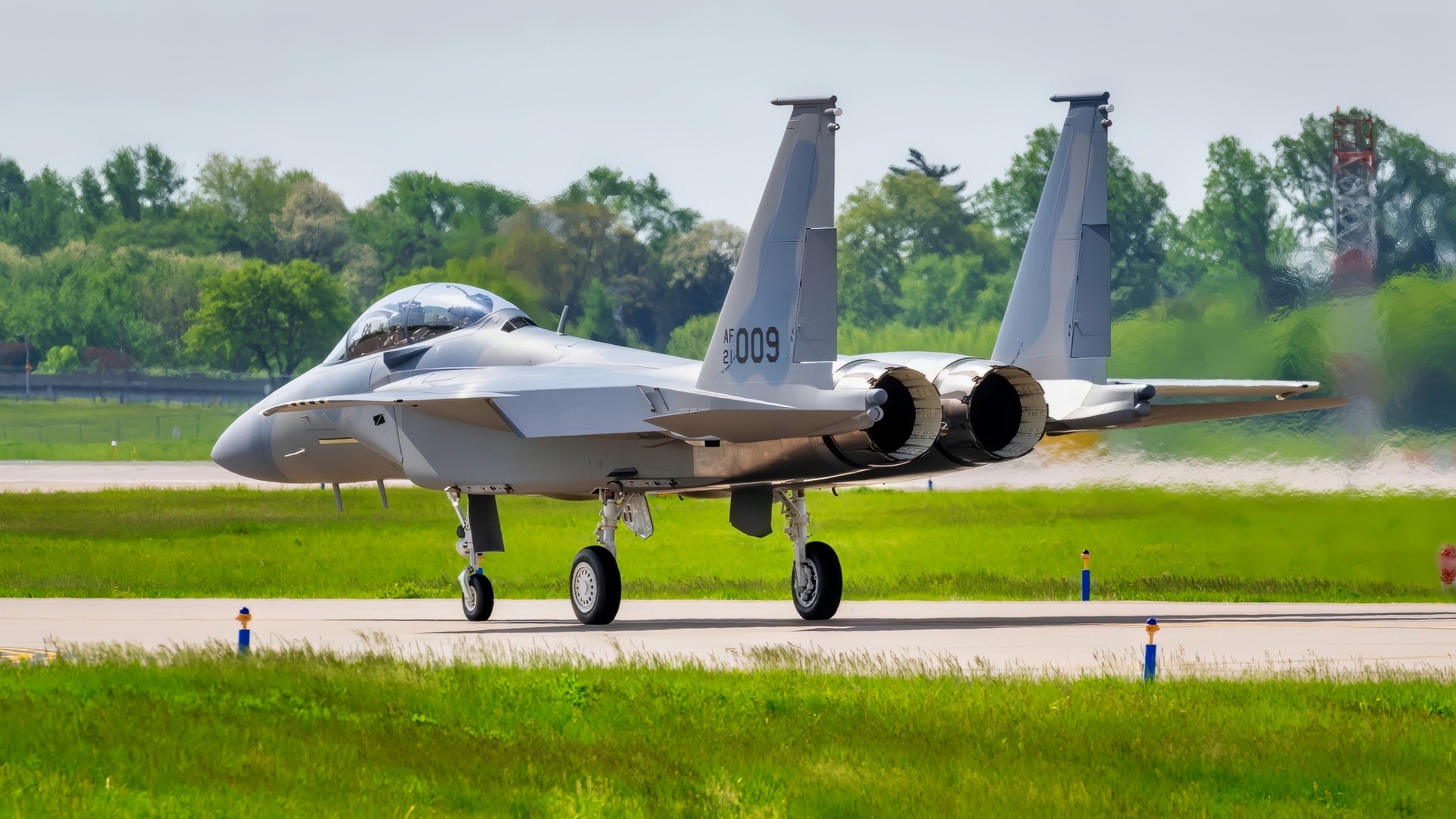
F-15EX-9 in St. Louis Missouri, shortly before delivery to Portland Air National Guard Base, Ore. (Boeing/Eric Shindelbower)
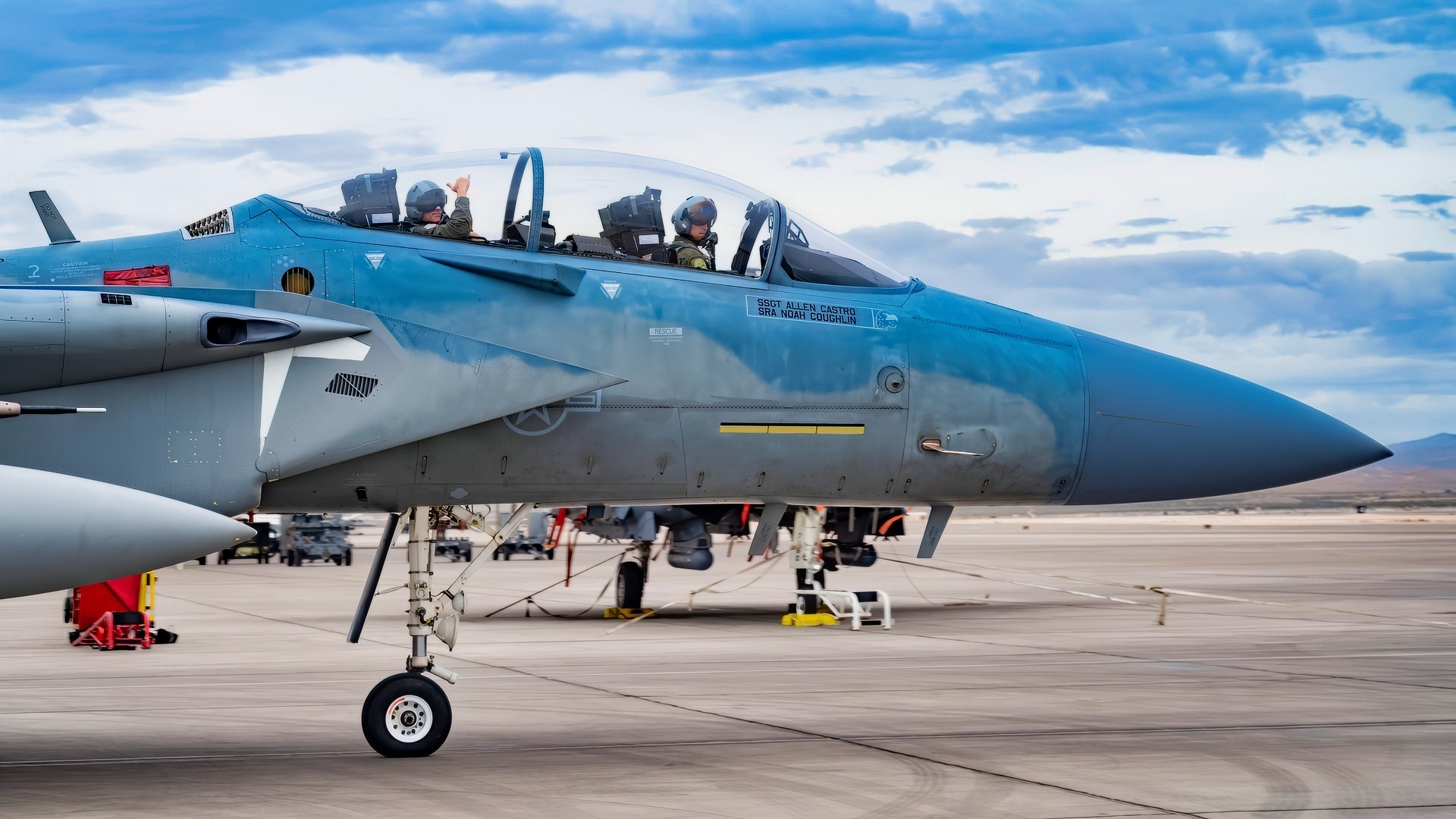
U.S. Air Force Maj. Michael Tope, right, and Brig. Gen. Michael Rawls, taxis to the runway in a F-15EX Eagle II for a training operation at Nellis Air Force Base, Nevada, Nov. 15, 2023. The EX is the most advanced variant of the F-15 aircraft family, with the capability to carry a great number of missiles in support of the F-35A Lightning II. (U.S. Air Force photo by Airman 1st Class Elizabeth Tan)
What this portends for Russia’s aerospace sector is that its fighters will be increasingly at a disadvantage when facing Western counterparts. Not only has Russia failed to field its only AESA-equipped aircraft in any serious numbers, but Moscow has also retrofitted very few of its earlier-generation platforms with an AESA, as the US has done with the F-15E/EX, F-16E/F, and F/A-18E/F.
As the war in Ukraine continues but appears to be moving towards a close, Russia will be looking to rebuild its air power inventory after so many losses since 2022. Barring some miraculous revival of the Russian economy, they will find the process very tough going and probably unaffordable.
About the Author: Reuben F. Johnson
Reuben F. Johnson has thirty-six years of experience analyzing and reporting on foreign weapons systems, defense technologies, and international arms export policy. Johnson is the Director of Research at the Casimir Pulaski Foundation. He is also a survivor of the Russian invasion of Ukraine in February 2022. He worked for years in the American defense industry as a foreign technology analyst and later as a consultant for the U.S. Department of Defense, the Departments of the Navy and Air Force, and the governments of the United Kingdom and Australia. In 2022-2023, he won two consecutive awards for his defense reporting. He holds a bachelor’s degree from DePauw University and a master’s degree from Miami University in Ohio, specializing in Soviet and Russian studies. He lives in Warsaw.


