


Summary and Key Points: Saab’s JAS 39 Gripen began as Sweden’s Cold War response to replacing the Draken and Viggen, shaped by the need for efficiency, modular avionics, and survivability under Soviet pressure.
-The Mission: Take on the Soviet Union and now Russia.

JAS 39 Gripen Fighter From Sweden. Image Credit: Creative Commons.
-The “Gripen” name—derived from the griffin—arose from a Swedish Air Force magazine contest, with the program making its public debut years later and its first flight in 1988.
-In 2026 framing, the Gripen E is positioned as a “Day 800” endurance fighter, emphasizing dispersed road-base operations, rapid turnarounds, and AI-enabled human-machine collaboration via MS22.
-The global user list and evolving variants keep the story moving.
Saab’s JAS 39 Gripen Has a Message for the F-35 Debate: “Day 800” Wins Wars
Okay, some of you dear readers are probably thinking, “Oh, not, not again! Not yet another article on the Royal Canadian Air Force (RCAF) and the seemingly endless Lockheed Martin F-35 Lightning II vs. Saab JAS 39 Gripen debate!”
Well, rest assured, folks, that this is not one of those articles. But we know you like them, that’s for sure. And those issues are clearly important, so we will continue the coverage for sure.
Instead, we’ll now be looking at the early history of the JAS 39, which goes all the way back to the Cold War, i.e., long before either U.S. President Donald John Trump or Canadian Prime Minister Mark Joseph Carney ever took office, and long before the F-35 (or any other 5th Generation stealth fighter for that matter) even existed.
The Why and the Wherefore: The Premise and Promise of the JAS 39 Gripen
‘Twas the year 1979, and Sweden, though still maintaining an official position of neutrality—and 45 years away from finally joining NATO—was nonetheless ever mindful of the looming Soviet threat, since the memories of their Scandinavian neighbor Finland’s previous run-ins with the Sovietskiy Soyuz (Soviet Union) were still fairly fresh in the minds of Sweden’s senior military and political leaders.

JAS 39 Gripen. Image Credit: Creative Commons.

JAS 39 Gripen Taking Off. Image Credit: Creative Commons.
Accordingly, Sweden always maintained a top-notch air force, the Flygvapnet (abbreviated as “Fv”). In that final year of the 1970s, the Fv was looking to replace its aging Saab 35 Draken (“Dragon” or “Kite”) and Saab 37 Viggen (“Thunderbolt” or “Tufted Duck”, the latter name referring to the warbird’s canard configuration).
Sticking with a proven homegrown winning formula, Saab AB was once again the winner of the contract.
As noted by the Blog Before Flight Staff in a July 19, 2017, article, “During the Cold War [sic], Sweden felt threatened by the Warsaw Pact countries. The country needed an aircraft that could outperform and outmanoeuvre a larger force of advanced fighters … Sweden’s relatively small defence budget and the tough conditions under which Gripen was designed, led Saab to make the fighter as efficient as possible. A fundamental aspect of this approach is Gripen’s modular and open avionics architecture. This enables the integration of off-the-shelf products wherever possible, as well as continuous development of new functions to meet future needs.”
Okay, so now we know the impetus for the warplane’s design, but where did the name come from?
“What’s In a Name?”
Continuing with the Shakespearean “Romeo & Juliet” quote, “What’s in a name? That which we call a rose/By any other name would smell as sweet.”
Well, the mythical beast for which the Gripen was named probably didn’t smell too rosy, nor did it look like a rose, but eh, why nitpick?
Saab AB’s official website tells the story behind the Gripen’s moniker in a May 19, 2020, article: “In 1982, the Swedish Air Force’s magazine ‘FlygvapenNytt’ [Air Force News] published the contest and a flight attendant named Helena Sillen suggested the name Gripen…Sillen justified her proposal as follows: the name Gripen derives from the English word Griffin and refers to a mythical creature with the face, beak, claws, and wings of an eagle and the body of a lion. According to legend, the lion’s ferocity and the eagle’s wisdom symbolize God’s power and wisdom, making the Griffin the king of heaven and earth. Thus, no one could stand in your way … With this explanation, the jury, formed by the magazine’s editor-in-chief, the chief of Air Force and the head of communication of the Swedish Air Force, among others, decided to name the new Swedish fighter ‘Gripen’.”
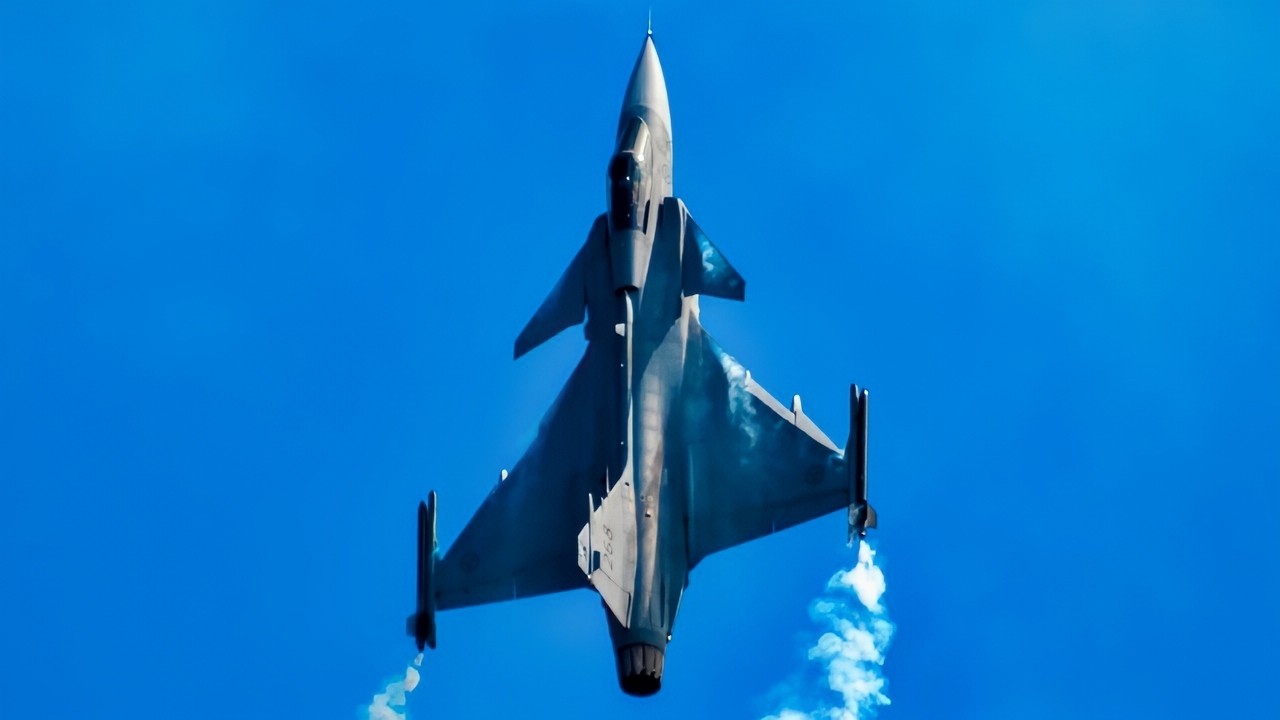
A Swedish Air Force Saab JAS 39 Gripen climbs during the 2019 Royal International Air Tattoo at RAF Fairford, England, July 20, 2019. This year, RIAT commemorated the 70th anniversary of NATO and highlighted the United States’ enduring commitment to its European allies. (U.S. Air Force photo by Tech Sgt. Aaron Thomasson)
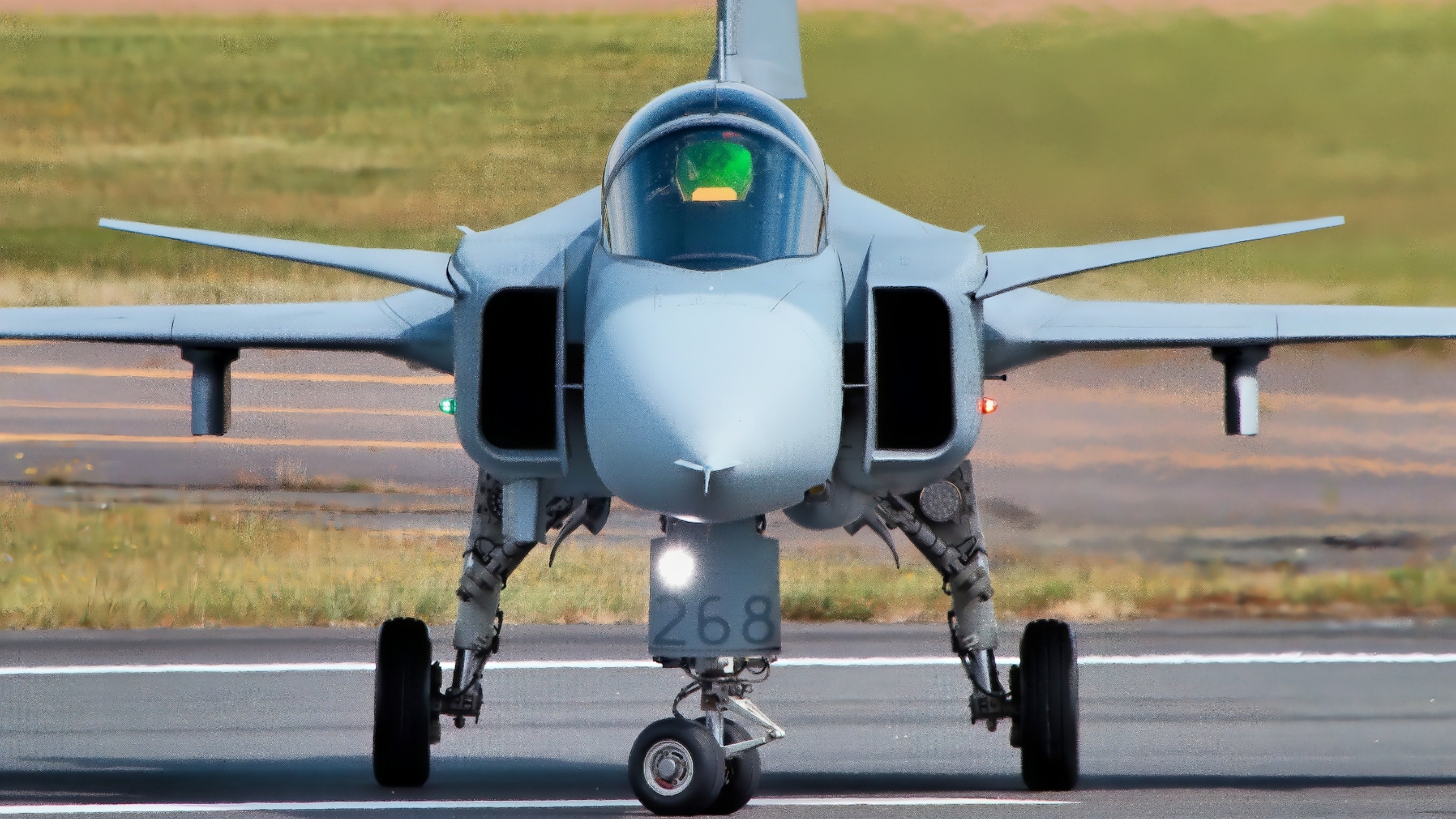
JAS 39 Gripen Front and Center. Image Credit: Creative Commons.
However, it would be another four years after Fröken (Ms.) Sillen (whom I presume worked for Scandinavian Airlines [SAS], Sweden’s national airline, in addition to being a joint carrier with Denmark and Norway) won the contest before the Gripen fighter was officially introduced to the public for the first time. (The actual maiden flight took place on December 9, 1988.)
The Rest of the Gripen Story
The rest is history, and that history is still being made as these words are being typed. As of February 2023, roughly 300 JAS 39 airframes have been built.
According to the World Directory of Modern Military Aircraft (WDMMA), the Fv currently possesses 74 of these, specifically 71 Gripen C variants and 3 Gripen E variants, thus outlasting the Soviet Union by 35 years.
Other users of the JAS 39 Gripen include:
-The Brazilian Air Force (Força Aérea Brasileira, FAB), which first purchased the plane back in 2015 and has officially redesignated the warbird as the F-39; FAB currently has nine F-39E/Fs, with 18 more on order for frontline multirole missions and an additional eight to be used as trainers
-The Czech Air Force (Vzdušné síly Armády České republiky), which signed a lease agreement in 2004 and currently possesses a dozen of the Swedish-made fighters (the C model)
-The Hungarian Air Force (Magyar Légierő), which entered into a lease-and-buy arrangement with the Swedish government in February 2017, currently has 12 Gripen Cs and two Gripen Ds
-The South African Air Force (SAAF), which first took delivery of the plane in April 2008, thus replacing the homegrown Denel (Atlas) Cheetah C/Ds; SAAF currently has 17 JAS 39Cs on frontline duty—assigned to 2 Sqn—and nine more in the trainer role
-The Royal Thai Air Force (RTAF; Kong Thap Akat Thai), which signed the purchase agreement in February 2008 and began taking deliveries in 2011; currently the RTAF has seven Gripen Cs—assigned to 701 Fighter Squadron of Wing 7 (nicknamed “Ferocious Shark of the Andaman” and “House of Gripen”)—on frontline duty and four Gripen Ds assigned as combat trainers; meanwhile, a dozen Gripen Es are on order, with eight earmarked for combat and four as trainers
-The United Kingdom’s Royal Air Force (RAF), which signed an agreement in February 2008 (notice a pattern with that calendar year, anyone?) for usage by the Empire Test Pilots’ School (ETPS); as noted at the time by Ian Burrett, Director Aerospace Training at QinetiQ, “Modern aircraft rely on both sophisticated flight control systems and advanced integrated mission systems for their effectiveness. It is important that future generations of test pilots and flight test engineers are exposed to these technologies and can test and evaluate them objectively. In recent years, ETPS has been using the Saab Gripen aircraft as an important component of this training with great success and is pleased to be continuing the programme.”
The delicious irony of several former Eastern Bloc/Warsaw Pact countries being among the current users of Sweden’s bread-and-butter fighter is not lost on this writer. However, thus far, only the RTAF has used the real-world combat thus far, “blooding” the warbird precision airstrikes against Cambodian artillery positions near the Phu Ma Kua ridge and Ta Muen Thom temple back on July 26, 2025; according to Army Recognition, “Gripens flew coordinated attack profiles using real-time data feeds and targeting support, ensuring surgical strikes with minimal collateral damage.”
About the Author: Christian D. Orr, Defense Expert
Christian D. Orr is a Senior Defense Editor. He is a former Air Force Security Forces officer, Federal law enforcement officer, and private military contractor (with assignments worked in Iraq, the United Arab Emirates, Kosovo, Japan, Germany, and the Pentagon). Chris holds a B.A. in International Relations from the University of Southern California (USC) and an M.A. in Intelligence Studies (concentration in Terrorism Studies) from American Military University (AMU). He is also the author of the newly published book “Five Decades of a Fabulous Firearm: Celebrating the 50th Anniversary of the Beretta 92 Pistol Series.”


Swamplaw Yankee
February 19, 2026 at 4:31 am
Again, the op-ed need to bring CANADA to the fore as a buyer of the F-35. Again, the refusal to even mention the wealthy hugely populated Mexico as the logical buyer of hundreds of F-35 air frames. The fixation on pushing tiny populated Canada to take on the tax burden that Mexico avoids is such a blatant Yankee aporia.
The Mexican cartels train staff to drone, some with Xi vassal states. Cartels have their own drone units. The Mexican cartels run 24/7 hundreds of thousands of covert UAV/drone flights into the US. Official data or not, these drone invasions of the USA by Mexico show that the speculation on future intentions of the cartel suppliers are gossamer, but legitimate. When will more op-ed push for Mexico to purchase + fly the airpower 24/7 to stop these current invasions of the USA?
The reading of bloggers shows that the innovative World War Xi includes the training not only of NKPR military inside Ukraine but other cadres such as motivated Houthis + Cubans. With these elements covertly inside Mexico + the USA ( think the Biden 4 year open door for terrorists) the October 7th type surprise is very probable some where by the Mexican border.
The bleating of op-ed that avoids Mexican threat probability just covers up the needed attention of the inner beltway to new airframes for the southern USA border. Mexico can immediately order 500 Apache helicopter frames with proximity fuse options to patrol their own population. With these Apache air frames in prompt operation the wealthy in Mexico can methodically review their options, Gripens, F-35 or whatever that shows the Yankee that the Mexican State has stopped their current UAV/drone/missile attack potential stone cold 100% dead.