

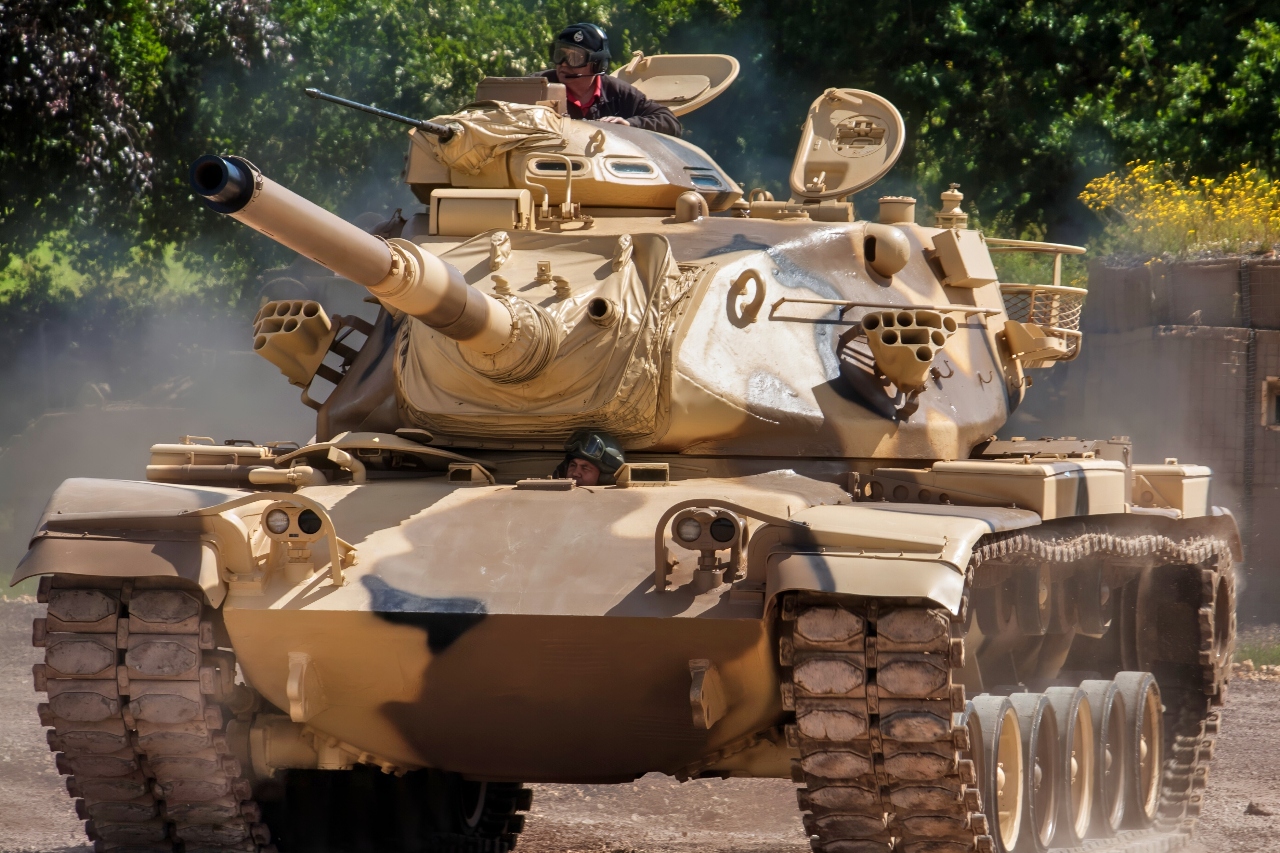
Key Points and Summary – An expert ranks the top five tanks in U.S. Army history, crowning the M1 Abrams as the undisputed king.
-The Abrams’ complete dominance over Iraqi T-72s in the Gulf War solidifies its top spot.
-The number two rank goes to the M60 “Patton,” the reliable predecessor that proved its mettle in Marine Corps service during Desert Storm.
-The M48 Patton, America’s first true main battle tank, comes in third, followed by the iconic and mass-produced M4 Sherman of World War II.
-Finally, the M26 Pershing, a heavy tank designed to kill German Tigers, rounds out the list.
5 Best US Army Tanks Ever
Ever since it made its first appearance in combat during World War I’s horrific Battle of the Somme, the tank has arguably been the most feared weapon system and the most potent symbol of power in ground warfare (although, historically speaking, artillery has actually been the biggest killer on the battlefield).
Accordingly, this writer, a military history buff, shall identify what he considers to be the US Army’s top 5 tanks of all time.
Admittedly, it’s a subjective list, but it’s backed with objective facts and reason.
(And yes, the US Marine Corps used some of these same tanks as well.)
#1. M1 Abrams
It’s no mere coincidence that a tank bearing the number 1 in its alphanumeric designation is in the No. 1 slot on this list. Simply put, the M1 Abrams is the most successful main battle tank (MBT) of all time.
The M1’s finest hour was during the 1991 Persian Gulf War, AKA Operation Desert Storm, wherein it totally outclassed the vaunted T-72 MBTs of then-Iraqi strongman Saddam Hussein’s elite Republican Guards.

A U.S. Army tank crew assigned to 2nd Battalion, 5th Cavalry Regiment, 1st Armored Brigade Combat Team, 1st Cavalry Division, maneuvers an M1A2 Abrams tank at a railhead in preparation to transport it to Hohenfels, Germany during a railhead operation, Corbu, Romania, October 24, 2018. The Battalion has deployed to Europe in support of Atlantic Resolve, an enduring training exercise between NATO and U.S. Forces. (U.S. Army National Guard photo by Sgt. Jamar Marcel Pugh, 382nd Public Affairs Detachment/ 1st ABCT, 1st CD/Released)
For example, during the Battle of 73 Easting (which was later described by participant Lt. John Mecca as “the last great tank battle of the 20th century”), the Iraqi Army lost 160 tanks, while the Americans suffered zero tank losses.
#2. M60 “Patton”
One Desert Storm veteran MBT deserves another (even though the US Marines who used this tank during that war might take interservice umbrage at taking second place to a bunch of Army pukes).
“Patton” is placed in quote marks here because, unlike with the M48 (more on this one in the next segment), the M60 was never actually officially named for WWII’s legendary Gen. George Smith Patton Jr. However, the unofficial nickname for the M60 tank has stuck.
The M60 “Patton” was the immediate predecessor of the M1 Abrams in both the US Army and the Marine Corps. However, it was only the latter service that was still using the M60 during Desert Storm, specifically the M60A3 TTS variant, which features upgrades such as (1) a thermal sight that gave the crew the ability to pick out an enemy vehicle in the dark and (2) a meteorological sensor device.

M60 Tank. Image Credit: Creative Commons.
The “devil dog” tank crews put these upgrades to good use during the Gulf War. During engagements such as the Battle of Medina Ridge and the Battle of Norfolk, the upgraded USMC Pattons destroyed 100 enemy tanks while losing only one of their own.
As far as the M60’s Army service, retired LTC (and prior enlisted soldier) Rick Bogdan, who commanded M60 units during the Cold War, had this to say in a July 2022 interview: “Ha! ‘More torque in reverse.’
On a serious note, when we heard about the M-1, we were excited until we learned about the limited number of rounds it carried compared to the M-60, given the ‘fight outnumbered and win’ doctrine.
Plus, the 60 could at least cross bridges in Europe vs the M-1. So yes, our trusty M-60 with five tanks per platoon seemed to remain a good bet.” (LTC Bogdan is the author of the semi-autobiographical novel “Grunts, Gramps & Tanks,” an excellent read.)
#3. M48 Patton
This time we’ve removed the quote marks, because, as already noted, unlike the M60, this tank truly *was* officially designated the Patton. The M48 Patton was also historically significant as America’s first MBT.
It was also a tank fit for a king, as in the King of Rock ‘n’ Roll, Elvis Aaron Presley, who served as an M48 crewman during his brief but momentous Army career.
The Patton was the most heavily used tank by the United States during the Vietnam War, with over 600 being deployed to the Southeast Asian conflict. Therein, its primary usage was in the infantry support role.
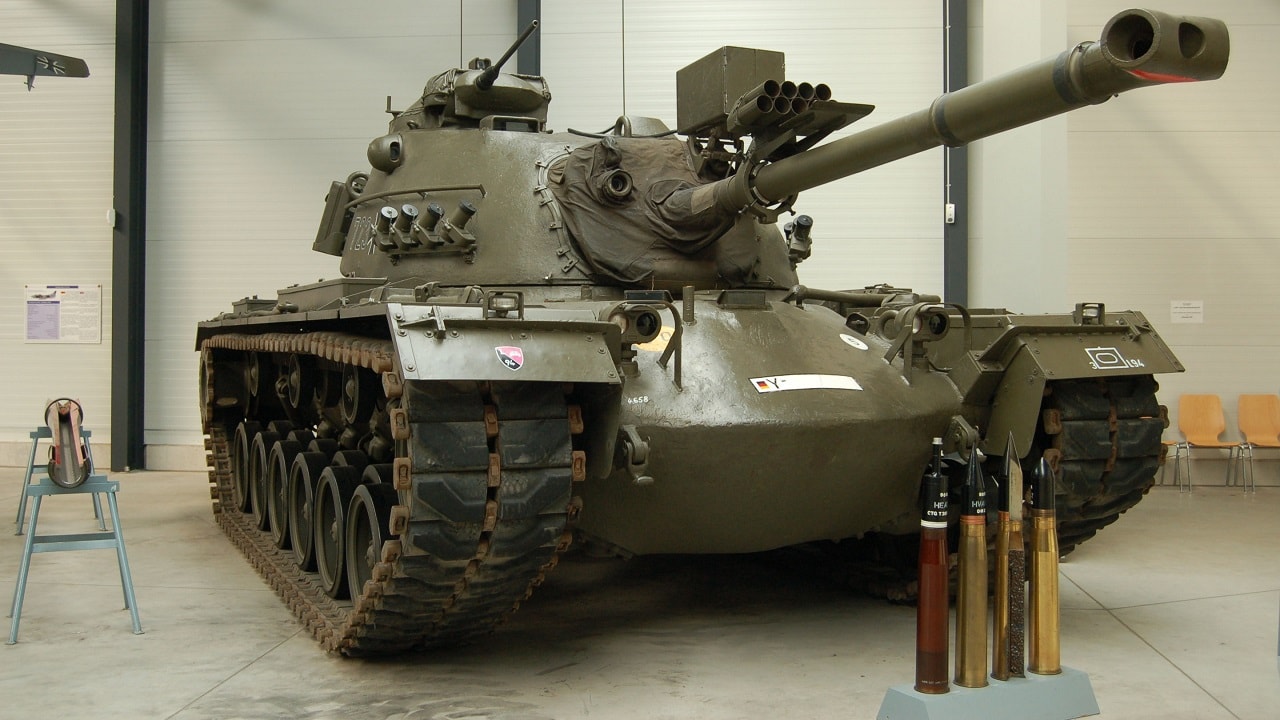
M48 Patton. Image Credit: Creative Commons.
The only tank battle between the US and the North Vietnamese Army (NVA) was the Battle of Ben Het in March 1969; the final tally of that battle was one Patton tank damaged with two crew members KIA vs. two PT-76 amphibious tanks and one BTR-50 armored personnel carrier (APC) destroyed.
#4. M4 Sherman
Once again, a tank’s alphanumeric designation matches its ranking. No American tank ranking list would be complete without the country’s most famous and ubiquitous tank of World War II.
Some critics question the greatness of the Sherman because it fared poorly against Nazi Germany’s fearsome Tiger tank.
However, the majority of Allied tank engagements on the Western Front were against anti-tank guns, infantry, and fortified positions, such as bunkers.
Against these sorts of targets, the Sherman’s armor plating and 75mm main gun worked just fine. It also worked fine against the German Panther tank, garnering a 3.6-to-1 kill ratio.
What’s more, unlike the Tiger, the Sherman was speedy, reliable, easy to maintain, and repair.
He could be produced in large numbers (49,234 built), which proved to be a difference-maker in the Allies’ ultimate victory.
#5. M26 Pershing
We conclude this list with a WWII tank (named for America’s most famous First World War general) which, unlike the Sherman, *was* specifically designed to fight heavy tanks like the Tiger.

M26 Pershing Tank. Image Credit: Creative Commons.
Military history expert Isaac Seitz assesses the Sheridan thusly: “With heavier frontal armor, the M26 was certainly a foe to be reckoned with. Unfortunately, being introduced too late in the war, the Pershing did not see much combat until the Korean War … Despite its limited lifetime, the Pershing had a short yet successful career, praised for its firepower and reliability.”
About the Author: Christian D. Orr, Defense Expert
Christian D. Orr is a Senior Defense Editor. He is a former Air Force Security Forces officer, Federal law enforcement officer, and private military contractor (with assignments worked in Iraq, the United Arab Emirates, Kosovo, Japan, Germany, and the Pentagon). Chris holds a B.A. in International Relations from the University of Southern California (USC) and an M.A. in Intelligence Studies (concentration in Terrorism Studies) from American Military University (AMU).
More Military
The B-1B Bomber Is Headed for the Boneyard


