

“De Nile,” as they say, “is no longer just a river in Egypt.” The man proving that statement in spades is the President of the Russian Federation, former Soviet-era KGB Lt. Col. Vladimir Putin.
Despite being an officer within one of the more capable intelligence organizations of the 20th century, Putin was never a standout performer as a KGB operative.
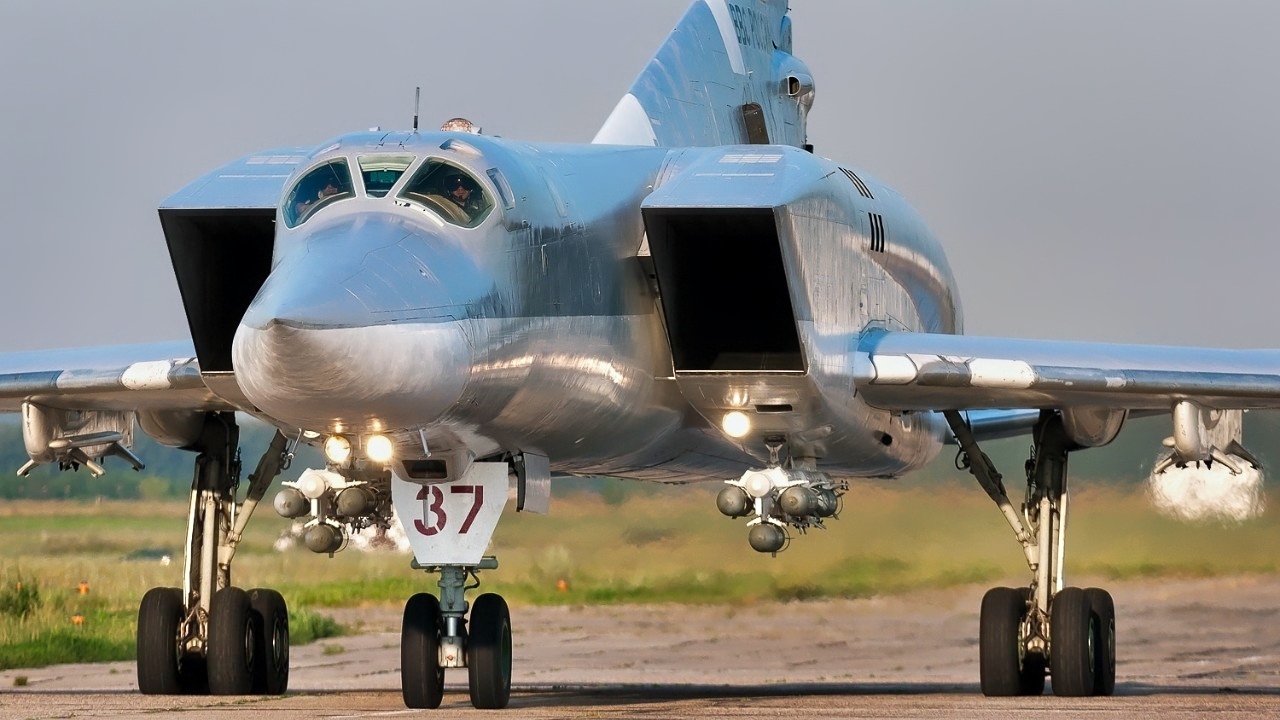
Russia Tu-22M Bomber. Image Credit: Creative Commons.

Tu-22M Bomber from Russian Air Force. Image Credit: Creative Commons.
The legends over the years that seemed to ascribe magical skills and abilities to him were purposely manufactured to paper over his real-world record of mediocrity.
In 2019, when Putin’s records from his time as a KGB officer in East Germany were declassified, the longtime UK scholar of Russia, Mark Galeotti, summed up the Russian President’s unimpressive performance as “a supportive but not especially masterful figure.”
Galeotti writes that Putin “was not recruiting and running agents so much as collating reports, liaising with the East German Stasi (who gave him his own access pass) and responding to queries from Moscow…Putin returned home to a country in crisis, and the KGB didn’t seem to know what to do with him.
Eventually, he was placed on the active reserve and looked for new jobs.
He left with the rank of Lieutenant Colonel, but he had really been only a major: a usual perk was to receive a one-rank career bump on leaving, to help round out one’s pension.”
The fatal consequences of placing such an unaccomplished individual in the role of Russian President in post-Yeltsin Russia are now on full display.
This is a position that demands a leader capable of dramatic accomplishments, which Putin has proven, time and time again, he is incapable of achieving.
Time Not on Moscow’s Side
Today, Putin is demonstrating all his shortcomings – both in height and in capability – as he continues to validate all the detractions that his superiors had voiced about him and his lack of fitness for real intelligence work.
He is pursuing a war that has no chance of turning in Russia’s favor, has no strategic objectives that are achievable any longer, and is grinding down his country’s economic and societal condition to the point where it is not recoverable.
For more than four years, Putin was betting on the prospect that Russia could outlast Ukraine in a long war of attrition – that Ukraine would run out of people, out of bullets, out of resources long before he did.
But as Ukrainian drones are degrading and dismantling both Russia’s military and oil industry, the people around Putin – although not the president himself – are learning that time is not on Russia’s side.
Putin prosecuting the war well beyond the point where it passes any test of cost-benefit calculations is severely damaging the long-term foundations of modern Russia.
The Kremlin has been forced to take extreme measures to insulate the Russian public from the effects of a deteriorating economy – creating what the Wall Street Journal calls “an illusion of resilience.”
But the structural costs to Russia’s armed forces and defense industry, its economy, and its overall geopolitical status in the world are severe and continue to be disastrous.
Taking just one data point out of many, one should look at the cost to the country’s future in demographic terms.
The country’s numbers in adult life expectancy and a shrinking population were already dire before the war began, but as of today, Russian fatalities in Ukraine are in excess of four times greater than all US casualties in all wars combined since World War II, and more than nine times greater than Soviet and Russian fatalities in all wars combined since World War II.
Ukraine Not Collapsing
On the other side of the ledger, Ukraine’s over-extended and pressured military has not collapsed as Putin had hoped. Kyiv’s military has even begun pushing back Russian units with small counterattacks. Ukraine’s constantly increasing army of drones is causing a fuel crisis in more than 50 different regions as it continues to wreak havoc on refineries deep inside Russia.
Military experts assess that the war is at a turning point—but when and how it might turn, and what comes next, are not at all clear. This is affecting how the conflict is assessed in other nations.
Whereas at one time Ukrainian President Volodymyr Zelensky had some disastrous interactions with US President Donald Trump, today the latter was singing the praises of Ukraine’s ingenuity and long-range drone capabilities in a side meeting between the two at the North Atlantic Treaty Organization (NATO) summit in Turkey.
Trump has also been shown US intelligence reports that show Ukraine’s improving strike capabilities and is said to have been impressed by them. At the same time, a sometimes-receptive demeanor once shown by some in Washington toward Putin is fading; the Russian public increasingly wants the war to end.
As more than one observer of the US President has said, “Trump likes to back a winner.” What he is now seeing is that Putin has few – if any – prospects of winning this conflict. This accounts for Trump’s recent decisions made in Ukraine’s favor, like extending a license for Ukraine to manufacture its own missiles for the Patriot system.
But Putin refuses to acknowledge or accept his worsening position. He continues to publicly repeat his maximalist war demands, which include territorial concessions by Ukraine and the imposition of Moscow’s Soviet-era influence inside the country.
How long can this dichotomy exist? Where Russia’s position continues to deteriorate, Putin continues to cling to the fantasy of a victory that he will never achieve.
The public and the army continue to be ground down. There is a breaking point coming, but the former KGB officer is likely to hang on until the point of no return is reached, until the limits of his long-running “denial” are reached and the system collapses around him.
About the Author: Reuben F. Johnson
Reuben F. Johnson has thirty-six years of experience analyzing and reporting on foreign weapons systems, defense technologies, and international arms export policy. Johnson is the Director of Research at the Casimir Pulaski Foundation. He is also a survivor of the Russian invasion of Ukraine in February 2022. He worked for years in the American defense industry as a foreign technology analyst and later as a consultant for the U.S. Department of Defense, the Departments of the Navy and Air Force, and the governments of the United Kingdom and Australia. In 2022-2023, he won two awards in a row for his defense reporting. He holds a bachelor’s degree from DePauw University and a master’s degree from Miami University in Ohio, with a specialization in Soviet and Russian studies. He lives in Warsaw.


MrObvious
July 14, 2026 at 7:47 pm
So Korea 18K maybe, Vietnam Almost 53K, Afghanistan 2K maybe and Iraq is added to Afghanistan.. We’ve lost I’m going to guess about 100,000 total which seems reasonable to me. Russia doesn’t care if their troops live or die during routine training exercises, what is that compared to a little bit of warfare? I doubt Putin is worried about this why should you?