


The head of Russia’s United Aircraft Corporation claims that work on what many assumed was an aspirational warplane, the Su-75 “Checkmate,” has progressed from the design phase to the prototype stage. According to Russian officials, UAC is currently manufacturing an experimental flight prototype.
Long ridiculed as little more than a “PowerPoint fighter” by Western analysts, if there is truth to what the head of UAC is claiming, it indicates that Russia’s defense industrial base continues operating at peak efficiency, especially considering the drain on resources that the ongoing Ukraine War has caused that system and the pressure Western sanctions have imposed.
What is the Su-75 “Checkmate”?
Russia’s proposed Su-75 warplane is a single-engine stealth fighter billed as cheaper than the twin-engine Sukhoi Su-57. Moscow views the Checkmate as a competitor to America’s Lockheed Martin F-35 Lightning II in export markets as well. Domestically, the Russian Armed Forces intend to replace the aging fourth-generation MiG-29 with the Su-75.
Sources in Russia claim the Su-75 will be capable of speeds above Mach 1.8, with a combat radius of around 1,500 kilometers. It will have internal weapons to enhance its stealth, along with an AESA radar system to improve situational awareness. In keeping with its purported stealth capabilities, UAC is designing the bird with a reduced radar cross-section.
What’s more, UAC plans to incorporate advances in manned-unmanned teaming (MUMT) capabilities into the Su-75 Checkmate as those systems mature alongside the Su-75.
Of course, much of the press in Russian media around the Su-75 is mostly speculative because no prototype ever flew.
Why the Su-75 Checkmate Program is Important
From a strategic standpoint, the Su-75 is arguably more important to Russia than the Su-57 “Felon,” which has struggled through massive resource drain and has endured chronically low production numbers.
Whereas the Su-57 is expensive and, therefore, a relatively small number of these systems have been produced, Russia conceived the Checkmate as the answer to the global demand for a lower-cost stealth fighter. If the Su-57 was Russia’s answer to the F-22 Raptor, then the Su-75 was designed as the answer to the F-35.

Su-75 Checkmate Stealth Fighter Russia. Image Credit: Creative Commons.
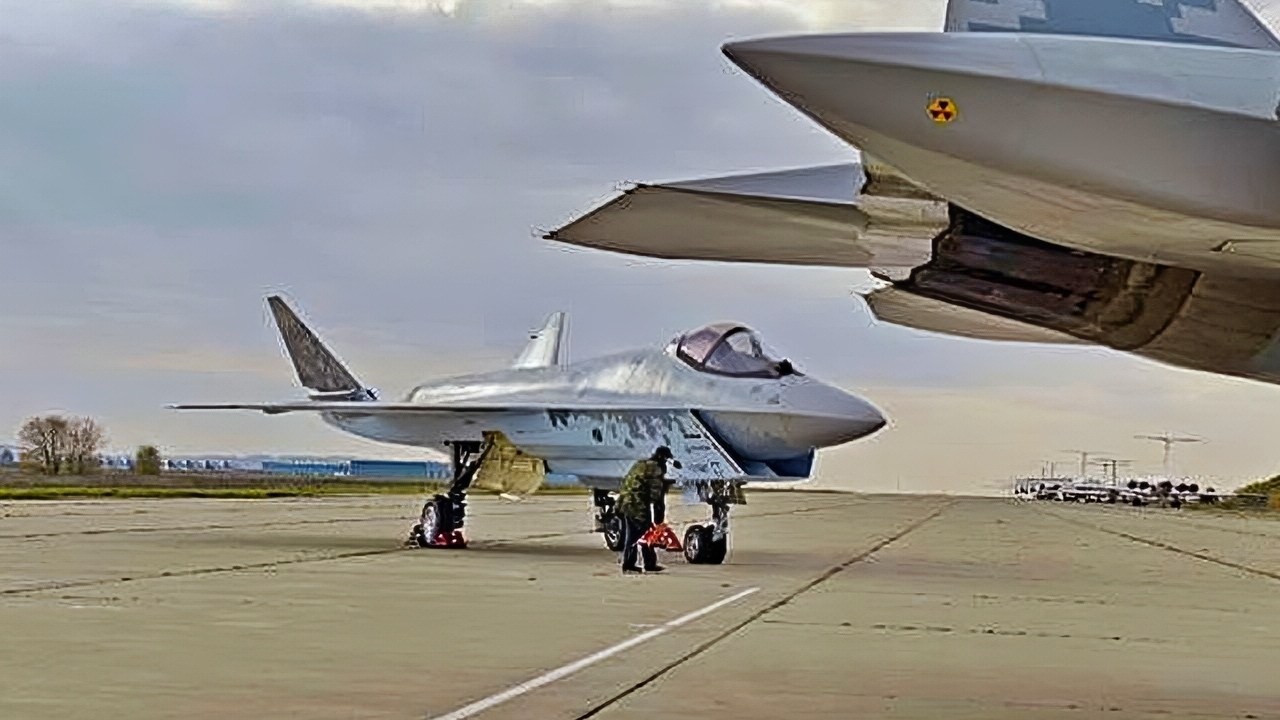
Su-75 Checkmate Fighter X Screenshot. Image Credit: X.
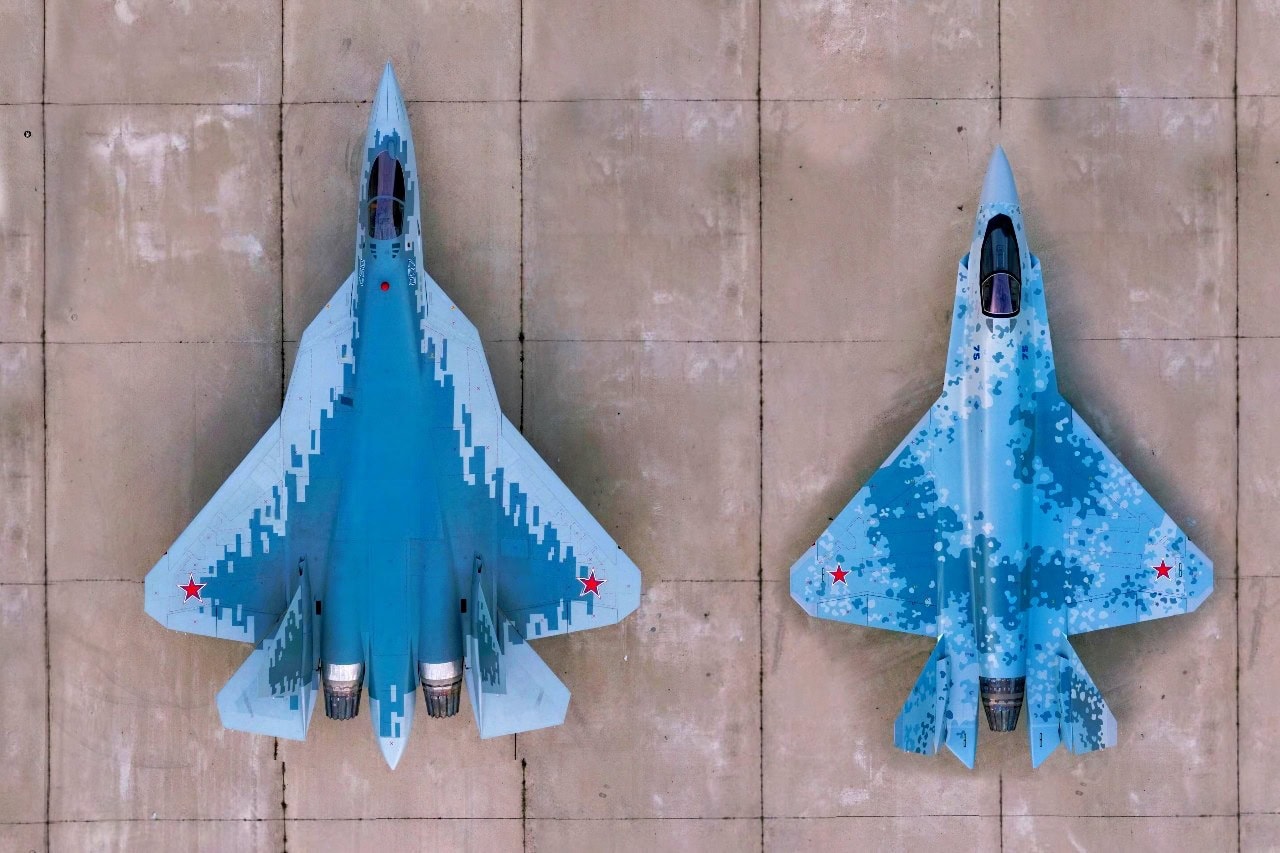
Su-57 and Su-75. Image Credit: Artist Rendering/Creative Commons.
One of Russia’s most important industries has long been its arms and weapons platforms export market. So, Russia is constantly creating new products to sell to the world. Moscow’s biggest selling point with its systems, especially to the Global South, is that its weapons and platforms are usually cheaper than the alternatives.
Moscow hoped that countries unable to afford America’s F-35 would instead turn to the Russian Su-75 Checkmate. Indeed, potential customers interested in the Su-75 have been in Vietnam, the United Arab Emirates (UAE), and several African nations.
Of course, there is no guarantee that Russia can achieve the goal of successfully producing the Su-75.
The Biggest Problem: Delays
UAC unveiled the Checkmate in 2021. At various times, Russia projected first-flight dates of 2023, 2024, 2025, early 2026, and, more recently, late 2026. According to United24 Media, Russia is again targeting the first flight for the Checkmate late this year.
These repeated schedule slips are among the main reasons for Western skepticism about the Su-75 program as a whole.
Can It Really Challenge the F-35?
Even if the prototype flies this year, Russia would still need to complete flight testing. Then UAC engineers would spend time validating the plane’s stealth performance. They’d next validate the avionics and sensor fusion.
Those processes, given the complex nature of the system in question, would take much longer than Moscow may be letting on publicly. During that time, numerous variables could further delay and complicate Russia’s mass production of these systems.
Once UAC validates all the systems for the proposed Su-75 Checkmate, Russia would establish production lines. Moscow would spend time securing export customers, too. However, that’s a relatively straightforward process, even with Western sanctions imposed upon Russia.
After all that, given the focus of Russia’s entire defense industrial base on fighting the War in Ukraine, UAC would need to figure out how to produce meaningful quantities of the Checkmate. And that’s another source of Western skepticism.
Using the Su-57 as a case study, Western skeptics of the Su-75 doubt the Russians can produce anywhere near enough of these new planes to satisfy their own needs and those of potential export clients.
But one reason the Su-57 has struggled to reach mass production is that it employs Western components. The Su-75 is an indigenized plane.
What’s Really Important About the Su-75
That the Russians have developed a plane that is purportedly a competitor to the vaunted Lockheed Martin F-35 Lightning II is not the real story here. What’s important is that the program, long written off by the West, has survived the West’s sanctions, the budget pressures of the Ukraine War, and the industrial constraints that were supposed to have killed the project immediately.
Instead, Moscow is still pushing forward and appears willing to invest in a future light stealth fighter. And the real point of focus should, for now, be on whether Russia makes its target flight date of later this year. If the Checkmate gets airborne this year, the program becomes a serious long-term factor in the global flight market. If the date slips again into 2027 or beyond, criticism that Checkmate is more marketing than aircraft will only intensify.
So, the Su-75 is less important because it’s a next-generation warplane produced by Russia. It’s a marker for determining how resilient Russia’s defense industrial base is.
About the Author: Brandon J. Weichert
Brandon J. Weichert is Senior National Security Editor. He also manages The Weichert Brief on Substack. Weichert hosts “National Security Talk” on Rumble, too. He is the author of four bestselling national security books, the most recent of which is A Disaster of Our Own Making: How the West Lost Ukraine (Encounter Books). Follow him via Twitter/X @WeTheBrandon.


